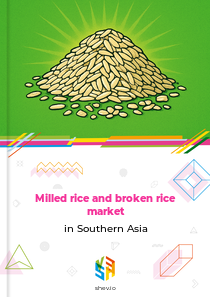







"Southern Asia" region includes following countries:
 Afghanistan
 Bangladesh
 Bhutan
 Sri Lanka
 India
India Iran
Iran Maldives
 Nepal
Nepal Pakistan
Earlier Report Observations
From 2018 to 2023, the production volume of milled rice and broken rice in Southern Asia rose from 159.7 million tonnes to 186.6 million tonnes, while the market volume increased from 157.0 million tonnes to 184.1 million tonnes. After a minor contraction in 2019, the market entered a period of sustained expansion.
The growth in 2023 was partly driven by India's increase of the minimum support price for rice, which incentivized higher domestic production. Concurrent government interventions to stabilize cereal prices amid inflationary pressures helped maintain consumption, supporting overall market volume.
Entering 2024, the publication of final official crop estimates provided greater supply certainty, while persistent global supply chain disruptions and evolving regional demand patterns continued to influence market dynamics in Southern Asia.
Table of content
- 1. Disclaimer
- 2. Terms of use of the report
- 3. Product codes in the statistical classifications used in the report
-
4. Key Market Indicators and Trends
-
4.1. Key Market Indicators
-
4.1.1. In kind
- 4.1.1.1. Production, 2018-2023
- 4.1.1.2. Imports, 2018-2024
- 4.1.1.3. Exports, 2018-2024
- 4.1.1.4. Market size, 2018-2023
-
4.1.2. In value
- 4.1.2.1. Production, 2018-2023
- 4.1.2.2. Imports, 2018-2024
- 4.1.2.3. Exports, 2018-2024
- 4.1.2.4. Market size, 2018-2023
-
4.1.1. In kind
- 4.2. Market Trends and Factors
-
4.1. Key Market Indicators
-
5. Production
-
5.1. Production in Southern Asia
- 5.1.1. Annual dynamics of production in Southern Asia in kind, 2018-2023, M t
-
5.2. Global production by Country, 2018-2023
- 5.2.1. Annual dynamics of production by macroregions in kind, 2018-2023, M t
- 5.2.2. Dynamics of production structure by macroregions in kind, 2018-2023
- 5.2.3. Annual dynamics of production by country in kind, 2018-2023, M t
- 5.2.4. Structure of production by countries in kind, 2018-2023
- 5.2.5. Dynamics of peoduction structure by countries in kind, 2018-2023
-
5.1. Production in Southern Asia
-
6. Imports
-
6.1. Imports (Direct Data*)
- 6.1.1. Imports - Total information
-
6.1.2. Imports in kind, K t
- 6.1.2.1. Annual dynamics of product's imports to Afghanistan in kind, 2018-2024, K t
- 6.1.2.2. Dynamics of product's imports in kind to Afghanistan by countries, 2018-2024, K t
- 6.1.2.3. Structure of product's imports in kind by countries, 2018-2024
-
6.1.3. Imports in value, M $ US
- 6.1.3.1. Annual dynamics of product's imports to Afghanistan in value, 2018-2024, M $ US
- 6.1.3.2. Dynamics of product's imports in value to Afghanistan by countries, 2018-2024, M $ US
- 6.1.3.3. Structure of product's imports in value by countries, 2018-2024
-
6.1.4. Average price of product's imports, $ US/t
- 6.1.4.1. Annual dynamics of average price of product's imports to Afghanistan, 2018-2024, $ US/t
- 6.1.4.2. Dynamics of average price of product's imports to Afghanistan by countries, 2018-2024, $ US/t
-
6.2. Imports (Mirror Data)
- 6.2.1. Imports - Total information
-
6.2.2. Imports in kind, K t
- 6.2.2.1. Annual dynamics of product's imports to Afghanistan in kind, 2018-2024, K t
- 6.2.2.2. Dynamics of product's imports in kind to Afghanistan by countries, 2018-2024, K t
- 6.2.2.3. Structure of product's imports in kind by countries, 2018-2024
-
6.2.3. Imports in value, M $ US
- 6.2.3.1. Annual dynamics of product's imports to Afghanistan in value, 2018-2024, M $ US
- 6.2.3.2. Dynamics of product's imports in value to Afghanistan by countries, 2018-2024, M $ US
- 6.2.3.3. Structure of product's imports in value by countries, 2018-2024
-
6.2.4. Average price of product's imports, $ US/t
- 6.2.4.1. Annual dynamics of average price of product's imports to Afghanistan, 2018-2024, $ US/t
- 6.2.4.2. Dynamics of average price of product's imports to Afghanistan by countries, 2018-2024, $ US/t
-
6.1. Imports (Direct Data*)
-
7. Exports
-
7.1. Exports (Direct Data*)
- 7.1.1. Exports - Total information
-
7.1.2. Exports in kind, K t
- 7.1.2.1. Annual dynamics of product's exports from Afghanistan in kind, 2018-2024, K t
- 7.1.2.2. Dynamics of product's exports in kind from Afghanistan by countries, 2018-2024, K t
- 7.1.2.3. Structure of product's exports in kind by countries, 2018-2024
-
7.1.3. Exports in value, M $ US
- 7.1.3.1. Annual dynamics of product's exports from Afghanistan in value, 2018-2024, M $ US
- 7.1.3.2. Dynamics of product's exports in value from Afghanistan by countries, 2018-2024, M $ US
- 7.1.3.3. Structure of product's exports in value by countries, 2018-2024
-
7.1.4. Average price of product's exports, $ US/t
- 7.1.4.1. Annual dynamics of average price of product's exports from Afghanistan, 2018-2024, $ US/t
- 7.1.4.2. Dynamics of average price of product's exports from Afghanistan by countries, 2018-2024, $ US/t
-
7.2. Exports (Mirror Data)
- 7.2.1. Exports - Total information
-
7.2.2. Exports in kind, K t
- 7.2.2.1. Annual dynamics of product's exports from Afghanistan in kind, 2018-2024, K t
- 7.2.2.2. Dynamics of product's exports in kind from Afghanistan by countries, 2018-2024, K t
- 7.2.2.3. Structure of product's exports in kind by countries, 2018-2024
-
7.2.3. Exports in value, M $ US
- 7.2.3.1. Annual dynamics of product's exports from Afghanistan in value, 2018-2024, M $ US
- 7.2.3.2. Dynamics of product's exports in value from Afghanistan by countries, 2018-2024, M $ US
- 7.2.3.3. Structure of product's exports in value by countries, 2018-2024
-
7.2.4. Average price of product's exports, $ US/t
- 7.2.4.1. Annual dynamics of average price of product's exports from Afghanistan, 2018-2024, $ US/t
- 7.2.4.2. Dynamics of average price of product's exports from Afghanistan by countries, 2018-2024, $ US/t
-
7.1. Exports (Direct Data*)
-
8. Trade balance
-
8.1. Trade balance (Direct Data)
- 8.1.1. In kind, K t
- 8.1.2. In value, M $ US
-
8.2. Trade balance (Mirror Data)
- 8.2.1. In kind, K t
- 8.2.2. In value, M $ US
-
8.1. Trade balance (Direct Data)
-
9. Top buying and selling countries, 2018-2024
-
9.1. Direct Data
- 9.1.1. Import in Value by Countries-buyers
- 9.1.2. Export in Value by Countries-suppliers
-
9.2. Mirror Data
- 9.2.1. Import in Value by Countries-buyers
- 9.2.2. Export in Value by Countries-suppliers
-
9.1. Direct Data
Production milled rice and broken rice in Southern Asia
In kind, 2017-2020, M t
Top producers of milled rice and broken rice, 2017-2020
World map of production of milled rice and broken rice, 2017-2020
Southern Asia's production of milled rice and broken rice has grown for the third year in a row. In 2020, the region produced 169.2 million tonnes, marking a 5.5% increase compared to the previous year. Looking at the period from 2017 to 2020, production rose by 10.3%, which translates to an average annual growth rate of 3.3%.
Annual dynamics of production in Southern Asia in kind, 2017-2020, M t
| Parameter | 2018 | 2019 | 2020 | CAGR | |
|---|---|---|---|---|---|
| 1 | Change from last year | 4.1% | 0.4% | 5.5% | 3.3% |
In value, 2017-2020, M $ US
In 2020, the value of milled rice and broken rice output in Southern Asia reached 88 769 million US dollars, up by 13.9% from 2019. Over the 2017-2020 period, production value increased by 19.5%, with an average annual growth rate of 6.1%. The most significant drop occurred in 2019, when it fell by 4.7%.
Annual dynamics of production in Southern Asia in value, 2017-2020, M $ US
| Parameter | 2018 | 2019 | 2020 | CAGR | |
|---|---|---|---|---|---|
| 1 | Change from last year | 10.2% | (4.7%) | 13.9% | 6.1% |
Exports milled rice and broken rice from Southern Asia
Exports in kind, K t
Following two years of growth, Southern Asia's exports of milled rice and broken rice declined. In 2020, exports totaled 3 466 thousand tonnes, down by 17.9% from the previous year. The peak was recorded in 2019 at 4 224 thousand tonnes, which also saw the largest increase of 11.7%.
Annual dynamics of product's exports from Southern Asia in kind, 2017-2020, K t
| Parameter | 2018 | 2019 | 2020 | CAGR | |
|---|---|---|---|---|---|
| 1 | Change from last year | 7.6% | 11.7% | (17.9%) | (0.5%) |
From 2017 to 2020, Southern Asia's export destinations for milled rice and broken rice were quite diverse. China accounted for 12.8% of exports, Kenya for 11.8%, and the United Arab Emirates for 5.8%. Together, these three partners represented just 30.4% of total export flows.
Structure of product's exports in kind by countries, 2017-2020
World map of product's exports from Southern Asia in kind, 2017-2020
Exports in value, M $ US
After two years of growth, the value of milled rice and broken rice exports from Southern Asia fell. In 2020, exports amounted to 1 818 million US dollars, a significant decrease of 11.4% compared to the prior year. Over the 2017-2020 period, exports increased by 6.8%, with a compound annual growth rate of 2.2%. The highest value was in 2019 at 2 053 million US dollars, while the largest increase occurred in 2018 at 13.8%.
Annual dynamics of product's exports from Southern Asia in value, 2017-2020, M $ US
| Parameter | 2018 | 2019 | 2020 | CAGR | |
|---|---|---|---|---|---|
| 1 | Change from last year | 13.8% | 5.9% | (11.4%) | 2.2% |
Between 2017 and 2020, the distribution of export value remained fragmented. China contributed 10.4% of the total, Kenya 9.9%, and the United Arab Emirates 9.0%. Combined, these three countries accounted for only 29.3% of total flows, with no single partner emerging as clearly dominant.
Structure of product's exports in value by countries, 2017-2020
World map of product's exports from Southern Asia in value, 2017-2020
Imports milled rice and broken rice to Southern Asia
Imports in kind, K t
After two years of decline, Southern Asia's imports of milled rice and broken rice rebounded. In 2020, imports reached 434 thousand tonnes, showing a substantial year-over-year gain of 17.7%. From 2017 to 2020, imports decreased by 61.6%, averaging an annual decline of 27.3%. The lowest point was in 2019 at 369 thousand tonnes, which also experienced the largest drop of 64.9%.
Annual dynamics of product's imports to Southern Asia in kind, 2017-2020, K t
| Parameter | 2018 | 2019 | 2020 | CAGR | |
|---|---|---|---|---|---|
| 1 | Change from last year | (7.1%) | (64.9%) | 17.7% | (27.3%) |
During 2017-2020, the main sources for Southern Asia's imports of milled rice and broken rice were Thailand, with a 4.0% share, Myanmar at 2.6%, and the United Arab Emirates at 2.0%. Together, these three countries made up 8.6% of total import volumes.
Structure of product's imports in kind by countries, 2017-2020
World map of product's imports to Southern Asia in kind, 2017-2020
Imports in value, M $ US
Southern Asia's imports of milled rice and broken rice declined for the third consecutive year. In 2020, the region imported a total of value_last_year million US dollars, indicating a 28.9% decrease compared to the previous year. Between 2017 and 2020, imports fell by 47.4%, with an average annual decline of 19.3%.
Annual dynamics of product's imports to Southern Asia in value, 2017-2020, M $ US
| Parameter | 2018 | 2019 | 2020 | CAGR | |
|---|---|---|---|---|---|
| 1 | Change from last year | (3.1%) | (23.6%) | (28.9%) | (19.3%) |
From 2017 to 2020, the top suppliers of milled rice and broken rice to Southern Asia in value terms were the United Arab Emirates with a 2.9% share, Thailand at 2.8%, and Myanmar at 1.4%. Their combined share reached 7.1% of total import value.
Structure of product's imports in value by countries, 2017-2020
World map of product's imports to Southern Asia in value, 2017-2020
Related Reports

Milled rice and broken rice market in Kenya
2026-03-30
Milled rice and broken rice market in Gabon
2026-03-30

Barley market in Southern Asia
2026-03-28

Millet market in Southern Asia
2026-03-28

Paddy rice market in Southern Asia
2026-03-28

Wheat and meslin market in Southern Asia
2026-03-28
In-depth market research on this product
Global Broken Rice Market 2021–2031: Size, Share, Trends and Forecast
Global market report: size, trends and forecast to 2031 · 192 pages
Why Choose Us?
Only Verified Data
No Hidden Costs or Separate Fees
Smarter Subscription Pricing
Contact Our Team
Submit your inquiry using the form below — our team will get back to you within 24 hours.