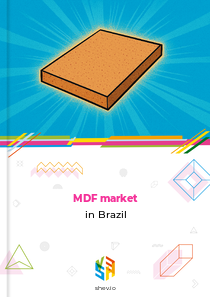







Earlier Report Observations
The Brazilian MDF market volume grew significantly from 3.9 million m³ in 2018 to 6.1 million m³ in 2021. This expansion was fueled by the resurgence of construction and renovation projects following the COVID-19 pandemic, which had previously delayed industrial and residential activity. Increased consumer demand for ready-made and low-maintenance furniture further supported MDF consumption during these years.
After reaching its peak in 2021, the market contracted to 4.2 million m³ in 2022 before partially recovering to 4.7 million m³ in 2023. This period of adjustment reflected shifting market conditions following the post-pandemic surge.
Table of content
- 1. Disclaimer
- 2. Terms of use of the report
- 3. Product codes in the statistical classifications used in the report
-
4. Key Market Indicators and Trends
-
4.1. Key Market Indicators
-
4.1.1. In kind
- 4.1.1.1. Production, 2018-2023
- 4.1.1.2. Imports, 2018-2025
- 4.1.1.3. Exports, 2018-2025
- 4.1.1.4. Market size, 2018-2023
-
4.1.2. In value
- 4.1.2.1. Production, 2018-2023
- 4.1.2.2. Imports, 2018-2025
- 4.1.2.3. Exports, 2018-2025
- 4.1.2.4. Market size, 2018-2023
-
4.1.1. In kind
- 4.2. Market Trends and Factors
-
4.1. Key Market Indicators
-
5. Production
-
5.1. Production in Brazil
- 5.1.1. Annual dynamics of production in Brazil in kind, 2018-2023, K m³
- 5.1.2. Annual dynamics of production in Brazil in value, 2018-2023, $ US
-
5.2. Global production by Country, 2018-2023
- 5.2.1. Annual dynamics of production by macroregions in kind, 2018-2023, K m³
- 5.2.2. Dynamics of production structure by macroregions in kind, 2018-2023
- 5.2.3. Annual dynamics of production by country in kind, 2018-2023, K m³
- 5.2.4. Structure of production by countries in kind, 2018-2023
- 5.2.5. Dynamics of peoduction structure by countries in kind, 2018-2023
-
5.1. Production in Brazil
-
6. Exports
-
6.1. Exports (Direct Data)
- 6.1.1. Exports - Total information
-
6.1.2. Exports in kind, K m³
- 6.1.2.1. Annual dynamics of product's exports from Brazil in kind, 2018-2025, K m³
- 6.1.2.2. Dynamics of product's exports in kind from Brazil by countries, 2018-2025, K m³
- 6.1.2.3. Structure of product's exports in kind by countries, 2018-2025
-
6.1.3. Exports in value, M $ US
- 6.1.3.1. Annual dynamics of product's exports from Brazil in value, 2018-2025, M $ US
- 6.1.3.2. Dynamics of product's exports in value from Brazil by countries, 2018-2025, M $ US
- 6.1.3.3. Structure of product's exports in value by countries, 2018-2025
-
6.1.4. Average price of product's exports, $ US/m³
- 6.1.4.1. Annual dynamics of average price of product's exports from Brazil, 2018-2025, $ US/m³
- 6.1.4.2. Dynamics of average price of product's exports from Brazil by countries, 2018-2025, $ US/m³
-
6.2. Exports (Mirror Data)
- 6.2.1. Exports - Total information
-
6.2.2. Exports in kind, K m³
- 6.2.2.1. Annual dynamics of product's exports from Brazil in kind, 2018-2025, K m³
- 6.2.2.2. Dynamics of product's exports in kind from Brazil by countries, 2018-2025, K m³
- 6.2.2.3. Structure of product's exports in kind by countries, 2018-2025
-
6.2.3. Exports in value, M $ US
- 6.2.3.1. Annual dynamics of product's exports from Brazil in value, 2018-2025, M $ US
- 6.2.3.2. Dynamics of product's exports in value from Brazil by countries, 2018-2025, M $ US
- 6.2.3.3. Structure of product's exports in value by countries, 2018-2025
-
6.2.4. Average price of product's exports, $ US/m³
- 6.2.4.1. Annual dynamics of average price of product's exports from Brazil, 2018-2025, $ US/m³
- 6.2.4.2. Dynamics of average price of product's exports from Brazil by countries, 2018-2025, $ US/m³
-
6.1. Exports (Direct Data)
-
7. Imports
-
7.1. Imports (Direct Data)
- 7.1.1. Imports - Total information
-
7.1.2. Imports in kind, K m³
- 7.1.2.1. Annual dynamics of product's imports to Brazil in kind, 2018-2025, K m³
- 7.1.2.2. Dynamics of product's imports in kind to Brazil by countries, 2018-2025, K m³
- 7.1.2.3. Structure of product's imports in kind by countries, 2018-2025
-
7.1.3. Imports in value, M $ US
- 7.1.3.1. Annual dynamics of product's imports to Brazil in value, 2018-2025, M $ US
- 7.1.3.2. Dynamics of product's imports in value to Brazil by countries, 2018-2025, M $ US
- 7.1.3.3. Structure of product's imports in value by countries, 2018-2025
-
7.1.4. Average price of product's imports, $ US/m³
- 7.1.4.1. Annual dynamics of average price of product's imports to Brazil, 2018-2025, $ US/m³
- 7.1.4.2. Dynamics of average price of product's imports to Brazil by countries, 2018-2025, $ US/m³
-
7.2. Imports (Mirror Data)
- 7.2.1. Imports - Total information
-
7.2.2. Imports in kind, K m³
- 7.2.2.1. Annual dynamics of product's imports to Brazil in kind, 2018-2025, K m³
- 7.2.2.2. Dynamics of product's imports in kind to Brazil by countries, 2018-2025, K m³
- 7.2.2.3. Structure of product's imports in kind by countries, 2018-2025
-
7.2.3. Imports in value, M $ US
- 7.2.3.1. Annual dynamics of product's imports to Brazil in value, 2018-2025, M $ US
- 7.2.3.2. Dynamics of product's imports in value to Brazil by countries, 2018-2025, M $ US
- 7.2.3.3. Structure of product's imports in value by countries, 2018-2025
-
7.2.4. Average price of product's imports, $ US/m³
- 7.2.4.1. Annual dynamics of average price of product's imports to Brazil, 2018-2025, $ US/m³
- 7.2.4.2. Dynamics of average price of product's imports to Brazil by countries, 2018-2025, $ US/m³
-
7.1. Imports (Direct Data)
-
8. Trade balance
-
8.1. Trade balance (Direct Data)
- 8.1.1. In kind, K m³
- 8.1.2. In value, M $ US
-
8.2. Trade balance (Mirror Data)
- 8.2.1. In kind, K m³
- 8.2.2. In value, M $ US
-
8.1. Trade balance (Direct Data)
-
9. Top buying and selling countries, 2018-2025
-
9.1. Direct Data
- 9.1.1. Import in Value by Countries-buyers
- 9.1.2. Export in Value by Countries-suppliers
-
9.2. Mirror Data
- 9.2.1. Import in Value by Countries-buyers
- 9.2.2. Export in Value by Countries-suppliers
-
9.1. Direct Data
Production MDF in Brazil
In kind, 2018-2021, K m³
From 2018 to 2021, Brazil maintained its position as the world's third-largest producer of MDF by volume.
Top producers of MDF, 2018-2021
World map of production of MDF, 2018-2021
Brazil's MDF production volume grew for the third consecutive year. In 2021, the country produced 6 845 K m³ of MDF, marking a significant increase of 15.0% compared to the previous year. Over the 2018-2021 period, production rose by 47.3%, with a compound annual growth rate (CAGR) of 13.8%.
Annual dynamics of production in Brazil in kind, 2018-2021, K m³
| Parameter | 2019 | 2020 | 2021 | CAGR | |
|---|---|---|---|---|---|
| 1 | Change from last year | 7.5% | 19.1% | 15.0% | 13.8% |
In value, 2018-2021, M $ US
MDF production in Brazil increased for the third year in a row. In 2021, the output was valued at 1 799 M $ US, representing a substantial 48.6% rise from the previous year. From 2018 to 2021, production grew by 83.3%, with a CAGR of 22.4%.
Annual dynamics of production in Brazil in value, 2018-2021, M $ US
| Parameter | 2019 | 2020 | 2021 | CAGR | |
|---|---|---|---|---|---|
| 1 | Change from last year | 6.3% | 16.1% | 48.6% | 22.4% |
Exports MDF from Brazil
Exports in kind, K m³
Brazil's MDF export volume expanded for the second consecutive year. In 2021, the country exported 795.9 K m³ of MDF, an 11.7% increase compared to 2020. The lowest volume was recorded in 2019 at 705.7 K m³, which saw the largest decline of 10.3%.
Annual dynamics of product's exports from Brazil in kind, 2018-2021, K m³
| Parameter | 2019 | 2020 | 2021 | CAGR | |
|---|---|---|---|---|---|
| 1 | Change from last year | (10.3%) | 0.9% | 11.7% | 0.4% |
During the 2018–2021 period, Mexico (26.8% of exports in kind), the United States (19.2% of exports in kind), and Colombia (8.7% of exports in kind) were the leading destinations for Brazil's MDF exports in kind, collectively accounting for 54.7% of total flows.
Structure of product's exports in kind by countries, 2018-2021
World map of product's exports from Brazil in kind, 2018-2021
Exports in value, M $ US
After a two-year decline, Brazil's MDF export value rebounded. In 2021, exports amounted to 209.2 M $ US, a 44.4% year-on-year gain. Over the 2018-2021 period, exports increased by 25.9%, with a CAGR of 8.0%. The lowest value was recorded in 2020 at 144.9 M $ US, following the largest decline of 11.3% in 2019.
Annual dynamics of product's exports from Brazil in value, 2018-2021, M $ US
| Parameter | 2019 | 2020 | 2021 | CAGR | |
|---|---|---|---|---|---|
| 1 | Change from last year | (11.3%) | (1.6%) | 44.4% | 8.0% |
From 2018 to 2021, Mexico (25.1% of exports in value terms), the United States (25.1% of exports in value terms), and Colombia (7.6% of exports in value terms) led the structure of Brazil's MDF exports in value terms, together representing 57.9% of total flows.
Structure of product's exports in value by countries, 2018-2021
World map of product's exports from Brazil in value, 2018-2021
Imports MDF to Brazil
Imports in kind, K m³
The market exhibited volatility during these years. Imports reached their lowest point in 2020 at 3.3 K m³, with the largest decline of 62.6% occurring that year. In 2021, imports rose to 7.7 K m³, a sharp increase of 137.6% compared to the previous year. From the peak in 2018 to the trough in 2020, imports changed by a factor of 3.6.
Annual dynamics of product's imports to Brazil in kind, 2018-2021, K m³
| Parameter | 2019 | 2020 | 2021 | CAGR | |
|---|---|---|---|---|---|
| 1 | Change from last year | (26.5%) | (62.6%) | 137.6% | (13.2%) |
Between 2018 and 2021, Germany (27.2% of imports in kind), Argentina (25.5% of imports in kind), and China (10.5% of imports in kind) were the main suppliers of MDF to Brazil, together comprising 63.3% of total imports in kind.
Structure of product's imports in kind by countries, 2018-2021
World map of product's imports to Brazil in kind, 2018-2021
Imports in value, M $ US
The market showed signs of volatility over the observed period. Imports hit their lowest point in 2020 at 2.1 M $ US, with the largest decline of 41.2% recorded that year. In 2021, imports surged to 4.2 M $ US, a near-doubling increase of 98.9% compared to 2020. The gap between the peak in 2021 and the trough in 2020 was twofold.
Annual dynamics of product's imports to Brazil in value, 2018-2021, M $ US
| Parameter | 2019 | 2020 | 2021 | CAGR | |
|---|---|---|---|---|---|
| 1 | Change from last year | 14.7% | (41.2%) | 98.9% | 10.3% |
In the 2018–2021 period, Spain (18.2% of imports in value terms), Belgium (14.9% of imports in value terms), and China (14.2% of imports in value terms) played notable but not dominant roles as suppliers of MDF to Brazil, with their combined share reaching 47.3% of total imports in value terms.
Structure of product's imports in value by countries, 2018-2021
World map of product's imports to Brazil in value, 2018-2021
Related Reports

2026-03-29
2026-03-29
2026-03-29
Coniferous wood fuel market in Brazil
2026-03-30

2026-03-30

Non coniferous wood fuel market in Brazil
2026-03-30
2026-03-29
Why Choose Us?
Only Verified Data
No Hidden Costs or Separate Fees
Smarter Subscription Pricing
Contact Our Team
Submit your inquiry using the form below — our team will get back to you within 24 hours.