







"MERCOSUR" region includes following countries:
 Brazil
 Argentina
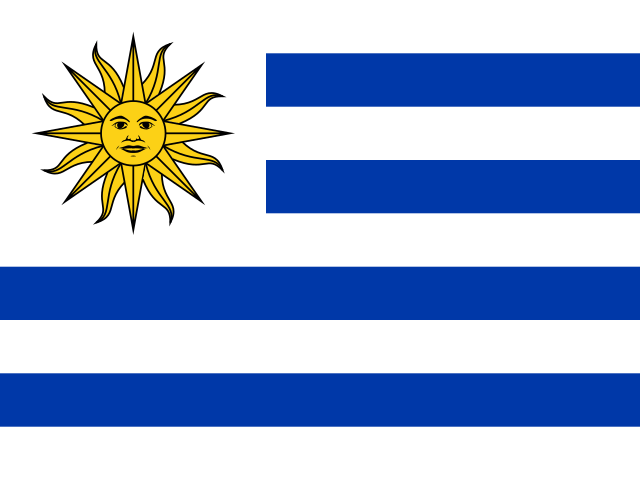 Uruguay
 Paraguay
Earlier Report Observations
The malt market in MERCOSUR began the period at 2 057 thousand tons in 2018, supported by the bloc's ongoing economic integration and progressive tariff reductions that facilitated regional trade access. Growth to 2 192 thousand tons followed in 2019, before the COVID-19 pandemic disrupted supply chains and dampened demand, pulling the market size down to 2 034 thousand tons in 2020.
A sharp recovery and expansion lifted the market to 2 706 thousand tons in 2021, primarily driven by rising consumer preference for craft beers and premium products, which boosted demand for specialized malt. This trend was reinforced by the entry of new players and the expansion of major companies like Malteurop. Growth continued into 2022, with the market reaching 3 093 thousand tons, fueled by a growing middle class, higher disposable incomes, and local flavor preferences, alongside significant investments and mergers in the sector.
By 2023, the market stabilized at 3 152 thousand tons, with modest growth underpinned by a shift towards sustainable and responsible production practices. Digitalization and e-commerce also facilitated broader distribution. In 2024, the market continued to be influenced by international price fluctuations and logistical challenges, while sustained consumer demand for natural ingredients and healthy malt beverages provided ongoing support.
Table of content
- 1. Disclaimer
- 2. Terms of use of the report
- 3. Product codes in the statistical classifications used in the report
-
4. Key Market Indicators and Trends
-
4.1. Key Market Indicators
-
4.1.1. In kind
- 4.1.1.1. Production, 2018-2023
- 4.1.1.2. Imports, 2018-2024
- 4.1.1.3. Exports, 2018-2024
- 4.1.1.4. Market size, 2018-2023
-
4.1.1. In kind
- 4.2. Market Trends and Factors
-
4.1. Key Market Indicators
-
5. Production
-
5.1. Production in MERCOSUR
- 5.1.1. Annual dynamics of production in MERCOSUR in kind, 2018-2023, K t
-
5.2. Global production by Country, 2018-2023
- 5.2.1. Annual dynamics of production by macroregions in kind, 2018-2023, K t
- 5.2.2. Dynamics of production structure by macroregions in kind, 2018-2023
- 5.2.3. Annual dynamics of production by country in kind, 2018-2023, K t
- 5.2.4. Structure of production by countries in kind, 2018-2023
- 5.2.5. Dynamics of peoduction structure by countries in kind, 2018-2023
-
5.1. Production in MERCOSUR
-
6. Imports
-
6.1. Imports (Direct Data)
- 6.1.1. Imports - Total information
-
6.1.2. Imports in kind, K t
- 6.1.2.1. Annual dynamics of product's imports to Brazil in kind, 2018-2024, K t
- 6.1.2.2. Dynamics of product's imports in kind to Brazil by countries, 2018-2024, K t
- 6.1.2.3. Structure of product's imports in kind by countries, 2018-2024
-
6.1.3. Imports in value, M $ US
- 6.1.3.1. Annual dynamics of product's imports to Brazil in value, 2018-2024, M $ US
- 6.1.3.2. Dynamics of product's imports in value to Brazil by countries, 2018-2024, M $ US
- 6.1.3.3. Structure of product's imports in value by countries, 2018-2024
-
6.1.4. Average price of product's imports, $ US/t
- 6.1.4.1. Annual dynamics of average price of product's imports to Brazil, 2018-2024, $ US/t
- 6.1.4.2. Dynamics of average price of product's imports to Brazil by countries, 2018-2024, $ US/t
-
6.2. Imports (Mirror Data)
- 6.2.1. Imports - Total information
-
6.2.2. Imports in kind, K t
- 6.2.2.1. Annual dynamics of product's imports to Brazil in kind, 2018-2024, K t
- 6.2.2.2. Dynamics of product's imports in kind to Brazil by countries, 2018-2024, K t
- 6.2.2.3. Structure of product's imports in kind by countries, 2018-2024
-
6.2.3. Imports in value, M $ US
- 6.2.3.1. Annual dynamics of product's imports to Brazil in value, 2018-2024, M $ US
- 6.2.3.2. Dynamics of product's imports in value to Brazil by countries, 2018-2024, M $ US
- 6.2.3.3. Structure of product's imports in value by countries, 2018-2024
-
6.2.4. Average price of product's imports, $ US/t
- 6.2.4.1. Annual dynamics of average price of product's imports to Brazil, 2018-2024, $ US/t
- 6.2.4.2. Dynamics of average price of product's imports to Brazil by countries, 2018-2024, $ US/t
-
6.1. Imports (Direct Data)
-
7. Exports
-
7.1. Exports (Direct Data)
- 7.1.1. Exports - Total information
-
7.1.2. Exports in kind, K t
- 7.1.2.1. Annual dynamics of product's exports from Brazil in kind, 2018-2024, K t
- 7.1.2.2. Dynamics of product's exports in kind from Brazil by countries, 2018-2024, K t
- 7.1.2.3. Structure of product's exports in kind by countries, 2018-2024
-
7.1.3. Exports in value, M $ US
- 7.1.3.1. Annual dynamics of product's exports from Brazil in value, 2018-2024, M $ US
- 7.1.3.2. Dynamics of product's exports in value from Brazil by countries, 2018-2024, M $ US
- 7.1.3.3. Structure of product's exports in value by countries, 2018-2024
-
7.1.4. Average price of product's exports, $ US/t
- 7.1.4.1. Annual dynamics of average price of product's exports from Brazil, 2018-2024, $ US/t
- 7.1.4.2. Dynamics of average price of product's exports from Brazil by countries, 2018-2024, $ US/t
-
7.2. Exports (Mirror Data)
- 7.2.1. Exports - Total information
-
7.2.2. Exports in kind, K t
- 7.2.2.1. Annual dynamics of product's exports from Brazil in kind, 2018-2024, K t
- 7.2.2.2. Dynamics of product's exports in kind from Brazil by countries, 2018-2024, K t
- 7.2.2.3. Structure of product's exports in kind by countries, 2018-2024
-
7.2.3. Exports in value, M $ US
- 7.2.3.1. Annual dynamics of product's exports from Brazil in value, 2018-2024, M $ US
- 7.2.3.2. Dynamics of product's exports in value from Brazil by countries, 2018-2024, M $ US
- 7.2.3.3. Structure of product's exports in value by countries, 2018-2024
-
7.2.4. Average price of product's exports, $ US/t
- 7.2.4.1. Annual dynamics of average price of product's exports from Brazil, 2018-2024, $ US/t
- 7.2.4.2. Dynamics of average price of product's exports from Brazil by countries, 2018-2024, $ US/t
-
7.1. Exports (Direct Data)
-
8. Trade balance
-
8.1. Trade balance (Direct Data)
- 8.1.1. In kind, K t
- 8.1.2. In value, M $ US
-
8.2. Trade balance (Mirror Data)
- 8.2.1. In kind, K t
- 8.2.2. In value, M $ US
-
8.1. Trade balance (Direct Data)
-
9. Top buying and selling countries, 2018-2024
-
9.1. Direct Data
- 9.1.1. Import in Value by Countries-buyers
- 9.1.2. Export in Value by Countries-suppliers
-
9.2. Mirror Data
- 9.2.1. Import in Value by Countries-buyers
- 9.2.2. Export in Value by Countries-suppliers
-
9.1. Direct Data
Production malt in MERCOSUR
In kind, 2017-2020, K t
Top producers of malt, 2017-2020
World map of production of malt, 2017-2020
Malt production in MERCOSUR has grown for the third year in a row. In 2020, the region produced 2 411 K t of malt, representing a 24.8% year-over-year increase. From 2017 to 2020, production rose by 27.8%, with an average annual growth rate of 8.5%.
Annual dynamics of production in MERCOSUR in kind, 2017-2020, K t
| Parameter | 2018 | 2019 | 2020 | CAGR | |
|---|---|---|---|---|---|
| 1 | Change from last year | 1.5% | 0.8% | 24.8% | 8.5% |
In value, 2017-2020, M $ US
Malt production in MERCOSUR continued its upward trend for the third consecutive year. In 2020, the output was valued at 1 218 M $ US, showing a robust 17.2% increase compared to the previous year. Over the 2017-2020 period, production grew by 26.3%, with an average annual growth rate of 8.1%.
Annual dynamics of production in MERCOSUR in value, 2017-2020, M $ US
| Parameter | 2018 | 2019 | 2020 | CAGR | |
|---|---|---|---|---|---|
| 1 | Change from last year | 2.0% | 5.7% | 17.2% | 8.1% |
Exports malt from MERCOSUR
Exports in kind, K t
In 2020, MERCOSUR exported 806 K t of malt, a 10.2% decrease from the previous year. From 2017 to 2020, exports fell by 6.9%, with an average annual decline of 2.4%. The lowest export volume was in 2018 at 753 K t, while the highest was in 2019 at 898 K t. The largest drop occurred in 2018 at 13.0%, and the biggest increase was in 2019 at 19.3%.
Annual dynamics of product's exports from MERCOSUR in kind, 2017-2020, K t
| Parameter | 2018 | 2019 | 2020 | CAGR | |
|---|---|---|---|---|---|
| 1 | Change from last year | (13.0%) | 19.3% | (10.2%) | (2.4%) |
Between 2017 and 2020, MERCOSUR's malt exports were distributed across a wide range of partners. Free Zones accounted for 10.7% of exports in kind, Chile for 4.3%, and Bolivia for 3.7%, together making up 18.7% of total flows. The remaining 81.3% was spread among numerous smaller markets.
Structure of product's exports in kind by countries, 2017-2020
World map of product's exports from MERCOSUR in kind, 2017-2020
Exports in value, M $ US
In 2020, MERCOSUR's malt exports totaled 407.2 M $ US, marking a significant 15.8% decline from the previous year. From 2017 to 2020, exports decreased by 8%, with an average annual decline of 2.7%. The lowest value was recorded in 2018 at 386.6 M $ US, and the highest in 2019 at 483.5 M $ US. The largest increase occurred in 2019 at 25.1%.
Annual dynamics of product's exports from MERCOSUR in value, 2017-2020, M $ US
| Parameter | 2018 | 2019 | 2020 | CAGR | |
|---|---|---|---|---|---|
| 1 | Change from last year | (12.6%) | 25.1% | (15.8%) | (2.7%) |
From 2017 to 2020, key buyers of MERCOSUR's malt included Free Zones with 11.4% of exports in value terms, Chile with 4.1%, and Bolivia with 4.0%. However, their combined share reached only 19.4% of total exports, while the remaining 80.6% was distributed among many other partners.
Structure of product's exports in value by countries, 2017-2020
World map of product's exports from MERCOSUR in value, 2017-2020
Imports malt to MERCOSUR
Imports in kind, K t
In 2020, MERCOSUR imported {value_last_year} K t of malt, a dramatic 63.0% drop compared to 2019. From 2017 to 2020, imports decreased by 52.8%, with an average annual decline of 22.1%. The highest import volume was in 2019 at 1 159 K t, and the largest increase occurred that same year at 29.6%.
Annual dynamics of product's imports to MERCOSUR in kind, 2017-2020, K t
| Parameter | 2018 | 2019 | 2020 | CAGR | |
|---|---|---|---|---|---|
| 1 | Change from last year | (1.6%) | 29.6% | (63.0%) | (22.1%) |
Between 2017 and 2020, MERCOSUR's malt imports in kind were spread across various countries. Belgium accounted for 6.2% of imports, France for 4.6%, and Germany for 4.0%, together making up 14.8% of total flows. No single partner emerged as clearly dominant during this period.
Structure of product's imports in kind by countries, 2017-2020
World map of product's imports to MERCOSUR in kind, 2017-2020
Imports in value, M $ US
In 2020, MERCOSUR's malt imports were valued at 612.1 M $ US, showing a slight 0.7% decline from 2019. From 2017 to 2020, imports increased by 32.5%, equating to an average annual growth rate of 9.8%. The lowest value was in 2018 at 459.9 M $ US, and the highest in 2019 at 616.6 M $ US. The largest increase was recorded in 2019 at 34.1%.
Annual dynamics of product's imports to MERCOSUR in value, 2017-2020, M $ US
| Parameter | 2018 | 2019 | 2020 | CAGR | |
|---|---|---|---|---|---|
| 1 | Change from last year | (0.5%) | 34.1% | (0.7%) | 9.8% |
From 2017 to 2020, no single market dominated MERCOSUR's malt imports in value terms. Belgium accounted for 5.2% of imports, Germany for 4.1%, and France for 3.7%, together totaling 13.0% of imports. The rest was distributed among many smaller partners, each with modest individual shares.
Structure of product's imports in value by countries, 2017-2020
World map of product's imports to MERCOSUR in value, 2017-2020
Related Reports

2026-03-28
2026-03-28
Malt market in Southern Europe
2026-03-28
2026-03-28

Cassava starch market in MERCOSUR
2026-03-28


Maize flour and cereals market in MERCOSUR
2026-03-30

In-depth market research on this product
Global Malt Market 2021–2031: Size, Share, Trends and Forecast
Global market report: size, trends and forecast to 2031 · 186 pages
Why Choose Us?
Only Verified Data
No Hidden Costs or Separate Fees
Smarter Subscription Pricing
Contact Our Team
Submit your inquiry using the form below — our team will get back to you within 24 hours.