






"SADC" region includes following countries:
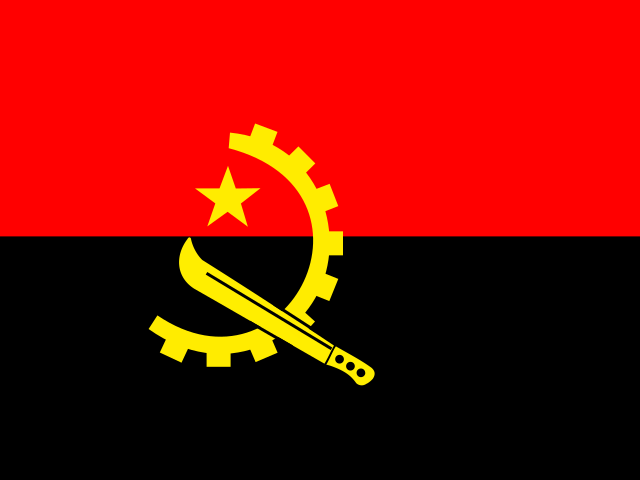 Angola
 Botswana
 Comoros
 Democratic Republic of the Congo
 Eswatini
 Lesotho
 Madagascar
 Malawi
 Mauritius
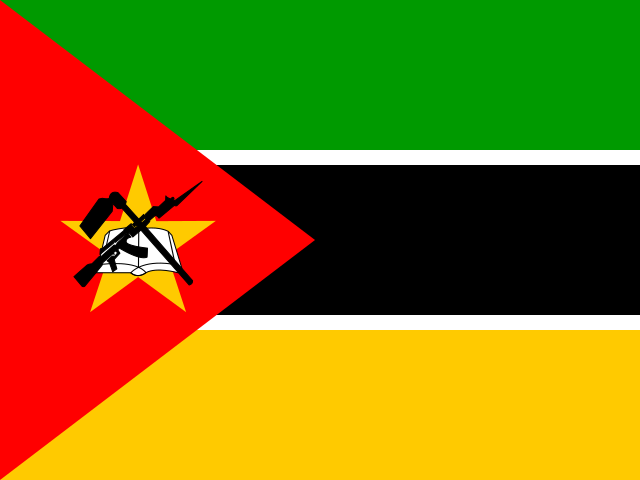 Mozambique
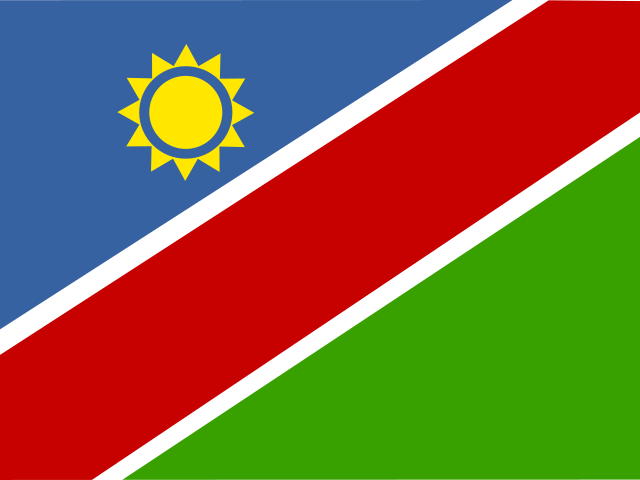 Namibia
 Seychelles
 South Africa
 Tanzania
 Zambia
 Zimbabwe
Earlier Report Observations
The maize starch market in SADC recorded a volume of 85 589 t in 2018, a year marked by heat and dryness in key South African growing regions that reduced maize yield prospects. This weather stress contributed to a shift among farmers away from white maize towards more profitable crops like soybeans. By 2019, continued drought conditions lowered maize opening stocks by approximately 60%, which increased reliance on imports and supported the market size, lifting it to 94 444 t.
Market volume fell sharply to 65 767 t in 2020, then recovered to 82 832 t in 2021 before moderating to 78 421 t in 2022. The market stabilized in 2023 at 79 461 t, aided by a record South African maize harvest of 16.4 million tons that improved raw material availability for starch production. Furthermore, high food inflation during this period increased consumer reliance on staple starches like maize starch, supporting domestic consumption.
Table of content
- 1. Disclaimer
- 2. Terms of use of the report
- 3. Product codes in the statistical classifications used in the report
-
4. Key Market Indicators and Trends
-
4.1. Key Market Indicators
-
4.1.1. In kind
- 4.1.1.1. Production, 2018-2023
- 4.1.1.2. Imports, 2018-2024
- 4.1.1.3. Exports, 2018-2024
- 4.1.1.4. Market size, 2018-2023
-
4.1.1. In kind
- 4.2. Market Trends and Factors
-
4.1. Key Market Indicators
-
5. Production
-
5.1. Production in SADC
- 5.1.1. Annual dynamics of production in SADC in kind, 2018-2023, t
-
5.2. Global production by Country, 2018-2023
- 5.2.1. Annual dynamics of production by macroregions in kind, 2018-2023, t
- 5.2.2. Dynamics of production structure by macroregions in kind, 2018-2023
- 5.2.3. Annual dynamics of production by country in kind, 2018-2023, t
- 5.2.4. Structure of production by countries in kind, 2018-2023
- 5.2.5. Dynamics of peoduction structure by countries in kind, 2018-2023
-
5.1. Production in SADC
-
6. Imports
-
6.1. Imports (Direct Data*)
- 6.1.1. Imports - Total information
-
6.1.2. Imports in kind, t
- 6.1.2.1. Annual dynamics of product's imports to Angola in kind, 2018-2024, t
- 6.1.2.2. Dynamics of product's imports in kind to Angola by countries, 2018-2024, t
- 6.1.2.3. Structure of product's imports in kind by countries, 2018-2024
-
6.1.3. Imports in value, K $ US
- 6.1.3.1. Annual dynamics of product's imports to Angola in value, 2018-2024, K $ US
- 6.1.3.2. Dynamics of product's imports in value to Angola by countries, 2018-2024, K $ US
- 6.1.3.3. Structure of product's imports in value by countries, 2018-2024
-
6.1.4. Average price of product's imports, $ US/t
- 6.1.4.1. Annual dynamics of average price of product's imports to Angola, 2018-2024, $ US/t
- 6.1.4.2. Dynamics of average price of product's imports to Angola by countries, 2018-2024, $ US/t
-
6.2. Imports (Mirror Data)
- 6.2.1. Imports - Total information
-
6.2.2. Imports in kind, t
- 6.2.2.1. Annual dynamics of product's imports to Angola in kind, 2018-2024, t
- 6.2.2.2. Dynamics of product's imports in kind to Angola by countries, 2018-2024, t
- 6.2.2.3. Structure of product's imports in kind by countries, 2018-2024
-
6.2.3. Imports in value, K $ US
- 6.2.3.1. Annual dynamics of product's imports to Angola in value, 2018-2024, K $ US
- 6.2.3.2. Dynamics of product's imports in value to Angola by countries, 2018-2024, K $ US
- 6.2.3.3. Structure of product's imports in value by countries, 2018-2024
-
6.2.4. Average price of product's imports, $ US/t
- 6.2.4.1. Annual dynamics of average price of product's imports to Angola, 2018-2024, $ US/t
- 6.2.4.2. Dynamics of average price of product's imports to Angola by countries, 2018-2024, $ US/t
-
6.1. Imports (Direct Data*)
-
7. Exports
-
7.1. Exports (Direct Data*)
- 7.1.1. Exports - Total information
-
7.1.2. Exports in kind, t
- 7.1.2.1. Annual dynamics of product's exports from Angola in kind, 2018-2024, t
- 7.1.2.2. Dynamics of product's exports in kind from Angola by countries, 2018-2024, t
- 7.1.2.3. Structure of product's exports in kind by countries, 2018-2024
-
7.1.3. Exports in value, K $ US
- 7.1.3.1. Annual dynamics of product's exports from Angola in value, 2018-2024, K $ US
- 7.1.3.2. Dynamics of product's exports in value from Angola by countries, 2018-2024, K $ US
- 7.1.3.3. Structure of product's exports in value by countries, 2018-2024
-
7.1.4. Average price of product's exports, $ US/t
- 7.1.4.1. Annual dynamics of average price of product's exports from Angola, 2018-2024, $ US/t
- 7.1.4.2. Dynamics of average price of product's exports from Angola by countries, 2018-2024, $ US/t
-
7.2. Exports (Mirror Data)
- 7.2.1. Exports - Total information
-
7.2.2. Exports in kind, t
- 7.2.2.1. Annual dynamics of product's exports from Angola in kind, 2018-2024, t
- 7.2.2.2. Dynamics of product's exports in kind from Angola by countries, 2018-2024, t
- 7.2.2.3. Structure of product's exports in kind by countries, 2018-2024
-
7.2.3. Exports in value, K $ US
- 7.2.3.1. Annual dynamics of product's exports from Angola in value, 2018-2024, K $ US
- 7.2.3.2. Dynamics of product's exports in value from Angola by countries, 2018-2024, K $ US
- 7.2.3.3. Structure of product's exports in value by countries, 2018-2024
-
7.2.4. Average price of product's exports, $ US/t
- 7.2.4.1. Annual dynamics of average price of product's exports from Angola, 2018-2024, $ US/t
- 7.2.4.2. Dynamics of average price of product's exports from Angola by countries, 2018-2024, $ US/t
-
7.1. Exports (Direct Data*)
-
8. Trade balance
-
8.1. Trade balance (Direct Data)
- 8.1.1. In kind, t
- 8.1.2. In value, K $ US
-
8.2. Trade balance (Mirror Data)
- 8.2.1. In kind, t
- 8.2.2. In value, K $ US
-
8.1. Trade balance (Direct Data)
-
9. Top buying and selling countries, 2018-2024
-
9.1. Direct Data
- 9.1.1. Import in Value by Countries-buyers
- 9.1.2. Export in Value by Countries-suppliers
-
9.2. Mirror Data
- 9.2.1. Import in Value by Countries-buyers
- 9.2.2. Export in Value by Countries-suppliers
-
9.1. Direct Data
Production maize starch in SADC
In kind, 2017-2020, t
Top producers of maize starch, 2017-2020
World map of production of maize starch, 2017-2020
SADC's maize starch production has declined for the second consecutive year. In 2020, production reached 70 424 tonnes, which represents an 18.3% decrease compared to the previous year. Looking at the period from 2017 to 2020, production fell by 22%, translating to an annualized decline rate of 8.0%. The highest production level was recorded in 2018 at 91 839 tonnes, with the largest year-on-year increase of 1.7% also occurring that year.
Annual dynamics of production in SADC in kind, 2017-2020, t
| Parameter | 2018 | 2019 | 2020 | CAGR | |
|---|---|---|---|---|---|
| 1 | Change from last year | 1.7% | (6.1%) | (18.3%) | (8.0%) |
In value, 2017-2020, K $ US
SADC's maize starch production has declined for the third consecutive year. In 2020, the output was valued at 31 480 thousand US dollars, marking a 19.1% decrease year-on-year. Over the 2017-2020 period, production value dropped by 23.6%, with a compound annual growth rate (CAGR) of -8.6%.
Annual dynamics of production in SADC in value, 2017-2020, K $ US
| Parameter | 2018 | 2019 | 2020 | CAGR | |
|---|---|---|---|---|---|
| 1 | Change from last year | (1.6%) | (4.0%) | (19.1%) | (8.6%) |
Exports maize starch from SADC
Exports in kind, t
After two years of decline, maize starch exports from SADC increased in 2020. Exports reached 27 043 tonnes, showing a 12.6% rise compared to the previous year. However, over the 2017-2020 period, exports decreased by 3.4%, which corresponds to an annualized decline of 1.2%. The lowest export volume was recorded in 2019 at 24 008 tonnes, with the largest year-on-year drop of 11.2% also occurring that year.
Annual dynamics of product's exports from SADC in kind, 2017-2020, t
| Parameter | 2018 | 2019 | 2020 | CAGR | |
|---|---|---|---|---|---|
| 1 | Change from last year | (3.5%) | (11.2%) | 12.6% | (1.2%) |
Between 2017 and 2020, Asia (not elsewhere specified), Australia, and the Philippines were notable buyers of maize starch from SADC, but their combined share was not dominant. Asia accounted for 22.5% of exports in kind, Australia for 17.6%, and the Philippines for 8.2%, totaling 48.3% of all exports.
Structure of product's exports in kind by countries, 2017-2020
World map of product's exports from SADC in kind, 2017-2020
Exports in value, K $ US
Following a two-year decline, maize starch exports from SADC increased in 2020. Exports were valued at 12 088 thousand US dollars, representing an 11.7% rise compared to 2019. Over the 2017-2020 period, however, export value decreased by 5.3%, equating to an annualized decline of 1.8%. The lowest value was recorded in 2019 at 10 825 thousand US dollars, with the largest year-on-year drop of 9.3% also occurring that year.
Annual dynamics of product's exports from SADC in value, 2017-2020, K $ US
| Parameter | 2018 | 2019 | 2020 | CAGR | |
|---|---|---|---|---|---|
| 1 | Change from last year | (6.6%) | (9.3%) | 11.7% | (1.8%) |
From 2017 to 2020, maize starch exports in value terms were distributed across a wide range of partner countries. The top three destinations—Asia (not elsewhere specified), Australia, and the Philippines—together accounted for just 44.2% of total flows. Asia represented 19.6% of exports in value, Australia 17.5%, and the Philippines 7.1%.
Structure of product's exports in value by countries, 2017-2020
World map of product's exports from SADC in value, 2017-2020
Imports maize starch to SADC
Imports in kind, t
After two years of growth, maize starch imports into SADC declined in 2020. Import volume totaled 22 387 tonnes, indicating a 30.5% decrease year-on-year. However, over the 2017-2020 period, imports increased by 21.7%, which corresponds to an annualized growth rate of 6.8%. The highest import volume was recorded in 2019 at 32 206 tonnes, with the largest year-on-year increase of 54.9% also occurring that year.
Annual dynamics of product's imports to SADC in kind, 2017-2020, t
| Parameter | 2018 | 2019 | 2020 | CAGR | |
|---|---|---|---|---|---|
| 1 | Change from last year | 13.0% | 54.9% | (30.5%) | 6.8% |
Throughout 2017-2020, India, Turkey, and China were the leading sources of maize starch imports into SADC in kind. India accounted for 32.8% of imports, Turkey for 19.6%, and China for 4.7%, jointly representing 57.1% of total import flows.
Structure of product's imports in kind by countries, 2017-2020
World map of product's imports to SADC in kind, 2017-2020
Imports in value, K $ US
SADC's maize starch imports have increased for the third consecutive year. In 2020, imports reached 11 687 thousand US dollars, showing a 5.9% rise compared to 2019. Over the 2017-2020 period, import value grew by 14.5%, with a compound annual growth rate (CAGR) of 4.6%.
Annual dynamics of product's imports to SADC in value, 2017-2020, K $ US
| Parameter | 2018 | 2019 | 2020 | CAGR | |
|---|---|---|---|---|---|
| 1 | Change from last year | 3.9% | 4.1% | 5.9% | 4.6% |
During 2017-2020, maize starch imports into SADC in value terms came from many different markets. Even the largest suppliers—India, Turkey, and China—together represented only 44.9% of total imports.
Structure of product's imports in value by countries, 2017-2020
World map of product's imports to SADC in value, 2017-2020
Related Reports

Maize starch market in Eastern Africa
2026-03-28
Maize starch market in Denmark
2026-03-28
Maize starch market in Thailand
2026-03-28
Maize starch market in Belgium
2026-03-28

2026-03-28
2026-03-28

Maize flour and cereals market in SADC
2026-03-30

2026-03-28
Why Choose Us?
Only Verified Data
No Hidden Costs or Separate Fees
Smarter Subscription Pricing
Contact Our Team
Submit your inquiry using the form below — our team will get back to you within 24 hours.