






"SADC" region includes following countries:
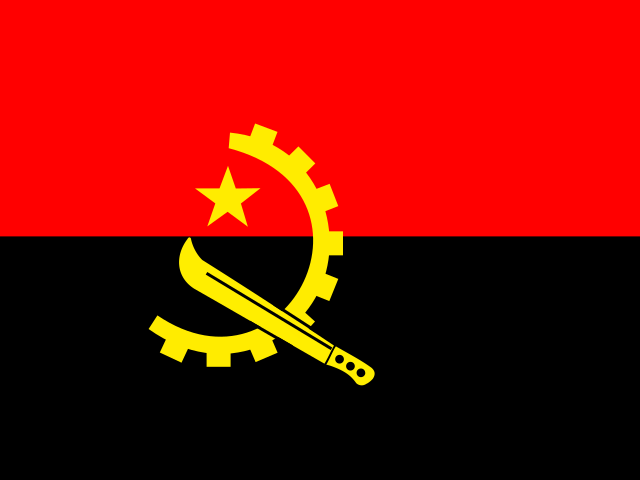 Angola
 Botswana
 Comoros
 Democratic Republic of the Congo
 Eswatini
 Lesotho
 Madagascar
 Malawi
 Mauritius
 Mozambique
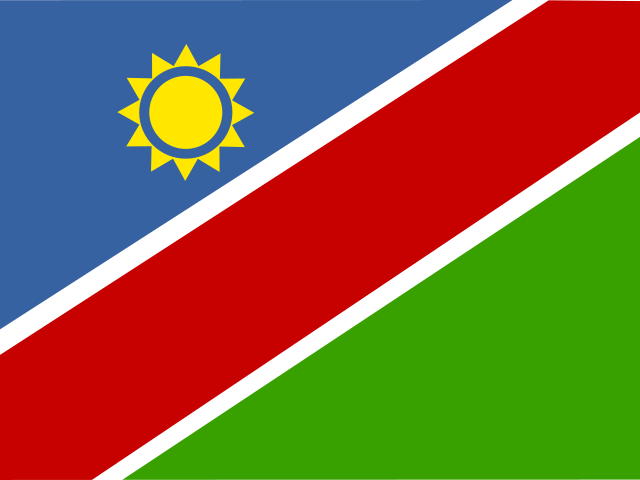 Namibia
 Seychelles
 South Africa
 Tanzania
 Zambia
 Zimbabwe
Earlier Report Observations
Maize flour and cereals production in South Africa showed overall growth from 2018 to 2023, though with fluctuations. Early in the period, heat and dryness in western producing areas reduced yield prospects in 2018. Production recovered in 2019 as global conditions improved in major supplying countries like Argentina, Brazil, and the US. However, the COVID-19 pandemic and economic recession in 2020 increased pressure on consumers and sector players, leading to a production decline due to higher input costs and exchange rate volatility.
From 2021, production resumed growth. Rising global poultry meat prices, driven by high demand and increased feed costs due to Avian Influenza in the EU, boosted demand for maize as animal feed. In 2022, strong demand from China and higher global maize production supported further expansion. By 2023, despite uncertainty from US planting intentions, local production prospects remained favorable, contributing to a modest increase.
In 2024, drought significantly reduced maize yields and tightened stocks, pushing up white maize prices. This prompted South Africa to import white maize for the first time since 2017. Retailers responded with measures like expanding private brand portfolios and freezing prices on staple commodities to mitigate consumer impact.
Table of content
- 1. Disclaimer
- 2. Terms of use of the report
- 3. Product codes in the statistical classifications used in the report
-
4. Key Market Indicators and Trends
-
4.1. Key Market Indicators
-
4.1.1. In kind
- 4.1.1.1. Production, 2018-2023
- 4.1.1.2. Imports, 2018-2024
- 4.1.1.3. Exports, 2018-2024
- 4.1.1.4. Market size, 2018-2023
-
4.1.1. In kind
- 4.2. Market Trends and Factors
-
4.1. Key Market Indicators
-
5. Production
-
5.1. Production in SADC
- 5.1.1. Annual dynamics of production in SADC in kind, 2018-2023, K t
-
5.2. Global production by Country, 2018-2023
- 5.2.1. Annual dynamics of production by macroregions in kind, 2018-2023, K t
- 5.2.2. Dynamics of production structure by macroregions in kind, 2018-2023
- 5.2.3. Annual dynamics of production by country in kind, 2018-2023, K t
- 5.2.4. Structure of production by countries in kind, 2018-2023
- 5.2.5. Dynamics of peoduction structure by countries in kind, 2018-2023
-
5.1. Production in SADC
-
6. Imports
-
6.1. Imports (Direct Data*)
- 6.1.1. Imports - Total information
-
6.1.2. Imports in kind, K t
- 6.1.2.1. Annual dynamics of product's imports to Angola in kind, 2018-2024, K t
- 6.1.2.2. Dynamics of product's imports in kind to Angola by countries, 2018-2024, K t
- 6.1.2.3. Structure of product's imports in kind by countries, 2018-2024
-
6.1.3. Imports in value, M $ US
- 6.1.3.1. Annual dynamics of product's imports to Angola in value, 2018-2024, M $ US
- 6.1.3.2. Dynamics of product's imports in value to Angola by countries, 2018-2024, M $ US
- 6.1.3.3. Structure of product's imports in value by countries, 2018-2024
-
6.1.4. Average price of product's imports, $ US/t
- 6.1.4.1. Annual dynamics of average price of product's imports to Angola, 2018-2024, $ US/t
- 6.1.4.2. Dynamics of average price of product's imports to Angola by countries, 2018-2024, $ US/t
-
6.2. Imports (Mirror Data)
- 6.2.1. Imports - Total information
-
6.2.2. Imports in kind, K t
- 6.2.2.1. Annual dynamics of product's imports to Angola in kind, 2018-2024, K t
- 6.2.2.2. Dynamics of product's imports in kind to Angola by countries, 2018-2024, K t
- 6.2.2.3. Structure of product's imports in kind by countries, 2018-2024
-
6.2.3. Imports in value, M $ US
- 6.2.3.1. Annual dynamics of product's imports to Angola in value, 2018-2024, M $ US
- 6.2.3.2. Dynamics of product's imports in value to Angola by countries, 2018-2024, M $ US
- 6.2.3.3. Structure of product's imports in value by countries, 2018-2024
-
6.2.4. Average price of product's imports, $ US/t
- 6.2.4.1. Annual dynamics of average price of product's imports to Angola, 2018-2024, $ US/t
- 6.2.4.2. Dynamics of average price of product's imports to Angola by countries, 2018-2024, $ US/t
-
6.1. Imports (Direct Data*)
-
7. Exports
-
7.1. Exports (Direct Data*)
- 7.1.1. Exports - Total information
-
7.1.2. Exports in kind, K t
- 7.1.2.1. Annual dynamics of product's exports from Angola in kind, 2018-2024, K t
- 7.1.2.2. Dynamics of product's exports in kind from Angola by countries, 2018-2024, K t
- 7.1.2.3. Structure of product's exports in kind by countries, 2018-2024
-
7.1.3. Exports in value, M $ US
- 7.1.3.1. Annual dynamics of product's exports from Angola in value, 2018-2024, M $ US
- 7.1.3.2. Dynamics of product's exports in value from Angola by countries, 2018-2024, M $ US
- 7.1.3.3. Structure of product's exports in value by countries, 2018-2024
-
7.1.4. Average price of product's exports, $ US/t
- 7.1.4.1. Annual dynamics of average price of product's exports from Angola, 2018-2024, $ US/t
- 7.1.4.2. Dynamics of average price of product's exports from Angola by countries, 2018-2024, $ US/t
-
7.2. Exports (Mirror Data)
- 7.2.1. Exports - Total information
-
7.2.2. Exports in kind, K t
- 7.2.2.1. Annual dynamics of product's exports from Angola in kind, 2018-2024, K t
- 7.2.2.2. Dynamics of product's exports in kind from Angola by countries, 2018-2024, K t
- 7.2.2.3. Structure of product's exports in kind by countries, 2018-2024
-
7.2.3. Exports in value, M $ US
- 7.2.3.1. Annual dynamics of product's exports from Angola in value, 2018-2024, M $ US
- 7.2.3.2. Dynamics of product's exports in value from Angola by countries, 2018-2024, M $ US
- 7.2.3.3. Structure of product's exports in value by countries, 2018-2024
-
7.2.4. Average price of product's exports, $ US/t
- 7.2.4.1. Annual dynamics of average price of product's exports from Angola, 2018-2024, $ US/t
- 7.2.4.2. Dynamics of average price of product's exports from Angola by countries, 2018-2024, $ US/t
-
7.1. Exports (Direct Data*)
-
8. Trade balance
-
8.1. Trade balance (Direct Data)
- 8.1.1. In kind, K t
- 8.1.2. In value, M $ US
-
8.2. Trade balance (Mirror Data)
- 8.2.1. In kind, K t
- 8.2.2. In value, M $ US
-
8.1. Trade balance (Direct Data)
-
9. Top buying and selling countries, 2018-2024
-
9.1. Direct Data
- 9.1.1. Import in Value by Countries-buyers
- 9.1.2. Export in Value by Countries-suppliers
-
9.2. Mirror Data
- 9.2.1. Import in Value by Countries-buyers
- 9.2.2. Export in Value by Countries-suppliers
-
9.1. Direct Data
Production maize flour and cereals in SADC
In kind, 2017-2020, K t
Top producers of maize flour and cereals, 2017-2020
World map of production of maize flour and cereals, 2017-2020
SADC's maize flour and cereals production saw a two-year advance before declining. In 2019, production reached its peak at 18 131 K t. However, in 2020, it fell to 17 537 K t, marking a moderate 3.3% decrease from the previous year. The largest annual increase occurred in 2018, with a 1.7% rise.
Annual dynamics of production in SADC in kind, 2017-2020, K t
| Parameter | 2018 | 2019 | 2020 | CAGR | |
|---|---|---|---|---|---|
| 1 | Change from last year | 1.7% | 1.5% | (3.3%) | (0.0%) |
Exports maize flour and cereals from SADC
Exports in kind, K t
Maize flour and cereals exports from SADC have increased for three consecutive years. In 2020, exports totaled 390.5 K t, reflecting a substantial 221.3% surge compared to 2019. Over the period from 2017 to 2020, exports grew by 1 976.2%, with a compound annual growth rate of 174.8%.
Annual dynamics of product's exports from SADC in kind, 2017-2020, K t
| Parameter | 2018 | 2019 | 2020 | CAGR | |
|---|---|---|---|---|---|
| 1 | Change from last year | 383.3% | 33.7% | 221.3% | 174.8% |
From 2017 to 2020, SADC's maize flour and cereals exports were distributed across many countries. The top destinations—Asia (not elsewhere specified), Special Categories, and Ethiopia—together accounted for only 7.9% of total exports in kind, indicating a highly diversified trade pattern.
Structure of product's exports in kind by countries, 2017-2020
World map of product's exports from SADC in kind, 2017-2020
Exports in value, M $ US
Maize flour and cereals export volumes from SADC have risen for two consecutive years. In 2020, the export value reached 199.7 M $ US, showing a sharp 45.1% increase over the previous year. Between 2017 and 2020, exports grew by 63.3%, equating to an annualized rate of 17.8%. The lowest value was recorded in 2018 at 100.4 M $ US, which also saw the largest decline of 17.9%.
Annual dynamics of product's exports from SADC in value, 2017-2020, M $ US
| Parameter | 2018 | 2019 | 2020 | CAGR | |
|---|---|---|---|---|---|
| 1 | Change from last year | (17.9%) | 37.1% | 45.1% | 17.8% |
From 2017 to 2020, the export value of maize flour and cereals from SADC remained widely scattered. Ethiopia accounted for 2.1% of exports in value terms, Asia (not elsewhere specified) for 2.0%, and Special Categories for 1.6%. Together, these three partners represented just 5.8% of total flows, with no single country emerging as clearly dominant.
Structure of product's exports in value by countries, 2017-2020
World map of product's exports from SADC in value, 2017-2020
Imports maize flour and cereals to SADC
Imports in kind, K t
The market exhibited volatility over the observed period. Imports reached their lowest point in 2019 at 231.1 K t, after declining by 29.8% in 2018. In 2020, imports rebounded to 395.5 K t, a 71.2% increase from 2019. Overall, from the high in 2017 to the low in 2019, import volumes varied by a factor of 1.8.
Annual dynamics of product's imports to SADC in kind, 2017-2020, K t
| Parameter | 2018 | 2019 | 2020 | CAGR | |
|---|---|---|---|---|---|
| 1 | Change from last year | (29.8%) | (21.0%) | 71.2% | (1.7%) |
Data from 2017 to 2020 show that imports of maize flour and cereals to SADC were not heavily concentrated. Brazil was the largest source, accounting for 27.0% of imports in kind, followed by Turkey at 4.4% and Argentina at 3.4%. Together, these three countries represented only 34.8% of total flows.
Structure of product's imports in kind by countries, 2017-2020
World map of product's imports to SADC in kind, 2017-2020
Imports in value, M $ US
After a two-year decline, SADC's maize flour and cereals import volumes increased. In 2020, imports amounted to 200.3 M $ US, a sharp 59.0% rise from the previous year. Between 2017 and 2020, imports decreased by 23.8%, equating to an annualized rate of 8.7%. The minimum value was recorded in 2019 at 125.9 M $ US, following the largest decline of 35.4% in 2018.
Annual dynamics of product's imports to SADC in value, 2017-2020, M $ US
| Parameter | 2018 | 2019 | 2020 | CAGR | |
|---|---|---|---|---|---|
| 1 | Change from last year | (35.4%) | (25.8%) | 59.0% | (8.7%) |
Over the period 2017–2020, no single market dominated SADC's maize flour and cereals imports in value terms. Brazil accounted for 29.4% of imports in value terms, Portugal for 2.4%, and Turkey for 2.2%. Collectively, these three partners took only 33.9% of total imports, while many smaller partners each held modest individual shares.
Structure of product's imports in value by countries, 2017-2020
World map of product's imports to SADC in value, 2017-2020
Related Reports

Maize flour and cereals market in ASEAN
2026-03-30
Maize flour and cereals market in Kuwait
2026-03-30
2026-03-28


2026-03-28
Why Choose Us?
Only Verified Data
No Hidden Costs or Separate Fees
Smarter Subscription Pricing
Contact Our Team
Submit your inquiry using the form below — our team will get back to you within 24 hours.