






"Africa" region includes following countries:
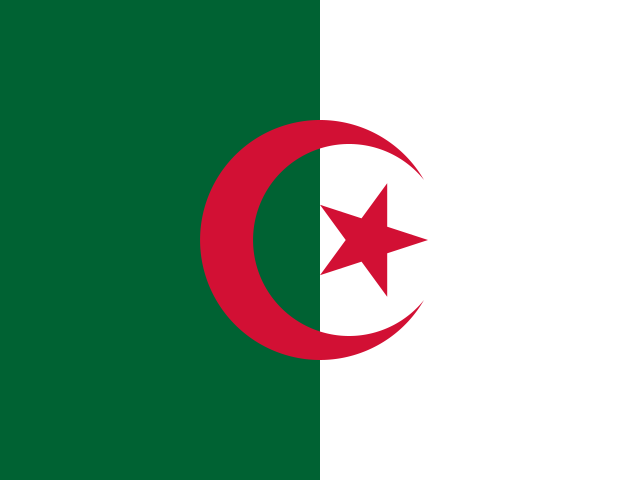 Algeria
 Libya
Libya Morocco
 Sudan
Sudan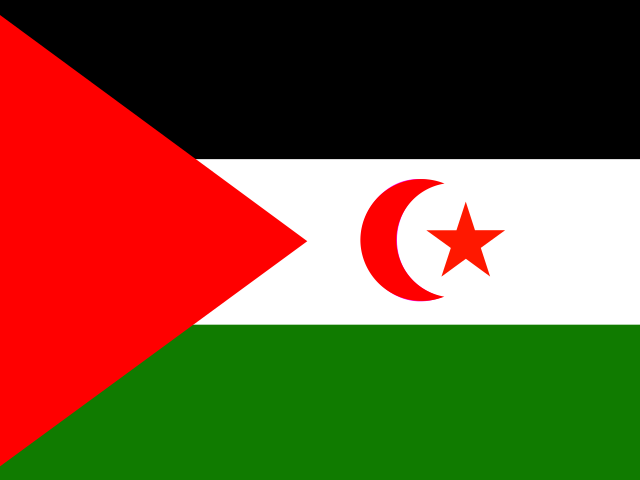 Western Sahara
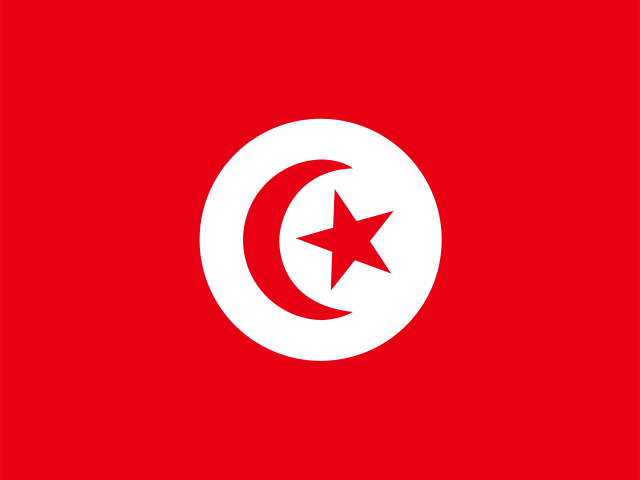 Tunisia
 Egypt
Egypt Cabo Verde
 Benin
Benin Gambia
 Ghana
Ghana Guinea
 Côte d'Ivoire
 Liberia
 Mali
Mali Mauritania
 Niger
Niger Nigeria
 Guinea-Bissau
 Saint Helena, Ascension and Tristan da Cunha
 Senegal
 Sierra Leone
 Togo
Togo Burkina Faso
 British Indian Ocean Territory
 Burundi
 Comoros
 Mayotte
 Ethiopia
 Eritrea
 French Southern Territories
 Djibouti
 Kenya
Kenya Madagascar
 Malawi
 Mauritius
 Mozambique
 Reunion
 Rwanda
 Seychelles
 Somalia
 Zimbabwe
 South Sudan
 Uganda
 Tanzania
 Zambia
 Angola
 Cameroon
 Central African Republic
 Chad
Chad Congo
Congo Democratic Republic of the Congo
 Equatorial Guinea
 Gabon
Gabon Sao Tome and Principe
 Botswana
 Lesotho
 Namibia
 South Africa
 Eswatini
Earlier Report Observations
The maize market in Africa expanded from 98.6 million tonnes in 2018 to 115.1 million tonnes in 2020. This growth was initiated by the adoption of the African Continental Free Trade Area (AfCFTA) in 2018, which progressively reduced tariff and non-tariff barriers to boost intra-regional trade. In 2020, the COVID-19 pandemic sustained demand for maize as a staple food, supporting market volume despite supply chain disruptions.
After peaking in 2020, the market contracted slightly to 110.6 million tonnes by 2022. A key driver in 2021 was the reduced chicken-to-maize price ratio, which lowered profitability for the poultry industry and decreased feed demand. In 2022, record South African agricultural exports and a decline in global maize production tightened availability. The market recovered to 114 million tonnes in 2023, supported by a bumper harvest in South Africa that strengthened its position as a net exporter.
Table of content
- 1. Disclaimer
- 2. Terms of use of the report
- 3. Product codes in the statistical classifications used in the report
-
4. Key Market Indicators and Trends
-
4.1. Key Market Indicators
-
4.1.1. In kind
- 4.1.1.1. Production, 2018-2023
- 4.1.1.2. Imports, 2018-2024
- 4.1.1.3. Exports, 2018-2024
- 4.1.1.4. Market size, 2018-2023
-
4.1.1. In kind
- 4.2. Market Trends and Factors
-
4.1. Key Market Indicators
-
5. Production
-
5.1. Production in Africa
- 5.1.1. Annual dynamics of production in Africa in kind, 2018-2023, K t
-
5.2. Global production by Country, 2018-2023
- 5.2.1. Annual dynamics of production by macroregions in kind, 2018-2023, K t
- 5.2.2. Dynamics of production structure by macroregions in kind, 2018-2023
- 5.2.3. Annual dynamics of production by country in kind, 2018-2023, K t
- 5.2.4. Structure of production by countries in kind, 2018-2023
- 5.2.5. Dynamics of peoduction structure by countries in kind, 2018-2023
-
5.1. Production in Africa
-
6. Imports
-
6.1. Imports (Direct Data*)
- 6.1.1. Imports - Total information
-
6.1.2. Imports in kind, K t
- 6.1.2.1. Annual dynamics of product's imports to Algeria in kind, 2018-2024, K t
- 6.1.2.2. Dynamics of product's imports in kind to Algeria by countries, 2018-2024, K t
- 6.1.2.3. Structure of product's imports in kind by countries, 2018-2024
-
6.1.3. Imports in value, M $ US
- 6.1.3.1. Annual dynamics of product's imports to Algeria in value, 2018-2024, M $ US
- 6.1.3.2. Dynamics of product's imports in value to Algeria by countries, 2018-2024, M $ US
- 6.1.3.3. Structure of product's imports in value by countries, 2018-2024
-
6.1.4. Average price of product's imports, $ US/t
- 6.1.4.1. Annual dynamics of average price of product's imports to Algeria, 2018-2024, $ US/t
- 6.1.4.2. Dynamics of average price of product's imports to Algeria by countries, 2018-2024, $ US/t
-
6.2. Imports (Mirror Data)
- 6.2.1. Imports - Total information
-
6.2.2. Imports in kind, K t
- 6.2.2.1. Annual dynamics of product's imports to Algeria in kind, 2018-2024, K t
- 6.2.2.2. Dynamics of product's imports in kind to Algeria by countries, 2018-2024, K t
- 6.2.2.3. Structure of product's imports in kind by countries, 2018-2024
-
6.2.3. Imports in value, M $ US
- 6.2.3.1. Annual dynamics of product's imports to Algeria in value, 2018-2024, M $ US
- 6.2.3.2. Dynamics of product's imports in value to Algeria by countries, 2018-2024, M $ US
- 6.2.3.3. Structure of product's imports in value by countries, 2018-2024
-
6.2.4. Average price of product's imports, $ US/t
- 6.2.4.1. Annual dynamics of average price of product's imports to Algeria, 2018-2024, $ US/t
- 6.2.4.2. Dynamics of average price of product's imports to Algeria by countries, 2018-2024, $ US/t
-
6.1. Imports (Direct Data*)
-
7. Exports
-
7.1. Exports (Direct Data*)
- 7.1.1. Exports - Total information
-
7.1.2. Exports in kind, K t
- 7.1.2.1. Annual dynamics of product's exports from Algeria in kind, 2018-2024, K t
- 7.1.2.2. Dynamics of product's exports in kind from Algeria by countries, 2018-2024, K t
- 7.1.2.3. Structure of product's exports in kind by countries, 2018-2024
-
7.1.3. Exports in value, M $ US
- 7.1.3.1. Annual dynamics of product's exports from Algeria in value, 2018-2024, M $ US
- 7.1.3.2. Dynamics of product's exports in value from Algeria by countries, 2018-2024, M $ US
- 7.1.3.3. Structure of product's exports in value by countries, 2018-2024
-
7.1.4. Average price of product's exports, $ US/t
- 7.1.4.1. Annual dynamics of average price of product's exports from Algeria, 2018-2024, $ US/t
- 7.1.4.2. Dynamics of average price of product's exports from Algeria by countries, 2018-2024, $ US/t
-
7.2. Exports (Mirror Data)
- 7.2.1. Exports - Total information
-
7.2.2. Exports in kind, K t
- 7.2.2.1. Annual dynamics of product's exports from Algeria in kind, 2018-2024, K t
- 7.2.2.2. Dynamics of product's exports in kind from Algeria by countries, 2018-2024, K t
- 7.2.2.3. Structure of product's exports in kind by countries, 2018-2024
-
7.2.3. Exports in value, M $ US
- 7.2.3.1. Annual dynamics of product's exports from Algeria in value, 2018-2024, M $ US
- 7.2.3.2. Dynamics of product's exports in value from Algeria by countries, 2018-2024, M $ US
- 7.2.3.3. Structure of product's exports in value by countries, 2018-2024
-
7.2.4. Average price of product's exports, $ US/t
- 7.2.4.1. Annual dynamics of average price of product's exports from Algeria, 2018-2024, $ US/t
- 7.2.4.2. Dynamics of average price of product's exports from Algeria by countries, 2018-2024, $ US/t
-
7.1. Exports (Direct Data*)
-
8. Trade balance
-
8.1. Trade balance (Direct Data)
- 8.1.1. In kind, K t
- 8.1.2. In value, M $ US
-
8.2. Trade balance (Mirror Data)
- 8.2.1. In kind, K t
- 8.2.2. In value, M $ US
-
8.1. Trade balance (Direct Data)
-
9. Top buying and selling countries, 2018-2024
-
9.1. Direct Data
- 9.1.1. Import in Value by Countries-buyers
- 9.1.2. Export in Value by Countries-suppliers
-
9.2. Mirror Data
- 9.2.1. Import in Value by Countries-buyers
- 9.2.2. Export in Value by Countries-suppliers
-
9.1. Direct Data
Production maize in Africa
In kind, 2017-2020, K t
Top producers of maize, 2017-2020
World map of production of maize, 2017-2020
Africa's maize production has increased for the second consecutive year. In 2020, Africa produced 94 085 K t of maize, which represents a 9.6% increase compared to the previous year. Over the period from 2017 to 2020, production grew by 4%, with a compound annual growth rate of 1.3%. The lowest production level was recorded in 2018 at 83 926 K t, which also saw the largest decline of 7.3%.
Annual dynamics of production in Africa in kind, 2017-2020, K t
| Parameter | 2018 | 2019 | 2020 | CAGR | |
|---|---|---|---|---|---|
| 1 | Change from last year | (7.3%) | 2.3% | 9.6% | 1.3% |
Exports maize from Africa
Exports in kind, K t
The market showed an unstable trend throughout the period. Exports reached their lowest point in 2019 at 399 K t, with the largest decline of 84.4% recorded that year. In 2020, maize deliveries from Africa peaked at 2 838 K t, marking a significant increase of 610.6% from the previous year. The difference between the peak in 2020 and the low in 2019 was 7.1-fold.
Annual dynamics of product's exports from Africa in kind, 2017-2020, K t
| Parameter | 2018 | 2019 | 2020 | CAGR | |
|---|---|---|---|---|---|
| 1 | Change from last year | (4.5%) | (84.4%) | 610.6% | 1.8% |
From 2017 to 2020, the partner portfolio for Africa's maize exports in kind was quite broad. Japan accounted for 9.7% of exports in kind, Vietnam for 7.6%, and South Korea for 5.7%. Together, these three countries represented only 23.0% of total export flows.
Structure of product's exports in kind by countries, 2017-2020
World map of product's exports from Africa in kind, 2017-2020
Exports in value, M $ US
Volatility characterized the market behavior during these years. Exports hit their lowest point in 2019 at 429 M $ US, with the largest decline of 36.7% recorded that year. In 2020, Africa exported 751 M $ US of maize, showing a sharp rise of 75.3% from 2019. The difference between the high in 2020 and the low in 2019 was a factor of 1.8.
Annual dynamics of product's exports from Africa in value, 2017-2020, M $ US
| Parameter | 2018 | 2019 | 2020 | CAGR | |
|---|---|---|---|---|---|
| 1 | Change from last year | (6.0%) | (36.7%) | 75.3% | 1.4% |
Throughout 2017 to 2020, Africa's maize exports in value terms were not concentrated on a few key markets. Japan represented 7.3% of exports in value terms, Vietnam 6.5%, and South Korea 4.7%. Collectively, these three countries accounted for only 18.4% of total export flows.
Structure of product's exports in value by countries, 2017-2020
World map of product's exports from Africa in value, 2017-2020
Imports maize to Africa
Imports in kind, K t
Africa's maize imports have increased for the second consecutive year. In 2020, imports totaled 23 879 K t, up by 4.5% compared to the previous year. Over the period from 2017 to 2020, imports grew by 10.8%, with a compound annual growth rate of 3.5%. The lowest import level was recorded in 2018 at 17 216 K t, which also saw the largest decline of 20.1%. The largest increase occurred in 2019, with a rise of 32.7%.
Annual dynamics of product's imports to Africa in kind, 2017-2020, K t
| Parameter | 2018 | 2019 | 2020 | CAGR | |
|---|---|---|---|---|---|
| 1 | Change from last year | (20.1%) | 32.7% | 4.5% | 3.5% |
From 2017 to 2020, Argentina, Ukraine, and Brazil led the structure of Africa's maize imports in kind. Argentina accounted for 42.1% of imports in kind, Ukraine for 20.8%, and Brazil for 18.1%. Together, these three countries represented 80.9% of total import flows.
Structure of product's imports in kind by countries, 2017-2020
World map of product's imports to Africa in kind, 2017-2020
Imports in value, M $ US
Africa's maize imports have increased for the second consecutive year. In 2020, Africa imported approximately 4 722 M $ US of maize, corresponding to an uptick of 7.1% compared with 2019. Between 2017 and 2020, imports increased by 5.2%, equating to an annualized rate of 1.7%. The lowest value was recorded in 2018 at 4 034 M $ US, which also saw the largest decline of 10.2%. The largest increase occurred in 2019, with a rise of 9.3%.
Annual dynamics of product's imports to Africa in value, 2017-2020, M $ US
| Parameter | 2018 | 2019 | 2020 | CAGR | |
|---|---|---|---|---|---|
| 1 | Change from last year | (10.2%) | 9.3% | 7.1% | 1.7% |
From 2017 to 2020, Argentina, Ukraine, and Brazil were the main destinations in the geographical breakdown of Africa's maize imports in value terms. Argentina accounted for 37.6% of imports in value terms, Ukraine for 20.0%, and Brazil for 17.8%. Together, these three countries had a combined share of 75.4% of total import flows.
Structure of product's imports in value by countries, 2017-2020
World map of product's imports to Africa in value, 2017-2020
Related Reports

Maize market in Northern Europe
2026-03-28
2026-03-28
2026-03-28
2026-03-28

2026-03-28

2026-03-28

Wheat and meslin market in Africa
2026-03-28

Why Choose Us?
Only Verified Data
No Hidden Costs or Separate Fees
Smarter Subscription Pricing
Contact Our Team
Submit your inquiry using the form below — our team will get back to you within 24 hours.