






"Middle Africa" region includes following countries:
 Angola
 Cameroon
 Central African Republic
 Chad
Chad Congo
Congo Democratic Republic of the Congo
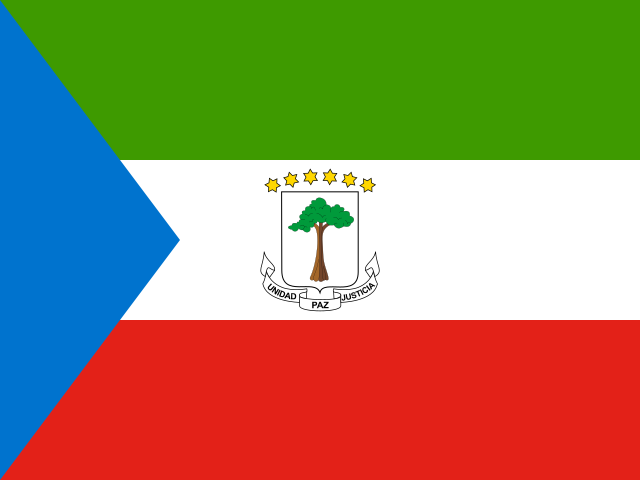 Equatorial Guinea
 Gabon
Gabon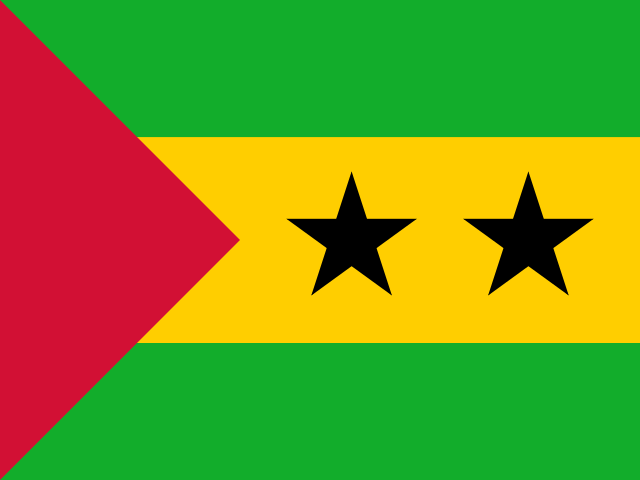 Sao Tome and Principe
Earlier Report Observations
Between 2018 and 2019, Cameroon's maize flour and cereals market remained stable near 4 million tonnes, supported by the government's import-substitution policy. This policy encouraged local processing, highlighted by the operational launch of the state-owned Société des Céréales du Cameroun (SCC) mill and the expansion of private player Maïscam, which together boosted domestic production capacity.
Market volume grew to 4.2 million tonnes in 2020, partly due to increased demand from a government-backed livestock development project that used more maize for animal feed. In the following years, rising wheat flour prices driven by global instability, including the Russia-Ukraine conflict, made locally produced maize flour a more affordable alternative, sustaining market size above 4.2 million tonnes despite inflationary pressures.
By 2024, regulatory developments aimed to further integrate local flours, with new mandatory standards for whole-maize flour and a policy mandating 15% local flour content in bakery products from 2025. These steps occurred alongside record cereal imports, underscoring the ongoing tension between import substitution and dependence on foreign supplies.
Table of content
- 1. Disclaimer
- 2. Terms of use of the report
- 3. Product codes in the statistical classifications used in the report
-
4. Key Market Indicators and Trends
-
4.1. Key Market Indicators
-
4.1.1. In kind
- 4.1.1.1. Production, 2018-2023
- 4.1.1.2. Imports, 2018-2024
- 4.1.1.3. Exports, 2018-2024
- 4.1.1.4. Market size, 2018-2023
-
4.1.1. In kind
- 4.2. Market Trends and Factors
-
4.1. Key Market Indicators
-
5. Production
-
5.1. Production in Middle Africa
- 5.1.1. Annual dynamics of production in Middle Africa in kind, 2018-2023, K t
-
5.2. Global production by Country, 2018-2023
- 5.2.1. Annual dynamics of production by macroregions in kind, 2018-2023, K t
- 5.2.2. Dynamics of production structure by macroregions in kind, 2018-2023
- 5.2.3. Annual dynamics of production by country in kind, 2018-2023, K t
- 5.2.4. Structure of production by countries in kind, 2018-2023
- 5.2.5. Dynamics of peoduction structure by countries in kind, 2018-2023
-
5.1. Production in Middle Africa
-
6. Imports
-
6.1. Imports (Direct Data*)
- 6.1.1. Imports - Total information
-
6.1.2. Imports in kind, K t
- 6.1.2.1. Annual dynamics of product's imports to Angola in kind, 2018-2024, K t
- 6.1.2.2. Dynamics of product's imports in kind to Angola by countries, 2018-2024, K t
- 6.1.2.3. Structure of product's imports in kind by countries, 2018-2024
-
6.1.3. Imports in value, M $ US
- 6.1.3.1. Annual dynamics of product's imports to Angola in value, 2018-2024, M $ US
- 6.1.3.2. Dynamics of product's imports in value to Angola by countries, 2018-2024, M $ US
- 6.1.3.3. Structure of product's imports in value by countries, 2018-2024
-
6.1.4. Average price of product's imports, $ US/t
- 6.1.4.1. Annual dynamics of average price of product's imports to Angola, 2018-2024, $ US/t
- 6.1.4.2. Dynamics of average price of product's imports to Angola by countries, 2018-2024, $ US/t
-
6.2. Imports (Mirror Data)
- 6.2.1. Imports - Total information
-
6.2.2. Imports in kind, K t
- 6.2.2.1. Annual dynamics of product's imports to Angola in kind, 2018-2024, K t
- 6.2.2.2. Dynamics of product's imports in kind to Angola by countries, 2018-2024, K t
- 6.2.2.3. Structure of product's imports in kind by countries, 2018-2024
-
6.2.3. Imports in value, M $ US
- 6.2.3.1. Annual dynamics of product's imports to Angola in value, 2018-2024, M $ US
- 6.2.3.2. Dynamics of product's imports in value to Angola by countries, 2018-2024, M $ US
- 6.2.3.3. Structure of product's imports in value by countries, 2018-2024
-
6.2.4. Average price of product's imports, $ US/t
- 6.2.4.1. Annual dynamics of average price of product's imports to Angola, 2018-2024, $ US/t
- 6.2.4.2. Dynamics of average price of product's imports to Angola by countries, 2018-2024, $ US/t
-
6.1. Imports (Direct Data*)
-
7. Exports
-
7.1. Exports (Direct Data*)
- 7.1.1. Exports - Total information
-
7.1.2. Exports in kind, K t
- 7.1.2.1. Annual dynamics of product's exports from Angola in kind, 2018-2024, K t
- 7.1.2.2. Dynamics of product's exports in kind from Angola by countries, 2018-2024, K t
- 7.1.2.3. Structure of product's exports in kind by countries, 2018-2024
-
7.1.3. Exports in value, M $ US
- 7.1.3.1. Annual dynamics of product's exports from Angola in value, 2018-2024, M $ US
- 7.1.3.2. Dynamics of product's exports in value from Angola by countries, 2018-2024, M $ US
- 7.1.3.3. Structure of product's exports in value by countries, 2018-2024
-
7.1.4. Average price of product's exports, $ US/t
- 7.1.4.1. Annual dynamics of average price of product's exports from Angola, 2018-2024, $ US/t
- 7.1.4.2. Dynamics of average price of product's exports from Angola by countries, 2018-2024, $ US/t
-
7.2. Exports (Mirror Data)
- 7.2.1. Exports - Total information
-
7.2.2. Exports in kind, K t
- 7.2.2.1. Annual dynamics of product's exports from Angola in kind, 2018-2024, K t
- 7.2.2.2. Dynamics of product's exports in kind from Angola by countries, 2018-2024, K t
- 7.2.2.3. Structure of product's exports in kind by countries, 2018-2024
-
7.2.3. Exports in value, M $ US
- 7.2.3.1. Annual dynamics of product's exports from Angola in value, 2018-2024, M $ US
- 7.2.3.2. Dynamics of product's exports in value from Angola by countries, 2018-2024, M $ US
- 7.2.3.3. Structure of product's exports in value by countries, 2018-2024
-
7.2.4. Average price of product's exports, $ US/t
- 7.2.4.1. Annual dynamics of average price of product's exports from Angola, 2018-2024, $ US/t
- 7.2.4.2. Dynamics of average price of product's exports from Angola by countries, 2018-2024, $ US/t
-
7.1. Exports (Direct Data*)
-
8. Trade balance
-
8.1. Trade balance (Direct Data)
- 8.1.1. In kind, K t
- 8.1.2. In value, M $ US
-
8.2. Trade balance (Mirror Data)
- 8.2.1. In kind, K t
- 8.2.2. In value, M $ US
-
8.1. Trade balance (Direct Data)
-
9. Top buying and selling countries, 2018-2024
-
9.1. Direct Data
- 9.1.1. Import in Value by Countries-buyers
- 9.1.2. Export in Value by Countries-suppliers
-
9.2. Mirror Data
- 9.2.1. Import in Value by Countries-buyers
- 9.2.2. Export in Value by Countries-suppliers
-
9.1. Direct Data
Production maize flour and cereals in Middle Africa
In kind, 2017-2020, K t
Top producers of maize flour and cereals, 2017-2020
World map of production of maize flour and cereals, 2017-2020
Middle Africa's production of maize flour and cereals has grown for the third year in a row. In 2019, the region produced 3 764 K t, which increased to 4 003 K t in 2020—a 6.3% rise. Looking at the period from 2017 to 2020, production grew by 11.8%, averaging an annual growth rate of 3.8%.
Annual dynamics of production in Middle Africa in kind, 2017-2020, K t
| Parameter | 2018 | 2019 | 2020 | CAGR | |
|---|---|---|---|---|---|
| 1 | Change from last year | 4.5% | 0.7% | 6.3% | 3.8% |
In value, 2017-2020, M $ US
In 2020, the value of maize flour and cereals production in Middle Africa was 1 930 M $ US, down 21.1% from 2019. Over the 2017-2020 period, production value fell by 24.2%, with an average annual decline of 8.8%. The sharpest drop occurred in 2018 at 22.6%, while 2019 saw the largest increase at 24.1%.
Annual dynamics of production in Middle Africa in value, 2017-2020, M $ US
| Parameter | 2018 | 2019 | 2020 | CAGR | |
|---|---|---|---|---|---|
| 1 | Change from last year | (22.6%) | 24.1% | (21.1%) | (8.8%) |
Exports maize flour and cereals from Middle Africa
Exports in kind, K t
Middle Africa exported 3.8 K t of maize flour and cereals in 2020, up 55.1% from 2019. From 2017 to 2020, exports rose by 78%, with an average annual growth rate of 21.2%. The biggest decline was in 2019, at 19.0%.
Annual dynamics of product's exports from Middle Africa in kind, 2017-2020, K t
| Parameter | 2018 | 2019 | 2020 | CAGR | |
|---|---|---|---|---|---|
| 1 | Change from last year | 41.8% | (19.0%) | 55.1% | 21.2% |
Between 2017 and 2020, Uganda was the main exporter of maize flour and cereals from Middle Africa in volume terms, accounting for 6.4% of total exports.
Structure of product's exports in kind by countries, 2017-2020
World map of product's exports from Middle Africa in kind, 2017-2020
Exports in value, M $ US
In 2020, Middle Africa's exports of maize flour and cereals were valued at 1.9 M $ US, a 15.1% increase from 2019. Over the 2017-2020 period, export value grew by 20.6%, with an average annual rate of 6.4%. The largest decline was in 2019, at 0.2%.
Annual dynamics of product's exports from Middle Africa in value, 2017-2020, M $ US
| Parameter | 2018 | 2019 | 2020 | CAGR | |
|---|---|---|---|---|---|
| 1 | Change from last year | 5.0% | (0.2%) | 15.1% | 6.4% |
From 2017 to 2020, Uganda led in the value of maize flour and cereals exports from Middle Africa, holding a 1.5% share of total export value.
Structure of product's exports in value by countries, 2017-2020
World map of product's exports from Middle Africa in value, 2017-2020
Imports maize flour and cereals to Middle Africa
Imports in kind, K t
Middle Africa's imports of maize flour and cereals have fallen for the third consecutive year. In 2019, imports were 245.9 K t, dropping to 232.4 K t in 2020—a moderate decline of 5.5%. Over the 2017-2020 period, imports decreased by 56.5%, with an average annual decline of 24.2%.
Annual dynamics of product's imports to Middle Africa in kind, 2017-2020, K t
| Parameter | 2018 | 2019 | 2020 | CAGR | |
|---|---|---|---|---|---|
| 1 | Change from last year | (48.9%) | (9.9%) | (5.5%) | (24.2%) |
Between 2017 and 2020, Brazil, South Africa, and Turkey were the top sources for maize flour and cereals imports to Middle Africa in volume terms, together making up 72.6% of total imports.
Structure of product's imports in kind by countries, 2017-2020
World map of product's imports to Middle Africa in kind, 2017-2020
Imports in value, M $ US
Foreign supplies of maize flour and cereals to Middle Africa have declined for the third year in a row. In 2019, imports totaled 97.2 M $ US, which fell to 91.1 M $ US in 2020—a moderate contraction of 6.3%. Over the 2017-2020 period, import value dropped by 59.5%, with an average annual decline of 26.0%.
Annual dynamics of product's imports to Middle Africa in value, 2017-2020, M $ US
| Parameter | 2018 | 2019 | 2020 | CAGR | |
|---|---|---|---|---|---|
| 1 | Change from last year | (39.4%) | (28.6%) | (6.3%) | (26.0%) |
From 2017 to 2020, Brazil (40.6% of import value), South Africa (27.3%), and Spain (6.8%) were the main sources for maize flour and cereals imports to Middle Africa in value terms, together accounting for 74.7% of total import value.
Structure of product's imports in value by countries, 2017-2020
World map of product's imports to Middle Africa in value, 2017-2020
Related Reports

Maize flour and cereals market in ASEAN
2026-03-30
Maize flour and cereals market in Pakistan
2026-03-30
Maize flour and cereals market in Caribbean
2026-03-30

Cassava starch market in Middle Africa
2026-03-28

Why Choose Us?
Only Verified Data
No Hidden Costs or Separate Fees
Smarter Subscription Pricing
Contact Our Team
Submit your inquiry using the form below — our team will get back to you within 24 hours.