






"ASEAN" region includes following countries:
 Brunei Darussalam
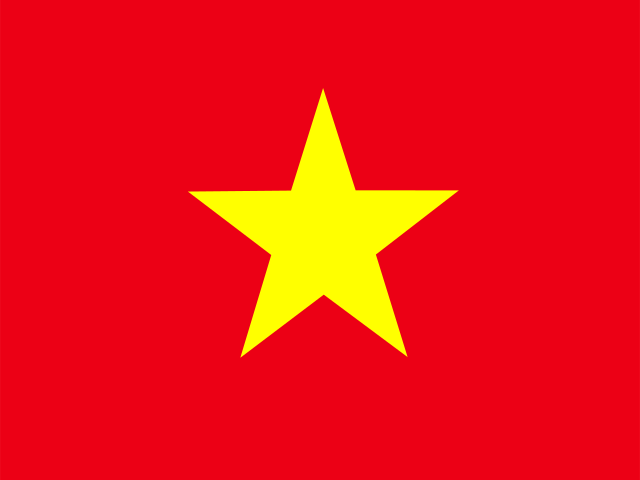 Vietnam
 Indonesia
 Cambodia
 Laos
Laos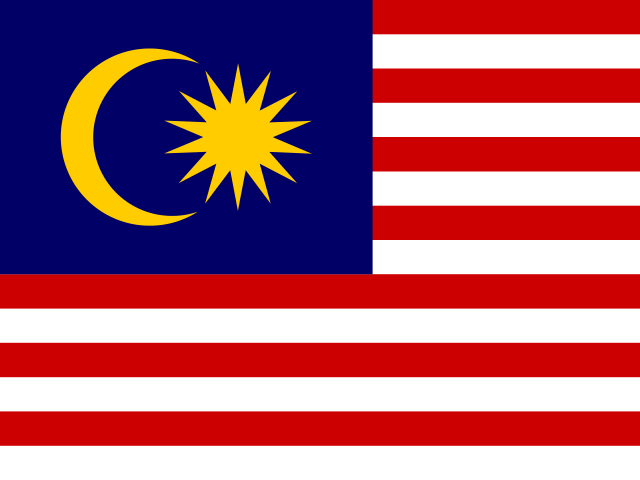 Malaysia
 Myanmar
 Singapore
 Thailand
 the Philippines
Earlier Report Observations
ASEAN's maize flour and cereals market volume grew to 8 947 thousand tonnes in 2019 from 8 009 thousand tonnes the previous year. It then halved to 4 952 thousand tonnes in 2020, as the COVID-19 pandemic caused widespread supply chain disruptions and reduced demand. The decline continued into 2021, with the market falling to 4 326 thousand tonnes.
From 2022, the market stabilized and began a modest recovery, reaching 4 458 thousand tonnes in 2023. This turnaround was driven by growing consumer preference for gluten-free and organic products, where maize flour serves as a key ingredient. Regulatory measures in many countries requiring grain fortification with vitamins and minerals further stimulated demand for enriched maize flour, while supportive government policies in the region aimed at boosting production aided market resilience.
The period also saw increased incorporation of maize flour in traditional foods, snacks, and baked goods, aligned with a shift toward plant-based diets. Extreme weather events and higher raw material costs posed challenges, but the market adapted through technological innovations in processing and a focus on sustainable agricultural practices.
Table of content
- 1. Disclaimer
- 2. Terms of use of the report
- 3. Product codes in the statistical classifications used in the report
-
4. Key Market Indicators and Trends
-
4.1. Key Market Indicators
-
4.1.1. In kind
- 4.1.1.1. Production, 2018-2023
- 4.1.1.2. Imports, 2018-2024
- 4.1.1.3. Exports, 2018-2024
- 4.1.1.4. Market size, 2018-2023
-
4.1.1. In kind
- 4.2. Market Trends and Factors
-
4.1. Key Market Indicators
-
5. Production
-
5.1. Production in ASEAN
- 5.1.1. Annual dynamics of production in ASEAN in kind, 2018-2023, K t
-
5.2. Global production by Country, 2018-2023
- 5.2.1. Annual dynamics of production by macroregions in kind, 2018-2023, K t
- 5.2.2. Dynamics of production structure by macroregions in kind, 2018-2023
- 5.2.3. Annual dynamics of production by country in kind, 2018-2023, K t
- 5.2.4. Structure of production by countries in kind, 2018-2023
- 5.2.5. Dynamics of peoduction structure by countries in kind, 2018-2023
-
5.1. Production in ASEAN
-
6. Imports
-
6.1. Imports (Direct Data*)
- 6.1.1. Imports - Total information
-
6.1.2. Imports in kind, K t
- 6.1.2.1. Annual dynamics of product's imports to Brunei Darussalam in kind, 2018-2024, K t
- 6.1.2.2. Dynamics of product's imports in kind to Brunei Darussalam by countries, 2018-2024, K t
- 6.1.2.3. Structure of product's imports in kind by countries, 2018-2024
-
6.1.3. Imports in value, M $ US
- 6.1.3.1. Annual dynamics of product's imports to Brunei Darussalam in value, 2018-2024, M $ US
- 6.1.3.2. Dynamics of product's imports in value to Brunei Darussalam by countries, 2018-2024, M $ US
- 6.1.3.3. Structure of product's imports in value by countries, 2018-2024
-
6.1.4. Average price of product's imports, $ US/t
- 6.1.4.1. Annual dynamics of average price of product's imports to Brunei Darussalam, 2018-2024, $ US/t
- 6.1.4.2. Dynamics of average price of product's imports to Brunei Darussalam by countries, 2018-2024, $ US/t
-
6.2. Imports (Mirror Data)
- 6.2.1. Imports - Total information
-
6.2.2. Imports in kind, K t
- 6.2.2.1. Annual dynamics of product's imports to Brunei Darussalam in kind, 2018-2024, K t
- 6.2.2.2. Dynamics of product's imports in kind to Brunei Darussalam by countries, 2018-2024, K t
- 6.2.2.3. Structure of product's imports in kind by countries, 2018-2024
-
6.2.3. Imports in value, M $ US
- 6.2.3.1. Annual dynamics of product's imports to Brunei Darussalam in value, 2018-2024, M $ US
- 6.2.3.2. Dynamics of product's imports in value to Brunei Darussalam by countries, 2018-2024, M $ US
- 6.2.3.3. Structure of product's imports in value by countries, 2018-2024
-
6.2.4. Average price of product's imports, $ US/t
- 6.2.4.1. Annual dynamics of average price of product's imports to Brunei Darussalam, 2018-2024, $ US/t
- 6.2.4.2. Dynamics of average price of product's imports to Brunei Darussalam by countries, 2018-2024, $ US/t
-
6.1. Imports (Direct Data*)
-
7. Exports
-
7.1. Exports (Direct Data*)
- 7.1.1. Exports - Total information
-
7.1.2. Exports in kind, K t
- 7.1.2.1. Annual dynamics of product's exports from Brunei Darussalam in kind, 2018-2024, K t
- 7.1.2.2. Dynamics of product's exports in kind from Brunei Darussalam by countries, 2018-2024, K t
- 7.1.2.3. Structure of product's exports in kind by countries, 2018-2024
-
7.1.3. Exports in value, M $ US
- 7.1.3.1. Annual dynamics of product's exports from Brunei Darussalam in value, 2018-2024, M $ US
- 7.1.3.2. Dynamics of product's exports in value from Brunei Darussalam by countries, 2018-2024, M $ US
- 7.1.3.3. Structure of product's exports in value by countries, 2018-2024
-
7.1.4. Average price of product's exports, $ US/t
- 7.1.4.1. Annual dynamics of average price of product's exports from Brunei Darussalam, 2018-2024, $ US/t
- 7.1.4.2. Dynamics of average price of product's exports from Brunei Darussalam by countries, 2018-2024, $ US/t
-
7.2. Exports (Mirror Data)
- 7.2.1. Exports - Total information
-
7.2.2. Exports in kind, K t
- 7.2.2.1. Annual dynamics of product's exports from Brunei Darussalam in kind, 2018-2024, K t
- 7.2.2.2. Dynamics of product's exports in kind from Brunei Darussalam by countries, 2018-2024, K t
- 7.2.2.3. Structure of product's exports in kind by countries, 2018-2024
-
7.2.3. Exports in value, M $ US
- 7.2.3.1. Annual dynamics of product's exports from Brunei Darussalam in value, 2018-2024, M $ US
- 7.2.3.2. Dynamics of product's exports in value from Brunei Darussalam by countries, 2018-2024, M $ US
- 7.2.3.3. Structure of product's exports in value by countries, 2018-2024
-
7.2.4. Average price of product's exports, $ US/t
- 7.2.4.1. Annual dynamics of average price of product's exports from Brunei Darussalam, 2018-2024, $ US/t
- 7.2.4.2. Dynamics of average price of product's exports from Brunei Darussalam by countries, 2018-2024, $ US/t
-
7.1. Exports (Direct Data*)
-
8. Trade balance
-
8.1. Trade balance (Direct Data)
- 8.1.1. In kind, K t
- 8.1.2. In value, M $ US
-
8.2. Trade balance (Mirror Data)
- 8.2.1. In kind, K t
- 8.2.2. In value, M $ US
-
8.1. Trade balance (Direct Data)
-
9. Top buying and selling countries, 2018-2024
-
9.1. Direct Data
- 9.1.1. Import in Value by Countries-buyers
- 9.1.2. Export in Value by Countries-suppliers
-
9.2. Mirror Data
- 9.2.1. Import in Value by Countries-buyers
- 9.2.2. Export in Value by Countries-suppliers
-
9.1. Direct Data
Production maize flour and cereals in ASEAN
In kind, 2017-2020, K t
Top producers of maize flour and cereals, 2017-2020
World map of production of maize flour and cereals, 2017-2020
ASEAN's production of maize flour and cereals saw a two-year increase before declining. In 2019, production peaked at 8 833 thousand tons. However, by 2020, it had dropped to 4 841 thousand tons, marking a significant 45.2% decrease from the previous year. Over the period from 2017 to 2020, overall production fell by 31.5%, which translates to an average annual decline of 11.8%. The largest year-on-year increase occurred in 2018, with a growth of 12.1%.
Annual dynamics of production in ASEAN in kind, 2017-2020, K t
| Parameter | 2018 | 2019 | 2020 | CAGR | |
|---|---|---|---|---|---|
| 1 | Change from last year | 12.1% | 11.6% | (45.2%) | (11.8%) |
Exports maize flour and cereals from ASEAN
Exports in kind, K t
The market exhibited volatility during the observed period. Exports reached their lowest point in 2017 and peaked in 2020, with volumes varying by a factor of 1.9 between these years. In 2020, ASEAN's exports of maize flour and cereals amounted to 197.1 thousand tons, representing a 16.8% increase compared to the previous year. The largest decline was recorded in 2019 at 7.4%, while the most substantial increase occurred in 2018, with a surge of 79.2%.
Annual dynamics of product's exports from ASEAN in kind, 2017-2020, K t
| Parameter | 2018 | 2019 | 2020 | CAGR | |
|---|---|---|---|---|---|
| 1 | Change from last year | 79.2% | (7.4%) | 16.8% | 24.7% |
From 2017 to 2020, the export structure for maize flour and cereals from ASEAN was balanced rather than concentrated. China accounted for 11.9% of exports in kind, Japan for 10.9%, and Hong Kong for 7.4%. Together, these three partners represented 30.2% of total export flows, with the remaining 69.8% distributed among numerous other countries.
Structure of product's exports in kind by countries, 2017-2020
World map of product's exports from ASEAN in kind, 2017-2020
Exports in value, M $ US
ASEAN's exports of maize flour and cereals in value terms increased for the third consecutive year. In 2020, exports reached 201.3 million US dollars, showing a strong improvement of 13.5% over the previous year. Between 2017 and 2020, exports grew by 44%, equivalent to an annualized rate of 12.9%.
Annual dynamics of product's exports from ASEAN in value, 2017-2020, M $ US
| Parameter | 2018 | 2019 | 2020 | CAGR | |
|---|---|---|---|---|---|
| 1 | Change from last year | 20.7% | 5.2% | 13.5% | 12.9% |
Between 2017 and 2020, the value of maize flour and cereals exports from ASEAN was widely dispersed across partner countries. Japan accounted for 12.4% of exports in value terms, China for 11.6%, and Hong Kong for 7.9%. Collectively, these three countries represented only 31.9% of total export flows, indicating a diverse market distribution.
Structure of product's exports in value by countries, 2017-2020
World map of product's exports from ASEAN in value, 2017-2020
Imports maize flour and cereals to ASEAN
Imports in kind, K t
ASEAN's imports of maize flour and cereals in volume terms increased for the third year in a row. In 2020, imports were recorded at 308.0 thousand tons, up by 9.0% year-on-year. From 2017 to 2020, imports rose by 31.5%, which corresponds to an annualized growth rate of 9.6%.
Annual dynamics of product's imports to ASEAN in kind, 2017-2020, K t
| Parameter | 2018 | 2019 | 2020 | CAGR | |
|---|---|---|---|---|---|
| 1 | Change from last year | 16.5% | 3.6% | 9.0% | 9.6% |
Throughout 2017 to 2020, Argentina, Brazil, and India played leading roles in ASEAN's imports of maize flour and cereals in kind. Argentina accounted for 42.2% of imports, Brazil for 11.4%, and India for 7.2%. Together, these three countries accounted for 60.7% of total import flows.
Structure of product's imports in kind by countries, 2017-2020
World map of product's imports to ASEAN in kind, 2017-2020
Imports in value, M $ US
In 2020, ASEAN's imports of maize flour and cereals in value terms were recorded at 149.7 million US dollars, showing a strong gain of 13.1% compared to the previous year. Between 2017 and 2020, imports increased by 30.9%, equating to an annualized rate of 9.4%. The largest decline occurred in 2019 at 1.6%, while the most significant increase was in 2018, with a rise of 17.6%.
Annual dynamics of product's imports to ASEAN in value, 2017-2020, M $ US
| Parameter | 2018 | 2019 | 2020 | CAGR | |
|---|---|---|---|---|---|
| 1 | Change from last year | 17.6% | (1.6%) | 13.1% | 9.4% |
From 2017 to 2020, the country structure of ASEAN's imports in value terms was highly diversified. Argentina accounted for 19.8% of imports, China for 8.6%, and India for 6.3%. Together, these three countries represented only 34.8% of total import flows, with the remaining 65.2% spread across a long tail of smaller markets.
Structure of product's imports in value by countries, 2017-2020
World map of product's imports to ASEAN in value, 2017-2020
Related Reports

Maize flour and cereals market in Belgium
2026-03-30
Maize flour and cereals market in ECOWAS
2026-03-30
Maize flour and cereals market in Bulgaria
2026-03-30

2026-03-28


2026-03-28
Why Choose Us?
Only Verified Data
No Hidden Costs or Separate Fees
Smarter Subscription Pricing
Contact Our Team
Submit your inquiry using the form below — our team will get back to you within 24 hours.