






"Caribbean" region includes following countries:
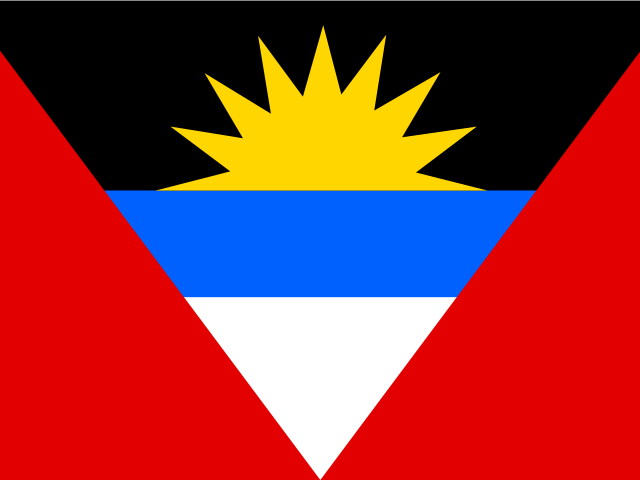 Antigua and Barbuda
 the Bahamas
 Barbados
 British Virgin Islands
 Cayman Islands
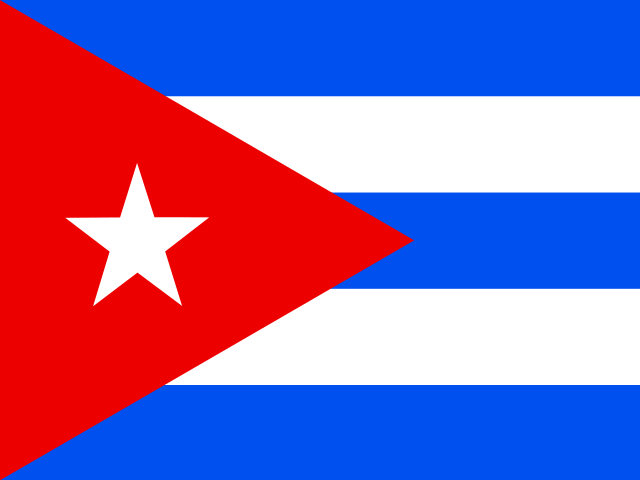 Cuba
Cuba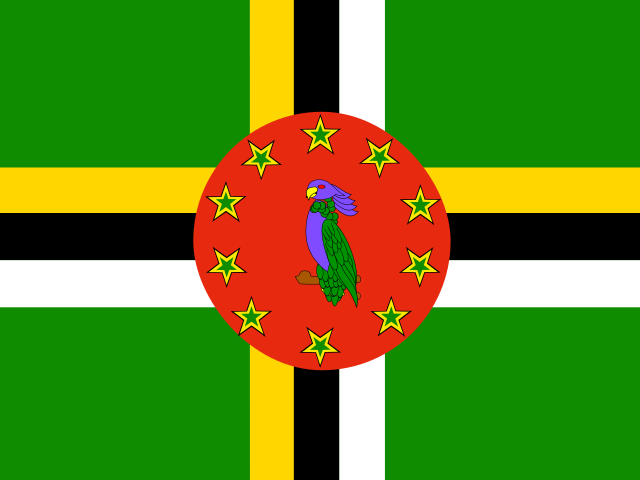 Dominica
 Dominican Republic
 Grenada
 Guadeloupe
 Haiti
Haiti Jamaica
 Martinique
 Montserrat
 Curacao
 Aruba
Aruba Saint Maarten (Dutch part)
 Bonaire
 Puerto Rico
 Saint Kitts and Nevis
 Anguilla
 Saint Lucia
 Saint-Martin (French Part)
 Saint Vincent and the Grenadines
 Trinidad and Tobago
 Turks and Caicos Islands
 United States Virgin Islands
Earlier Report Observations
The maize flour and cereals market in the Caribbean began the period at a volume of 334 thousand tonnes in 2018. Local industry structure played a role, with producers like NFM and Nutrimix in Trinidad and Tobago collaborating to maintain supply chain continuity and food security, while maize flour remained a dietary staple in the region. Market volume then contracted significantly, falling to 221 thousand tonnes by 2020.
A partial recovery occurred in the following years, with volume reaching 272 thousand tonnes in 2022 before moderating to 257 thousand tonnes in 2023. In the later part of the period, the market was affected by rising global wheat prices and increased shipping costs, prompting price adjustments from major millers. Concurrently, worldwide health and wellness trends began promoting demand for enriched and functional flour varieties, influencing the broader market environment.
Table of content
- 1. Disclaimer
- 2. Terms of use of the report
- 3. Product codes in the statistical classifications used in the report
-
4. Key Market Indicators and Trends
-
4.1. Key Market Indicators
-
4.1.1. In kind
- 4.1.1.1. Production, 2018-2023
- 4.1.1.2. Imports, 2018-2024
- 4.1.1.3. Exports, 2018-2024
- 4.1.1.4. Market size, 2018-2023
-
4.1.2. In value
- 4.1.2.1. Production, 2018-2023
- 4.1.2.2. Imports, 2018-2024
- 4.1.2.3. Exports, 2018-2024
- 4.1.2.4. Market size, 2018-2023
-
4.1.1. In kind
- 4.2. Market Trends and Factors
-
4.1. Key Market Indicators
-
5. Production
-
5.1. Production in Caribbean
- 5.1.1. Annual dynamics of production in Caribbean in kind, 2018-2023, K t
-
5.2. Global production by Country, 2018-2023
- 5.2.1. Annual dynamics of production by macroregions in kind, 2018-2023, K t
- 5.2.2. Dynamics of production structure by macroregions in kind, 2018-2023
- 5.2.3. Annual dynamics of production by country in kind, 2018-2023, K t
- 5.2.4. Structure of production by countries in kind, 2018-2023
- 5.2.5. Dynamics of peoduction structure by countries in kind, 2018-2023
-
5.1. Production in Caribbean
-
6. Imports
-
6.1. Imports (Direct Data*)
- 6.1.1. Imports - Total information
-
6.1.2. Imports in kind, t
- 6.1.2.1. Annual dynamics of product's imports to Antigua and Barbuda in kind, 2018-2024, t
- 6.1.2.2. Dynamics of product's imports in kind to Antigua and Barbuda by countries, 2018-2024, t
- 6.1.2.3. Structure of product's imports in kind by countries, 2018-2024
-
6.1.3. Imports in value, K $ US
- 6.1.3.1. Annual dynamics of product's imports to Antigua and Barbuda in value, 2018-2024, K $ US
- 6.1.3.2. Dynamics of product's imports in value to Antigua and Barbuda by countries, 2018-2024, K $ US
- 6.1.3.3. Structure of product's imports in value by countries, 2018-2024
-
6.1.4. Average price of product's imports, $ US/t
- 6.1.4.1. Annual dynamics of average price of product's imports to Antigua and Barbuda, 2018-2024, $ US/t
- 6.1.4.2. Dynamics of average price of product's imports to Antigua and Barbuda by countries, 2018-2024, $ US/t
-
6.2. Imports (Mirror Data)
- 6.2.1. Imports - Total information
-
6.2.2. Imports in kind, t
- 6.2.2.1. Annual dynamics of product's imports to Antigua and Barbuda in kind, 2018-2024, t
- 6.2.2.2. Dynamics of product's imports in kind to Antigua and Barbuda by countries, 2018-2024, t
- 6.2.2.3. Structure of product's imports in kind by countries, 2018-2024
-
6.2.3. Imports in value, K $ US
- 6.2.3.1. Annual dynamics of product's imports to Antigua and Barbuda in value, 2018-2024, K $ US
- 6.2.3.2. Dynamics of product's imports in value to Antigua and Barbuda by countries, 2018-2024, K $ US
- 6.2.3.3. Structure of product's imports in value by countries, 2018-2024
-
6.2.4. Average price of product's imports, $ US/t
- 6.2.4.1. Annual dynamics of average price of product's imports to Antigua and Barbuda, 2018-2024, $ US/t
- 6.2.4.2. Dynamics of average price of product's imports to Antigua and Barbuda by countries, 2018-2024, $ US/t
-
6.1. Imports (Direct Data*)
-
7. Exports
-
7.1. Exports (Direct Data*)
- 7.1.1. Exports - Total information
-
7.1.2. Exports in kind, t
- 7.1.2.1. Annual dynamics of product's exports from Antigua and Barbuda in kind, 2018-2024, t
- 7.1.2.2. Dynamics of product's exports in kind from Antigua and Barbuda by countries, 2018-2024, t
- 7.1.2.3. Structure of product's exports in kind by countries, 2018-2024
-
7.1.3. Exports in value, K $ US
- 7.1.3.1. Annual dynamics of product's exports from Antigua and Barbuda in value, 2018-2024, K $ US
- 7.1.3.2. Dynamics of product's exports in value from Antigua and Barbuda by countries, 2018-2024, K $ US
- 7.1.3.3. Structure of product's exports in value by countries, 2018-2024
-
7.1.4. Average price of product's exports, $ US/t
- 7.1.4.1. Annual dynamics of average price of product's exports from Antigua and Barbuda, 2018-2024, $ US/t
- 7.1.4.2. Dynamics of average price of product's exports from Antigua and Barbuda by countries, 2018-2024, $ US/t
-
7.2. Exports (Mirror Data)
- 7.2.1. Exports - Total information
-
7.2.2. Exports in kind, t
- 7.2.2.1. Annual dynamics of product's exports from Antigua and Barbuda in kind, 2018-2024, t
- 7.2.2.2. Dynamics of product's exports in kind from Antigua and Barbuda by countries, 2018-2024, t
- 7.2.2.3. Structure of product's exports in kind by countries, 2018-2024
-
7.2.3. Exports in value, K $ US
- 7.2.3.1. Annual dynamics of product's exports from Antigua and Barbuda in value, 2018-2024, K $ US
- 7.2.3.2. Dynamics of product's exports in value from Antigua and Barbuda by countries, 2018-2024, K $ US
- 7.2.3.3. Structure of product's exports in value by countries, 2018-2024
-
7.2.4. Average price of product's exports, $ US/t
- 7.2.4.1. Annual dynamics of average price of product's exports from Antigua and Barbuda, 2018-2024, $ US/t
- 7.2.4.2. Dynamics of average price of product's exports from Antigua and Barbuda by countries, 2018-2024, $ US/t
-
7.1. Exports (Direct Data*)
-
8. Trade balance
-
8.1. Trade balance (Direct Data)
- 8.1.1. In kind, t
- 8.1.2. In value, K $ US
-
8.2. Trade balance (Mirror Data)
- 8.2.1. In kind, t
- 8.2.2. In value, K $ US
-
8.1. Trade balance (Direct Data)
-
9. Top buying and selling countries, 2018-2024
-
9.1. Direct Data
- 9.1.1. Import in Value by Countries-buyers
- 9.1.2. Export in Value by Countries-suppliers
-
9.2. Mirror Data
- 9.2.1. Import in Value by Countries-buyers
- 9.2.2. Export in Value by Countries-suppliers
-
9.1. Direct Data
Production maize flour and cereals in Caribbean
In kind, 2017-2020, K t
Top producers of maize flour and cereals, 2017-2020
World map of production of maize flour and cereals, 2017-2020
Maize flour and cereals production in the Caribbean declined for the third consecutive year. In 2020, 173.2 thousand tonnes were produced, representing a steep 34.0% year-over-year reduction. From 2017 to 2020, production decreased by 54.9%, with a compound annual growth rate of -23.3%.
Annual dynamics of production in Caribbean in kind, 2017-2020, K t
| Parameter | 2018 | 2019 | 2020 | CAGR | |
|---|---|---|---|---|---|
| 1 | Change from last year | (16.6%) | (18.0%) | (34.0%) | (23.3%) |
In value, 2017-2020, M $ US
The value of maize flour and cereals production in the Caribbean also fell for the third straight year. In 2020, output was valued at 371 million US dollars, which is 50.5% lower than the previous year. Between 2017 and 2020, production value decreased by 68.3%, with a compound annual growth rate of -31.8%.
Annual dynamics of production in Caribbean in value, 2017-2020, M $ US
| Parameter | 2018 | 2019 | 2020 | CAGR | |
|---|---|---|---|---|---|
| 1 | Change from last year | (27.9%) | (11.2%) | (50.5%) | (31.8%) |
Exports maize flour and cereals from Caribbean
Exports in kind, t
Export volumes showed significant volatility during this period. The lowest volume was recorded in 2017, while the highest was in 2018, creating a 3.7-fold difference between these years. In 2020, maize flour and cereals exports from the Caribbean amounted to 26 548 tonnes, marking a slight decrease of 2.7% compared to 2019. The largest decline occurred in 2019 at 20.0%, while the most substantial increase was in 2018 at 267.9%.
Annual dynamics of product's exports from Caribbean in kind, 2017-2020, t
| Parameter | 2018 | 2019 | 2020 | CAGR | |
|---|---|---|---|---|---|
| 1 | Change from last year | 267.9% | (20.0%) | (2.7%) | 42.0% |
From 2017 to 2020, Guatemala (8.6% of export volume), Honduras (7.7%), and El Salvador (0.6%) together accounted for 16.9% of total maize flour and cereals exports from the Caribbean, remaining the primary destinations.
Structure of product's exports in kind by countries, 2017-2020
World map of product's exports from Caribbean in kind, 2017-2020
Exports in value, K $ US
The value of maize flour and cereals exports from the Caribbean increased for the second consecutive year. In 2020, exports reached 21 782 thousand US dollars, showing a 3.9% uptick compared to the previous year. However, over the 2017-2020 period, export value decreased by 5%, with a compound annual growth rate of -1.7%. The lowest value was recorded in 2018 at 18 440 thousand US dollars, which also saw the largest decline of 19.6%. The most significant increase occurred in 2019 at 13.7%.
Annual dynamics of product's exports from Caribbean in value, 2017-2020, K $ US
| Parameter | 2018 | 2019 | 2020 | CAGR | |
|---|---|---|---|---|---|
| 1 | Change from last year | (19.6%) | 13.7% | 3.9% | (1.7%) |
Throughout 2017-2020, Guatemala (7.4% of export value), Honduras (7.3%), and Guyana (1.4%) remained the main markets for maize flour and cereals exports from the Caribbean, jointly accounting for 16.1% of total export value.
Structure of product's exports in value by countries, 2017-2020
World map of product's exports from Caribbean in value, 2017-2020
Imports maize flour and cereals to Caribbean
Imports in kind, t
Imports of maize flour and cereals into the Caribbean increased for the second consecutive year. In 2020, imports totaled 74 487 tonnes, representing a significant 12.9% increase compared to 2019. Over the 2017-2020 period, import volume grew by 11.3%, with a compound annual growth rate of 3.6%. The lowest volume was recorded in 2018 at 48 117 tonnes, which also experienced the largest decline of 28.1%. The most substantial increase occurred in 2019 at 37.1%.
Annual dynamics of product's imports to Caribbean in kind, 2017-2020, t
| Parameter | 2018 | 2019 | 2020 | CAGR | |
|---|---|---|---|---|---|
| 1 | Change from last year | (28.1%) | 37.1% | 12.9% | 3.6% |
The import structure for maize flour and cereals in the Caribbean remained fragmented from 2017 to 2020. The United States (27.5% of import volume), Brazil (8.8%), and Turkey (6.2%) together accounted for only 42.5% of total imports, with no single country holding a dominant share.
Structure of product's imports in kind by countries, 2017-2020
World map of product's imports to Caribbean in kind, 2017-2020
Imports in value, K $ US
The value of maize flour and cereals imports into the Caribbean rose for the second consecutive year. In 2020, imports were valued at 45 669 thousand US dollars, indicating a significant 14.0% year-over-year increase. Between 2017 and 2020, import value grew by 14.3%, with a compound annual growth rate of 4.6%. The lowest value was recorded in 2018 at 35 057 thousand US dollars, which saw a decline of 12.3%. The largest increase occurred in 2019 at 14.3%.
Annual dynamics of product's imports to Caribbean in value, 2017-2020, K $ US
| Parameter | 2018 | 2019 | 2020 | CAGR | |
|---|---|---|---|---|---|
| 1 | Change from last year | (12.3%) | 14.3% | 14.0% | 4.6% |
From 2017 to 2020, no single country dominated maize flour and cereals imports into the Caribbean. The United States (36.6% of import value), Brazil (7.5%), and Turkey (3.4%) together accounted for only 47.5% of total import value, while numerous smaller partners each held modest individual shares.
Structure of product's imports in value by countries, 2017-2020
World map of product's imports to Caribbean in value, 2017-2020
Related Reports

Maize flour and cereals market in Paraguay
2026-03-30

Cereal germ market in Caribbean
2026-03-28


Dried shelled legumes market in Caribbean
2026-03-27
Why Choose Us?
Only Verified Data
No Hidden Costs or Separate Fees
Smarter Subscription Pricing
Contact Our Team
Submit your inquiry using the form below — our team will get back to you within 24 hours.