






"Middle Africa" region includes following countries:
 Angola
 Cameroon
 Central African Republic
 Chad
Chad Congo
Congo Democratic Republic of the Congo
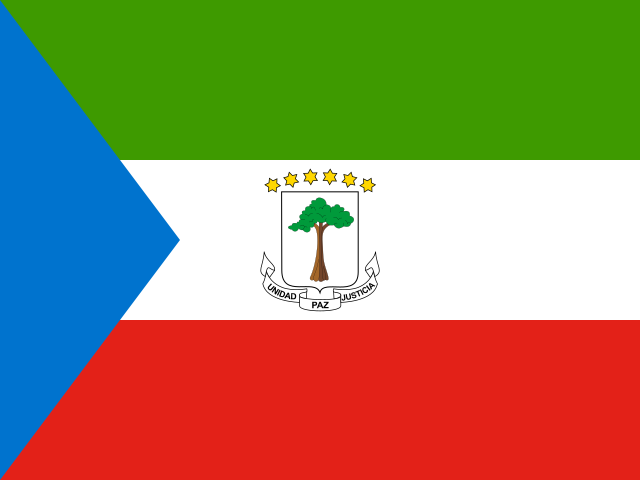 Equatorial Guinea
 Gabon
Gabon Sao Tome and Principe
Earlier Report Observations
Cassava starch production in Middle Africa remained stable at around 7 444 t in 2018 and 2019, as the extraction industry was still underdeveloped despite cassava's growing recognition as a high-value agricultural raw material for starch, cardboard, and plywood. A gradual tariff elimination for certain EU goods, initiated in August 2017 and extending to starch by January 2021, began reshaping market access and local competition.
Output expanded to 8 963 t in 2020, supported by cassava's role as a key subsistence and industrial crop in Cameroon, providing a reliable raw material base. Production continued its upward trend, reaching 10 007 t by 2023, while domestic market volume fluctuated—declining to 7 121 t in 2022 before recovering to 8 888 t in 2023.
The industry's development accelerated in 2024 with the inauguration of a cassava processing plant in Ngoulemakong, the first of eight planned facilities, equipped to produce starch, tapioca, and bread-making flour. Government-led diagnostic studies, strategic action plans, and identified investment opportunities for new players aim to strengthen the entire cassava starch value chain.
Table of content
- 1. Disclaimer
- 2. Terms of use of the report
- 3. Product codes in the statistical classifications used in the report
-
4. Key Market Indicators and Trends
-
4.1. Key Market Indicators
-
4.1.1. In kind
- 4.1.1.1. Production, 2018-2023
- 4.1.1.2. Imports, 2018-2024
- 4.1.1.3. Exports, 2018-2024
- 4.1.1.4. Market size, 2018-2023
-
4.1.1. In kind
- 4.2. Market Trends and Factors
-
4.1. Key Market Indicators
-
5. Production
-
5.1. Production in Middle Africa
- 5.1.1. Annual dynamics of production in Middle Africa in kind, 2018-2023, t
-
5.2. Global production by Country, 2018-2023
- 5.2.1. Annual dynamics of production by macroregions in kind, 2018-2023, t
- 5.2.2. Dynamics of production structure by macroregions in kind, 2018-2023
- 5.2.3. Annual dynamics of production by country in kind, 2018-2023, t
- 5.2.4. Structure of production by countries in kind, 2018-2023
- 5.2.5. Dynamics of peoduction structure by countries in kind, 2018-2023
-
5.1. Production in Middle Africa
-
6. Imports
-
6.1. Imports (Direct Data*)
- 6.1.1. Imports - Total information
-
6.1.2. Imports in kind, t
- 6.1.2.1. Annual dynamics of product's imports to Angola in kind, 2018-2024, t
- 6.1.2.2. Dynamics of product's imports in kind to Angola by countries, 2018-2024, t
- 6.1.2.3. Structure of product's imports in kind by countries, 2018-2024
-
6.1.3. Imports in value, K $ US
- 6.1.3.1. Annual dynamics of product's imports to Angola in value, 2018-2024, K $ US
- 6.1.3.2. Dynamics of product's imports in value to Angola by countries, 2018-2024, K $ US
- 6.1.3.3. Structure of product's imports in value by countries, 2018-2024
-
6.1.4. Average price of product's imports, $ US/t
- 6.1.4.1. Annual dynamics of average price of product's imports to Angola, 2018-2024, $ US/t
- 6.1.4.2. Dynamics of average price of product's imports to Angola by countries, 2018-2024, $ US/t
-
6.2. Imports (Mirror Data)
- 6.2.1. Imports - Total information
-
6.2.2. Imports in kind, t
- 6.2.2.1. Annual dynamics of product's imports to Angola in kind, 2018-2024, t
- 6.2.2.2. Dynamics of product's imports in kind to Angola by countries, 2018-2024, t
- 6.2.2.3. Structure of product's imports in kind by countries, 2018-2024
-
6.2.3. Imports in value, K $ US
- 6.2.3.1. Annual dynamics of product's imports to Angola in value, 2018-2024, K $ US
- 6.2.3.2. Dynamics of product's imports in value to Angola by countries, 2018-2024, K $ US
- 6.2.3.3. Structure of product's imports in value by countries, 2018-2024
-
6.2.4. Average price of product's imports, $ US/t
- 6.2.4.1. Annual dynamics of average price of product's imports to Angola, 2018-2024, $ US/t
- 6.2.4.2. Dynamics of average price of product's imports to Angola by countries, 2018-2024, $ US/t
-
6.1. Imports (Direct Data*)
-
7. Exports
-
7.1. Exports (Direct Data*)
- 7.1.1. Exports - Total information
-
7.1.2. Exports in kind, t
- 7.1.2.1. Annual dynamics of product's exports from Angola in kind, 2018-2024, t
- 7.1.2.2. Dynamics of product's exports in kind from Angola by countries, 2018-2024, t
- 7.1.2.3. Structure of product's exports in kind by countries, 2018-2024
-
7.1.3. Exports in value, K $ US
- 7.1.3.1. Annual dynamics of product's exports from Angola in value, 2018-2024, K $ US
- 7.1.3.2. Dynamics of product's exports in value from Angola by countries, 2018-2024, K $ US
- 7.1.3.3. Structure of product's exports in value by countries, 2018-2024
-
7.1.4. Average price of product's exports, $ US/t
- 7.1.4.1. Annual dynamics of average price of product's exports from Angola, 2018-2024, $ US/t
- 7.1.4.2. Dynamics of average price of product's exports from Angola by countries, 2018-2024, $ US/t
-
7.2. Exports (Mirror Data)
- 7.2.1. Exports - Total information
-
7.2.2. Exports in kind, t
- 7.2.2.1. Annual dynamics of product's exports from Angola in kind, 2018-2024, t
- 7.2.2.2. Dynamics of product's exports in kind from Angola by countries, 2018-2024, t
- 7.2.2.3. Structure of product's exports in kind by countries, 2018-2024
-
7.2.3. Exports in value, K $ US
- 7.2.3.1. Annual dynamics of product's exports from Angola in value, 2018-2024, K $ US
- 7.2.3.2. Dynamics of product's exports in value from Angola by countries, 2018-2024, K $ US
- 7.2.3.3. Structure of product's exports in value by countries, 2018-2024
-
7.2.4. Average price of product's exports, $ US/t
- 7.2.4.1. Annual dynamics of average price of product's exports from Angola, 2018-2024, $ US/t
- 7.2.4.2. Dynamics of average price of product's exports from Angola by countries, 2018-2024, $ US/t
-
7.1. Exports (Direct Data*)
-
8. Trade balance
-
8.1. Trade balance (Direct Data)
- 8.1.1. In kind, t
- 8.1.2. In value, K $ US
-
8.2. Trade balance (Mirror Data)
- 8.2.1. In kind, t
- 8.2.2. In value, K $ US
-
8.1. Trade balance (Direct Data)
-
9. Top buying and selling countries, 2018-2024
-
9.1. Direct Data
- 9.1.1. Import in Value by Countries-buyers
- 9.1.2. Export in Value by Countries-suppliers
-
9.2. Mirror Data
- 9.2.1. Import in Value by Countries-buyers
- 9.2.2. Export in Value by Countries-suppliers
-
9.1. Direct Data
Production cassava starch in Middle Africa
In kind, 2017-2020, t
Top producers of cassava starch, 2017-2020
World map of production of cassava starch, 2017-2020
In 2020, Middle Africa produced 8,963 tons of cassava starch, marking a 20.4% increase from the previous year. Looking at the period from 2017 to 2020, production grew by 28.4%, which translates to an annualized growth rate of 8.7%. The smallest change occurred in 2019, with production remaining stable.
Annual dynamics of production in Middle Africa in kind, 2017-2020, t
| Parameter | 2018 | 2019 | 2020 | CAGR | |
|---|---|---|---|---|---|
| 1 | Change from last year | 6.7% | 0.0% | 20.4% | 8.7% |
Exports cassava starch from Middle Africa
Exports in kind, t
The data shows irregular fluctuations, pointing to a volatile market environment. Exports reached their lowest point in 2018 at 170 tons and peaked in 2020 at 1,001 tons, representing a 5.9-fold difference between these years. In 2020, Middle Africa's cassava starch export volume surged by 102.7% compared to the previous year. The largest decline was recorded in 2018 at 4.5%, while the most significant increase occurred in 2019 with a jump of 190.7%.
Annual dynamics of product's exports from Middle Africa in kind, 2017-2020, t
| Parameter | 2018 | 2019 | 2020 | CAGR | |
|---|---|---|---|---|---|
| 1 | Change from last year | (4.5%) | 190.7% | 102.7% | 77.8% |
From 2017 to 2020, the geographical structure of exports in kind was highly diversified. Belgium accounted for 22.2% of exports, the United States for 14.5%, and Canada for 12.6%, together making up only 49.4% of total flows. The remaining 50.6% was distributed among numerous smaller partner countries.
Structure of product's exports in kind by countries, 2017-2020
World map of product's exports from Middle Africa in kind, 2017-2020
Exports in value, K $ US
Middle Africa's cassava starch export value increased for the third consecutive year. In 2020, export value reached 567.1 thousand US dollars, showing a dramatic gain of 181.2% compared to 2019. Between 2017 and 2020, exports grew by 917.1%, equating to an annualized rate of 116.7%.
Annual dynamics of product's exports from Middle Africa in value, 2017-2020, K $ US
| Parameter | 2018 | 2019 | 2020 | CAGR | |
|---|---|---|---|---|---|
| 1 | Change from last year | 10.7% | 226.8% | 181.2% | 116.7% |
During 2017–2020, exports in value terms of cassava starch from Middle Africa were spread relatively evenly. Canada accounted for 15.1% of exports, the United States for 14.6%, and Belgium for 12.2%, jointly representing only 41.9% of total flows.
Structure of product's exports in value by countries, 2017-2020
World map of product's exports from Middle Africa in value, 2017-2020
Imports cassava starch to Middle Africa
Imports in kind, t
Volatility characterized the market behavior during these years. Imports bottomed in 2017 and peaked in 2019, changing by 28-fold over this period. In 2020, Middle Africa's cassava starch import volume amounted to 50 tons, reflecting a steep reduction of 78.6% compared to 2019. The maximum value was recorded in 2019 at 232 tons, with the largest increase occurring that same year at 552.4%.
Annual dynamics of product's imports to Middle Africa in kind, 2017-2020, t
| Parameter | 2018 | 2019 | 2020 | CAGR | |
|---|---|---|---|---|---|
| 1 | Change from last year | 330.4% | 552.4% | (78.6%) | 81.8% |
Over 2017–2020, Uganda, Rwanda, and Israel consistently held leading positions in the country structure of imports in kind. Uganda accounted for 48.5% of imports, Rwanda for 19.1%, and Israel for 10.5%, jointly making up 78.2% of total flows.
Structure of product's imports in kind by countries, 2017-2020
World map of product's imports to Middle Africa in kind, 2017-2020
Imports in value, K $ US
The market showed signs of volatility over the observed period. Imports varied by 8.4 times from a low in 2017 to a high in 2019. In 2020, Middle Africa's cassava starch import value was recorded at 33.3 thousand US dollars, which is 52.9% smaller than the previous year. The maximum value was in 2019 at 70.7 thousand US dollars, with the largest increase recorded in 2018 at 235.8%.
Annual dynamics of product's imports to Middle Africa in value, 2017-2020, K $ US
| Parameter | 2018 | 2019 | 2020 | CAGR | |
|---|---|---|---|---|---|
| 1 | Change from last year | 235.8% | 149.9% | (52.9%) | 58.2% |
Throughout 2017–2020, Uganda, Brazil, and Israel remained the main markets for imports in value terms of cassava starch to Middle Africa. Uganda accounted for 23.5% of imports, Brazil for 20.4%, and Israel for 18.3%, jointly taking 62.1% of total flows.
Structure of product's imports in value by countries, 2017-2020
World map of product's imports to Middle Africa in value, 2017-2020
Related Reports

Cassava starch market in Paraguay
2026-03-28
2026-03-28
Cassava starch market in Eastern Africa
2026-03-28
Cassava starch market in China
2026-03-28



Cereal germ market in Middle Africa
2026-03-28
Why Choose Us?
Only Verified Data
No Hidden Costs or Separate Fees
Smarter Subscription Pricing
Contact Our Team
Submit your inquiry using the form below — our team will get back to you within 24 hours.