






"Sub-Saharan Africa" region includes following countries:
 Cabo Verde
 Benin
Benin Gambia
 Ghana
Ghana Guinea
 Côte d'Ivoire
 Liberia
 Mali
Mali Mauritania
 Niger
Niger Nigeria
 Guinea-Bissau
 Saint Helena, Ascension and Tristan da Cunha
 Senegal
 Sierra Leone
 Togo
Togo Burkina Faso
 British Indian Ocean Territory
 Burundi
 Comoros
 Mayotte
 Ethiopia
 Eritrea
 French Southern Territories
 Djibouti
 Kenya
Kenya Madagascar
 Malawi
 Mauritius
 Mozambique
 Reunion
 Rwanda
 Seychelles
 Somalia
 Zimbabwe
 South Sudan
 Uganda
 Tanzania
 Zambia
 Angola
 Cameroon
 Central African Republic
 Chad
Chad Congo
Congo Democratic Republic of the Congo
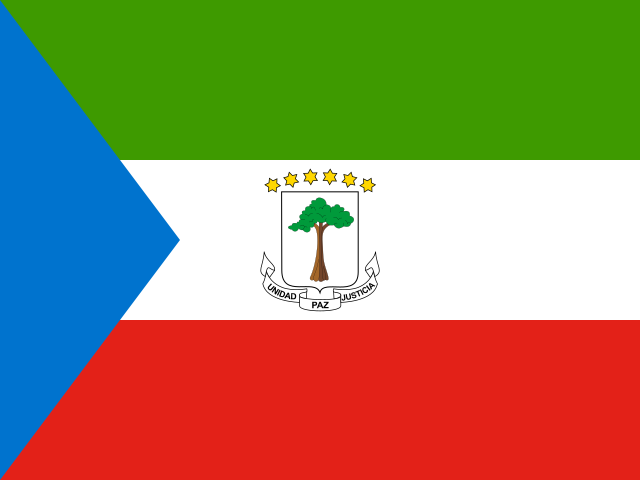 Equatorial Guinea
 Gabon
Gabon Sao Tome and Principe
 Botswana
 Lesotho
 Namibia
 South Africa
 Eswatini
Earlier Report Observations
The market for unfermented fruit and vegetable juices in Sub-Saharan Africa showed considerable movement between 2018 and 2023, starting at 707 million liters and reaching a high of 827 million liters in 2022 before settling at 733 million liters in 2023. Growth in 2019 to 741 million liters was supported by rising consumer concerns over food safety in Kenya, which increased demand for juices as a safer alternative. The market then contracted in 2020 but recovered strongly through 2021 and into 2022.
By 2024, structural initiatives began shaping the market's foundation. Kenya launched a national Post-Harvest Management Strategy to reduce fruit and vegetable losses, aiming to improve supply chain efficiency for juice production. Simultaneously, projects aimed at increasing vegetable consumption and a significant consumer shift towards healthier juice options with reduced sugar content started to influence product innovation and demand dynamics.
Table of content
- 1. Disclaimer
- 2. Terms of use of the report
- 3. Product codes in the statistical classifications used in the report
-
4. Key Market Indicators and Trends
-
4.1. Key Market Indicators
-
4.1.1. In kind
- 4.1.1.1. Production, 2018-2023
- 4.1.1.2. Imports, 2018-2024
- 4.1.1.3. Exports, 2018-2024
- 4.1.1.4. Market size, 2018-2023
-
4.1.1. In kind
- 4.2. Market Trends and Factors
-
4.1. Key Market Indicators
-
5. Production
-
5.1. Production in Sub-Saharan Africa
- 5.1.1. Annual dynamics of production in Sub-Saharan Africa in kind, 2018-2023, M l
-
5.2. Global production by Country, 2018-2023
- 5.2.1. Annual dynamics of production by macroregions in kind, 2018-2023, M l
- 5.2.2. Dynamics of production structure by macroregions in kind, 2018-2023
- 5.2.3. Annual dynamics of production by country in kind, 2018-2023, M l
- 5.2.4. Structure of production by countries in kind, 2018-2023
- 5.2.5. Dynamics of peoduction structure by countries in kind, 2018-2023
-
5.1. Production in Sub-Saharan Africa
-
6. Imports
-
6.1. Imports (Direct Data*)
- 6.1.1. Imports - Total information
-
6.1.2. Imports in kind, M l
- 6.1.2.1. Annual dynamics of product's imports to Cabo Verde in kind, 2018-2024, M l
- 6.1.2.2. Dynamics of product's imports in kind to Cabo Verde by countries, 2018-2024, M l
- 6.1.2.3. Structure of product's imports in kind by countries, 2018-2024
-
6.1.3. Imports in value, M $ US
- 6.1.3.1. Annual dynamics of product's imports to Cabo Verde in value, 2018-2024, M $ US
- 6.1.3.2. Dynamics of product's imports in value to Cabo Verde by countries, 2018-2024, M $ US
- 6.1.3.3. Structure of product's imports in value by countries, 2018-2024
-
6.1.4. Average price of product's imports, $ US/K l
- 6.1.4.1. Annual dynamics of average price of product's imports to Cabo Verde, 2018-2024, $ US/K l
- 6.1.4.2. Dynamics of average price of product's imports to Cabo Verde by countries, 2018-2024, $ US/K l
-
6.2. Imports (Mirror Data)
- 6.2.1. Imports - Total information
-
6.2.2. Imports in kind, M l
- 6.2.2.1. Annual dynamics of product's imports to Cabo Verde in kind, 2018-2024, M l
- 6.2.2.2. Dynamics of product's imports in kind to Cabo Verde by countries, 2018-2024, M l
- 6.2.2.3. Structure of product's imports in kind by countries, 2018-2024
-
6.2.3. Imports in value, M $ US
- 6.2.3.1. Annual dynamics of product's imports to Cabo Verde in value, 2018-2024, M $ US
- 6.2.3.2. Dynamics of product's imports in value to Cabo Verde by countries, 2018-2024, M $ US
- 6.2.3.3. Structure of product's imports in value by countries, 2018-2024
-
6.2.4. Average price of product's imports, $ US/K l
- 6.2.4.1. Annual dynamics of average price of product's imports to Cabo Verde, 2018-2024, $ US/K l
- 6.2.4.2. Dynamics of average price of product's imports to Cabo Verde by countries, 2018-2024, $ US/K l
-
6.1. Imports (Direct Data*)
-
7. Exports
-
7.1. Exports (Direct Data*)
- 7.1.1. Exports - Total information
-
7.1.2. Exports in kind, M l
- 7.1.2.1. Annual dynamics of product's exports from Cabo Verde in kind, 2018-2024, M l
- 7.1.2.2. Dynamics of product's exports in kind from Cabo Verde by countries, 2018-2024, M l
- 7.1.2.3. Structure of product's exports in kind by countries, 2018-2024
-
7.1.3. Exports in value, M $ US
- 7.1.3.1. Annual dynamics of product's exports from Cabo Verde in value, 2018-2024, M $ US
- 7.1.3.2. Dynamics of product's exports in value from Cabo Verde by countries, 2018-2024, M $ US
- 7.1.3.3. Structure of product's exports in value by countries, 2018-2024
-
7.1.4. Average price of product's exports, $ US/K l
- 7.1.4.1. Annual dynamics of average price of product's exports from Cabo Verde, 2018-2024, $ US/K l
- 7.1.4.2. Dynamics of average price of product's exports from Cabo Verde by countries, 2018-2024, $ US/K l
-
7.2. Exports (Mirror Data)
- 7.2.1. Exports - Total information
-
7.2.2. Exports in kind, M l
- 7.2.2.1. Annual dynamics of product's exports from Cabo Verde in kind, 2018-2024, M l
- 7.2.2.2. Dynamics of product's exports in kind from Cabo Verde by countries, 2018-2024, M l
- 7.2.2.3. Structure of product's exports in kind by countries, 2018-2024
-
7.2.3. Exports in value, M $ US
- 7.2.3.1. Annual dynamics of product's exports from Cabo Verde in value, 2018-2024, M $ US
- 7.2.3.2. Dynamics of product's exports in value from Cabo Verde by countries, 2018-2024, M $ US
- 7.2.3.3. Structure of product's exports in value by countries, 2018-2024
-
7.2.4. Average price of product's exports, $ US/K l
- 7.2.4.1. Annual dynamics of average price of product's exports from Cabo Verde, 2018-2024, $ US/K l
- 7.2.4.2. Dynamics of average price of product's exports from Cabo Verde by countries, 2018-2024, $ US/K l
-
7.1. Exports (Direct Data*)
-
8. Trade balance
-
8.1. Trade balance (Direct Data)
- 8.1.1. In kind, M l
- 8.1.2. In value, M $ US
-
8.2. Trade balance (Mirror Data)
- 8.2.1. In kind, M l
- 8.2.2. In value, M $ US
-
8.1. Trade balance (Direct Data)
-
9. Top buying and selling countries, 2018-2024
-
9.1. Direct Data
- 9.1.1. Import in Value by Countries-buyers
- 9.1.2. Export in Value by Countries-suppliers
-
9.2. Mirror Data
- 9.2.1. Import in Value by Countries-buyers
- 9.2.2. Export in Value by Countries-suppliers
-
9.1. Direct Data
Production fruit and vegetable juices in Sub-Saharan Africa
In kind, 2017-2020, M l
Top producers of fruit and vegetable juices, 2017-2020
World map of production of fruit and vegetable juices, 2017-2020
In Sub-Saharan Africa, fruit and vegetable juice production reached 610.1 million liters in 2020, marking a 7.7% increase from 2019. Over the 2017-2020 period, production grew by 15.6%, with an average annual growth rate of 4.9%. The largest decline occurred in 2019, when production fell by 0.8%, while the biggest increase was recorded in 2018 with an 8.1% rise.
Annual dynamics of production in Sub-Saharan Africa in kind, 2017-2020, M l
| Parameter | 2018 | 2019 | 2020 | CAGR | |
|---|---|---|---|---|---|
| 1 | Change from last year | 8.1% | (0.8%) | 7.7% | 4.9% |
In value, 2017-2020, M $ US
Following two years of growth, fruit and vegetable juice production in Sub-Saharan Africa experienced a decline. In 2020, the output was valued at 860 million US dollars, down 16.9% from 2019. Over the 2017-2020 period, production value increased by 10.8%, with an average annual growth rate of 3.5%. The peak value was recorded in 2019 at 1 035 million US dollars, which also saw the largest increase of 28.8%.
Annual dynamics of production in Sub-Saharan Africa in value, 2017-2020, M $ US
| Parameter | 2018 | 2019 | 2020 | CAGR | |
|---|---|---|---|---|---|
| 1 | Change from last year | 3.5% | 28.8% | (16.9%) | 3.5% |
Exports fruit and vegetable juices from Sub-Saharan Africa
Exports in kind, M l
In 2020, fruit and vegetable juice exports from Sub-Saharan Africa totaled 227.8 million liters, representing a 24.4% increase compared to 2019. Between 2017 and 2020, exports grew by 5.7%, with an average annual rate of 1.9%. The lowest volume was recorded in 2019 at 183.1 million liters, while the highest was in 2018 at 277.7 million liters. The largest decline occurred in 2019 with a 34.1% drop, and the biggest increase was in 2018 with a 28.9% rise.
Annual dynamics of product's exports from Sub-Saharan Africa in kind, 2017-2020, M l
| Parameter | 2018 | 2019 | 2020 | CAGR | |
|---|---|---|---|---|---|
| 1 | Change from last year | 28.9% | (34.1%) | 24.4% | 1.9% |
From 2017 to 2020, fruit and vegetable juice exports from Sub-Saharan Africa were not concentrated in a few key markets. The Netherlands accounted for 10.7% of exports, the United States for 2.8%, and Japan for 2.5%, with these three countries together representing just 15.9% of total export flows.
Structure of product's exports in kind by countries, 2017-2020
World map of product's exports from Sub-Saharan Africa in kind, 2017-2020
Exports in value, M $ US
Fruit and vegetable juice export values from Sub-Saharan Africa declined for the second consecutive year. In 2020, exports stood at 321.0 million US dollars, a 4.0% decrease from the previous year. The highest value was recorded in 2018 at 390.9 million US dollars. The largest decline occurred in 2019 with a 14.4% drop, while the biggest increase was in 2018 with a 23.4% rise.
Annual dynamics of product's exports from Sub-Saharan Africa in value, 2017-2020, M $ US
| Parameter | 2018 | 2019 | 2020 | CAGR | |
|---|---|---|---|---|---|
| 1 | Change from last year | 23.4% | (14.4%) | (4.0%) | 0.4% |
Between 2017 and 2020, the country structure of fruit and vegetable juice exports in value terms remained highly diversified. The Netherlands accounted for 18.0% of export value, the United States for 5.3%, and Japan for 3.7%, with these three countries together representing only 27.0% of total flows. The remaining 73.0% came from a wide range of smaller markets.
Structure of product's exports in value by countries, 2017-2020
World map of product's exports from Sub-Saharan Africa in value, 2017-2020
Imports fruit and vegetable juices to Sub-Saharan Africa
Imports in kind, M l
Fruit and vegetable juice imports into Sub-Saharan Africa declined for the third consecutive year. In 2020, imports stood at 316.1 million liters, an 11.9% decrease from the previous year. Between 2017 and 2020, imports fell by 34.1%, with an average annual decline rate of 13.0%.
Annual dynamics of product's imports to Sub-Saharan Africa in kind, 2017-2020, M l
| Parameter | 2018 | 2019 | 2020 | CAGR | |
|---|---|---|---|---|---|
| 1 | Change from last year | (12.2%) | (14.8%) | (11.9%) | (13.0%) |
The structure of fruit and vegetable juice imports into Sub-Saharan Africa from 2017 to 2020 can be described as diversified. China accounted for 12.0% of imports, Spain for 6.1%, and the United Arab Emirates for 4.8%, with these three countries together representing just 23.0% of total flows, and no single country held a clearly dominant position.
Structure of product's imports in kind by countries, 2017-2020
World map of product's imports to Sub-Saharan Africa in kind, 2017-2020
Imports in value, M $ US
Fruit and vegetable juice imports into Sub-Saharan Africa declined for the second consecutive year. In 2020, imports amounted to 359.5 million US dollars, a 12.0% decrease year-over-year. Between 2017 and 2020, imports fell by 6.2%, with an average annual decline rate of 2.1%. The highest value was recorded in 2018 at 420.0 million US dollars, which also saw the largest increase of 9.6%.
Annual dynamics of product's imports to Sub-Saharan Africa in value, 2017-2020, M $ US
| Parameter | 2018 | 2019 | 2020 | CAGR | |
|---|---|---|---|---|---|
| 1 | Change from last year | 9.6% | (2.7%) | (12.0%) | (2.1%) |
From 2017 to 2020, China, Spain, and Germany were the largest but not dominant suppliers of fruit and vegetable juices to Sub-Saharan Africa. China accounted for 12.6% of import value, Spain for 6.0%, and Germany for 4.8%, with these three countries together representing 23.4% of total imports in value terms, against a broad background of smaller trading partners.
Structure of product's imports in value by countries, 2017-2020
World map of product's imports to Sub-Saharan Africa in value, 2017-2020
Related Reports

Fruit and vegetable juices market in Kenya
2026-03-29
Fruit and vegetable juices market in Iran
2026-03-29
Fruit and vegetable juices market in Syria
2026-03-29




Why Choose Us?
Only Verified Data
No Hidden Costs or Separate Fees
Smarter Subscription Pricing
Contact Our Team
Submit your inquiry using the form below — our team will get back to you within 24 hours.