






"Middle Africa" region includes following countries:
 Angola
 Cameroon
 Central African Republic
 Chad
Chad Congo
Congo Democratic Republic of the Congo
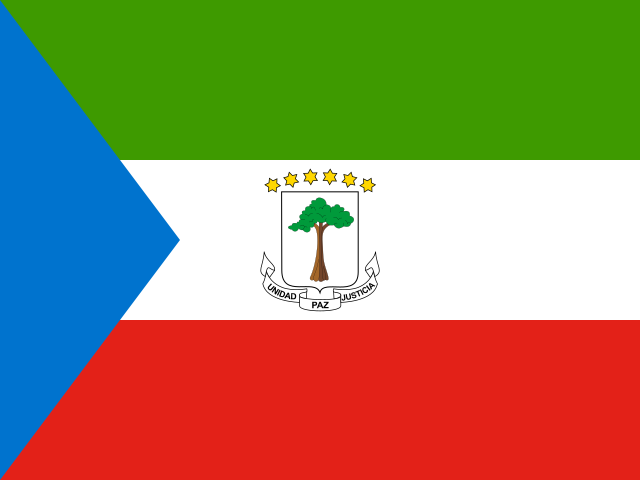 Equatorial Guinea
 Gabon
Gabon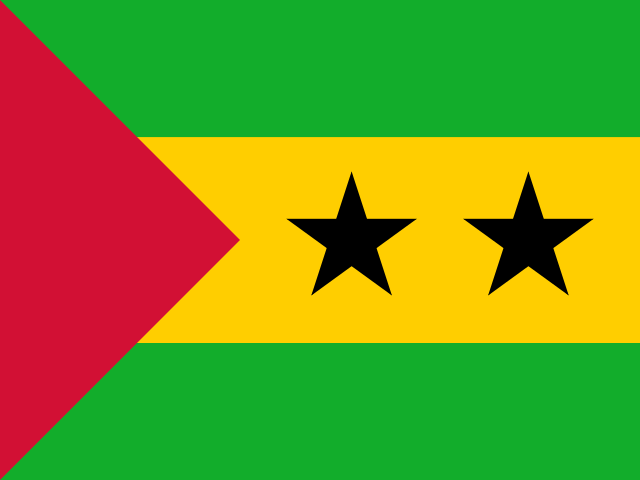 Sao Tome and Principe
Earlier Report Observations
The ethyl alcohol market in Middle Africa began the period at 178.4 million liters in 2018 but declined to 162.9 million liters in 2019. This reduction coincided with the widespread presence of high-strength artisanal drinks like 'Agene' and 'Lotoko', which competed directly with officially produced beverages. Additionally, civil society movements denounced the sale of prohibited alcoholic drinks, including those produced by companies like Première Distillerie, highlighting regulatory challenges and unfair competition that likely diverted consumption away from the formal market.
A sharp downturn occurred in 2020, with production collapsing to 20.6 million liters and overall market volume dropping to 148.7 million liters. The market remained under pressure from illicit artisanal alcohol, as evidenced by a 2021 parliamentary appeal to ban 'Lotoko' due to its negative social impact. The formal market size continued to shrink, reaching 120.2 million liters in 2021.
Market volume stabilized around 119 million liters in 2022 before rising to 138.7 million liters in 2023. In 2022, a shortage of malt—a key ingredient in beer brewing—contributed to higher prices for alcoholic beverages, potentially affecting demand for ethyl alcohol used in production. The following year, price increases for consumer goods, driven by depreciation of the Congolese franc, introduced additional cost pressures. By 2024, authorities extended import restrictions on ethyl alcohol in some regions, even as imported volumes reached 133.7 million liters, suggesting ongoing adjustments in supply chains.
Table of content
- 1. Disclaimer
- 2. Terms of use of the report
- 3. Product codes in the statistical classifications used in the report
-
4. Key Market Indicators and Trends
-
4.1. Key Market Indicators
-
4.1.1. In kind
- 4.1.1.1. Production, 2018-2023
- 4.1.1.2. Imports, 2018-2024
- 4.1.1.3. Exports, 2018-2024
- 4.1.1.4. Market size, 2018-2023
-
4.1.1. In kind
- 4.2. Market Trends and Factors
-
4.1. Key Market Indicators
-
5. Production
-
5.1. Production in Middle Africa
- 5.1.1. Annual dynamics of production in Middle Africa in kind, 2018-2023, K l
-
5.2. Global production by Country, 2018-2023
- 5.2.1. Annual dynamics of production by macroregions in kind, 2018-2023, K l
- 5.2.2. Dynamics of production structure by macroregions in kind, 2018-2023
- 5.2.3. Annual dynamics of production by country in kind, 2018-2023, K l
- 5.2.4. Structure of production by countries in kind, 2018-2023
- 5.2.5. Dynamics of peoduction structure by countries in kind, 2018-2023
-
5.1. Production in Middle Africa
-
6. Imports
-
6.1. Imports (Direct Data*)
- 6.1.1. Imports - Total information
-
6.1.2. Imports in kind, M l
- 6.1.2.1. Annual dynamics of product's imports to Angola in kind, 2018-2024, M l
- 6.1.2.2. Dynamics of product's imports in kind to Angola by countries, 2018-2024, M l
- 6.1.2.3. Structure of product's imports in kind by countries, 2018-2024
-
6.1.3. Imports in value, M $ US
- 6.1.3.1. Annual dynamics of product's imports to Angola in value, 2018-2024, M $ US
- 6.1.3.2. Dynamics of product's imports in value to Angola by countries, 2018-2024, M $ US
- 6.1.3.3. Structure of product's imports in value by countries, 2018-2024
-
6.1.4. Average price of product's imports, $ US/K l
- 6.1.4.1. Annual dynamics of average price of product's imports to Angola, 2018-2024, $ US/K l
- 6.1.4.2. Dynamics of average price of product's imports to Angola by countries, 2018-2024, $ US/K l
-
6.2. Imports (Mirror Data)
- 6.2.1. Imports - Total information
-
6.2.2. Imports in kind, M l
- 6.2.2.1. Annual dynamics of product's imports to Angola in kind, 2018-2024, M l
- 6.2.2.2. Dynamics of product's imports in kind to Angola by countries, 2018-2024, M l
- 6.2.2.3. Structure of product's imports in kind by countries, 2018-2024
-
6.2.3. Imports in value, M $ US
- 6.2.3.1. Annual dynamics of product's imports to Angola in value, 2018-2024, M $ US
- 6.2.3.2. Dynamics of product's imports in value to Angola by countries, 2018-2024, M $ US
- 6.2.3.3. Structure of product's imports in value by countries, 2018-2024
-
6.2.4. Average price of product's imports, $ US/K l
- 6.2.4.1. Annual dynamics of average price of product's imports to Angola, 2018-2024, $ US/K l
- 6.2.4.2. Dynamics of average price of product's imports to Angola by countries, 2018-2024, $ US/K l
-
6.1. Imports (Direct Data*)
-
7. Exports
-
7.1. Exports (Direct Data*)
- 7.1.1. Exports - Total information
-
7.1.2. Exports in kind, M l
- 7.1.2.1. Annual dynamics of product's exports from Angola in kind, 2018-2024, M l
- 7.1.2.2. Dynamics of product's exports in kind from Angola by countries, 2018-2024, M l
- 7.1.2.3. Structure of product's exports in kind by countries, 2018-2024
-
7.1.3. Exports in value, M $ US
- 7.1.3.1. Annual dynamics of product's exports from Angola in value, 2018-2024, M $ US
- 7.1.3.2. Dynamics of product's exports in value from Angola by countries, 2018-2024, M $ US
- 7.1.3.3. Structure of product's exports in value by countries, 2018-2024
-
7.1.4. Average price of product's exports, $ US/K l
- 7.1.4.1. Annual dynamics of average price of product's exports from Angola, 2018-2024, $ US/K l
- 7.1.4.2. Dynamics of average price of product's exports from Angola by countries, 2018-2024, $ US/K l
-
7.2. Exports (Mirror Data)
- 7.2.1. Exports - Total information
-
7.2.2. Exports in kind, M l
- 7.2.2.1. Annual dynamics of product's exports from Angola in kind, 2018-2024, M l
- 7.2.2.2. Dynamics of product's exports in kind from Angola by countries, 2018-2024, M l
- 7.2.2.3. Structure of product's exports in kind by countries, 2018-2024
-
7.2.3. Exports in value, M $ US
- 7.2.3.1. Annual dynamics of product's exports from Angola in value, 2018-2024, M $ US
- 7.2.3.2. Dynamics of product's exports in value from Angola by countries, 2018-2024, M $ US
- 7.2.3.3. Structure of product's exports in value by countries, 2018-2024
-
7.2.4. Average price of product's exports, $ US/K l
- 7.2.4.1. Annual dynamics of average price of product's exports from Angola, 2018-2024, $ US/K l
- 7.2.4.2. Dynamics of average price of product's exports from Angola by countries, 2018-2024, $ US/K l
-
7.1. Exports (Direct Data*)
-
8. Trade balance
-
8.1. Trade balance (Direct Data)
- 8.1.1. In kind, M l
- 8.1.2. In value, M $ US
-
8.2. Trade balance (Mirror Data)
- 8.2.1. In kind, M l
- 8.2.2. In value, M $ US
-
8.1. Trade balance (Direct Data)
-
9. Top buying and selling countries, 2018-2024
-
9.1. Direct Data
- 9.1.1. Import in Value by Countries-buyers
- 9.1.2. Export in Value by Countries-suppliers
-
9.2. Mirror Data
- 9.2.1. Import in Value by Countries-buyers
- 9.2.2. Export in Value by Countries-suppliers
-
9.1. Direct Data
Production ethyl alcohol in Middle Africa
In kind, 2017-2020, K l
Top producers of ethyl alcohol, 2017-2020
World map of production of ethyl alcohol, 2017-2020
Middle Africa's ethyl alcohol production saw a two-year increase before declining. In 2020, production dropped to 20 572 thousand liters, marking a 55.3% decrease compared to the previous year. Over the 2017-2020 period, production fell by 51%, with a compound annual growth rate of -21.2%. The highest production level was recorded in 2019 at 46 000 thousand liters, while the largest year-over-year increase occurred in 2018 at 7.0%.
Annual dynamics of production in Middle Africa in kind, 2017-2020, K l
| Parameter | 2018 | 2019 | 2020 | CAGR | |
|---|---|---|---|---|---|
| 1 | Change from last year | 7.0% | 2.3% | (55.3%) | (21.2%) |
Exports ethyl alcohol from Middle Africa
Exports in kind, M l
The export market for ethyl alcohol from Middle Africa experienced significant fluctuations during this period. Exports reached their lowest point in 2018 and peaked in 2019, with a dramatic 171-fold difference between these two years. In 2020, exports amounted to 0.0 million liters, representing a sharp 44.2% decline from the previous year. The minimum value was recorded in 2018 at 0.0 million liters, while the maximum occurred in 2019 at 0.1 million liters. The most substantial decline happened in 2018 at 94.4%, and the largest increase was recorded in 2019 at 17 033.4%.
Annual dynamics of product's exports from Middle Africa in kind, 2017-2020, M l
| Parameter | 2018 | 2019 | 2020 | CAGR | |
|---|---|---|---|---|---|
| 1 | Change from last year | (94.4%) | 17 033.4% | (44.2%) | 75.2% |
From 2017 to 2020, China served as the primary destination for Middle Africa's ethyl alcohol exports in volume terms, accounting for 1.4% of total export flows.
Structure of product's exports in kind by countries, 2017-2020
World map of product's exports from Middle Africa in kind, 2017-2020
Exports in value, M $ US
The market demonstrated considerable volatility during these years. Exports reached their lowest point in 2018 and peaked in 2020, showing a remarkable 279-fold swing between these extremes. In 2020, the value of ethyl alcohol exports from Middle Africa totaled 0.1 million US dollars, representing a substantial 75.3% increase compared to the previous year. The minimum value was recorded in 2018 at 0.0 million US dollars. The most significant decline occurred in 2018 at 93.6%, while the largest increase was recorded in 2019 at 15 839.8%.
Annual dynamics of product's exports from Middle Africa in value, 2017-2020, M $ US
| Parameter | 2018 | 2019 | 2020 | CAGR | |
|---|---|---|---|---|---|
| 1 | Change from last year | (93.6%) | 15 839.8% | 75.3% | 161.8% |
Throughout the 2017-2020 period, China remained the leading partner for Middle Africa's ethyl alcohol exports in value terms, representing 3.4% of total export flows.
Structure of product's exports in value by countries, 2017-2020
World map of product's exports from Middle Africa in value, 2017-2020
Imports ethyl alcohol to Middle Africa
Imports in kind, M l
In 2020, Middle Africa imported 128.2 million liters of ethyl alcohol, reflecting a moderate 9.6% increase compared to the previous year. Over the 2017-2020 period, imports grew by 21.4%, with a compound annual growth rate of 6.7%. The highest import volume was recorded in 2018 at 133.7 million liters. The most substantial decline occurred in 2019 at 12.5%, while the largest increase was recorded in 2018 at 26.6%.
Annual dynamics of product's imports to Middle Africa in kind, 2017-2020, M l
| Parameter | 2018 | 2019 | 2020 | CAGR | |
|---|---|---|---|---|---|
| 1 | Change from last year | 26.6% | (12.5%) | 9.6% | 6.7% |
Between 2017 and 2020, South Africa (29.4% of import volume), India (24.8% of import volume), and Pakistan (16.4% of import volume) were the principal suppliers of ethyl alcohol to Middle Africa. Together, these three countries accounted for 70.5% of total imports in volume terms.
Structure of product's imports in kind by countries, 2017-2020
World map of product's imports to Middle Africa in kind, 2017-2020
Imports in value, M $ US
In 2020, Middle Africa's ethyl alcohol imports amounted to 113.9 million US dollars, representing a 13.0% increase compared to 2019. Between 2017 and 2020, imports grew by 32%, equating to an annualized growth rate of 9.7%. The most significant decline occurred in 2019 at 3.1%, while the largest increase was recorded in 2018 at 20.6%.
Annual dynamics of product's imports to Middle Africa in value, 2017-2020, M $ US
| Parameter | 2018 | 2019 | 2020 | CAGR | |
|---|---|---|---|---|---|
| 1 | Change from last year | 20.6% | (3.1%) | 13.0% | 9.7% |
From 2017 to 2020, South Africa (33.5% of import value), India (23.6% of import value), and Pakistan (13.6% of import value) were the main suppliers of ethyl alcohol to Middle Africa in value terms. Collectively, these three countries represented 70.8% of total import value.
Structure of product's imports in value by countries, 2017-2020
World map of product's imports to Middle Africa in value, 2017-2020
Related Reports

Ethyl alcohol market in South America
2026-03-29
2026-03-29
Ethyl alcohol market in Brazil
2026-03-29
2026-03-29

Alcoholic beer market in Middle Africa
2026-03-29



Why Choose Us?
Only Verified Data
No Hidden Costs or Separate Fees
Smarter Subscription Pricing
Contact Our Team
Submit your inquiry using the form below — our team will get back to you within 24 hours.