





"Eastern Europe (including Northern Asia)" region includes following countries:
 Bulgaria
 Belarus
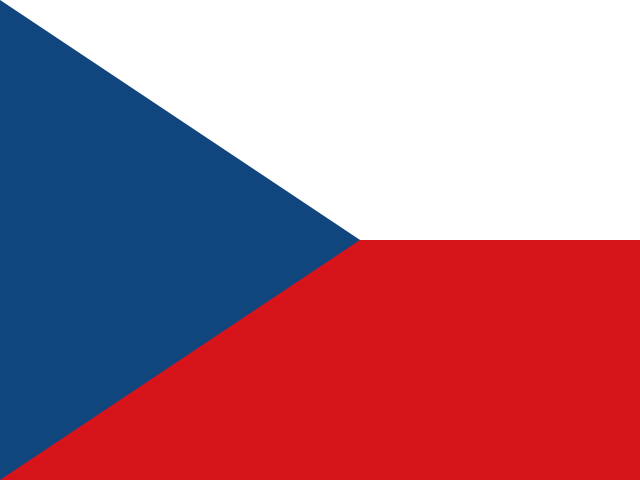 Czechia
 Hungary
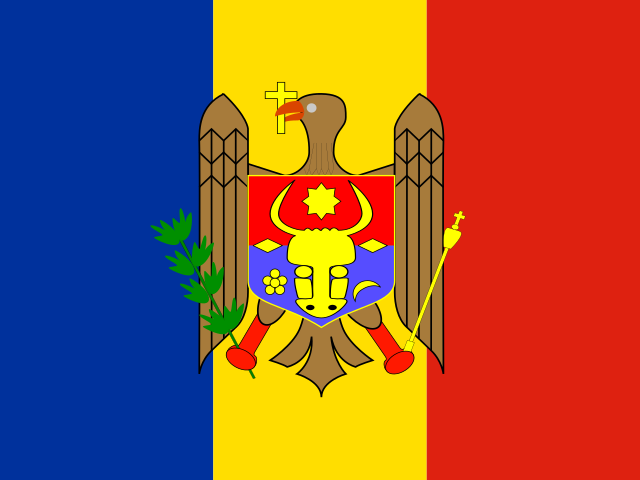 Moldova
 Poland
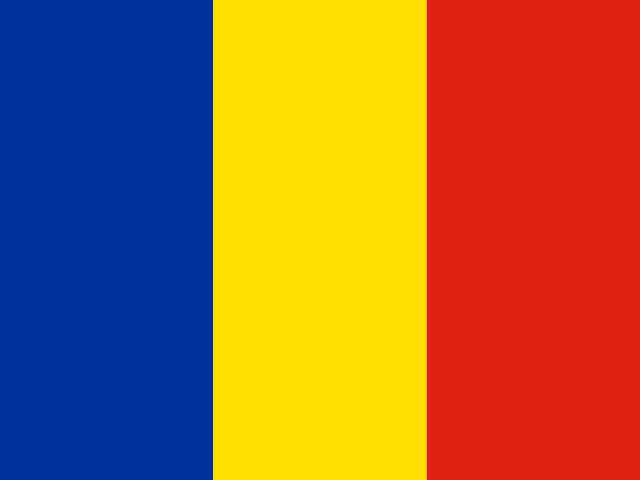 Romania
 Russia
 Slovakia
 Ukraine
Earlier Report Observations
The market for camel meat and offal in Eastern Europe experienced considerable fluctuations between 2018 and 2023. Volume peaked at 53 587 kg in 2018 before dropping to 31 604 kg the following year. A partial recovery to 38 362 kg occurred in 2020, but the market contracted again to 27 000 kg in 2021. Another rise to 34 300 kg was recorded in 2022, followed by a decline to 27 820 kg in 2023.
Regulatory measures introduced during the period affected storage and handling practices. In 2020, new sanitary rules (SP 2.3.6.3668-20) mandated specific conditions for storing meat and offal, likely influencing supply chain operations. These requirements were further detailed in subsequent years, with updated norms for natural loss during storage and transport.
By 2024, the broader meat by-products market saw significant export growth to China and increased imports from several countries, though camel meat remained a niche segment with minimal direct export activity. Sanitary standards for packaging and labeling continued to shape market conditions.
Table of content
- 1. Disclaimer
- 2. Terms of use of the report
- 3. Product codes in the statistical classifications used in the report
-
4. Key Market Indicators and Trends
-
4.1. Key Market Indicators
-
4.1.1. In kind
- 4.1.1.1. Production, 2018-2023
- 4.1.1.2. Imports, 2018-2024
- 4.1.1.3. Exports, 2018-2024
- 4.1.1.4. Market size, 2018-2023
-
4.1.1. In kind
- 4.2. Market Trends and Factors
-
4.1. Key Market Indicators
-
5. Production
-
5.1. Production in Eastern Europe (including Northern Asia)
- 5.1.1. Annual dynamics of production in Eastern Europe (including Northern Asia) in kind, 2018-2023, t
-
5.2. Global production by Country, 2018-2023
- 5.2.1. Annual dynamics of production by macroregions in kind, 2018-2023, t
- 5.2.2. Dynamics of production structure by macroregions in kind, 2018-2023
- 5.2.3. Annual dynamics of production by country in kind, 2018-2023, t
- 5.2.4. Structure of production by countries in kind, 2018-2023
- 5.2.5. Dynamics of peoduction structure by countries in kind, 2018-2023
-
5.1. Production in Eastern Europe (including Northern Asia)
-
6. Imports
-
6.1. Imports (Direct Data*)
- 6.1.1. Imports - Total information
-
6.1.2. Imports in kind, kg
- 6.1.2.1. Annual dynamics of product's imports to Bulgaria in kind, 2018-2024, kg
- 6.1.2.2. Dynamics of product's imports in kind to Bulgaria by countries, 2018-2024, kg
- 6.1.2.3. Structure of product's imports in kind by countries, 2018-2024
-
6.1.3. Imports in value, $ US
- 6.1.3.1. Annual dynamics of product's imports to Bulgaria in value, 2018-2024, $ US
- 6.1.3.2. Dynamics of product's imports in value to Bulgaria by countries, 2018-2024, $ US
- 6.1.3.3. Structure of product's imports in value by countries, 2018-2024
-
6.1.4. Average price of product's imports, $ US/kg
- 6.1.4.1. Annual dynamics of average price of product's imports to Bulgaria, 2018-2024, $ US/kg
- 6.1.4.2. Dynamics of average price of product's imports to Bulgaria by countries, 2018-2024, $ US/kg
-
6.2. Imports (Mirror Data)
- 6.2.1. Imports - Total information
-
6.2.2. Imports in kind, kg
- 6.2.2.1. Annual dynamics of product's imports to Bulgaria in kind, 2018-2024, kg
- 6.2.2.2. Dynamics of product's imports in kind to Bulgaria by countries, 2018-2024, kg
- 6.2.2.3. Structure of product's imports in kind by countries, 2018-2024
-
6.2.3. Imports in value, $ US
- 6.2.3.1. Annual dynamics of product's imports to Bulgaria in value, 2018-2024, $ US
- 6.2.3.2. Dynamics of product's imports in value to Bulgaria by countries, 2018-2024, $ US
- 6.2.3.3. Structure of product's imports in value by countries, 2018-2024
-
6.2.4. Average price of product's imports, $ US/kg
- 6.2.4.1. Annual dynamics of average price of product's imports to Bulgaria, 2018-2024, $ US/kg
- 6.2.4.2. Dynamics of average price of product's imports to Bulgaria by countries, 2018-2024, $ US/kg
-
6.1. Imports (Direct Data*)
-
7. Trade balance
-
7.1. Trade balance (Direct Data)
- 7.1.1. In kind, kg
- 7.1.2. In value, $ US
-
7.2. Trade balance (Mirror Data)
- 7.2.1. In kind, kg
- 7.2.2. In value, $ US
-
7.1. Trade balance (Direct Data)
-
8. Top buying and selling countries, 2018-2024
-
8.1. Direct Data
- 8.1.1. Import in Value by Countries-buyers
- 8.1.2. Export in Value by Countries-suppliers
-
8.2. Mirror Data
- 8.2.1. Import in Value by Countries-buyers
- 8.2.2. Export in Value by Countries-suppliers
-
8.1. Direct Data
Production camel meat and offal in Eastern Europe (including Northern Asia)
In kind, 2017-2020, t
Top producers of camel meat and offal, 2017-2020
World map of production of camel meat and offal, 2017-2020
Following two years of decline, camel meat and offal production in Eastern Europe (including Northern Asia) rebounded in 2020. That year, the region produced 36.8 tonnes, marking a significant 22.7% increase compared to 2019. Looking at the broader period from 2017 to 2020, overall production fell by 35.7%, which translates to an average annual decline of 13.7%. The lowest production level was recorded in 2019 at 30.0 tonnes, when output dropped by 42.4%—the steepest decrease observed during this timeframe.
Annual dynamics of production in Eastern Europe (including Northern Asia) in kind, 2017-2020, t
| Parameter | 2018 | 2019 | 2020 | CAGR | |
|---|---|---|---|---|---|
| 1 | Change from last year | (9.0%) | (42.4%) | 22.7% | (13.7%) |
Exports camel meat and offal from Eastern Europe (including Northern Asia)
According to market research data, Eastern Europe (including Northern Asia) did not export any camel meat and offal between 2017 and 2020.
Imports camel meat and offal to Eastern Europe (including Northern Asia)
Imports in kind, kg
After rising for two consecutive years, imports of camel meat and offal into Eastern Europe (including Northern Asia) decreased in 2020. Imports totaled 1 562 kg that year, down 2.6% from 2019. Over the full 2017-2020 period, imports grew by 55.3%, averaging an annual increase of 15.8%. The peak import volume was reached in 2019 at 1 604 kg, while the largest year-on-year surge occurred in 2018 with a 47.8% rise.
Annual dynamics of product's imports to Eastern Europe (including Northern Asia) in kind, 2017-2020, kg
| Parameter | 2018 | 2019 | 2020 | CAGR | |
|---|---|---|---|---|---|
| 1 | Change from last year | 47.8% | 7.9% | (2.6%) | 15.8% |
From 2017 to 2020, the United Kingdom, Belgium, and the Netherlands were the main suppliers of camel meat and offal to Eastern Europe (including Northern Asia). The United Kingdom accounted for 54.1% of imports by volume, Belgium for 16.3%, and the Netherlands for 14.2%. Together, these three countries represented 84.5% of total imports in kind during this period.
Structure of product's imports in kind by countries, 2017-2020
World map of product's imports to Eastern Europe (including Northern Asia) in kind, 2017-2020
Imports in value, $ US
Camel meat and offal imports into Eastern Europe (including Northern Asia) declined for the second year in a row in 2020. The region imported camel products worth 5 576 US dollars that year, a sharp 17.0% drop from 2019. Over the 2017-2020 span, import value decreased by 15.2%, with an average annual decline of 5.4%. The highest import value was recorded in 2018 at 7 777 US dollars, which also saw the largest year-on-year increase of 18.2%.
Annual dynamics of product's imports to Eastern Europe (including Northern Asia) in value, 2017-2020, $ US
| Parameter | 2018 | 2019 | 2020 | CAGR | |
|---|---|---|---|---|---|
| 1 | Change from last year | 18.2% | (13.7%) | (17.0%) | (5.4%) |
Between 2017 and 2020, the United Kingdom, Belgium, and the Netherlands dominated the import market for camel meat and offal in Eastern Europe (including Northern Asia) in value terms. The United Kingdom contributed 44.0% of import value, Belgium 19.5%, and the Netherlands 16.0%. Collectively, these three markets made up 79.6% of total import flows by value.
Structure of product's imports in value by countries, 2017-2020
World map of product's imports to Eastern Europe (including Northern Asia) in value, 2017-2020
Related Reports

Camel meat and offal market in Pakistan
2026-03-27
Camel meat and offal market in Iraq
2026-03-27
Camel meat and offal market in Saudi Arabia
2026-03-27
Camel meat and offal market in Eastern Asia
2026-03-27




Why Choose Us?
Only Verified Data
No Hidden Costs or Separate Fees
Smarter Subscription Pricing
Contact Our Team
Submit your inquiry using the form below — our team will get back to you within 24 hours.