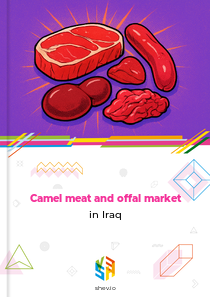







Earlier Report Observations
Iraqi camel meat production increased from 1 693 t in 2018 to 2 149 t in 2020. This growth was initially supported by large-scale livestock projects managed by state-owned companies, such as the National Company in Samawa, Diyala, and Diwaniya provinces, which expanded production capacity. In 2020, shifts in agricultural policy aimed at boosting local meat output and reducing import dependency further encouraged production increases.
The market continued to expand in 2021 and 2022, reaching 2 506 t. Tighter controls on meat imports reduced the inflow of non-compliant products, creating space for domestic producers. Concurrently, ongoing government support through new provincial investment projects and the enlargement of state-owned processing facilities provided additional production momentum.
By 2023, production rose to 2 707 t, partly due to the entry of new players investing in fresh and frozen meat facilities. The market also broadened into processed meat and semi-finished product segments, diversifying demand. These developments, alongside sustained state backing, maintained upward volume trends throughout the period.
Table of content
- 1. Disclaimer
- 2. Terms of use of the report
- 3. Product codes in the statistical classifications used in the report
-
4. Key Market Indicators and Trends
-
4.1. Key Market Indicators
-
4.1.1. In kind
- 4.1.1.1. Production, 2018-2023
- 4.1.1.2. Imports, 2018-2024
- 4.1.1.3. Exports, 2018-2024
- 4.1.1.4. Market size, 2018-2023
-
4.1.1. In kind
- 4.2. Market Trends and Factors
-
4.1. Key Market Indicators
-
5. Production
-
5.1. Production in Iraq
- 5.1.1. Annual dynamics of production in Iraq in kind, 2018-2023, t
- 5.1.2. Annual dynamics of production in Iraq in value, 2018-2023, $ US
-
5.2. Global production by Country, 2018-2023
- 5.2.1. Annual dynamics of production by macroregions in kind, 2018-2023, t
- 5.2.2. Dynamics of production structure by macroregions in kind, 2018-2023
- 5.2.3. Annual dynamics of production by country in kind, 2018-2023, t
- 5.2.4. Structure of production by countries in kind, 2018-2023
- 5.2.5. Dynamics of peoduction structure by countries in kind, 2018-2023
-
5.1. Production in Iraq
-
6. Imports
-
6.1. Imports (Direct Data*)
- 6.1.1. Imports - Total information
-
6.1.2. Imports in kind, kg
- 6.1.2.1. Annual dynamics of product's imports to Iraq in kind, 2018-2024, kg
- 6.1.2.2. Dynamics of product's imports in kind to Iraq by countries, 2018-2024, kg
- 6.1.2.3. Structure of product's imports in kind by countries, 2018-2024
-
6.1.3. Imports in value, $ US
- 6.1.3.1. Annual dynamics of product's imports to Iraq in value, 2018-2024, $ US
- 6.1.3.2. Dynamics of product's imports in value to Iraq by countries, 2018-2024, $ US
- 6.1.3.3. Structure of product's imports in value by countries, 2018-2024
-
6.1.4. Average price of product's imports, $ US/t
- 6.1.4.1. Annual dynamics of average price of product's imports to Iraq, 2018-2024, $ US/t
- 6.1.4.2. Dynamics of average price of product's imports to Iraq by countries, 2018-2024, $ US/t
-
6.2. Imports (Mirror Data)
- 6.2.1. Imports - Total information
-
6.2.2. Imports in kind, kg
- 6.2.2.1. Annual dynamics of product's imports to Iraq in kind, 2018-2024, kg
- 6.2.2.2. Dynamics of product's imports in kind to Iraq by countries, 2018-2024, kg
- 6.2.2.3. Structure of product's imports in kind by countries, 2018-2024
-
6.2.3. Imports in value, $ US
- 6.2.3.1. Annual dynamics of product's imports to Iraq in value, 2018-2024, $ US
- 6.2.3.2. Dynamics of product's imports in value to Iraq by countries, 2018-2024, $ US
- 6.2.3.3. Structure of product's imports in value by countries, 2018-2024
-
6.2.4. Average price of product's imports, $ US/t
- 6.2.4.1. Annual dynamics of average price of product's imports to Iraq, 2018-2024, $ US/t
- 6.2.4.2. Dynamics of average price of product's imports to Iraq by countries, 2018-2024, $ US/t
-
6.1. Imports (Direct Data*)
-
7. Trade balance
-
7.1. Trade balance (Direct Data)
- 7.1.1. In kind, kg
- 7.1.2. In value, $ US
-
7.2. Trade balance (Mirror Data)
- 7.2.1. In kind, kg
- 7.2.2. In value, $ US
-
7.1. Trade balance (Direct Data)
-
8. Top buying and selling countries, 2018-2024
-
8.1. Direct Data
- 8.1.1. Import in Value by Countries-buyers
- 8.1.2. Export in Value by Countries-suppliers
-
8.2. Mirror Data
- 8.2.1. Import in Value by Countries-buyers
- 8.2.2. Export in Value by Countries-suppliers
-
8.1. Direct Data
Production camel meat and offal in Iraq
In kind, 2017-2020, t
From 2017 to 2020, Iraq ranked 28th globally in the production of camel meat and offal.
Top producers of camel meat and offal, 2017-2020
World map of production of camel meat and offal, 2017-2020
Iraq's production of camel meat and offal grew for the second year in a row. In 2019, output stood at 1 693 tonnes, marking the lowest point in the period. The following year, production rose to 2 149 tonnes, an increase of 11.1% compared to 2019. Over the entire 2017-2020 timeframe, production expanded by 13.7%, with an average annual growth rate of 4.4%. The largest decline occurred in 2018, when production fell by 10.4%, while the most significant increase was recorded in 2019, with a 14.3% rise.
Annual dynamics of production in Iraq in kind, 2017-2020, t
| Parameter | 2018 | 2019 | 2020 | CAGR | |
|---|---|---|---|---|---|
| 1 | Change from last year | (10.4%) | 14.3% | 11.1% | 4.4% |
Related Reports

Camel meat and offal market in Kuwait
2026-03-27
Camel meat and offal market in MENA
2026-03-27
Camel meat and offal market in Kazakhstan
2026-03-27
Camel meat and offal market in ECOWAS
2026-03-27
Chicken meat and offal market in Iraq
2026-03-27
2026-03-27

Sheep and goat meat market in Iraq
2026-03-27
Poultry meat and offal market in Iraq
2026-03-27
Why Choose Us?
Only Verified Data
No Hidden Costs or Separate Fees
Smarter Subscription Pricing
Contact Our Team
Submit your inquiry using the form below — our team will get back to you within 24 hours.