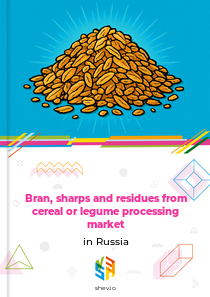







Earlier Report Observations
Between 2018 and 2020, production of bran and cereal residues in Russia increased from 4 575 thousand tons to 5 060 thousand tons, while the domestic market volume grew from 3 619 to 4 059 thousand tons. This expansion was supported by Russia's emergence as a global leader in wheat bran exports, capitalizing on rising international demand for grain processing by-products.
From 2021, the domestic market volume contracted, falling to 3 383 thousand tons by 2023 despite stable production around 5 000 thousand tons. The decline was driven by rapidly growing exports, which reached 1 679 thousand tons in 2023. Key exporters like Agro Zerno Yug significantly increased shipments abroad in 2021, while a 20-million-ton reduction in Russia's grain harvest in 2023 limited raw material availability, putting pressure on production growth.
In 2024, exports continued their upward trajectory, reaching 1 894 thousand tons. This was facilitated by regulatory progress, including Rosselkhoznadzor's work to gain access for Russian wheat bran to the Chinese market and India's authorization for the use of aluminum phosphide treatments on Russian grain products, simplifying export procedures.
Table of content
- 1. Disclaimer
- 2. Terms of use of the report
- 3. Product codes in the statistical classifications used in the report
-
4. Key Market Indicators and Trends
-
4.1. Key Market Indicators
-
4.1.1. In kind
- 4.1.1.1. Production, 2018-2023
- 4.1.1.2. Imports, 2018-2024
- 4.1.1.3. Exports, 2018-2024
- 4.1.1.4. Market size, 2018-2023
-
4.1.1. In kind
- 4.2. Market Trends and Factors
-
4.1. Key Market Indicators
-
5. Production
-
5.1. Production in Russia
- 5.1.1. Annual dynamics of production in Russia in kind, 2018-2023, K t
- 5.1.2. Annual dynamics of production in Russia in value, 2018-2023, $ US
-
5.2. Global production by Country, 2018-2023
- 5.2.1. Annual dynamics of production by macroregions in kind, 2018-2023, K t
- 5.2.2. Dynamics of production structure by macroregions in kind, 2018-2023
- 5.2.3. Annual dynamics of production by country in kind, 2018-2023, K t
- 5.2.4. Structure of production by countries in kind, 2018-2023
- 5.2.5. Dynamics of peoduction structure by countries in kind, 2018-2023
-
5.1. Production in Russia
-
6. Exports
-
6.1. Exports (Direct Data*)
- 6.1.1. Exports - Total information
-
6.1.2. Exports in kind, K t
- 6.1.2.1. Annual dynamics of product's exports from Russia in kind, 2018-2024, K t
- 6.1.2.2. Dynamics of product's exports in kind from Russia by countries, 2018-2024, K t
- 6.1.2.3. Structure of product's exports in kind by countries, 2018-2024
-
6.1.3. Exports in value, M $ US
- 6.1.3.1. Annual dynamics of product's exports from Russia in value, 2018-2024, M $ US
- 6.1.3.2. Dynamics of product's exports in value from Russia by countries, 2018-2024, M $ US
- 6.1.3.3. Structure of product's exports in value by countries, 2018-2024
-
6.1.4. Average price of product's exports, $ US/t
- 6.1.4.1. Annual dynamics of average price of product's exports from Russia, 2018-2024, $ US/t
- 6.1.4.2. Dynamics of average price of product's exports from Russia by countries, 2018-2024, $ US/t
-
6.2. Exports (Mirror Data)
- 6.2.1. Exports - Total information
-
6.2.2. Exports in kind, K t
- 6.2.2.1. Annual dynamics of product's exports from Russia in kind, 2018-2024, K t
- 6.2.2.2. Dynamics of product's exports in kind from Russia by countries, 2018-2024, K t
- 6.2.2.3. Structure of product's exports in kind by countries, 2018-2024
-
6.2.3. Exports in value, M $ US
- 6.2.3.1. Annual dynamics of product's exports from Russia in value, 2018-2024, M $ US
- 6.2.3.2. Dynamics of product's exports in value from Russia by countries, 2018-2024, M $ US
- 6.2.3.3. Structure of product's exports in value by countries, 2018-2024
-
6.2.4. Average price of product's exports, $ US/t
- 6.2.4.1. Annual dynamics of average price of product's exports from Russia, 2018-2024, $ US/t
- 6.2.4.2. Dynamics of average price of product's exports from Russia by countries, 2018-2024, $ US/t
-
6.1. Exports (Direct Data*)
-
7. Imports
-
7.1. Imports (Direct Data*)
- 7.1.1. Imports - Total information
-
7.1.2. Imports in kind, K t
- 7.1.2.1. Annual dynamics of product's imports to Russia in kind, 2018-2024, K t
- 7.1.2.2. Dynamics of product's imports in kind to Russia by countries, 2018-2024, K t
- 7.1.2.3. Structure of product's imports in kind by countries, 2018-2024
-
7.1.3. Imports in value, M $ US
- 7.1.3.1. Annual dynamics of product's imports to Russia in value, 2018-2024, M $ US
- 7.1.3.2. Dynamics of product's imports in value to Russia by countries, 2018-2024, M $ US
- 7.1.3.3. Structure of product's imports in value by countries, 2018-2024
-
7.1.4. Average price of product's imports, $ US/t
- 7.1.4.1. Annual dynamics of average price of product's imports to Russia, 2018-2024, $ US/t
- 7.1.4.2. Dynamics of average price of product's imports to Russia by countries, 2018-2024, $ US/t
-
7.2. Imports (Mirror Data)
- 7.2.1. Imports - Total information
-
7.2.2. Imports in kind, K t
- 7.2.2.1. Annual dynamics of product's imports to Russia in kind, 2018-2024, K t
- 7.2.2.2. Dynamics of product's imports in kind to Russia by countries, 2018-2024, K t
- 7.2.2.3. Structure of product's imports in kind by countries, 2018-2024
-
7.2.3. Imports in value, M $ US
- 7.2.3.1. Annual dynamics of product's imports to Russia in value, 2018-2024, M $ US
- 7.2.3.2. Dynamics of product's imports in value to Russia by countries, 2018-2024, M $ US
- 7.2.3.3. Structure of product's imports in value by countries, 2018-2024
-
7.2.4. Average price of product's imports, $ US/t
- 7.2.4.1. Annual dynamics of average price of product's imports to Russia, 2018-2024, $ US/t
- 7.2.4.2. Dynamics of average price of product's imports to Russia by countries, 2018-2024, $ US/t
-
7.1. Imports (Direct Data*)
-
8. Trade balance
-
8.1. Trade balance (Direct Data)
- 8.1.1. In kind, K t
- 8.1.2. In value, M $ US
-
8.2. Trade balance (Mirror Data)
- 8.2.1. In kind, K t
- 8.2.2. In value, M $ US
-
8.1. Trade balance (Direct Data)
-
9. Top buying and selling countries, 2018-2024
-
9.1. Direct Data
- 9.1.1. Import in Value by Countries-buyers
- 9.1.2. Export in Value by Countries-suppliers
-
9.2. Mirror Data
- 9.2.1. Import in Value by Countries-buyers
- 9.2.2. Export in Value by Countries-suppliers
-
9.1. Direct Data
Production bran, sharps and residues from cereal or legume processing in Russia
In kind, 2017-2020, K t
Between 2017 and 2020, Russia ranked fifth globally in the production of bran, sharps, and residues from cereal or legume processing.
Top producers of bran, sharps and residues from cereal or legume processing, 2017-2020
World map of production of bran, sharps and residues from cereal or legume processing, 2017-2020
Russia's production of bran, sharps, and residues from cereal or legume processing grew for the second consecutive year. In 2020, output reached 5 060 K t, marking a 7.5% increase from 2019. Over the 2017–2020 period, production rose by 5.6%, with a compound annual growth rate of 1.8%. The lowest production level was recorded in 2018 at 4 575 K t, which represented the largest decline of 4.6% during this timeframe.
Annual dynamics of production in Russia in kind, 2017-2020, K t
| Parameter | 2018 | 2019 | 2020 | CAGR | |
|---|---|---|---|---|---|
| 1 | Change from last year | (4.6%) | 2.8% | 7.5% | 1.8% |
In value, 2017-2020, M $ US
Russia's production value of bran, sharps, and residues from cereal or legume processing increased for the third year in a row. In 2020, the output was valued at 787.2 M $ US, showing a moderate uptick of 9.7% compared to the previous year. From 2017 to 2020, production value grew by 27.4%, equating to an annualized rate of 8.4%.
Annual dynamics of production in Russia in value, 2017-2020, M $ US
| Parameter | 2018 | 2019 | 2020 | CAGR | |
|---|---|---|---|---|---|
| 1 | Change from last year | 5.0% | 10.6% | 9.7% | 8.4% |
Exports bran, sharps and residues from cereal or legume processing from Russia
Exports in kind, K t
Following a two-year decrease, Russia's export volume of bran, sharps, and residues from cereal or legume processing rebounded. In 2020, exports reached 1 025 K t, an 8.1% advance over 2019. The lowest export volume was recorded in 2019 at 948 K t, which also saw the largest decline of 5.5%.
Annual dynamics of product's exports from Russia in kind, 2017-2020, K t
| Parameter | 2018 | 2019 | 2020 | CAGR | |
|---|---|---|---|---|---|
| 1 | Change from last year | (3.3%) | (5.5%) | 8.1% | (0.4%) |
From 2017 to 2020, Turkey was the dominant buyer of bran, sharps, and residues from cereal or legume processing from Russia, accounting for 91.5% of total exports in volume terms.
Structure of product's exports in kind by countries, 2017-2020
World map of product's exports from Russia in kind, 2017-2020
Exports in value, M $ US
The value of bran, sharps, and residues from cereal or legume processing exported from Russia increased for the third consecutive year. In 2020, exports totaled 159.5 M $ US, representing a 10.2% gain relative to the prior year. Over the 2017–2020 period, export value rose by 19.2%, with a compound annual growth rate of 6.0%.
Annual dynamics of product's exports from Russia in value, 2017-2020, M $ US
| Parameter | 2018 | 2019 | 2020 | CAGR | |
|---|---|---|---|---|---|
| 1 | Change from last year | 6.4% | 1.6% | 10.2% | 6.0% |
Between 2017 and 2020, bran, sharps, and residues from cereal or legume processing from Russia were supplied almost exclusively to Turkey, which absorbed 92.0% of total exports in value terms.
Structure of product's exports in value by countries, 2017-2020
World map of product's exports from Russia in value, 2017-2020
Imports bran, sharps and residues from cereal or legume processing to Russia
Imports in kind, K t
After a two-year decline, Russia's imports of bran, sharps, and residues from cereal or legume processing increased. In 2020, imports amounted to 24 K t, a sharp rise of 44.3% compared to 2019. Over the 2017–2020 period, imports decreased by 74.8%, with a compound annual decline rate of 36.8%. The lowest import volume was recorded in 2019 at 16 K t, which also experienced the largest decline of 66.0%.
Annual dynamics of product's imports to Russia in kind, 2017-2020, K t
| Parameter | 2018 | 2019 | 2020 | CAGR | |
|---|---|---|---|---|---|
| 1 | Change from last year | (48.6%) | (66.0%) | 44.3% | (36.8%) |
Throughout 2017–2020, the import structure in volume terms was primarily shaped by Kazakhstan and Ukraine, which together accounted for 98.4% of total flows, while other markets contributed minimally.
Structure of product's imports in kind by countries, 2017-2020
World map of product's imports to Russia in kind, 2017-2020
Imports in value, M $ US
Following a two-year reduction, Russia's import value of bran, sharps, and residues from cereal or legume processing rose. In 2020, imports were approximately 2.7 M $ US, showing a 36.0% increase compared to 2019. Over the 2017–2020 period, import value decreased by 69%, with a compound annual decline rate of 32.3%. The lowest import value was recorded in 2019 at 2.0 M $ US, which also saw the largest decline of 56.5%.
Annual dynamics of product's imports to Russia in value, 2017-2020, M $ US
| Parameter | 2018 | 2019 | 2020 | CAGR | |
|---|---|---|---|---|---|
| 1 | Change from last year | (47.7%) | (56.5%) | 36.0% | (32.3%) |
From 2017 to 2020, Kazakhstan and Ukraine remained the key partner countries for imports in value terms, with a combined share of 88.7% of total flows, while other partners accounted for the remainder.
Structure of product's imports in value by countries, 2017-2020
World map of product's imports to Russia in value, 2017-2020
Related Reports


Animal feed preparations market in Russia
2026-03-29



Why Choose Us?
Only Verified Data
No Hidden Costs or Separate Fees
Smarter Subscription Pricing
Contact Our Team
Submit your inquiry using the form below — our team will get back to you within 24 hours.