






"Middle Africa" region includes following countries:
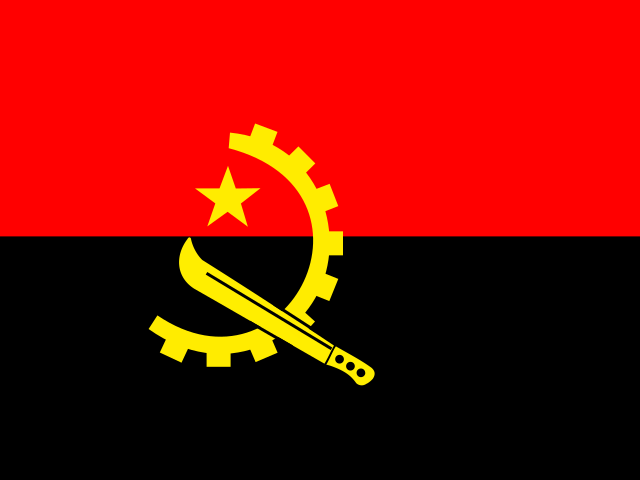 Angola
 Cameroon
 Central African Republic
 Chad
Chad Congo
Congo Democratic Republic of the Congo
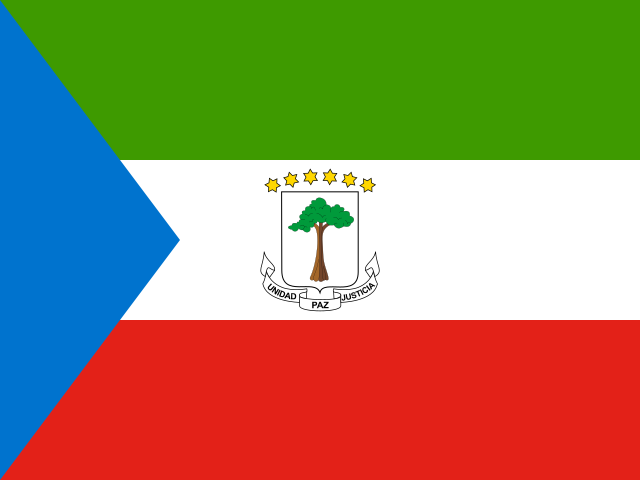 Equatorial Guinea
 Gabon
Gabon Sao Tome and Principe
Earlier Report Observations
Between 2018 and 2023, the market volume for bran, sharps, and residues from cereal and legume processing in Middle Africa increased by 18%, from 531 000 tonnes to 625 000 tonnes. This growth was uneven, with a moderate rise in 2019, a slight contraction in 2020, and a sharp expansion in 2021 that defined the overall upward trend.
The market surge in 2021 was marked by production jumping to 914 000 tonnes, supported by a spike in imports to 21 000 tonnes. Although exports also rose significantly that year, the net effect was a substantial increase in domestic availability. In the following years, production receded slightly but remained well above pre-2021 levels, while imports normalized.
By 2023, the market volume settled at 625 000 tonnes, which represented a 4.9% decrease from the 2022 peak but was still markedly higher than at the start of the period. Concurrently, exports continued their upward trajectory, reaching 289 000 tonnes in 2023, indicating sustained external demand for these processing by-products.
Table of content
- 1. Disclaimer
- 2. Terms of use of the report
- 3. Product codes in the statistical classifications used in the report
-
4. Key Market Indicators and Trends
-
4.1. Key Market Indicators
-
4.1.1. In kind
- 4.1.1.1. Production, 2018-2023
- 4.1.1.2. Imports, 2018-2024
- 4.1.1.3. Exports, 2018-2024
- 4.1.1.4. Market size, 2018-2023
-
4.1.1. In kind
- 4.2. Market Trends and Factors
-
4.1. Key Market Indicators
-
5. Production
-
5.1. Production in Middle Africa
- 5.1.1. Annual dynamics of production in Middle Africa in kind, 2018-2023, K t
-
5.2. Global production by Country, 2018-2023
- 5.2.1. Annual dynamics of production by macroregions in kind, 2018-2023, K t
- 5.2.2. Dynamics of production structure by macroregions in kind, 2018-2023
- 5.2.3. Annual dynamics of production by country in kind, 2018-2023, K t
- 5.2.4. Structure of production by countries in kind, 2018-2023
- 5.2.5. Dynamics of peoduction structure by countries in kind, 2018-2023
-
5.1. Production in Middle Africa
-
6. Exports
-
6.1. Exports (Direct Data*)
- 6.1.1. Exports - Total information
-
6.1.2. Exports in kind, K t
- 6.1.2.1. Annual dynamics of product's exports from Angola in kind, 2018-2024, K t
- 6.1.2.2. Dynamics of product's exports in kind from Angola by countries, 2018-2024, K t
- 6.1.2.3. Structure of product's exports in kind by countries, 2018-2024
-
6.1.3. Exports in value, K $ US
- 6.1.3.1. Annual dynamics of product's exports from Angola in value, 2018-2024, K $ US
- 6.1.3.2. Dynamics of product's exports in value from Angola by countries, 2018-2024, K $ US
- 6.1.3.3. Structure of product's exports in value by countries, 2018-2024
-
6.1.4. Average price of product's exports, $ US/t
- 6.1.4.1. Annual dynamics of average price of product's exports from Angola, 2018-2024, $ US/t
- 6.1.4.2. Dynamics of average price of product's exports from Angola by countries, 2018-2024, $ US/t
-
6.2. Exports (Mirror Data)
- 6.2.1. Exports - Total information
-
6.2.2. Exports in kind, K t
- 6.2.2.1. Annual dynamics of product's exports from Angola in kind, 2018-2024, K t
- 6.2.2.2. Dynamics of product's exports in kind from Angola by countries, 2018-2024, K t
- 6.2.2.3. Structure of product's exports in kind by countries, 2018-2024
-
6.2.3. Exports in value, K $ US
- 6.2.3.1. Annual dynamics of product's exports from Angola in value, 2018-2024, K $ US
- 6.2.3.2. Dynamics of product's exports in value from Angola by countries, 2018-2024, K $ US
- 6.2.3.3. Structure of product's exports in value by countries, 2018-2024
-
6.2.4. Average price of product's exports, $ US/t
- 6.2.4.1. Annual dynamics of average price of product's exports from Angola, 2018-2024, $ US/t
- 6.2.4.2. Dynamics of average price of product's exports from Angola by countries, 2018-2024, $ US/t
-
6.1. Exports (Direct Data*)
-
7. Imports
-
7.1. Imports (Direct Data*)
- 7.1.1. Imports - Total information
-
7.1.2. Imports in kind, K t
- 7.1.2.1. Annual dynamics of product's imports to Angola in kind, 2018-2024, K t
- 7.1.2.2. Dynamics of product's imports in kind to Angola by countries, 2018-2024, K t
- 7.1.2.3. Structure of product's imports in kind by countries, 2018-2024
-
7.1.3. Imports in value, K $ US
- 7.1.3.1. Annual dynamics of product's imports to Angola in value, 2018-2024, K $ US
- 7.1.3.2. Dynamics of product's imports in value to Angola by countries, 2018-2024, K $ US
- 7.1.3.3. Structure of product's imports in value by countries, 2018-2024
-
7.1.4. Average price of product's imports, $ US/t
- 7.1.4.1. Annual dynamics of average price of product's imports to Angola, 2018-2024, $ US/t
- 7.1.4.2. Dynamics of average price of product's imports to Angola by countries, 2018-2024, $ US/t
-
7.2. Imports (Mirror Data)
- 7.2.1. Imports - Total information
-
7.2.2. Imports in kind, K t
- 7.2.2.1. Annual dynamics of product's imports to Angola in kind, 2018-2024, K t
- 7.2.2.2. Dynamics of product's imports in kind to Angola by countries, 2018-2024, K t
- 7.2.2.3. Structure of product's imports in kind by countries, 2018-2024
-
7.2.3. Imports in value, K $ US
- 7.2.3.1. Annual dynamics of product's imports to Angola in value, 2018-2024, K $ US
- 7.2.3.2. Dynamics of product's imports in value to Angola by countries, 2018-2024, K $ US
- 7.2.3.3. Structure of product's imports in value by countries, 2018-2024
-
7.2.4. Average price of product's imports, $ US/t
- 7.2.4.1. Annual dynamics of average price of product's imports to Angola, 2018-2024, $ US/t
- 7.2.4.2. Dynamics of average price of product's imports to Angola by countries, 2018-2024, $ US/t
-
7.1. Imports (Direct Data*)
-
8. Trade balance
-
8.1. Trade balance (Direct Data)
- 8.1.1. In kind, K t
- 8.1.2. In value, K $ US
-
8.2. Trade balance (Mirror Data)
- 8.2.1. In kind, K t
- 8.2.2. In value, K $ US
-
8.1. Trade balance (Direct Data)
-
9. Top buying and selling countries, 2018-2024
-
9.1. Direct Data
- 9.1.1. Import in Value by Countries-buyers
- 9.1.2. Export in Value by Countries-suppliers
-
9.2. Mirror Data
- 9.2.1. Import in Value by Countries-buyers
- 9.2.2. Export in Value by Countries-suppliers
-
9.1. Direct Data
Production bran, sharps and residues from cereal or legume processing in Middle Africa
In kind, 2017-2020, K t
Top producers of bran, sharps and residues from cereal or legume processing, 2017-2020
World map of production of bran, sharps and residues from cereal or legume processing, 2017-2020
After two years of growth, production of bran, sharps, and residues from cereal or legume processing in Middle Africa declined. In 2020, the region produced 754.9 K t, marking a slight year-on-year decrease of 0.6%. Looking at the period from 2017 to 2020, production rose by 19.5%, which translates to an average annual growth rate of 6.1%. The peak was reached in 2019 at 759.3 K t, with the largest annual increase of 11.2% also occurring that year.
Annual dynamics of production in Middle Africa in kind, 2017-2020, K t
| Parameter | 2018 | 2019 | 2020 | CAGR | |
|---|---|---|---|---|---|
| 1 | Change from last year | 8.1% | 11.2% | (0.6%) | 6.1% |
In value, 2017-2020, K $ US
In 2020, the output of bran, sharps, and residues from cereal or legume processing in Middle Africa was valued at 48 270 K $ US, showing a steady increase of 8.2% compared to the previous year. From 2017 to 2020, production value grew by 22.9%, averaging 7.1% per year. The highest value was recorded in 2018 at 51 085 K $ US, which also saw the largest annual increase of 30.1%. In contrast, 2019 experienced the most significant decline of 12.7%.
Annual dynamics of production in Middle Africa in value, 2017-2020, K $ US
| Parameter | 2018 | 2019 | 2020 | CAGR | |
|---|---|---|---|---|---|
| 1 | Change from last year | 30.1% | (12.7%) | 8.2% | 7.1% |
Exports bran, sharps and residues from cereal or legume processing from Middle Africa
Exports in kind, K t
Exports of bran, sharps, and residues from cereal or legume processing from Middle Africa have risen for the third year in a row. In 2020, exports reached 219.2 K t, reflecting a moderate increase of 4.1% over the previous year. Between 2017 and 2020, export volumes surged by 106.6%, equivalent to an annualized growth rate of 27.4%.
Annual dynamics of product's exports from Middle Africa in kind, 2017-2020, K t
| Parameter | 2018 | 2019 | 2020 | CAGR | |
|---|---|---|---|---|---|
| 1 | Change from last year | 44.0% | 37.7% | 4.1% | 27.4% |
From 2017 to 2020, Morocco, Turkey, and France consistently led as the top destinations for exports in kind. Morocco accounted for 68.8% of exports, Turkey for 11.0%, and France for 6.3%. Together, these three countries represented 86.1% of total export flows.
Structure of product's exports in kind by countries, 2017-2020
World map of product's exports from Middle Africa in kind, 2017-2020
Exports in value, K $ US
The value of exported bran, sharps, and residues from cereal or legume processing from Middle Africa has increased for the third consecutive year. In 2020, exports amounted to 14 019 K $ US, up by 13.3% compared to 2019. Over the 2017-2020 period, export value grew by 112.4%, with a compound annual growth rate of 28.5%.
Annual dynamics of product's exports from Middle Africa in value, 2017-2020, K $ US
| Parameter | 2018 | 2019 | 2020 | CAGR | |
|---|---|---|---|---|---|
| 1 | Change from last year | 73.3% | 8.2% | 13.3% | 28.5% |
Between 2017 and 2020, Morocco, Turkey, and France remained the key markets for exports in value terms. Collectively, they accounted for 83.1% of total export flows.
Structure of product's exports in value by countries, 2017-2020
World map of product's exports from Middle Africa in value, 2017-2020
Imports bran, sharps and residues from cereal or legume processing to Middle Africa
Imports in kind, K t
The import market for bran, sharps, and residues from cereal or legume processing in Middle Africa showed significant volatility during these years. The lowest volume was recorded in 2018 at 0.7 K t, while the highest was in 2017, resulting in a peak-to-trough ratio of 42 times. In 2020, imports stood at 1.9 K t, up by 49.3% from the previous year. The largest decline occurred in 2018 at 97.6%, and the largest increase was in 2019 at 85.0%.
Annual dynamics of product's imports to Middle Africa in kind, 2017-2020, K t
| Parameter | 2018 | 2019 | 2020 | CAGR | |
|---|---|---|---|---|---|
| 1 | Change from last year | (97.6%) | 85.0% | 49.3% | (59.7%) |
From 2017 to 2020, Uruguay, Argentina, and Paraguay were the leading suppliers of bran, sharps, and residues from cereal or legume processing to Middle Africa in terms of volume. Uruguay contributed 39.5% of imports, Argentina 27.1%, and Paraguay 15.4%. Together, they made up 82.0% of total imports in kind.
Structure of product's imports in kind by countries, 2017-2020
World map of product's imports to Middle Africa in kind, 2017-2020
Imports in value, K $ US
Import values for bran, sharps, and residues from cereal or legume processing in Middle Africa displayed irregular changes, pointing to a volatile market. The lowest value was in 2019 at 414 K $ US, while the peak was in 2017, with a difference of 6.7 times between these years. In 2020, imports reached 1 253 K $ US, showing a sharp increase of 202.7% from 2019. The largest decline was recorded in 2018 at 79.0%.
Annual dynamics of product's imports to Middle Africa in value, 2017-2020, K $ US
| Parameter | 2018 | 2019 | 2020 | CAGR | |
|---|---|---|---|---|---|
| 1 | Change from last year | (79.0%) | (28.9%) | 202.7% | (23.3%) |
Over the 2017-2020 period, Argentina, Paraguay, and Portugal were the top contributors to imports in value terms. Argentina accounted for 35.2% of imports, Paraguay for 14.4%, and Portugal for 13.4%. Combined, they represented 63.0% of total import flows.
Structure of product's imports in value by countries, 2017-2020
World map of product's imports to Middle Africa in value, 2017-2020
Related Reports

Groundnutoil-cake market in Middle Africa
2026-03-29


Cottonseed oil-cake market in Middle Africa
2026-03-29

Why Choose Us?
Only Verified Data
No Hidden Costs or Separate Fees
Smarter Subscription Pricing
Contact Our Team
Submit your inquiry using the form below — our team will get back to you within 24 hours.