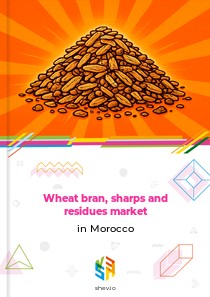







Earlier Report Observations
Between 2018 and 2020, the market volume for wheat bran, sharps and residues in Morocco expanded from 1 186 thousand tons to a peak of 1 375 thousand tons. This growth was primarily driven by a sharp increase in imports, which rose from 211 thousand tons to 390 thousand tons over the same period, while domestic production showed modest growth. During these years, broader agricultural developments such as the adoption of wheat yield modeling for better planning and enhanced focus on agricultural residue management and water use efficiency likely supported the overall supply chain for wheat by-products.
Following the 2020 peak, the market contracted to 1 223 thousand tons in 2021 and remained at that level in 2022, before a modest recovery to 1 273 thousand tons in 2023. Imports fell back significantly after 2020 but remained a key component of supply, while domestic production continued its steady climb, reaching 1 013 thousand tons in 2023. The general trend in Moroccan agriculture toward aligning with international quality and safety standards provided a stable backdrop for the market in the later years of the period.
Table of content
- 1. Disclaimer
- 2. Terms of use of the report
- 3. Product codes in the statistical classifications used in the report
-
4. Key Market Indicators and Trends
-
4.1. Key Market Indicators
-
4.1.1. In kind
- 4.1.1.1. Production, 2018-2023
- 4.1.1.2. Imports, 2018-2024
- 4.1.1.3. Exports, 2018-2024
- 4.1.1.4. Market size, 2018-2023
-
4.1.1. In kind
- 4.2. Market Trends and Factors
-
4.1. Key Market Indicators
-
5. Production
-
5.1. Production in Morocco
- 5.1.1. Annual dynamics of production in Morocco in kind, 2018-2023, K t
- 5.1.2. Annual dynamics of production in Morocco in value, 2018-2023, $ US
-
5.2. Global production by Country, 2018-2023
- 5.2.1. Annual dynamics of production by macroregions in kind, 2018-2023, K t
- 5.2.2. Dynamics of production structure by macroregions in kind, 2018-2023
- 5.2.3. Annual dynamics of production by country in kind, 2018-2023, K t
- 5.2.4. Structure of production by countries in kind, 2018-2023
- 5.2.5. Dynamics of peoduction structure by countries in kind, 2018-2023
-
5.1. Production in Morocco
-
6. Imports
-
6.1. Imports (Direct Data)
- 6.1.1. Imports - Total information
-
6.1.2. Imports in kind, K t
- 6.1.2.1. Annual dynamics of product's imports to Morocco in kind, 2018-2024, K t
- 6.1.2.2. Dynamics of product's imports in kind to Morocco by countries, 2018-2024, K t
- 6.1.2.3. Structure of product's imports in kind by countries, 2018-2024
-
6.1.3. Imports in value, K $ US
- 6.1.3.1. Annual dynamics of product's imports to Morocco in value, 2018-2024, K $ US
- 6.1.3.2. Dynamics of product's imports in value to Morocco by countries, 2018-2024, K $ US
- 6.1.3.3. Structure of product's imports in value by countries, 2018-2024
-
6.1.4. Average price of product's imports, $ US/t
- 6.1.4.1. Annual dynamics of average price of product's imports to Morocco, 2018-2024, $ US/t
- 6.1.4.2. Dynamics of average price of product's imports to Morocco by countries, 2018-2024, $ US/t
-
6.2. Imports (Mirror Data)
- 6.2.1. Imports - Total information
-
6.2.2. Imports in kind, K t
- 6.2.2.1. Annual dynamics of product's imports to Morocco in kind, 2018-2024, K t
- 6.2.2.2. Dynamics of product's imports in kind to Morocco by countries, 2018-2024, K t
- 6.2.2.3. Structure of product's imports in kind by countries, 2018-2024
-
6.2.3. Imports in value, K $ US
- 6.2.3.1. Annual dynamics of product's imports to Morocco in value, 2018-2024, K $ US
- 6.2.3.2. Dynamics of product's imports in value to Morocco by countries, 2018-2024, K $ US
- 6.2.3.3. Structure of product's imports in value by countries, 2018-2024
-
6.2.4. Average price of product's imports, $ US/t
- 6.2.4.1. Annual dynamics of average price of product's imports to Morocco, 2018-2024, $ US/t
- 6.2.4.2. Dynamics of average price of product's imports to Morocco by countries, 2018-2024, $ US/t
-
6.1. Imports (Direct Data)
-
7. Trade balance
-
7.1. Trade balance (Direct Data)
- 7.1.1. In kind, K t
- 7.1.2. In value, K $ US
-
7.2. Trade balance (Mirror Data)
- 7.2.1. In kind, K t
- 7.2.2. In value, K $ US
-
7.1. Trade balance (Direct Data)
-
8. Top buying and selling countries, 2018-2024
-
8.1. Direct Data
- 8.1.1. Import in Value by Countries-buyers
- 8.1.2. Export in Value by Countries-suppliers
-
8.2. Mirror Data
- 8.2.1. Import in Value by Countries-buyers
- 8.2.2. Export in Value by Countries-suppliers
-
8.1. Direct Data
Production wheat bran, sharps and residues in Morocco
In kind, 2017-2020, K t
Between 2017 and 2020, Morocco ranked as the 19th largest global producer of wheat bran, sharps, and residues.
Top producers of wheat bran, sharps and residues, 2017-2020
World map of production of wheat bran, sharps and residues, 2017-2020
In 2020, Morocco produced 985.2 K t of wheat bran, sharps, and residues, marking a 2.0% increase from the previous year. The most significant production decline occurred in 2019, with a drop of 1.0%.
Annual dynamics of production in Morocco in kind, 2017-2020, K t
| Parameter | 2018 | 2019 | 2020 | CAGR | |
|---|---|---|---|---|---|
| 1 | Change from last year | 1.0% | (1.0%) | 2.0% | 0.7% |
Exports wheat bran, sharps and residues from Morocco
Market analysis indicates that Morocco did not export any wheat bran, sharps, or residues from 2017 through 2020.
Imports wheat bran, sharps and residues to Morocco
Imports in kind, K t
Morocco's imports of wheat bran, sharps, and residues grew for the second year in a row in 2020, reaching 390.1 K t—a sharp 29.9% rise compared to 2019. Over the 2017–2020 period, imports surged by 58%, averaging an annual growth rate of 16.5%. The lowest import volume was in 2018 at 210.5 K t, which also saw the largest decline of 14.8%. In contrast, 2019 recorded the biggest increase at 42.7%.
Annual dynamics of product's imports to Morocco in kind, 2017-2020, K t
| Parameter | 2018 | 2019 | 2020 | CAGR | |
|---|---|---|---|---|---|
| 1 | Change from last year | (14.8%) | 42.7% | 29.9% | 16.5% |
From 2017 to 2020, Nigeria, the Democratic Republic of the Congo, and Argentina were the top three sources for Morocco's imports of wheat bran, sharps, and residues, collectively making up 59.6% of the total volume.
Structure of product's imports in kind by countries, 2017-2020
World map of product's imports to Morocco in kind, 2017-2020
Imports in value, K $ US
Morocco's import value for wheat bran, sharps, and residues continued to climb in 2020, totaling 71 941 K $ US—a 35.6% jump from the previous year. Between 2017 and 2020, import value rose by 89.9%, with a compound annual growth rate of 23.8%. The lowest value was in 2018 at 37 407 K $ US, which also experienced the largest decline of 1.2%. The most substantial increase occurred in 2019, at 41.9%.
Annual dynamics of product's imports to Morocco in value, 2017-2020, K $ US
| Parameter | 2018 | 2019 | 2020 | CAGR | |
|---|---|---|---|---|---|
| 1 | Change from last year | (1.2%) | 41.9% | 35.6% | 23.8% |
During 2017–2020, Nigeria (24.2% of import value), the Democratic Republic of the Congo (22.1%), and Argentina (13.4%) were the leading suppliers of wheat bran, sharps, and residues to Morocco, together accounting for 59.8% of total import value.
Structure of product's imports in value by countries, 2017-2020
World map of product's imports to Morocco in value, 2017-2020
Related Reports


Groundnutoil-cake market in Morocco
2026-03-29


Sunflower-seed oilcake market in Morocco
2026-03-29
Why Choose Us?
Only Verified Data
No Hidden Costs or Separate Fees
Smarter Subscription Pricing
Contact Our Team
Submit your inquiry using the form below — our team will get back to you within 24 hours.