






"Africa" region includes following countries:
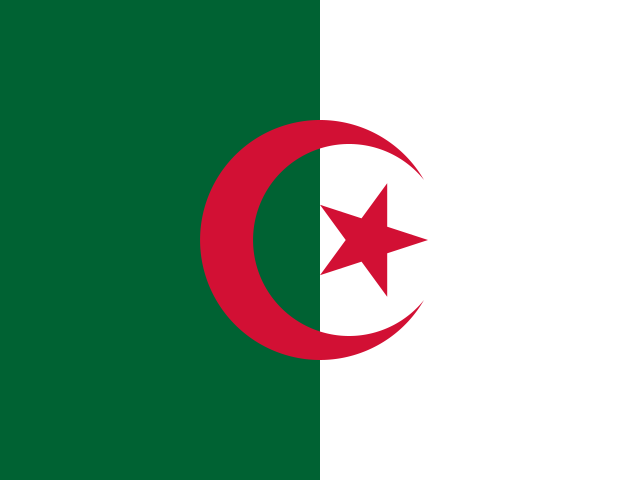 Algeria
 Libya
Libya Morocco
 Sudan
Sudan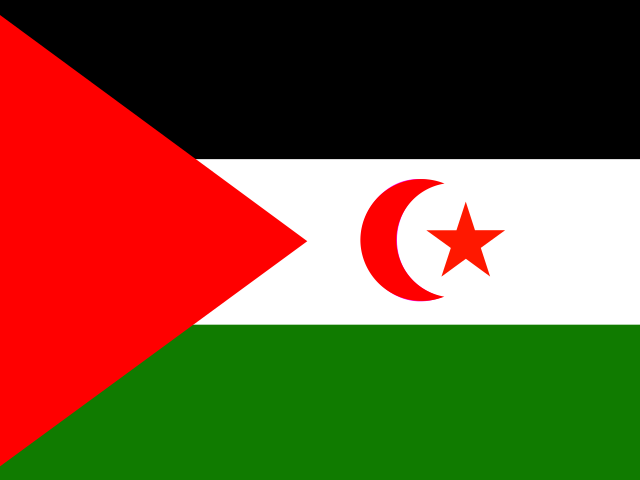 Western Sahara
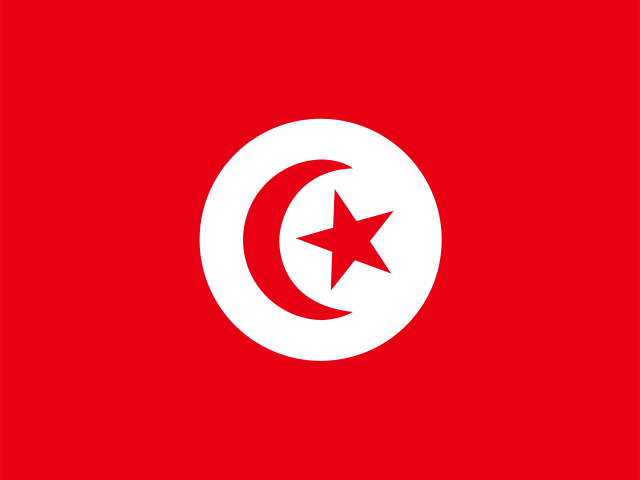 Tunisia
 Egypt
Egypt Cabo Verde
 Benin
Benin Gambia
 Ghana
Ghana Guinea
 Côte d'Ivoire
 Liberia
 Mali
Mali Mauritania
 Niger
Niger Nigeria
 Guinea-Bissau
 Saint Helena, Ascension and Tristan da Cunha
 Senegal
 Sierra Leone
 Togo
Togo Burkina Faso
 British Indian Ocean Territory
 Burundi
 Comoros
 Mayotte
 Ethiopia
 Eritrea
 French Southern Territories
 Djibouti
 Kenya
Kenya Madagascar
 Malawi
 Mauritius
 Mozambique
 Reunion
 Rwanda
 Seychelles
 Somalia
 Zimbabwe
 South Sudan
 Uganda
 Tanzania
 Zambia
 Angola
 Cameroon
 Central African Republic
 Chad
Chad Congo
Congo Democratic Republic of the Congo
 Equatorial Guinea
 Gabon
Gabon Sao Tome and Principe
 Botswana
 Lesotho
 Namibia
 South Africa
 Eswatini
Earlier Report Observations
From 2018 to 2020, production of wheat bran and residues increased from 10 095 thousand tonnes to 10 688 thousand tonnes, while market volume grew from 9 771 thousand tonnes to 10 125 thousand tonnes. This expansion was supported by the deregulation of maize and wheat boards, which encouraged the entry of new small and medium-scale millers aiming to establish their operations and client bases. Concurrently, the area planted with wheat, barley, and canola expanded due to favorable commodity prices and climatic conditions, boosting raw material availability for milling.
Between 2021 and 2023, market volume stabilized around 10 000 thousand tonnes with minor fluctuations, as production reached 11 017 thousand tonnes in 2021 before moderating. During this period, wheat bran and sharps found growing application in farm feeds and pet foods, supporting consumption. However, transport costs remained a significant factor affecting profitability, with industry calls to increase milling capacity in the Western Cape to reduce logistics expenses. The market also saw major players like Tiger Brands facing profitability pressures, while artisanal manufacturers gained traction by catering to consumer preferences for healthier and specialty products.
In 2024, major companies like Tiger Brands announced the sale of a maize mill due to profitability pressures, while smaller millers gained market share. The wheat tariff was maintained to stabilize local consumption, and transport costs continued to be a key issue, with calls to expand milling capacity in the Western Cape. Consumer preferences shifted towards artisanal and specialty wheat products.
Table of content
- 1. Disclaimer
- 2. Terms of use of the report
- 3. Product codes in the statistical classifications used in the report
-
4. Key Market Indicators and Trends
-
4.1. Key Market Indicators
-
4.1.1. In kind
- 4.1.1.1. Production, 2018-2023
- 4.1.1.2. Imports, 2018-2024
- 4.1.1.3. Exports, 2018-2024
- 4.1.1.4. Market size, 2018-2023
-
4.1.1. In kind
- 4.2. Market Trends and Factors
-
4.1. Key Market Indicators
-
5. Production
-
5.1. Production in Africa
- 5.1.1. Annual dynamics of production in Africa in kind, 2018-2023, K t
-
5.2. Global production by Country, 2018-2023
- 5.2.1. Annual dynamics of production by macroregions in kind, 2018-2023, K t
- 5.2.2. Dynamics of production structure by macroregions in kind, 2018-2023
- 5.2.3. Annual dynamics of production by country in kind, 2018-2023, K t
- 5.2.4. Structure of production by countries in kind, 2018-2023
- 5.2.5. Dynamics of peoduction structure by countries in kind, 2018-2023
-
5.1. Production in Africa
-
6. Exports
-
6.1. Exports (Direct Data*)
- 6.1.1. Exports - Total information
-
6.1.2. Exports in kind, K t
- 6.1.2.1. Annual dynamics of product's exports from Algeria in kind, 2018-2024, K t
- 6.1.2.2. Dynamics of product's exports in kind from Algeria by countries, 2018-2024, K t
- 6.1.2.3. Structure of product's exports in kind by countries, 2018-2024
-
6.1.3. Exports in value, M $ US
- 6.1.3.1. Annual dynamics of product's exports from Algeria in value, 2018-2024, M $ US
- 6.1.3.2. Dynamics of product's exports in value from Algeria by countries, 2018-2024, M $ US
- 6.1.3.3. Structure of product's exports in value by countries, 2018-2024
-
6.1.4. Average price of product's exports, $ US/t
- 6.1.4.1. Annual dynamics of average price of product's exports from Algeria, 2018-2024, $ US/t
- 6.1.4.2. Dynamics of average price of product's exports from Algeria by countries, 2018-2024, $ US/t
-
6.2. Exports (Mirror Data)
- 6.2.1. Exports - Total information
-
6.2.2. Exports in kind, K t
- 6.2.2.1. Annual dynamics of product's exports from Algeria in kind, 2018-2024, K t
- 6.2.2.2. Dynamics of product's exports in kind from Algeria by countries, 2018-2024, K t
- 6.2.2.3. Structure of product's exports in kind by countries, 2018-2024
-
6.2.3. Exports in value, M $ US
- 6.2.3.1. Annual dynamics of product's exports from Algeria in value, 2018-2024, M $ US
- 6.2.3.2. Dynamics of product's exports in value from Algeria by countries, 2018-2024, M $ US
- 6.2.3.3. Structure of product's exports in value by countries, 2018-2024
-
6.2.4. Average price of product's exports, $ US/t
- 6.2.4.1. Annual dynamics of average price of product's exports from Algeria, 2018-2024, $ US/t
- 6.2.4.2. Dynamics of average price of product's exports from Algeria by countries, 2018-2024, $ US/t
-
6.1. Exports (Direct Data*)
-
7. Imports
-
7.1. Imports (Direct Data*)
- 7.1.1. Imports - Total information
-
7.1.2. Imports in kind, K t
- 7.1.2.1. Annual dynamics of product's imports to Algeria in kind, 2018-2024, K t
- 7.1.2.2. Dynamics of product's imports in kind to Algeria by countries, 2018-2024, K t
- 7.1.2.3. Structure of product's imports in kind by countries, 2018-2024
-
7.1.3. Imports in value, M $ US
- 7.1.3.1. Annual dynamics of product's imports to Algeria in value, 2018-2024, M $ US
- 7.1.3.2. Dynamics of product's imports in value to Algeria by countries, 2018-2024, M $ US
- 7.1.3.3. Structure of product's imports in value by countries, 2018-2024
-
7.1.4. Average price of product's imports, $ US/t
- 7.1.4.1. Annual dynamics of average price of product's imports to Algeria, 2018-2024, $ US/t
- 7.1.4.2. Dynamics of average price of product's imports to Algeria by countries, 2018-2024, $ US/t
-
7.2. Imports (Mirror Data)
- 7.2.1. Imports - Total information
-
7.2.2. Imports in kind, K t
- 7.2.2.1. Annual dynamics of product's imports to Algeria in kind, 2018-2024, K t
- 7.2.2.2. Dynamics of product's imports in kind to Algeria by countries, 2018-2024, K t
- 7.2.2.3. Structure of product's imports in kind by countries, 2018-2024
-
7.2.3. Imports in value, M $ US
- 7.2.3.1. Annual dynamics of product's imports to Algeria in value, 2018-2024, M $ US
- 7.2.3.2. Dynamics of product's imports in value to Algeria by countries, 2018-2024, M $ US
- 7.2.3.3. Structure of product's imports in value by countries, 2018-2024
-
7.2.4. Average price of product's imports, $ US/t
- 7.2.4.1. Annual dynamics of average price of product's imports to Algeria, 2018-2024, $ US/t
- 7.2.4.2. Dynamics of average price of product's imports to Algeria by countries, 2018-2024, $ US/t
-
7.1. Imports (Direct Data*)
-
8. Trade balance
-
8.1. Trade balance (Direct Data)
- 8.1.1. In kind, K t
- 8.1.2. In value, M $ US
-
8.2. Trade balance (Mirror Data)
- 8.2.1. In kind, K t
- 8.2.2. In value, M $ US
-
8.1. Trade balance (Direct Data)
-
9. Top buying and selling countries, 2018-2024
-
9.1. Direct Data
- 9.1.1. Import in Value by Countries-buyers
- 9.1.2. Export in Value by Countries-suppliers
-
9.2. Mirror Data
- 9.2.1. Import in Value by Countries-buyers
- 9.2.2. Export in Value by Countries-suppliers
-
9.1. Direct Data
Production wheat bran, sharps and residues in Africa
In kind, 2017-2020, K t
Top producers of wheat bran, sharps and residues, 2017-2020
World map of production of wheat bran, sharps and residues, 2017-2020
Africa's production of wheat bran, sharps, and residues has grown for the third year in a row. In 2020, the continent produced 10 688 thousand tons, marking a modest year-over-year increase of 1.7%. Looking at the period from 2017 to 2020, production rose by 8.5%, with an average annual growth rate of 2.8%.
Annual dynamics of production in Africa in kind, 2017-2020, K t
| Parameter | 2018 | 2019 | 2020 | CAGR | |
|---|---|---|---|---|---|
| 1 | Change from last year | 2.5% | 4.1% | 1.7% | 2.8% |
Exports wheat bran, sharps and residues from Africa
Exports in kind, K t
Africa's exports of wheat bran, sharps, and residues have increased for the second consecutive year. In 2020, exports totaled 986.8 thousand tons, up 2.9% from the previous year. Over the 2017-2020 period, exports grew by 34.3%, averaging 10.3% per year. The lowest export volume was in 2018 at 670.2 thousand tons, which saw the largest decline of 8.8%. In contrast, 2019 recorded the biggest increase at 43.0%.
Annual dynamics of product's exports from Africa in kind, 2017-2020, K t
| Parameter | 2018 | 2019 | 2020 | CAGR | |
|---|---|---|---|---|---|
| 1 | Change from last year | (8.8%) | 43.0% | 2.9% | 10.3% |
From 2017 to 2020, Africa's exports in kind were spread across numerous partner countries. Vietnam accounted for 10.4% of exports, the United Arab Emirates for 9.9%, and Qatar for 7.1%. Together, these three countries made up just 27.3% of total export flows.
Structure of product's exports in kind by countries, 2017-2020
World map of product's exports from Africa in kind, 2017-2020
Exports in value, M $ US
In 2020, Africa's wheat bran, sharps, and residues exports reached 157.7 million US dollars, a 10.7% increase from 2019. Between 2017 and 2020, exports rose by 37.2%, with an annualized growth rate of 11.1%. The highest value was in 2018 at 157.9 million US dollars, which also saw the largest increase of 37.5%. The biggest decline occurred in 2019, dropping by 9.8%.
Annual dynamics of product's exports from Africa in value, 2017-2020, M $ US
| Parameter | 2018 | 2019 | 2020 | CAGR | |
|---|---|---|---|---|---|
| 1 | Change from last year | 37.5% | (9.8%) | 10.7% | 11.1% |
The partner structure for exports in value terms from 2017 to 2020 was fragmented. Vietnam contributed 23.3% of export value, the United Arab Emirates 8.5%, and Qatar 7.6%. Combined, these three countries accounted for only 39.4% of total flows, with no single country holding a dominant share.
Structure of product's exports in value by countries, 2017-2020
World map of product's exports from Africa in value, 2017-2020
Imports wheat bran, sharps and residues to Africa
Imports in kind, K t
After two years of decline, Africa's imports of wheat bran, sharps, and residues rebounded in 2020. Imports reached 423.5 thousand tons, a significant 43.2% increase from 2019. However, over the 2017-2020 period, imports fell by 33.5%, averaging a 12.7% annual decrease. The lowest import volume was in 2019 at 295.7 thousand tons, while the largest decline of 45.6% occurred in 2018.
Annual dynamics of product's imports to Africa in kind, 2017-2020, K t
| Parameter | 2018 | 2019 | 2020 | CAGR | |
|---|---|---|---|---|---|
| 1 | Change from last year | (45.6%) | (14.7%) | 43.2% | (12.7%) |
Analysis of imports in kind from 2017 to 2020 shows a broad distribution across many markets. Yemen accounted for 9.4% of imports, Italy for 8.0%, and Argentina for 5.6%. Together, these three countries represented only 22.9% of total import flows, with the remaining 77.1% coming from other partners.
Structure of product's imports in kind by countries, 2017-2020
World map of product's imports to Africa in kind, 2017-2020
Imports in value, M $ US
Following a two-year downturn, Africa's imports of wheat bran, sharps, and residues increased in 2020. Imports amounted to 142.5 million US dollars, a sharp rise of 36.8% from the previous year. Over the 2017-2020 period, imports grew by 27.5%, with an annualized rate of 8.4%. The lowest value was in 2019 at 104.1 million US dollars, which also saw the largest decline of 4.0%.
Annual dynamics of product's imports to Africa in value, 2017-2020, M $ US
| Parameter | 2018 | 2019 | 2020 | CAGR | |
|---|---|---|---|---|---|
| 1 | Change from last year | (2.9%) | (4.0%) | 36.8% | 8.4% |
From 2017 to 2020, Yemen, Italy, and Argentina were the largest suppliers of wheat bran, sharps, and residues to Africa in value terms, contributing 9.9%, 9.1%, and 6.4% respectively. However, their combined share was limited to 25.3% of total imports, reflecting a diversified country structure.
Structure of product's imports in value by countries, 2017-2020
World map of product's imports to Africa in value, 2017-2020
Related Reports


Linseed oil-cake market in Africa
2026-03-29

Palm-kernel oilcake market in Africa
2026-03-29

Starch-manufacture residues market in Africa
2026-03-29

Coconut oilcake market in Africa
2026-03-29
Why Choose Us?
Only Verified Data
No Hidden Costs or Separate Fees
Smarter Subscription Pricing
Contact Our Team
Submit your inquiry using the form below — our team will get back to you within 24 hours.