






"SADC" region includes following countries:
 Angola
 Botswana
 Comoros
 Democratic Republic of the Congo
 Eswatini
 Lesotho
 Madagascar
 Malawi
 Mauritius
 Mozambique
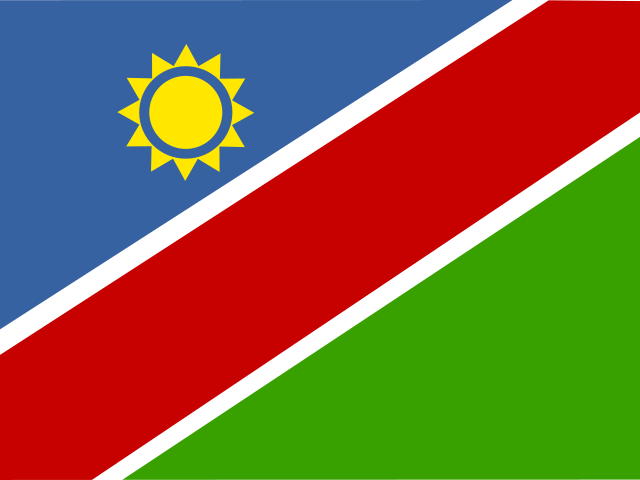 Namibia
 Seychelles
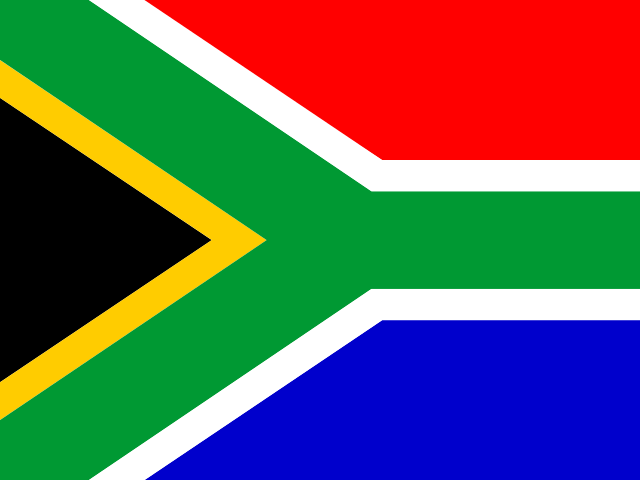 South Africa
 Tanzania
 Zambia
 Zimbabwe
Earlier Report Observations
The market for fresh watermelons in SADC grew rapidly, with volume expanding from 162 thousand tons in 2018 to 338 thousand tons in 2020. This period of strong growth established a significantly larger production base for the region.
Market volume contracted to 325.5 thousand tons in 2021 due to substantial crop losses from the outbreak of cucurbit yellow stunting disorder virus in key South African growing areas. A recovery followed in 2022, with volume reaching 348.9 thousand tons, supported by maize growers planting watermelons as a strategic crop for quicker returns.
Volume eased to 339.4 thousand tons in 2023. By 2024, the market experienced an oversupply that led to a sharp price drop and reports of unharvested fruit. A Fresh Produce Market Inquiry was initiated to examine competition barriers, while consumer preferences showed a notable shift towards smaller, icebox-type watermelons.
Table of content
- 1. Disclaimer
- 2. Terms of use of the report
- 3. Product codes in the statistical classifications used in the report
-
4. Key Market Indicators and Trends
-
4.1. Key Market Indicators
-
4.1.1. In kind
- 4.1.1.1. Production, 2018-2023
- 4.1.1.2. Imports, 2018-2024
- 4.1.1.3. Exports, 2018-2024
- 4.1.1.4. Market size, 2018-2023
-
4.1.1. In kind
- 4.2. Market Trends and Factors
-
4.1. Key Market Indicators
-
5. Production
-
5.1. Production in SADC
- 5.1.1. Annual dynamics of production in SADC in kind, 2018-2023, K t
-
5.2. Global production by Country, 2018-2023
- 5.2.1. Annual dynamics of production by macroregions in kind, 2018-2023, K t
- 5.2.2. Dynamics of production structure by macroregions in kind, 2018-2023
- 5.2.3. Annual dynamics of production by country in kind, 2018-2023, K t
- 5.2.4. Structure of production by countries in kind, 2018-2023
- 5.2.5. Dynamics of peoduction structure by countries in kind, 2018-2023
-
5.1. Production in SADC
-
6. Imports
-
6.1. Imports (Direct Data*)
- 6.1.1. Imports - Total information
-
6.1.2. Imports in kind, t
- 6.1.2.1. Annual dynamics of product's imports to Angola in kind, 2018-2024, t
- 6.1.2.2. Dynamics of product's imports in kind to Angola by countries, 2018-2024, t
- 6.1.2.3. Structure of product's imports in kind by countries, 2018-2024
-
6.1.3. Imports in value, K $ US
- 6.1.3.1. Annual dynamics of product's imports to Angola in value, 2018-2024, K $ US
- 6.1.3.2. Dynamics of product's imports in value to Angola by countries, 2018-2024, K $ US
- 6.1.3.3. Structure of product's imports in value by countries, 2018-2024
-
6.1.4. Average price of product's imports, $ US/t
- 6.1.4.1. Annual dynamics of average price of product's imports to Angola, 2018-2024, $ US/t
- 6.1.4.2. Dynamics of average price of product's imports to Angola by countries, 2018-2024, $ US/t
-
6.2. Imports (Mirror Data)
- 6.2.1. Imports - Total information
-
6.2.2. Imports in kind, t
- 6.2.2.1. Annual dynamics of product's imports to Angola in kind, 2018-2024, t
- 6.2.2.2. Dynamics of product's imports in kind to Angola by countries, 2018-2024, t
- 6.2.2.3. Structure of product's imports in kind by countries, 2018-2024
-
6.2.3. Imports in value, K $ US
- 6.2.3.1. Annual dynamics of product's imports to Angola in value, 2018-2024, K $ US
- 6.2.3.2. Dynamics of product's imports in value to Angola by countries, 2018-2024, K $ US
- 6.2.3.3. Structure of product's imports in value by countries, 2018-2024
-
6.2.4. Average price of product's imports, $ US/t
- 6.2.4.1. Annual dynamics of average price of product's imports to Angola, 2018-2024, $ US/t
- 6.2.4.2. Dynamics of average price of product's imports to Angola by countries, 2018-2024, $ US/t
-
6.1. Imports (Direct Data*)
-
7. Exports
-
7.1. Exports (Direct Data*)
- 7.1.1. Exports - Total information
-
7.1.2. Exports in kind, t
- 7.1.2.1. Annual dynamics of product's exports from Angola in kind, 2018-2024, t
- 7.1.2.2. Dynamics of product's exports in kind from Angola by countries, 2018-2024, t
- 7.1.2.3. Structure of product's exports in kind by countries, 2018-2024
-
7.1.3. Exports in value, K $ US
- 7.1.3.1. Annual dynamics of product's exports from Angola in value, 2018-2024, K $ US
- 7.1.3.2. Dynamics of product's exports in value from Angola by countries, 2018-2024, K $ US
- 7.1.3.3. Structure of product's exports in value by countries, 2018-2024
-
7.1.4. Average price of product's exports, $ US/t
- 7.1.4.1. Annual dynamics of average price of product's exports from Angola, 2018-2024, $ US/t
- 7.1.4.2. Dynamics of average price of product's exports from Angola by countries, 2018-2024, $ US/t
-
7.2. Exports (Mirror Data)
- 7.2.1. Exports - Total information
-
7.2.2. Exports in kind, t
- 7.2.2.1. Annual dynamics of product's exports from Angola in kind, 2018-2024, t
- 7.2.2.2. Dynamics of product's exports in kind from Angola by countries, 2018-2024, t
- 7.2.2.3. Structure of product's exports in kind by countries, 2018-2024
-
7.2.3. Exports in value, K $ US
- 7.2.3.1. Annual dynamics of product's exports from Angola in value, 2018-2024, K $ US
- 7.2.3.2. Dynamics of product's exports in value from Angola by countries, 2018-2024, K $ US
- 7.2.3.3. Structure of product's exports in value by countries, 2018-2024
-
7.2.4. Average price of product's exports, $ US/t
- 7.2.4.1. Annual dynamics of average price of product's exports from Angola, 2018-2024, $ US/t
- 7.2.4.2. Dynamics of average price of product's exports from Angola by countries, 2018-2024, $ US/t
-
7.1. Exports (Direct Data*)
-
8. Trade balance
-
8.1. Trade balance (Direct Data)
- 8.1.1. In kind, t
- 8.1.2. In value, K $ US
-
8.2. Trade balance (Mirror Data)
- 8.2.1. In kind, t
- 8.2.2. In value, K $ US
-
8.1. Trade balance (Direct Data)
-
9. Top buying and selling countries, 2018-2024
-
9.1. Direct Data
- 9.1.1. Import in Value by Countries-buyers
- 9.1.2. Export in Value by Countries-suppliers
-
9.2. Mirror Data
- 9.2.1. Import in Value by Countries-buyers
- 9.2.2. Export in Value by Countries-suppliers
-
9.1. Direct Data
Production watermelons in SADC
In kind, 2017-2020, K t
Top producers of watermelons, 2017-2020
World map of production of watermelons, 2017-2020
SADC's watermelon production volume increased for the second consecutive year. In 2020, the region produced 339.4 thousand tonnes of watermelons, marking a 28.2% increase compared to 2019. Over the period from 2017 to 2020, production grew by 109.2%, which translates to an annualized growth rate of 27.9%. The lowest production level was recorded in 2018 at 160.8 thousand tonnes, with the largest decline that year at 0.9%. The most significant increase occurred in 2019, when production surged by 64.7%.
Annual dynamics of production in SADC in kind, 2017-2020, K t
| Parameter | 2018 | 2019 | 2020 | CAGR | |
|---|---|---|---|---|---|
| 1 | Change from last year | (0.9%) | 64.7% | 28.2% | 27.9% |
Exports watermelons from SADC
Exports in kind, t
The market showed an unstable trend throughout the period. Export volumes reached their lowest point in 2017 and peaked in 2019, representing a 4.1-fold difference between these years. In 2020, SADC exported 2 810 tonnes of watermelons, a decrease of 39.0% year-on-year. The highest export volume was recorded in 2019 at 4 607 tonnes, with the largest increase that year at 209.5%.
Annual dynamics of product's exports from SADC in kind, 2017-2020, t
| Parameter | 2018 | 2019 | 2020 | CAGR | |
|---|---|---|---|---|---|
| 1 | Change from last year | 31.1% | 209.5% | (39.0%) | 35.2% |
From 2017 to 2020, watermelon exports from SADC were distributed across a wide range of partner countries. Kenya accounted for 11.2% of exports in kind, the United Kingdom for 7.4%, and the United Arab Emirates for 1.6%. Together, these three countries represented just 20.2% of total export flows.
Structure of product's exports in kind by countries, 2017-2020
World map of product's exports from SADC in kind, 2017-2020
Exports in value, K $ US
The data reveals irregular changes, indicating a volatile market environment. Export values reached their lowest point in 2020 and peaked in 2019, with a 2.8-fold gap between these years. In 2020, SADC exported watermelons worth 1 266 thousand US dollars, a decrease of 64.4% compared to the previous year. The highest export value was recorded in 2019 at 3 559 thousand US dollars, with the largest increase that year at 106.9%.
Annual dynamics of product's exports from SADC in value, 2017-2020, K $ US
| Parameter | 2018 | 2019 | 2020 | CAGR | |
|---|---|---|---|---|---|
| 1 | Change from last year | 6.0% | 106.9% | (64.4%) | (7.9%) |
From 2017 to 2020, the country structure of watermelon exports in value terms remained highly diversified. The United Kingdom accounted for 27.1% of exports in value terms, Ethiopia for 3.2%, and the United Arab Emirates for 2.0%. Together, these three countries represented only 32.4% of total export flows, while a long tail of smaller markets made up the remaining 67.6%.
Structure of product's exports in value by countries, 2017-2020
World map of product's exports from SADC in value, 2017-2020
Imports watermelons to SADC
Imports in kind, t
After a two-year uptick, cross-border shipments of watermelons to SADC declined. In 2020, SADC imported 1 510 tonnes of watermelons, down by 59.3% compared to 2019. Over the period from 2017 to 2020, imports decreased by 35.3%, equating to an annualized decline rate of 13.5%. The highest import volume was recorded in 2019 at 3 709 tonnes, with the largest increase that year at 38.0%.
Annual dynamics of product's imports to SADC in kind, 2017-2020, t
| Parameter | 2018 | 2019 | 2020 | CAGR | |
|---|---|---|---|---|---|
| 1 | Change from last year | 15.2% | 38.0% | (59.3%) | (13.5%) |
From 2017 to 2020, the partner structure for watermelon imports in kind was balanced rather than concentrated. Egypt accounted for 7.3% of imports in kind, Australia for 1.6%, and Turkey for 1.3%. Together, these three countries represented 10.2% of total import flows, while many other countries accounted for the remaining 89.8%.
Structure of product's imports in kind by countries, 2017-2020
World map of product's imports to SADC in kind, 2017-2020
Imports in value, K $ US
After a two-year gain, watermelon shipments to SADC from abroad declined. In 2020, import volume came to 1 411 thousand US dollars, down by 46.7% compared to 2019. Over the period from 2017 to 2020, imports decreased by 27.6%, with a compound annual growth rate of -10.2%. The highest import value was recorded in 2019 at 2 645 thousand US dollars, with the largest increase in 2018 at 21.2%.
Annual dynamics of product's imports to SADC in value, 2017-2020, K $ US
| Parameter | 2018 | 2019 | 2020 | CAGR | |
|---|---|---|---|---|---|
| 1 | Change from last year | 21.2% | 12.0% | (46.7%) | (10.2%) |
From 2017 to 2020, the portfolio of suppliers for watermelons to SADC was broad. Egypt accounted for 21.9% of imports in value terms, Australia for 6.3%, and Turkey for 2.1%. Together, these three countries contributed only 30.3% of total imports in value terms, while many other countries had smaller but non-negligible shares.
Structure of product's imports in value by countries, 2017-2020
World map of product's imports to SADC in value, 2017-2020
Related Reports

Watermelons market in Montenegro
2026-03-28
Watermelons market in Paraguay
2026-03-28
2026-03-28
Watermelons market in South America
2026-03-28

2026-03-28

2026-03-28

2026-03-28

Why Choose Us?
Only Verified Data
No Hidden Costs or Separate Fees
Smarter Subscription Pricing
Contact Our Team
Submit your inquiry using the form below — our team will get back to you within 24 hours.