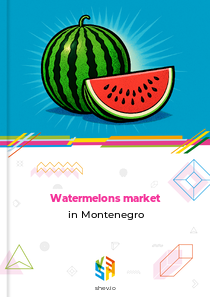







Earlier Report Observations
The watermelon market in Montenegro saw its volume decline from 18,623 t in 2018 to 14,423 t in 2021, before partially recovering to 17,220 t in 2023. This contraction was primarily driven by a sharp increase in exports, which reached 4,949 t in 2021, significantly reducing domestic availability despite stable production levels in that year.
Production fluctuated over the period, falling to 15,810 t in 2020 then recovering to above 17,500 t in 2022 and 2023. Concurrently, import volumes nearly halved from 2,207 t to 1,276 t, while exports remained elevated compared to pre-2021 levels, shaping the net market size.
The post-2021 recovery was supported by rebounding production and a reduction in export volumes from their peak, allowing the domestic market to stabilize around 17,000 t by 2023.
Table of content
- 1. Disclaimer
- 2. Terms of use of the report
- 3. Product codes in the statistical classifications used in the report
-
4. Key Market Indicators and Trends
-
4.1. Key Market Indicators
-
4.1.1. In kind
- 4.1.1.1. Production, 2018-2023
- 4.1.1.2. Imports, 2018-2024
- 4.1.1.3. Exports, 2018-2024
- 4.1.1.4. Market size, 2018-2023
-
4.1.1. In kind
- 4.2. Market Trends and Factors
-
4.1. Key Market Indicators
-
5. Production
-
5.1. Production in Montenegro
- 5.1.1. Annual dynamics of production in Montenegro in kind, 2018-2023, t
- 5.1.2. Annual dynamics of production in Montenegro in value, 2018-2023, $ US
-
5.2. Global production by Country, 2018-2023
- 5.2.1. Annual dynamics of production by macroregions in kind, 2018-2023, t
- 5.2.2. Dynamics of production structure by macroregions in kind, 2018-2023
- 5.2.3. Annual dynamics of production by country in kind, 2018-2023, t
- 5.2.4. Structure of production by countries in kind, 2018-2023
- 5.2.5. Dynamics of peoduction structure by countries in kind, 2018-2023
-
5.1. Production in Montenegro
-
6. Imports
-
6.1. Imports (Direct Data)
- 6.1.1. Imports - Total information
-
6.1.2. Imports in kind, t
- 6.1.2.1. Annual dynamics of product's imports to Montenegro in kind, 2018-2024, t
- 6.1.2.2. Dynamics of product's imports in kind to Montenegro by countries, 2018-2024, t
- 6.1.2.3. Structure of product's imports in kind by countries, 2018-2024
-
6.1.3. Imports in value, K $ US
- 6.1.3.1. Annual dynamics of product's imports to Montenegro in value, 2018-2024, K $ US
- 6.1.3.2. Dynamics of product's imports in value to Montenegro by countries, 2018-2024, K $ US
- 6.1.3.3. Structure of product's imports in value by countries, 2018-2024
-
6.1.4. Average price of product's imports, $ US/t
- 6.1.4.1. Annual dynamics of average price of product's imports to Montenegro, 2018-2024, $ US/t
- 6.1.4.2. Dynamics of average price of product's imports to Montenegro by countries, 2018-2024, $ US/t
-
6.2. Imports (Mirror Data)
- 6.2.1. Imports - Total information
-
6.2.2. Imports in kind, t
- 6.2.2.1. Annual dynamics of product's imports to Montenegro in kind, 2018-2024, t
- 6.2.2.2. Dynamics of product's imports in kind to Montenegro by countries, 2018-2024, t
- 6.2.2.3. Structure of product's imports in kind by countries, 2018-2024
-
6.2.3. Imports in value, K $ US
- 6.2.3.1. Annual dynamics of product's imports to Montenegro in value, 2018-2024, K $ US
- 6.2.3.2. Dynamics of product's imports in value to Montenegro by countries, 2018-2024, K $ US
- 6.2.3.3. Structure of product's imports in value by countries, 2018-2024
-
6.2.4. Average price of product's imports, $ US/t
- 6.2.4.1. Annual dynamics of average price of product's imports to Montenegro, 2018-2024, $ US/t
- 6.2.4.2. Dynamics of average price of product's imports to Montenegro by countries, 2018-2024, $ US/t
-
6.1. Imports (Direct Data)
-
7. Exports
-
7.1. Exports (Direct Data)
- 7.1.1. Exports - Total information
-
7.1.2. Exports in kind, t
- 7.1.2.1. Annual dynamics of product's exports from Montenegro in kind, 2018-2024, t
- 7.1.2.2. Dynamics of product's exports in kind from Montenegro by countries, 2018-2024, t
- 7.1.2.3. Structure of product's exports in kind by countries, 2018-2024
-
7.1.3. Exports in value, K $ US
- 7.1.3.1. Annual dynamics of product's exports from Montenegro in value, 2018-2024, K $ US
- 7.1.3.2. Dynamics of product's exports in value from Montenegro by countries, 2018-2024, K $ US
- 7.1.3.3. Structure of product's exports in value by countries, 2018-2024
-
7.1.4. Average price of product's exports, $ US/t
- 7.1.4.1. Annual dynamics of average price of product's exports from Montenegro, 2018-2024, $ US/t
- 7.1.4.2. Dynamics of average price of product's exports from Montenegro by countries, 2018-2024, $ US/t
-
7.2. Exports (Mirror Data)
- 7.2.1. Exports - Total information
-
7.2.2. Exports in kind, t
- 7.2.2.1. Annual dynamics of product's exports from Montenegro in kind, 2018-2024, t
- 7.2.2.2. Dynamics of product's exports in kind from Montenegro by countries, 2018-2024, t
- 7.2.2.3. Structure of product's exports in kind by countries, 2018-2024
-
7.2.3. Exports in value, K $ US
- 7.2.3.1. Annual dynamics of product's exports from Montenegro in value, 2018-2024, K $ US
- 7.2.3.2. Dynamics of product's exports in value from Montenegro by countries, 2018-2024, K $ US
- 7.2.3.3. Structure of product's exports in value by countries, 2018-2024
-
7.2.4. Average price of product's exports, $ US/t
- 7.2.4.1. Annual dynamics of average price of product's exports from Montenegro, 2018-2024, $ US/t
- 7.2.4.2. Dynamics of average price of product's exports from Montenegro by countries, 2018-2024, $ US/t
-
7.1. Exports (Direct Data)
-
8. Trade balance
-
8.1. Trade balance (Direct Data)
- 8.1.1. In kind, t
- 8.1.2. In value, K $ US
-
8.2. Trade balance (Mirror Data)
- 8.2.1. In kind, t
- 8.2.2. In value, K $ US
-
8.1. Trade balance (Direct Data)
-
9. Top buying and selling countries, 2018-2024
-
9.1. Direct Data
- 9.1.1. Import in Value by Countries-buyers
- 9.1.2. Export in Value by Countries-suppliers
-
9.2. Mirror Data
- 9.2.1. Import in Value by Countries-buyers
- 9.2.2. Export in Value by Countries-suppliers
-
9.1. Direct Data
Production watermelons in Montenegro
In kind, 2017-2020, t
Top producers of watermelons, 2017-2020
World map of production of watermelons, 2017-2020
Watermelon production in Montenegro has declined for the second year in a row. In 2020, the country produced 15 810 tons of watermelons, marking a modest decrease of 8.7% compared to 2019. Looking at the period from 2017 to 2020, overall production fell by 9.9%, which translates to an average annual decline of 3.4%. The highest production level was recorded in 2018 at 18 107 tons, with the largest year-on-year increase of 3.2% also occurring that year.
Annual dynamics of production in Montenegro in kind, 2017-2020, t
| Parameter | 2018 | 2019 | 2020 | CAGR | |
|---|---|---|---|---|---|
| 1 | Change from last year | 3.2% | (4.3%) | (8.7%) | (3.4%) |
Exports watermelons from Montenegro
Exports in kind, t
Export volumes showed considerable volatility over the observed period. The lowest point was in 2019, with exports totaling 1 134 tons, representing a sharp decline of 32.9% from the previous year. In 2020, exports rebounded strongly, reaching 1 978 tons—a 74.4% increase compared to 2019 and the peak for the period. The difference between the peak in 2020 and the trough in 2019 was 1.7-fold.
Annual dynamics of product's exports from Montenegro in kind, 2017-2020, t
| Parameter | 2018 | 2019 | 2020 | CAGR | |
|---|---|---|---|---|---|
| 1 | Change from last year | (2.9%) | (32.9%) | 74.4% | 4.3% |
Between 2017 and 2020, Bosnia and Herzegovina was the dominant destination for Montenegro's watermelon exports, accounting for 73.8% of total export volume. The remaining exports were distributed among a variety of smaller markets.
Structure of product's exports in kind by countries, 2017-2020
World map of product's exports from Montenegro in kind, 2017-2020
Exports in value, K $ US
In value terms, watermelon exports from Montenegro reached 379.4 thousand US dollars in 2020, a significant increase of 40.8% compared to 2019. Over the 2017-2020 period, export value grew by 67.1%, with an average annual growth rate of 18.7%. The only decline occurred in 2019, when exports fell by 3.9%.
Annual dynamics of product's exports from Montenegro in value, 2017-2020, K $ US
| Parameter | 2018 | 2019 | 2020 | CAGR | |
|---|---|---|---|---|---|
| 1 | Change from last year | 23.5% | (3.9%) | 40.8% | 18.7% |
From 2017 to 2020, Bosnia and Herzegovina remained the primary market for Montenegro's watermelon exports in value terms, representing 71.1% of total export earnings. Other destinations collectively accounted for the remaining share.
Structure of product's exports in value by countries, 2017-2020
World map of product's exports from Montenegro in value, 2017-2020
Imports watermelons to Montenegro
Imports in kind, t
After two consecutive years of decline, watermelon imports into Montenegro increased in 2020. The country imported approximately 2 100 tons that year, up 24.9% from 2019. However, over the full 2017-2020 period, imports decreased by 36.9%, equivalent to an average annual decline of 14.2%. The lowest import volume was recorded in 2019 at 1 682 tons, while the largest year-on-year drop of 33.7% occurred in 2018.
Annual dynamics of product's imports to Montenegro in kind, 2017-2020, t
| Parameter | 2018 | 2019 | 2020 | CAGR | |
|---|---|---|---|---|---|
| 1 | Change from last year | (33.7%) | (23.8%) | 24.9% | (14.2%) |
During the 2017-2020 period, Albania and Greece together accounted for 84.7% of Montenegro's watermelon imports by volume. The remaining imports came from a range of other, smaller sources.
Structure of product's imports in kind by countries, 2017-2020
World map of product's imports to Montenegro in kind, 2017-2020
Imports in value, K $ US
Following a two-year contraction, the value of watermelon imports into Montenegro rose in 2020. Imports totaled 497.0 thousand US dollars that year, reflecting a solid increase of 13.6% compared to 2019. Despite this recent growth, imports decreased by 15.4% over the 2017-2020 period, with an average annual decline of 5.4%. The lowest value was recorded in 2019 at 437.5 thousand US dollars, and the largest year-on-year decrease of 13.8% took place in 2018.
Annual dynamics of product's imports to Montenegro in value, 2017-2020, K $ US
| Parameter | 2018 | 2019 | 2020 | CAGR | |
|---|---|---|---|---|---|
| 1 | Change from last year | (13.8%) | (13.6%) | 13.6% | (5.4%) |
From 2017 to 2020, Albania and Greece dominated Montenegro's watermelon imports in value terms, jointly representing 83.3% of total import spending. Other countries accounted for the remainder.
Structure of product's imports in value by countries, 2017-2020
World map of product's imports to Montenegro in value, 2017-2020
Related Reports

Watermelons market in Western Africa
2026-03-28
2026-03-28
2026-03-28
2026-03-28
2026-03-28
2026-03-28
In-shell walnuts market in Montenegro
2026-03-28

Kiwifruit market in Montenegro
2026-03-28
Why Choose Us?
Only Verified Data
No Hidden Costs or Separate Fees
Smarter Subscription Pricing
Contact Our Team
Submit your inquiry using the form below — our team will get back to you within 24 hours.