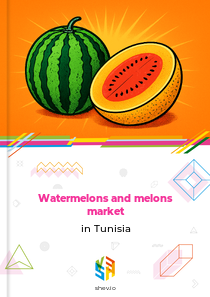







Earlier Report Observations
From 2018 to 2020, the market volume for watermelons and melons in Tunisia declined from 625.1 thousand tonnes to 550.9 thousand tonnes. This decrease coincided with a sharp rise in fruit exports, particularly watermelons shipped to Italy, which reached 11,494 tonnes in 2018, and a broader 28.8% growth in export volumes by 2019. Simultaneously, a drop in the national investment rate to 16% of GDP for 2020-2024 likely constrained capital inflows into agriculture, limiting production capacity.
The market rebounded to 625.8 thousand tonnes in 2021. However, it contracted again to 539.3 thousand tonnes in 2022, a year in which Tunisia consolidated its position as the fourth-largest Arab exporter of watermelons with revenues of $2.93 million. By 2023, the market volume recovered partially to 567.0 thousand tonnes.
In the following period, the sector faced mounting pressures, including a 1.53% reduction in land allocated for vegetable crops like watermelons and melons by 2024 due to climate change, water scarcity, and rising production costs. Export dynamics were further affected by stricter compliance with European Union regulations (Regulation 2019/2072), while rumors about product safety and significant water resource stress introduced additional volatility for local and export markets.
Table of content
- 1. Disclaimer
- 2. Terms of use of the report
- 3. Product codes in the statistical classifications used in the report
-
4. Key Market Indicators and Trends
-
4.1. Key Market Indicators
-
4.1.1. In kind
- 4.1.1.1. Production, 2018-2023
- 4.1.1.2. Imports, 2018-2024
- 4.1.1.3. Exports, 2018-2024
- 4.1.1.4. Market size, 2018-2023
-
4.1.1. In kind
- 4.2. Market Trends and Factors
-
4.1. Key Market Indicators
-
5. Production
-
5.1. Production in Tunisia
- 5.1.1. Annual dynamics of production in Tunisia in kind, 2018-2023, K t
- 5.1.2. Annual dynamics of production in Tunisia in value, 2018-2023, $ US
-
5.2. Global production by Country, 2018-2023
- 5.2.1. Annual dynamics of production by macroregions in kind, 2018-2023, K t
- 5.2.2. Dynamics of production structure by macroregions in kind, 2018-2023
- 5.2.3. Annual dynamics of production by country in kind, 2018-2023, K t
- 5.2.4. Structure of production by countries in kind, 2018-2023
- 5.2.5. Dynamics of peoduction structure by countries in kind, 2018-2023
-
5.1. Production in Tunisia
-
6. Exports
-
6.1. Exports (Direct Data)
- 6.1.1. Exports - Total information
-
6.1.2. Exports in kind, t
- 6.1.2.1. Annual dynamics of product's exports from Tunisia in kind, 2018-2024, t
- 6.1.2.2. Dynamics of product's exports in kind from Tunisia by countries, 2018-2024, t
- 6.1.2.3. Structure of product's exports in kind by countries, 2018-2024
-
6.1.3. Exports in value, K $ US
- 6.1.3.1. Annual dynamics of product's exports from Tunisia in value, 2018-2024, K $ US
- 6.1.3.2. Dynamics of product's exports in value from Tunisia by countries, 2018-2024, K $ US
- 6.1.3.3. Structure of product's exports in value by countries, 2018-2024
-
6.1.4. Average price of product's exports, $ US/t
- 6.1.4.1. Annual dynamics of average price of product's exports from Tunisia, 2018-2024, $ US/t
- 6.1.4.2. Dynamics of average price of product's exports from Tunisia by countries, 2018-2024, $ US/t
-
6.2. Exports (Mirror Data)
- 6.2.1. Exports - Total information
-
6.2.2. Exports in kind, t
- 6.2.2.1. Annual dynamics of product's exports from Tunisia in kind, 2018-2024, t
- 6.2.2.2. Dynamics of product's exports in kind from Tunisia by countries, 2018-2024, t
- 6.2.2.3. Structure of product's exports in kind by countries, 2018-2024
-
6.2.3. Exports in value, K $ US
- 6.2.3.1. Annual dynamics of product's exports from Tunisia in value, 2018-2024, K $ US
- 6.2.3.2. Dynamics of product's exports in value from Tunisia by countries, 2018-2024, K $ US
- 6.2.3.3. Structure of product's exports in value by countries, 2018-2024
-
6.2.4. Average price of product's exports, $ US/t
- 6.2.4.1. Annual dynamics of average price of product's exports from Tunisia, 2018-2024, $ US/t
- 6.2.4.2. Dynamics of average price of product's exports from Tunisia by countries, 2018-2024, $ US/t
-
6.1. Exports (Direct Data)
-
7. Imports
-
7.1. Imports (Direct Data)
- 7.1.1. Imports - Total information
-
7.1.2. Imports in kind, t
- 7.1.2.1. Annual dynamics of product's imports to Tunisia in kind, 2018-2024, t
- 7.1.2.2. Dynamics of product's imports in kind to Tunisia by countries, 2018-2024, t
- 7.1.2.3. Structure of product's imports in kind by countries, 2018-2024
-
7.1.3. Imports in value, K $ US
- 7.1.3.1. Annual dynamics of product's imports to Tunisia in value, 2018-2024, K $ US
- 7.1.3.2. Dynamics of product's imports in value to Tunisia by countries, 2018-2024, K $ US
- 7.1.3.3. Structure of product's imports in value by countries, 2018-2024
-
7.1.4. Average price of product's imports, $ US/t
- 7.1.4.1. Annual dynamics of average price of product's imports to Tunisia, 2018-2024, $ US/t
- 7.1.4.2. Dynamics of average price of product's imports to Tunisia by countries, 2018-2024, $ US/t
-
7.2. Imports (Mirror Data)
- 7.2.1. Imports - Total information
-
7.2.2. Imports in kind, t
- 7.2.2.1. Annual dynamics of product's imports to Tunisia in kind, 2018-2024, t
- 7.2.2.2. Dynamics of product's imports in kind to Tunisia by countries, 2018-2024, t
- 7.2.2.3. Structure of product's imports in kind by countries, 2018-2024
-
7.2.3. Imports in value, K $ US
- 7.2.3.1. Annual dynamics of product's imports to Tunisia in value, 2018-2024, K $ US
- 7.2.3.2. Dynamics of product's imports in value to Tunisia by countries, 2018-2024, K $ US
- 7.2.3.3. Structure of product's imports in value by countries, 2018-2024
-
7.2.4. Average price of product's imports, $ US/t
- 7.2.4.1. Annual dynamics of average price of product's imports to Tunisia, 2018-2024, $ US/t
- 7.2.4.2. Dynamics of average price of product's imports to Tunisia by countries, 2018-2024, $ US/t
-
7.1. Imports (Direct Data)
-
8. Trade balance
-
8.1. Trade balance (Direct Data)
- 8.1.1. In kind, t
- 8.1.2. In value, K $ US
-
8.2. Trade balance (Mirror Data)
- 8.2.1. In kind, t
- 8.2.2. In value, K $ US
-
8.1. Trade balance (Direct Data)
-
9. Top buying and selling countries, 2018-2024
-
9.1. Direct Data
- 9.1.1. Import in Value by Countries-buyers
- 9.1.2. Export in Value by Countries-suppliers
-
9.2. Mirror Data
- 9.2.1. Import in Value by Countries-buyers
- 9.2.2. Export in Value by Countries-suppliers
-
9.1. Direct Data
Production watermelons and melons in Tunisia
In kind, 2017-2020, K t
Globally, Tunisia ranked as the 25th largest producer of watermelons and melons during the period from 2017 to 2020.
Top producers of watermelons and melons, 2017-2020
World map of production of watermelons and melons, 2017-2020
Tunisia's production of watermelons and melons declined for the third consecutive year. In 2020, the country produced 557.0 thousand tons, marking a moderate decrease of 6.7% compared to the previous year. Over the 2017-2020 period, production fell by 17.5%, with a compound annual growth rate of -6.2%.
Annual dynamics of production in Tunisia in kind, 2017-2020, K t
| Parameter | 2018 | 2019 | 2020 | CAGR | |
|---|---|---|---|---|---|
| 1 | Change from last year | (6.1%) | (5.8%) | (6.7%) | (6.2%) |
Exports watermelons and melons from Tunisia
Exports in kind, t
The market displayed volatility during the observed period. Export volumes reached their lowest point in 2017 and peaked in 2019, showing a 3.3-fold increase between these years. In 2020, Tunisia exported 6 063 tons of watermelons and melons, representing a dramatic drop of 51.8% from the previous year. The highest volume was recorded in 2019 at 12 580 tons, while the largest year-over-year increase occurred in 2018 at 141.9%.
Annual dynamics of product's exports from Tunisia in kind, 2017-2020, t
| Parameter | 2018 | 2019 | 2020 | CAGR | |
|---|---|---|---|---|---|
| 1 | Change from last year | 141.9% | 37.7% | (51.8%) | 17.1% |
From 2017 to 2020, Italy, Libya, and France were the primary buyers of Tunisian watermelons and melons by volume. Italy accounted for 35.1% of exports, Libya for 31.4%, and France for 23.7%. Together, these three countries comprised 90.2% of Tunisia's total exports in kind.
Structure of product's exports in kind by countries, 2017-2020
World map of product's exports from Tunisia in kind, 2017-2020
Exports in value, K $ US
After two years of growth, the value of Tunisia's watermelon and melon exports declined. In 2020, exports totaled 3 124 thousand US dollars, an abrupt fall of 38.1% compared to 2019. Between 2017 and 2020, however, export value increased by 27.6%, equivalent to an annualized growth rate of 8.5%. The peak value was recorded in 2019 at 5 044 thousand US dollars, with the largest year-over-year increase occurring in 2018 at 46.8%.
Annual dynamics of product's exports from Tunisia in value, 2017-2020, K $ US
| Parameter | 2018 | 2019 | 2020 | CAGR | |
|---|---|---|---|---|---|
| 1 | Change from last year | 46.8% | 40.3% | (38.1%) | 8.5% |
During 2017-2020, Italy, Libya, and France were the largest buyers of Tunisian watermelons and melons by value. Italy represented 33.4% of export value, Libya 21.2%, and France 19.5%. Collectively, these three markets formed 74.1% of Tunisia's total export value.
Structure of product's exports in value by countries, 2017-2020
World map of product's exports from Tunisia in value, 2017-2020
Imports watermelons and melons to Tunisia
Imports in kind, t
The import market showed an unstable trend throughout the period. Import volumes fluctuated significantly, with a 7.1-fold difference between the high in 2018 and the low in 2020. In 2020, Tunisia imported 16 tons of watermelons and melons, reflecting a sharp increase of 29.2% from the previous year.
Annual dynamics of product's imports to Tunisia in kind, 2017-2020, t
| Parameter | 2018 | 2019 | 2020 | CAGR | |
|---|---|---|---|---|---|
| 1 | Change from last year | 29.2% | n/a | n/a | (43.4%) |
From 2017 to 2020, Egypt, Libya, and Brazil were the main sources of Tunisia's watermelon and melon imports by volume. Egypt accounted for 35.6% of imports, Libya for 26.5%, and Brazil for 5.6%. Together, these three countries represented 67.6% of total import flows in kind.
Structure of product's imports in kind by countries, 2017-2020
World map of product's imports to Tunisia in kind, 2017-2020
Imports in value, K $ US
The import market exhibited volatility during the timeframe. Values showed a 3.7-fold variation between the peak in 2018 and the trough in 2020. In 2020, Tunisia imported watermelons and melons worth 16 thousand US dollars, indicating an intense gain of 102.1% compared to 2019.
Annual dynamics of product's imports to Tunisia in value, 2017-2020, K $ US
| Parameter | 2018 | 2019 | 2020 | CAGR | |
|---|---|---|---|---|---|
| 1 | Change from last year | 102.1% | n/a | n/a | (18.1%) |
During 2017-2020, Egypt, Libya, and Brazil consistently remained the primary sources of Tunisia's watermelon and melon imports by value. Egypt accounted for 15.8% of import value, Libya for 11.6%, and Brazil for 4.2%. Together, these three markets comprised 31.5% of total import flows in value terms.
Structure of product's imports in value by countries, 2017-2020
World map of product's imports to Tunisia in value, 2017-2020
Related Reports

Watermelons and melons market Turkey
2026-03-28
Watermelons and melons market in Cabo Verde
2026-03-28
Watermelons and melons market in Russia
2026-03-28

2026-03-28

Dried apricots market in Tunisia
2026-03-28
2026-03-28

Apples, pears and quinces market in Tunisia
2026-03-28
Why Choose Us?
Only Verified Data
No Hidden Costs or Separate Fees
Smarter Subscription Pricing
Contact Our Team
Submit your inquiry using the form below — our team will get back to you within 24 hours.