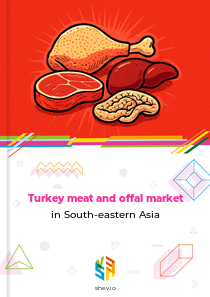







"South-eastern Asia" region includes following countries:
 Brunei Darussalam
 Myanmar
 Cambodia
 Indonesia
 Laos
Laos Malaysia
 the Philippines
 Timor-Leste
 Singapore
 Vietnam
 Thailand
Earlier Report Observations
The market for turkey meat and offal in South-eastern Asia expanded considerably from 2018 to 2020, with total volume growing from 5 238 t to 8 694 t. This increase was primarily supported by rising imports, which more than doubled from 4 129 t to 7 538 t over the period, while domestic production remained relatively stable at around 1 825 t annually.
Market volume contracted to 8 361 t in 2021 and fell sharply to 5 697 t in 2022, largely due to a significant reduction in imports. The subsequent recovery in 2023, with volume reaching 7 125 t, coincided with a rebound in imports to 6 620 t and a notable increase in exports. The Asia Pacific edible offal segment, however, continued to see underlying demand growth driven by cultural culinary practices and a shift towards nutrient-dense proteins.
By 2024, the broader Asia-Pacific market for prepared turkey products showed signs of stabilization after a multi-year decline. Factors influencing the regional landscape included technological advancements in cold-chain logistics and packaging, urbanization, changing dietary preferences, and the emergence of new product segments like frozen turkey burgers, which cater to evolving consumer lifestyles.
Table of content
- 1. Disclaimer
- 2. Terms of use of the report
- 3. Product codes in the statistical classifications used in the report
-
4. Key Market Indicators and Trends
-
4.1. Key Market Indicators
-
4.1.1. In kind
- 4.1.1.1. Production, 2018-2023
- 4.1.1.2. Imports, 2018-2024
- 4.1.1.3. Exports, 2018-2024
- 4.1.1.4. Market size, 2018-2023
-
4.1.1. In kind
- 4.2. Market Trends and Factors
-
4.1. Key Market Indicators
-
5. Production
-
5.1. Production in South-eastern Asia
- 5.1.1. Annual dynamics of production in South-eastern Asia in kind, 2018-2023, t
-
5.2. Global production by Country, 2018-2023
- 5.2.1. Annual dynamics of production by macroregions in kind, 2018-2023, t
- 5.2.2. Dynamics of production structure by macroregions in kind, 2018-2023
- 5.2.3. Annual dynamics of production by country in kind, 2018-2023, t
- 5.2.4. Structure of production by countries in kind, 2018-2023
- 5.2.5. Dynamics of peoduction structure by countries in kind, 2018-2023
-
5.1. Production in South-eastern Asia
-
6. Imports
-
6.1. Imports (Direct Data*)
- 6.1.1. Imports - Total information
-
6.1.2. Imports in kind, t
- 6.1.2.1. Annual dynamics of product's imports to Brunei Darussalam in kind, 2018-2024, t
- 6.1.2.2. Dynamics of product's imports in kind to Brunei Darussalam by countries, 2018-2024, t
- 6.1.2.3. Structure of product's imports in kind by countries, 2018-2024
-
6.1.3. Imports in value, K $ US
- 6.1.3.1. Annual dynamics of product's imports to Brunei Darussalam in value, 2018-2024, K $ US
- 6.1.3.2. Dynamics of product's imports in value to Brunei Darussalam by countries, 2018-2024, K $ US
- 6.1.3.3. Structure of product's imports in value by countries, 2018-2024
-
6.1.4. Average price of product's imports, $ US/t
- 6.1.4.1. Annual dynamics of average price of product's imports to Brunei Darussalam, 2018-2024, $ US/t
- 6.1.4.2. Dynamics of average price of product's imports to Brunei Darussalam by countries, 2018-2024, $ US/t
-
6.2. Imports (Mirror Data)
- 6.2.1. Imports - Total information
-
6.2.2. Imports in kind, t
- 6.2.2.1. Annual dynamics of product's imports to Brunei Darussalam in kind, 2018-2024, t
- 6.2.2.2. Dynamics of product's imports in kind to Brunei Darussalam by countries, 2018-2024, t
- 6.2.2.3. Structure of product's imports in kind by countries, 2018-2024
-
6.2.3. Imports in value, K $ US
- 6.2.3.1. Annual dynamics of product's imports to Brunei Darussalam in value, 2018-2024, K $ US
- 6.2.3.2. Dynamics of product's imports in value to Brunei Darussalam by countries, 2018-2024, K $ US
- 6.2.3.3. Structure of product's imports in value by countries, 2018-2024
-
6.2.4. Average price of product's imports, $ US/t
- 6.2.4.1. Annual dynamics of average price of product's imports to Brunei Darussalam, 2018-2024, $ US/t
- 6.2.4.2. Dynamics of average price of product's imports to Brunei Darussalam by countries, 2018-2024, $ US/t
-
6.1. Imports (Direct Data*)
-
7. Exports
-
7.1. Exports (Direct Data*)
- 7.1.1. Exports - Total information
-
7.1.2. Exports in kind, t
- 7.1.2.1. Annual dynamics of product's exports from Brunei Darussalam in kind, 2018-2024, t
- 7.1.2.2. Dynamics of product's exports in kind from Brunei Darussalam by countries, 2018-2024, t
- 7.1.2.3. Structure of product's exports in kind by countries, 2018-2024
-
7.1.3. Exports in value, K $ US
- 7.1.3.1. Annual dynamics of product's exports from Brunei Darussalam in value, 2018-2024, K $ US
- 7.1.3.2. Dynamics of product's exports in value from Brunei Darussalam by countries, 2018-2024, K $ US
- 7.1.3.3. Structure of product's exports in value by countries, 2018-2024
-
7.1.4. Average price of product's exports, $ US/t
- 7.1.4.1. Annual dynamics of average price of product's exports from Brunei Darussalam, 2018-2024, $ US/t
- 7.1.4.2. Dynamics of average price of product's exports from Brunei Darussalam by countries, 2018-2024, $ US/t
-
7.2. Exports (Mirror Data)
- 7.2.1. Exports - Total information
-
7.2.2. Exports in kind, t
- 7.2.2.1. Annual dynamics of product's exports from Brunei Darussalam in kind, 2018-2024, t
- 7.2.2.2. Dynamics of product's exports in kind from Brunei Darussalam by countries, 2018-2024, t
- 7.2.2.3. Structure of product's exports in kind by countries, 2018-2024
-
7.2.3. Exports in value, K $ US
- 7.2.3.1. Annual dynamics of product's exports from Brunei Darussalam in value, 2018-2024, K $ US
- 7.2.3.2. Dynamics of product's exports in value from Brunei Darussalam by countries, 2018-2024, K $ US
- 7.2.3.3. Structure of product's exports in value by countries, 2018-2024
-
7.2.4. Average price of product's exports, $ US/t
- 7.2.4.1. Annual dynamics of average price of product's exports from Brunei Darussalam, 2018-2024, $ US/t
- 7.2.4.2. Dynamics of average price of product's exports from Brunei Darussalam by countries, 2018-2024, $ US/t
-
7.1. Exports (Direct Data*)
-
8. Trade balance
-
8.1. Trade balance (Direct Data)
- 8.1.1. In kind, t
- 8.1.2. In value, K $ US
-
8.2. Trade balance (Mirror Data)
- 8.2.1. In kind, t
- 8.2.2. In value, K $ US
-
8.1. Trade balance (Direct Data)
-
9. Top buying and selling countries, 2018-2024
-
9.1. Direct Data
- 9.1.1. Import in Value by Countries-buyers
- 9.1.2. Export in Value by Countries-suppliers
-
9.2. Mirror Data
- 9.2.1. Import in Value by Countries-buyers
- 9.2.2. Export in Value by Countries-suppliers
-
9.1. Direct Data
Production turkey meat and offal in South-eastern Asia
In kind, 2017-2020, t
Top producers of turkey meat and offal, 2017-2020
World map of production of turkey meat and offal, 2017-2020
In 2018, South-eastern Asia produced 1 824 tonnes of turkey meat and offal, marking the lowest output during this period. Production then increased to 1 831 tonnes in 2019, representing a 0.4% rise from the previous year. By 2020, output remained largely stable at 1 826 tonnes, showing minimal change year-over-year.
Annual dynamics of production in South-eastern Asia in kind, 2017-2020, t
| Parameter | 2018 | 2019 | 2020 | CAGR | |
|---|---|---|---|---|---|
| 1 | Change from last year | (0.0%) | 0.4% | (0.3%) | 0.0% |
In value, 2017-2020, K $ US
Turkey meat and offal production in South-eastern Asia has been declining for three consecutive years. In 2020, the value of production dropped to 3 010 thousand US dollars, a 13.3% decrease compared to 2019. Looking at the broader trend from 2017 to 2020, production fell by 40%, which translates to an average annual decline of 15.6%.
Annual dynamics of production in South-eastern Asia in value, 2017-2020, K $ US
| Parameter | 2018 | 2019 | 2020 | CAGR | |
|---|---|---|---|---|---|
| 1 | Change from last year | (16.4%) | (17.2%) | (13.3%) | (15.6%) |
Exports turkey meat and offal from South-eastern Asia
Exports in kind, t
Export volumes of turkey meat and offal from South-eastern Asia showed significant volatility between 2017 and 2020. The lowest level was recorded in 2017, while exports peaked in 2018 at 716 tonnes, creating a 2.2-fold difference between these years. In 2019, exports experienced their largest decline of 3.5%. By 2020, exports stood at 670 tonnes, a 3.0% decrease from the previous year. Notably, 2018 saw the largest increase of 122.9%.
Annual dynamics of product's exports from South-eastern Asia in kind, 2017-2020, t
| Parameter | 2018 | 2019 | 2020 | CAGR | |
|---|---|---|---|---|---|
| 1 | Change from last year | 122.9% | (3.5%) | (3.0%) | 27.8% |
From 2017 to 2020, the key export markets for turkey meat and offal from South-eastern Asia were China, accounting for 34.7% of exports in volume, Hong Kong with 28.3%, and Maldives at 4.4%. Together, these three markets represented 67.4% of total export flows.
Structure of product's exports in kind by countries, 2017-2020
World map of product's exports from South-eastern Asia in kind, 2017-2020
Exports in value, K $ US
The value of turkey meat and offal exports from South-eastern Asia exhibited considerable volatility during this period. The lowest value occurred in 2017, while the highest was reached in 2018 at 1 645 thousand US dollars, resulting in a 1.9-fold peak-to-trough ratio. In 2019, exports saw their largest decline of 20.4%. By 2020, export value dropped to 1 104 thousand US dollars, a 15.7% decrease year-over-year. The largest increase of 86.4% was recorded in 2018.
Annual dynamics of product's exports from South-eastern Asia in value, 2017-2020, K $ US
| Parameter | 2018 | 2019 | 2020 | CAGR | |
|---|---|---|---|---|---|
| 1 | Change from last year | 86.4% | (20.4%) | (15.7%) | 7.7% |
Between 2017 and 2020, South-eastern Asia exported turkey meat and offal to a diverse range of markets. The top destinations by value were China with 23.9% of exports, Hong Kong at 18.2%, and Maldives with 5.3%. Collectively, these three markets accounted for 47.5% of total export value, while numerous smaller destinations made up the remaining 52.5%.
Structure of product's exports in value by countries, 2017-2020
World map of product's exports from South-eastern Asia in value, 2017-2020
Imports turkey meat and offal to South-eastern Asia
Imports in kind, t
Imports of turkey meat and offal into South-eastern Asia have increased for two consecutive years. In 2018, imports reached their lowest point at 4 129 tonnes, marking a 20.1% decline from the previous year. However, imports rebounded strongly in 2019 with a 38.8% increase. By 2020, imports totaled 7 538 tonnes, a 31.5% rise from 2019. Over the entire 2017-2020 period, imports grew by 45.8%, equivalent to an average annual growth rate of 13.4%.
Annual dynamics of product's imports to South-eastern Asia in kind, 2017-2020, t
| Parameter | 2018 | 2019 | 2020 | CAGR | |
|---|---|---|---|---|---|
| 1 | Change from last year | (20.1%) | 38.8% | 31.5% | 13.4% |
From 2017 to 2020, the primary sources for turkey meat and offal imports into South-eastern Asia were the United States, contributing 32.6% of import volume, Canada with 26.1%, and China at 7.8%. Together, these three countries supplied 66.5% of total import flows.
Structure of product's imports in kind by countries, 2017-2020
World map of product's imports to South-eastern Asia in kind, 2017-2020
Imports in value, K $ US
The value of turkey meat and offal imports into South-eastern Asia has risen for two straight years. In 2018, import value hit its lowest point at 9 827 thousand US dollars, representing a 16.4% decrease. This was followed by a substantial 43.1% increase in 2019. By 2020, import value reached 15 098 thousand US dollars, up 7.4% year-over-year. Between 2017 and 2020, import value increased by 28.5%, averaging 8.7% annual growth.
Annual dynamics of product's imports to South-eastern Asia in value, 2017-2020, K $ US
| Parameter | 2018 | 2019 | 2020 | CAGR | |
|---|---|---|---|---|---|
| 1 | Change from last year | (16.4%) | 43.1% | 7.4% | 8.7% |
During 2017-2020, the main sources of turkey meat and offal imports by value were the United States, accounting for 47.4% of imports, Canada with 12.7%, and the United Kingdom at 10.5%. These three markets together represented 70.6% of total import flows.
Structure of product's imports in value by countries, 2017-2020
World map of product's imports to South-eastern Asia in value, 2017-2020
Related Reports

Turkey meat and offal market in Western Asia
2026-03-27
Turkey meat and offal market in Norway
2026-03-27
Turkey meat and offal market in Slovenia
2026-03-27


Goat meat market in South-eastern Asia
2026-03-27

Pig offal market in South-eastern Asia
2026-03-30

Why Choose Us?
Only Verified Data
No Hidden Costs or Separate Fees
Smarter Subscription Pricing
Contact Our Team
Submit your inquiry using the form below — our team will get back to you within 24 hours.