






"SADC" region includes following countries:
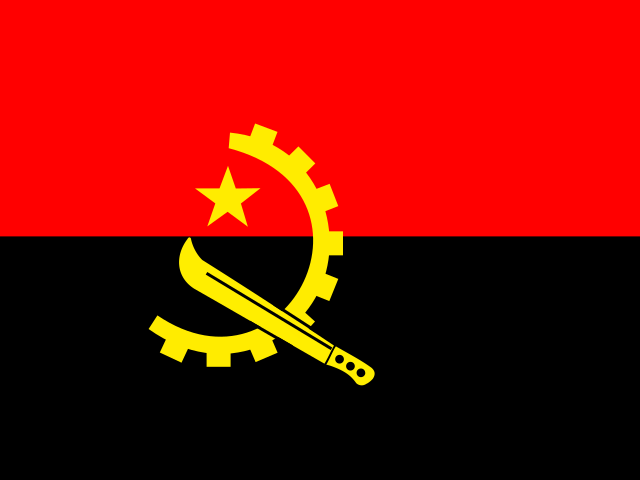 Angola
 Botswana
 Comoros
 Democratic Republic of the Congo
 Eswatini
 Lesotho
 Madagascar
 Malawi
 Mauritius
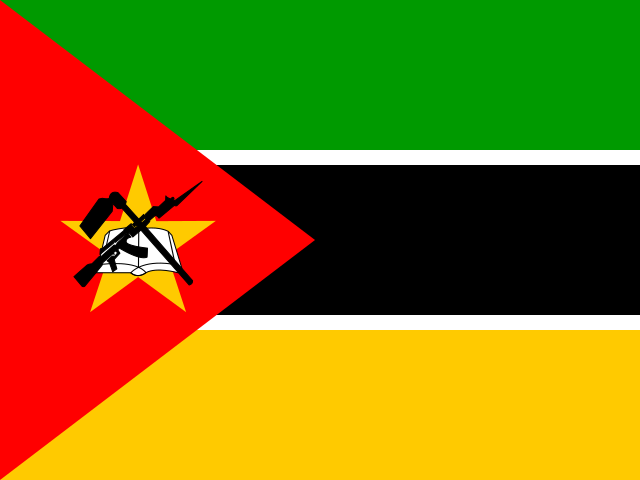 Mozambique
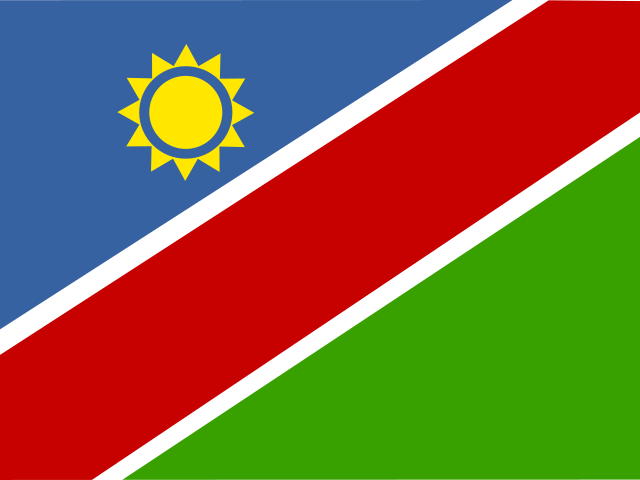 Namibia
 Seychelles
 South Africa
 Tanzania
 Zambia
 Zimbabwe
Earlier Report Observations
Between 2018 and 2020, the market volume for sunflower, safflower, or cottonseed oil and fractions in SADC fluctuated, dipping to 844 thousand tons in 2019 before surging to 1 025 thousand tons in 2020. Local production faced consistent pressure from global oilseed prices and a weak exchange rate, which limited planted area. The COVID-19 pandemic in 2020 introduced widespread global supply chain disruptions, impacting trade flows and contributing to the volatile market conditions.
From 2021, the Russia-Ukraine conflict severely disrupted global sunflower oil supplies and elevated input costs, leading to a sharp drop in imports and a market volume decline to 804 thousand tons in 2021. In 2022, the South African Competition Commission reported opportunistic price increases by sunflower oil processors, a situation enabled by high concentration in the value chain. These factors, combined with continued conflict-related trade disruptions, contributed to a further market contraction to 747 thousand tons.
The market recovered to 870 thousand tons in 2023, supported by improved opening stocks and industry adaptation to the new trade environment. Regulatory developments announced in 2024, including the forthcoming implementation of the Plant Improvement Act and new restrictions on agricultural remedy active ingredients, introduced additional compliance requirements for local production.
Table of content
- 1. Disclaimer
- 2. Terms of use of the report
- 3. Product codes in the statistical classifications used in the report
-
4. Key Market Indicators and Trends
-
4.1. Key Market Indicators
-
4.1.1. In kind
- 4.1.1.1. Production, 2018-2023
- 4.1.1.2. Imports, 2018-2024
- 4.1.1.3. Exports, 2018-2024
- 4.1.1.4. Market size, 2018-2023
-
4.1.1. In kind
- 4.2. Market Trends and Factors
-
4.1. Key Market Indicators
-
5. Production
-
5.1. Production in SADC
- 5.1.1. Annual dynamics of production in SADC in kind, 2018-2023, K t
-
5.2. Global production by Country, 2018-2023
- 5.2.1. Annual dynamics of production by macroregions in kind, 2018-2023, K t
- 5.2.2. Dynamics of production structure by macroregions in kind, 2018-2023
- 5.2.3. Annual dynamics of production by country in kind, 2018-2023, K t
- 5.2.4. Structure of production by countries in kind, 2018-2023
- 5.2.5. Dynamics of peoduction structure by countries in kind, 2018-2023
-
5.1. Production in SADC
-
6. Imports
-
6.1. Imports (Direct Data*)
- 6.1.1. Imports - Total information
-
6.1.2. Imports in kind, K t
- 6.1.2.1. Annual dynamics of product's imports to Angola in kind, 2018-2024, K t
- 6.1.2.2. Dynamics of product's imports in kind to Angola by countries, 2018-2024, K t
- 6.1.2.3. Structure of product's imports in kind by countries, 2018-2024
-
6.1.3. Imports in value, M $ US
- 6.1.3.1. Annual dynamics of product's imports to Angola in value, 2018-2024, M $ US
- 6.1.3.2. Dynamics of product's imports in value to Angola by countries, 2018-2024, M $ US
- 6.1.3.3. Structure of product's imports in value by countries, 2018-2024
-
6.1.4. Average price of product's imports, $ US/t
- 6.1.4.1. Annual dynamics of average price of product's imports to Angola, 2018-2024, $ US/t
- 6.1.4.2. Dynamics of average price of product's imports to Angola by countries, 2018-2024, $ US/t
-
6.2. Imports (Mirror Data)
- 6.2.1. Imports - Total information
-
6.2.2. Imports in kind, K t
- 6.2.2.1. Annual dynamics of product's imports to Angola in kind, 2018-2024, K t
- 6.2.2.2. Dynamics of product's imports in kind to Angola by countries, 2018-2024, K t
- 6.2.2.3. Structure of product's imports in kind by countries, 2018-2024
-
6.2.3. Imports in value, M $ US
- 6.2.3.1. Annual dynamics of product's imports to Angola in value, 2018-2024, M $ US
- 6.2.3.2. Dynamics of product's imports in value to Angola by countries, 2018-2024, M $ US
- 6.2.3.3. Structure of product's imports in value by countries, 2018-2024
-
6.2.4. Average price of product's imports, $ US/t
- 6.2.4.1. Annual dynamics of average price of product's imports to Angola, 2018-2024, $ US/t
- 6.2.4.2. Dynamics of average price of product's imports to Angola by countries, 2018-2024, $ US/t
-
6.1. Imports (Direct Data*)
-
7. Exports
-
7.1. Exports (Direct Data*)
- 7.1.1. Exports - Total information
-
7.1.2. Exports in kind, K t
- 7.1.2.1. Annual dynamics of product's exports from Angola in kind, 2018-2024, K t
- 7.1.2.2. Dynamics of product's exports in kind from Angola by countries, 2018-2024, K t
- 7.1.2.3. Structure of product's exports in kind by countries, 2018-2024
-
7.1.3. Exports in value, M $ US
- 7.1.3.1. Annual dynamics of product's exports from Angola in value, 2018-2024, M $ US
- 7.1.3.2. Dynamics of product's exports in value from Angola by countries, 2018-2024, M $ US
- 7.1.3.3. Structure of product's exports in value by countries, 2018-2024
-
7.1.4. Average price of product's exports, $ US/t
- 7.1.4.1. Annual dynamics of average price of product's exports from Angola, 2018-2024, $ US/t
- 7.1.4.2. Dynamics of average price of product's exports from Angola by countries, 2018-2024, $ US/t
-
7.2. Exports (Mirror Data)
- 7.2.1. Exports - Total information
-
7.2.2. Exports in kind, K t
- 7.2.2.1. Annual dynamics of product's exports from Angola in kind, 2018-2024, K t
- 7.2.2.2. Dynamics of product's exports in kind from Angola by countries, 2018-2024, K t
- 7.2.2.3. Structure of product's exports in kind by countries, 2018-2024
-
7.2.3. Exports in value, M $ US
- 7.2.3.1. Annual dynamics of product's exports from Angola in value, 2018-2024, M $ US
- 7.2.3.2. Dynamics of product's exports in value from Angola by countries, 2018-2024, M $ US
- 7.2.3.3. Structure of product's exports in value by countries, 2018-2024
-
7.2.4. Average price of product's exports, $ US/t
- 7.2.4.1. Annual dynamics of average price of product's exports from Angola, 2018-2024, $ US/t
- 7.2.4.2. Dynamics of average price of product's exports from Angola by countries, 2018-2024, $ US/t
-
7.1. Exports (Direct Data*)
-
8. Trade balance
-
8.1. Trade balance (Direct Data)
- 8.1.1. In kind, K t
- 8.1.2. In value, M $ US
-
8.2. Trade balance (Mirror Data)
- 8.2.1. In kind, K t
- 8.2.2. In value, M $ US
-
8.1. Trade balance (Direct Data)
-
9. Top buying and selling countries, 2018-2024
-
9.1. Direct Data
- 9.1.1. Import in Value by Countries-buyers
- 9.1.2. Export in Value by Countries-suppliers
-
9.2. Mirror Data
- 9.2.1. Import in Value by Countries-buyers
- 9.2.2. Export in Value by Countries-suppliers
-
9.1. Direct Data
Production sunflower, safflower or cottonseed oil and fractions in SADC
In kind, 2017-2020, K t
Top producers of sunflower, safflower or cottonseed oil and fractions, 2017-2020
World map of production of sunflower, safflower or cottonseed oil and fractions, 2017-2020
In 2020, SADC produced 682.0 thousand tonnes of sunflower, safflower, or cottonseed oil and fractions, marking a 14.7% year-on-year increase. Production grew by 9.2% over the 2017-2020 period, with a compound annual growth rate of 3.0%. The lowest production level was recorded in 2019 at 594.4 thousand tonnes, which represented the largest decline of 8.1% during this timeframe.
Annual dynamics of production in SADC in kind, 2017-2020, K t
| Parameter | 2018 | 2019 | 2020 | CAGR | |
|---|---|---|---|---|---|
| 1 | Change from last year | 3.6% | (8.1%) | 14.7% | 3.0% |
Exports sunflower, safflower or cottonseed oil and fractions from SADC
Exports in kind, K t
Export volumes showed significant fluctuations during the period. The highest exports were recorded in 2017, while the lowest occurred in 2020, creating a 7.7-fold difference between these years. In 2020, SADC exported 14.8 thousand tonnes of sunflower, safflower, or cottonseed oil and fractions, representing a sharp 84.5% reduction compared to 2019. The largest increase in exports was observed in 2019, with a substantial 324.4% growth.
Annual dynamics of product's exports from SADC in kind, 2017-2020, K t
| Parameter | 2018 | 2019 | 2020 | CAGR | |
|---|---|---|---|---|---|
| 1 | Change from last year | (80.3%) | 324.4% | (84.5%) | (49.4%) |
From 2017 to 2020, Switzerland (accounting for 5.3% of exports in kind), Saudi Arabia (1.4%), and Special Categories (0.6%) served as the principal destinations for SADC's exports in kind. Together, these three destinations represented 7.3% of total export flows.
Structure of product's exports in kind by countries, 2017-2020
World map of product's exports from SADC in kind, 2017-2020
Exports in value, M $ US
SADC's sunflower, safflower, or cottonseed oil and fractions exports increased in value for the second consecutive year. In 2020, exports reached 106.0 million US dollars, showing a 3.4% uptick compared to the previous year. However, over the 2017-2020 period, export values decreased by 12.4%, with a compound annual decline rate of 4.3%. The lowest value was recorded in 2018 at 97.6 million US dollars, which also marked the largest decline of 19.3%. The most significant increase occurred in 2019 with 5.0% growth.
Annual dynamics of product's exports from SADC in value, 2017-2020, M $ US
| Parameter | 2018 | 2019 | 2020 | CAGR | |
|---|---|---|---|---|---|
| 1 | Change from last year | (19.3%) | 5.0% | 3.4% | (4.3%) |
Throughout 2017-2020, Switzerland and Special Categories maintained leading positions in SADC's export structure by value, together accounting for 17.9% of total export flows.
Structure of product's exports in value by countries, 2017-2020
World map of product's exports from SADC in value, 2017-2020
Imports sunflower, safflower or cottonseed oil and fractions to SADC
Imports in kind, K t
SADC's imports of foreign sunflower, safflower, or cottonseed oil and fractions increased for the second consecutive year. In 2020, imports reached 358.0 thousand tonnes, showing a 3.5% advance compared to the previous year. Over the 2017-2020 period, imports grew substantially by 40.8%, with a compound annual growth rate of 12.1%. The minimum import volume was recorded in 2018 at 245.9 thousand tonnes, which also saw the largest decline of 3.3%. The most significant increase occurred in 2019 with 40.7% growth.
Annual dynamics of product's imports to SADC in kind, 2017-2020, K t
| Parameter | 2018 | 2019 | 2020 | CAGR | |
|---|---|---|---|---|---|
| 1 | Change from last year | (3.3%) | 40.7% | 3.5% | 12.1% |
Between 2017 and 2020, Bulgaria (representing 27.5% of imports in kind), Argentina (15.0%), and Romania (14.6%) remained the principal suppliers of sunflower, safflower, or cottonseed oil and fractions to SADC. Together, these three countries accounted for 57.1% of total imports in kind.
Structure of product's imports in kind by countries, 2017-2020
World map of product's imports to SADC in kind, 2017-2020
Imports in value, M $ US
In 2020, SADC's imports of sunflower, safflower, or cottonseed oil and fractions totaled 307.6 million US dollars, representing a 2.2% decrease compared to the previous year. Between 2017 and 2020, import values increased by 14.7%, equating to a 4.7% annualized growth rate. The minimum value was recorded in 2018 at 260.8 million US dollars, while the maximum occurred in 2019 at 314.6 million US dollars. The largest decline of 2.8% was observed in 2018, while the most significant increase of 20.6% took place in 2019.
Annual dynamics of product's imports to SADC in value, 2017-2020, M $ US
| Parameter | 2018 | 2019 | 2020 | CAGR | |
|---|---|---|---|---|---|
| 1 | Change from last year | (2.8%) | 20.6% | (2.2%) | 4.7% |
From 2017 to 2020, the country breakdown of imports by value remained relatively scattered. Bulgaria (23.4% of imports by value), Argentina (16.0%), and Romania (9.1%) together accounted for 48.4% of total import flows, with no single partner emerging as clearly dominant.
Structure of product's imports in value by countries, 2017-2020
World map of product's imports to SADC in value, 2017-2020
Related Reports

Soybean oil and fractions market in SADC
2026-03-28

Beef, sheep or goat fat market in SADC
2026-03-28


In-depth market research on this product
Global Sunflower Seeds Market 2021–2031: Size, Share, Trends and Forecast
Global market report: size, trends and forecast to 2031 · 184 pages
Global Cottonseed Oil Market 2021–2031: Size, Share, Trends and Forecast
Global market report: size, trends and forecast to 2031 · 186 pages
Why Choose Us?
Only Verified Data
No Hidden Costs or Separate Fees
Smarter Subscription Pricing
Contact Our Team
Submit your inquiry using the form below — our team will get back to you within 24 hours.