






"Middle Africa" region includes following countries:
 Angola
 Cameroon
 Central African Republic
 Chad
Chad Congo
Congo Democratic Republic of the Congo
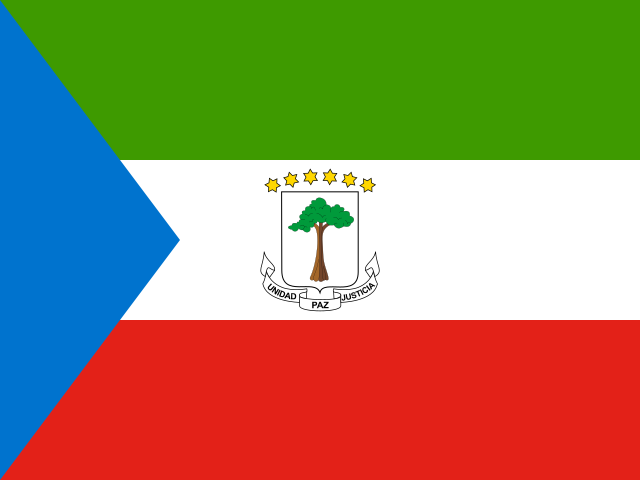 Equatorial Guinea
 Gabon
Gabon Sao Tome and Principe
Earlier Report Observations
The market volume for sunflower or safflower oil and fractions in Middle Africa contracted from 15 755 t in 2018 to 11 975 t in 2019, then stabilized and began a gradual recovery, reaching 12 364 t by 2020.
From 2021, the COVID-19 pandemic disrupted global supply chains, while increasing worldwide demand for healthy food products stimulated consumption. These factors supported a rise in imports, helping the market volume grow to 12 698 t in 2021. The war in Ukraine in 2022 caused a global sunflower oil shortage, leading to sharp price increases and a reorganization of international trade flows, which further expanded the regional market to 14 126 t.
In 2023, the continued effects of the Ukraine conflict, coupled with unfavorable weather conditions in major producing regions like Ukraine and Russia, kept global supply tight and prices elevated. Middle Africa's market volume responded with significant growth, reaching 18 341 t, as import flows adapted to the new global trade environment.
Table of content
- 1. Disclaimer
- 2. Terms of use of the report
- 3. Product codes in the statistical classifications used in the report
-
4. Key Market Indicators and Trends
-
4.1. Key Market Indicators
-
4.1.1. In kind
- 4.1.1.1. Production, 2018-2023
- 4.1.1.2. Imports, 2018-2024
- 4.1.1.3. Exports, 2018-2024
- 4.1.1.4. Market size, 2018-2023
-
4.1.1. In kind
- 4.2. Market Trends and Factors
-
4.1. Key Market Indicators
-
5. Production
-
5.1. Production in Middle Africa
- 5.1.1. Annual dynamics of production in Middle Africa in kind, 2018-2023, t
-
5.2. Global production by Country, 2018-2023
- 5.2.1. Annual dynamics of production by macroregions in kind, 2018-2023, t
- 5.2.2. Dynamics of production structure by macroregions in kind, 2018-2023
- 5.2.3. Annual dynamics of production by country in kind, 2018-2023, t
- 5.2.4. Structure of production by countries in kind, 2018-2023
- 5.2.5. Dynamics of peoduction structure by countries in kind, 2018-2023
-
5.1. Production in Middle Africa
-
6. Imports
-
6.1. Imports (Direct Data*)
- 6.1.1. Imports - Total information
-
6.1.2. Imports in kind, t
- 6.1.2.1. Annual dynamics of product's imports to Angola in kind, 2018-2024, t
- 6.1.2.2. Dynamics of product's imports in kind to Angola by countries, 2018-2024, t
- 6.1.2.3. Structure of product's imports in kind by countries, 2018-2024
-
6.1.3. Imports in value, K $ US
- 6.1.3.1. Annual dynamics of product's imports to Angola in value, 2018-2024, K $ US
- 6.1.3.2. Dynamics of product's imports in value to Angola by countries, 2018-2024, K $ US
- 6.1.3.3. Structure of product's imports in value by countries, 2018-2024
-
6.1.4. Average price of product's imports, $ US/t
- 6.1.4.1. Annual dynamics of average price of product's imports to Angola, 2018-2024, $ US/t
- 6.1.4.2. Dynamics of average price of product's imports to Angola by countries, 2018-2024, $ US/t
-
6.2. Imports (Mirror Data)
- 6.2.1. Imports - Total information
-
6.2.2. Imports in kind, t
- 6.2.2.1. Annual dynamics of product's imports to Angola in kind, 2018-2024, t
- 6.2.2.2. Dynamics of product's imports in kind to Angola by countries, 2018-2024, t
- 6.2.2.3. Structure of product's imports in kind by countries, 2018-2024
-
6.2.3. Imports in value, K $ US
- 6.2.3.1. Annual dynamics of product's imports to Angola in value, 2018-2024, K $ US
- 6.2.3.2. Dynamics of product's imports in value to Angola by countries, 2018-2024, K $ US
- 6.2.3.3. Structure of product's imports in value by countries, 2018-2024
-
6.2.4. Average price of product's imports, $ US/t
- 6.2.4.1. Annual dynamics of average price of product's imports to Angola, 2018-2024, $ US/t
- 6.2.4.2. Dynamics of average price of product's imports to Angola by countries, 2018-2024, $ US/t
-
6.1. Imports (Direct Data*)
-
7. Exports
-
7.1. Exports (Direct Data*)
- 7.1.1. Exports - Total information
-
7.1.2. Exports in kind, t
- 7.1.2.1. Annual dynamics of product's exports from Angola in kind, 2018-2024, t
- 7.1.2.2. Dynamics of product's exports in kind from Angola by countries, 2018-2024, t
- 7.1.2.3. Structure of product's exports in kind by countries, 2018-2024
-
7.1.3. Exports in value, K $ US
- 7.1.3.1. Annual dynamics of product's exports from Angola in value, 2018-2024, K $ US
- 7.1.3.2. Dynamics of product's exports in value from Angola by countries, 2018-2024, K $ US
- 7.1.3.3. Structure of product's exports in value by countries, 2018-2024
-
7.1.4. Average price of product's exports, $ US/t
- 7.1.4.1. Annual dynamics of average price of product's exports from Angola, 2018-2024, $ US/t
- 7.1.4.2. Dynamics of average price of product's exports from Angola by countries, 2018-2024, $ US/t
-
7.2. Exports (Mirror Data)
- 7.2.1. Exports - Total information
-
7.2.2. Exports in kind, t
- 7.2.2.1. Annual dynamics of product's exports from Angola in kind, 2018-2024, t
- 7.2.2.2. Dynamics of product's exports in kind from Angola by countries, 2018-2024, t
- 7.2.2.3. Structure of product's exports in kind by countries, 2018-2024
-
7.2.3. Exports in value, K $ US
- 7.2.3.1. Annual dynamics of product's exports from Angola in value, 2018-2024, K $ US
- 7.2.3.2. Dynamics of product's exports in value from Angola by countries, 2018-2024, K $ US
- 7.2.3.3. Structure of product's exports in value by countries, 2018-2024
-
7.2.4. Average price of product's exports, $ US/t
- 7.2.4.1. Annual dynamics of average price of product's exports from Angola, 2018-2024, $ US/t
- 7.2.4.2. Dynamics of average price of product's exports from Angola by countries, 2018-2024, $ US/t
-
7.1. Exports (Direct Data*)
-
8. Trade balance
-
8.1. Trade balance (Direct Data)
- 8.1.1. In kind, t
- 8.1.2. In value, K $ US
-
8.2. Trade balance (Mirror Data)
- 8.2.1. In kind, t
- 8.2.2. In value, K $ US
-
8.1. Trade balance (Direct Data)
-
9. Top buying and selling countries, 2018-2024
-
9.1. Direct Data
- 9.1.1. Import in Value by Countries-buyers
- 9.1.2. Export in Value by Countries-suppliers
-
9.2. Mirror Data
- 9.2.1. Import in Value by Countries-buyers
- 9.2.2. Export in Value by Countries-suppliers
-
9.1. Direct Data
Production sunflower or safflower oil and fractions in Middle Africa
In kind, 2017-2020, t
Top producers of sunflower or safflower oil and fractions, 2017-2020
World map of production of sunflower or safflower oil and fractions, 2017-2020
Middle Africa's production of sunflower or safflower oil and fractions has increased for the third consecutive year. In 2020, the region produced 3,760 tonnes, showing no significant change from the previous year.
Annual dynamics of production in Middle Africa in kind, 2017-2020, t
| Parameter | 2018 | 2019 | 2020 | CAGR | |
|---|---|---|---|---|---|
| 1 | Change from last year | 0.5% | 0.7% | 0.3% | 0.5% |
Exports sunflower or safflower oil and fractions from Middle Africa
Exports in kind, t
The market exhibited considerable volatility during this period. Exports reached their lowest point in 2020 at just 2 tonnes, marking a sharp year-over-year decline of 93.4%. This followed a peak in 2018 when exports hit 228 tonnes, representing a dramatic 6,083.1% increase from the previous year. Overall, the fluctuation between the 2018 high and 2020 low was 114-fold.
Annual dynamics of product's exports from Middle Africa in kind, 2017-2020, t
| Parameter | 2018 | 2019 | 2020 | CAGR | |
|---|---|---|---|---|---|
| 1 | Change from last year | 6 083.1% | (86.7%) | (93.4%) | (18.5%) |
From 2017 to 2020, Mauritania and Uganda consistently served as the primary markets for exports in kind, together accounting for 77.2% of total flows.
Structure of product's exports in kind by countries, 2017-2020
World map of product's exports from Middle Africa in kind, 2017-2020
Exports in value, K $ US
The data shows irregular changes, pointing to a volatile market environment. In 2020, sunflower or safflower oil and fractions deliveries from Middle Africa amounted to 2,000 US dollars, down 93.9% year-over-year. This contrasted with the peak in 2018 when exports reached 110,000 US dollars, representing a 2,355.1% increase from the previous year. The difference between the 2018 high and 2020 low was 48-fold.
Annual dynamics of product's exports from Middle Africa in value, 2017-2020, K $ US
| Parameter | 2018 | 2019 | 2020 | CAGR | |
|---|---|---|---|---|---|
| 1 | Change from last year | 2 355.1% | (65.6%) | (93.9%) | (19.9%) |
During 2017–2020, Mauritania (63.2% of exports in value terms), Namibia (2.6%), and Spain (1.7%) consistently remained the main destinations for exports in value terms, together accounting for 67.5% of total flows.
Structure of product's exports in value by countries, 2017-2020
World map of product's exports from Middle Africa in value, 2017-2020
Imports sunflower or safflower oil and fractions to Middle Africa
Imports in kind, t
Market behavior was characterized by volatility during these years. Imports hit their lowest point in 2017, then peaked in 2018, showing a 1.8-fold swing between these years. In 2020, Middle Africa's import volume of sunflower or safflower oil and fractions amounted to 8,606 tonnes, indicating a gradual 4.2% increase compared to the previous year. The maximum value was recorded in 2018 at 12,263 tonnes, which followed a 77.7% increase from 2017. The largest decline occurred in 2019, falling by 32.7%.
Annual dynamics of product's imports to Middle Africa in kind, 2017-2020, t
| Parameter | 2018 | 2019 | 2020 | CAGR | |
|---|---|---|---|---|---|
| 1 | Change from last year | 77.7% | (32.7%) | 4.2% | 7.6% |
Over the 2017–2020 period, Ukraine (23.1% of imports in kind), Portugal (15.9%), and Turkey (13.5%) stood out as the main markets for imports in kind, together representing 52.4% of total flows.
Structure of product's imports in kind by countries, 2017-2020
World map of product's imports to Middle Africa in kind, 2017-2020
Imports in value, K $ US
The data reveals irregular changes, indicating a volatile market environment. Imports reached their lowest point in 2017, then peaked in 2018, with a 2.1-fold gap between these years. In 2020, Middle Africa's volume of sunflower or safflower oil and fractions imports totaled 9,511,000 US dollars, showing a moderate 4.0% decrease year-over-year. The maximum value was recorded in 2018 at 19,274,000 US dollars, which followed a 107.9% increase from 2017. The largest decline occurred in 2019, falling by 48.6%.
Annual dynamics of product's imports to Middle Africa in value, 2017-2020, K $ US
| Parameter | 2018 | 2019 | 2020 | CAGR | |
|---|---|---|---|---|---|
| 1 | Change from last year | 107.9% | (48.6%) | (4.0%) | 0.9% |
From 2017 to 2020, Ukraine (20.3% of imports in value terms), Portugal (20.3%), and Turkey (14.7%) together absorbed 55.3% of total imports in value terms of sunflower or safflower oil and fractions to Middle Africa, making them the primary destinations.
Structure of product's imports in value by countries, 2017-2020
World map of product's imports to Middle Africa in value, 2017-2020
Related Reports





In-depth market research on this product
Global Sunflower Seeds Market 2021–2031: Size, Share, Trends and Forecast
Global market report: size, trends and forecast to 2031 · 184 pages
Why Choose Us?
Only Verified Data
No Hidden Costs or Separate Fees
Smarter Subscription Pricing
Contact Our Team
Submit your inquiry using the form below — our team will get back to you within 24 hours.