






"Middle Africa" region includes following countries:
 Angola
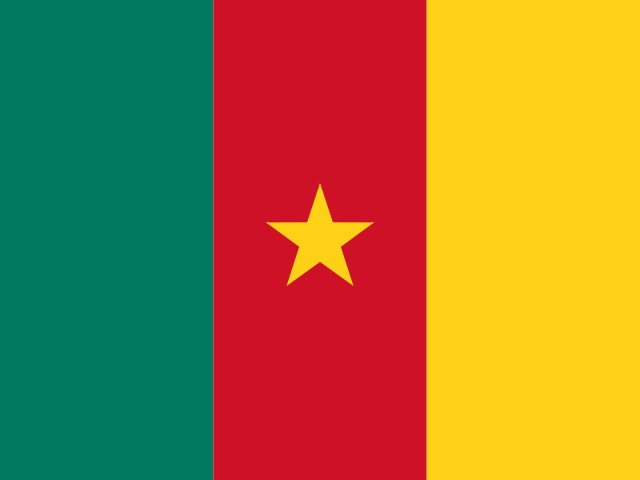 Cameroon
 Central African Republic
 Chad
Chad Congo
Congo Democratic Republic of the Congo
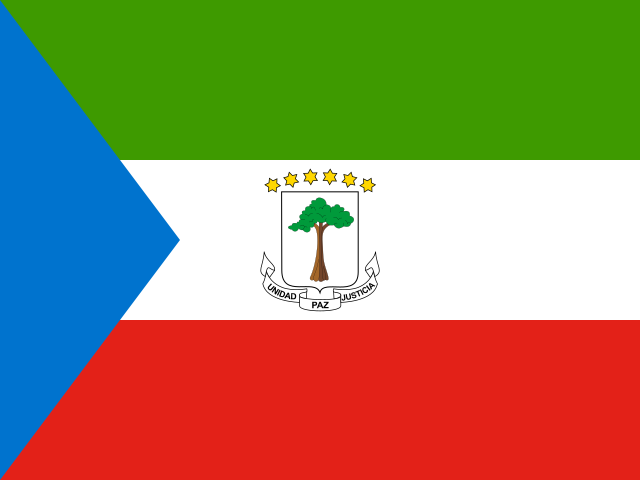 Equatorial Guinea
 Gabon
Gabon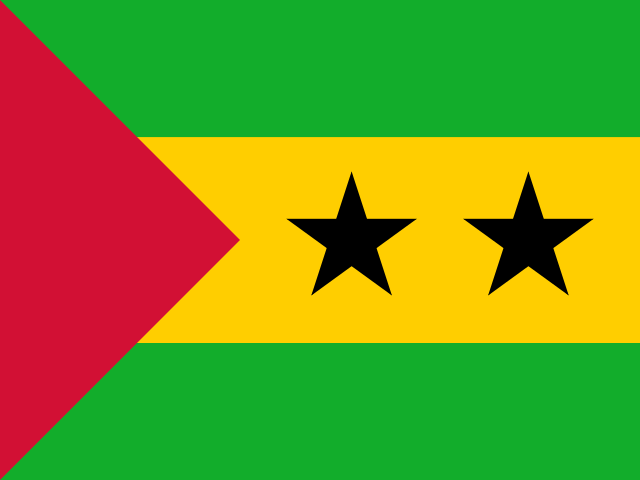 Sao Tome and Principe
Earlier Report Observations
The soybean market in Middle Africa experienced substantial growth between 2018 and 2023. Market volume increased from 125.5 thousand tons to 185.0 thousand tons, reflecting a robust expansion in domestic production, which rose from 123.4 thousand tons to 183.8 thousand tons over the same period. This growth was not linear, however, with a notable contraction in both production and market size in 2022 before recovery in the following year.
International trade played a minor role in the market, with imports fluctuating between 1.5 and 3.7 thousand tons annually. Exports were negligible until 2023, when the region began shipping small quantities abroad, reaching 0.3 thousand tons that year. The market remained predominantly supplied by local production throughout the period.
By 2023, the market had regained its upward trajectory, with production approaching previous peak levels. Preliminary trade data for 2024 shows continued import activity and modest exports, indicating sustained market engagement beyond domestic borders.
Table of content
- 1. Disclaimer
- 2. Terms of use of the report
- 3. Product codes in the statistical classifications used in the report
-
4. Key Market Indicators and Trends
-
4.1. Key Market Indicators
-
4.1.1. In kind
- 4.1.1.1. Production, 2018-2023
- 4.1.1.2. Imports, 2018-2024
- 4.1.1.3. Exports, 2018-2024
- 4.1.1.4. Market size, 2018-2023
-
4.1.1. In kind
- 4.2. Market Trends and Factors
-
4.1. Key Market Indicators
-
5. Production
-
5.1. Production in Middle Africa
- 5.1.1. Annual dynamics of production in Middle Africa in kind, 2018-2023, K t
-
5.2. Global production by Country, 2018-2023
- 5.2.1. Annual dynamics of production by macroregions in kind, 2018-2023, K t
- 5.2.2. Dynamics of production structure by macroregions in kind, 2018-2023
- 5.2.3. Annual dynamics of production by country in kind, 2018-2023, K t
- 5.2.4. Structure of production by countries in kind, 2018-2023
- 5.2.5. Dynamics of peoduction structure by countries in kind, 2018-2023
-
5.1. Production in Middle Africa
-
6. Imports
-
6.1. Imports (Direct Data*)
- 6.1.1. Imports - Total information
-
6.1.2. Imports in kind, t
- 6.1.2.1. Annual dynamics of product's imports to Angola in kind, 2018-2024, t
- 6.1.2.2. Dynamics of product's imports in kind to Angola by countries, 2018-2024, t
- 6.1.2.3. Structure of product's imports in kind by countries, 2018-2024
-
6.1.3. Imports in value, K $ US
- 6.1.3.1. Annual dynamics of product's imports to Angola in value, 2018-2024, K $ US
- 6.1.3.2. Dynamics of product's imports in value to Angola by countries, 2018-2024, K $ US
- 6.1.3.3. Structure of product's imports in value by countries, 2018-2024
-
6.1.4. Average price of product's imports, $ US/t
- 6.1.4.1. Annual dynamics of average price of product's imports to Angola, 2018-2024, $ US/t
- 6.1.4.2. Dynamics of average price of product's imports to Angola by countries, 2018-2024, $ US/t
-
6.2. Imports (Mirror Data)
- 6.2.1. Imports - Total information
-
6.2.2. Imports in kind, t
- 6.2.2.1. Annual dynamics of product's imports to Angola in kind, 2018-2024, t
- 6.2.2.2. Dynamics of product's imports in kind to Angola by countries, 2018-2024, t
- 6.2.2.3. Structure of product's imports in kind by countries, 2018-2024
-
6.2.3. Imports in value, K $ US
- 6.2.3.1. Annual dynamics of product's imports to Angola in value, 2018-2024, K $ US
- 6.2.3.2. Dynamics of product's imports in value to Angola by countries, 2018-2024, K $ US
- 6.2.3.3. Structure of product's imports in value by countries, 2018-2024
-
6.2.4. Average price of product's imports, $ US/t
- 6.2.4.1. Annual dynamics of average price of product's imports to Angola, 2018-2024, $ US/t
- 6.2.4.2. Dynamics of average price of product's imports to Angola by countries, 2018-2024, $ US/t
-
6.1. Imports (Direct Data*)
-
7. Exports
-
7.1. Exports (Direct Data*)
- 7.1.1. Exports - Total information
-
7.1.2. Exports in kind, t
- 7.1.2.1. Annual dynamics of product's exports from Angola in kind, 2018-2024, t
- 7.1.2.2. Dynamics of product's exports in kind from Angola by countries, 2018-2024, t
- 7.1.2.3. Structure of product's exports in kind by countries, 2018-2024
-
7.1.3. Exports in value, K $ US
- 7.1.3.1. Annual dynamics of product's exports from Angola in value, 2018-2024, K $ US
- 7.1.3.2. Dynamics of product's exports in value from Angola by countries, 2018-2024, K $ US
- 7.1.3.3. Structure of product's exports in value by countries, 2018-2024
-
7.1.4. Average price of product's exports, $ US/t
- 7.1.4.1. Annual dynamics of average price of product's exports from Angola, 2018-2024, $ US/t
- 7.1.4.2. Dynamics of average price of product's exports from Angola by countries, 2018-2024, $ US/t
-
7.2. Exports (Mirror Data)
- 7.2.1. Exports - Total information
-
7.2.2. Exports in kind, t
- 7.2.2.1. Annual dynamics of product's exports from Angola in kind, 2018-2024, t
- 7.2.2.2. Dynamics of product's exports in kind from Angola by countries, 2018-2024, t
- 7.2.2.3. Structure of product's exports in kind by countries, 2018-2024
-
7.2.3. Exports in value, K $ US
- 7.2.3.1. Annual dynamics of product's exports from Angola in value, 2018-2024, K $ US
- 7.2.3.2. Dynamics of product's exports in value from Angola by countries, 2018-2024, K $ US
- 7.2.3.3. Structure of product's exports in value by countries, 2018-2024
-
7.2.4. Average price of product's exports, $ US/t
- 7.2.4.1. Annual dynamics of average price of product's exports from Angola, 2018-2024, $ US/t
- 7.2.4.2. Dynamics of average price of product's exports from Angola by countries, 2018-2024, $ US/t
-
7.1. Exports (Direct Data*)
-
8. Trade balance
-
8.1. Trade balance (Direct Data)
- 8.1.1. In kind, t
- 8.1.2. In value, K $ US
-
8.2. Trade balance (Mirror Data)
- 8.2.1. In kind, t
- 8.2.2. In value, K $ US
-
8.1. Trade balance (Direct Data)
-
9. Top buying and selling countries, 2018-2024
-
9.1. Direct Data
- 9.1.1. Import in Value by Countries-buyers
- 9.1.2. Export in Value by Countries-suppliers
-
9.2. Mirror Data
- 9.2.1. Import in Value by Countries-buyers
- 9.2.2. Export in Value by Countries-suppliers
-
9.1. Direct Data
Production soybeans in Middle Africa
In kind, 2017-2020, K t
Top producers of soybeans, 2017-2020
World map of production of soybeans, 2017-2020
Soybean production in Middle Africa has increased for the third consecutive year. In 2020, the region produced 160.8 thousand tonnes of soybeans, marking a 22.2% increase compared to the previous year. Over the period from 2017 to 2020, production grew by 34.6%, with an average annual growth rate of 10.4%.
Annual dynamics of production in Middle Africa in kind, 2017-2020, K t
| Parameter | 2018 | 2019 | 2020 | CAGR | |
|---|---|---|---|---|---|
| 1 | Change from last year | 3.2% | 6.7% | 22.2% | 10.4% |
Exports soybeans from Middle Africa
Exports in kind, t
Middle Africa exported 42 tonnes of soybeans in 2020, representing a significant decrease of 16.0% from the previous year. Between 2017 and 2020, exports overall increased by 20.6%, which translates to an annualized growth rate of 6.4%. The lowest export volume was recorded in 2018 at 34 tonnes, while the highest was in 2019 at 49 tonnes. The largest year-on-year increase occurred in 2019, with a jump of 47.1%.
Annual dynamics of product's exports from Middle Africa in kind, 2017-2020, t
| Parameter | 2018 | 2019 | 2020 | CAGR | |
|---|---|---|---|---|---|
| 1 | Change from last year | (2.4%) | 47.1% | (16.0%) | 6.4% |
From 2017 to 2020, the main destinations for soybean exports from Middle Africa were Rwanda (30.2% of exports in kind), Namibia (27.3%), and Uganda (22.7%). Together, these three countries accounted for 80.2% of total export flows.
Structure of product's exports in kind by countries, 2017-2020
World map of product's exports from Middle Africa in kind, 2017-2020
Exports in value, K $ US
The market showed considerable volatility during this period. Exports in value terms varied by 4.4 times between the peak in 2017 and the low in 2020. In 2020, Middle Africa's soybean exports amounted to 8 thousand US dollars, a 51.6% decline from the previous year. The largest decrease was recorded in 2018 at 59.0%, while the largest increase occurred in 2019 at 15.8%.
Annual dynamics of product's exports from Middle Africa in value, 2017-2020, K $ US
| Parameter | 2018 | 2019 | 2020 | CAGR | |
|---|---|---|---|---|---|
| 1 | Change from last year | (59.0%) | 15.8% | (51.6%) | (38.7%) |
From 2017 to 2020, the leading destinations for soybean exports from Middle Africa in value terms were Namibia (51.7% of exports in value), Rwanda (12.9%), and Uganda (11.6%). Collectively, these three countries made up 76.2% of total export value.
Structure of product's exports in value by countries, 2017-2020
World map of product's exports from Middle Africa in value, 2017-2020
Imports soybeans to Middle Africa
Imports in kind, t
The market displayed an unstable trend throughout the timeframe. Import volumes varied by 4.9 times from the high in 2017 to the low in 2020. In 2020, Middle Africa imported 1 902 tonnes of soybeans, a decrease of 49.1% compared to the previous year. The largest decline was recorded in 2018 at 76.2%, while the largest increase occurred in 2019 at 67.9%.
Annual dynamics of product's imports to Middle Africa in kind, 2017-2020, t
| Parameter | 2018 | 2019 | 2020 | CAGR | |
|---|---|---|---|---|---|
| 1 | Change from last year | (76.2%) | 67.9% | (49.1%) | (41.2%) |
Throughout 2017 to 2020, Belgium (41.5% of imports in kind), South Africa (19.7%), and Portugal (15.4%) were the primary sources for soybean imports to Middle Africa. Together, they accounted for 76.6% of total import volumes.
Structure of product's imports in kind by countries, 2017-2020
World map of product's imports to Middle Africa in kind, 2017-2020
Imports in value, K $ US
The data indicates irregular changes, reflecting a volatile market environment. Imports in value terms varied by 3.5 times from the high in 2017 to the low in 2020. In 2020, soybean imports to Middle Africa totaled 1 864 thousand US dollars, down by 30.1% from 2019. The largest decline was recorded in 2018 at 69.6%, while the largest increase occurred in 2019 at 36.1%.
Annual dynamics of product's imports to Middle Africa in value, 2017-2020, K $ US
| Parameter | 2018 | 2019 | 2020 | CAGR | |
|---|---|---|---|---|---|
| 1 | Change from last year | (69.6%) | 36.1% | (30.1%) | (33.8%) |
Throughout 2017 to 2020, Belgium (47.0% of imports in value terms), South Africa (19.5%), and Uruguay (6.6%) were the key partners for soybean imports to Middle Africa. Together, they represented 73.2% of total import value.
Structure of product's imports in value by countries, 2017-2020
World map of product's imports to Middle Africa in value, 2017-2020
Related Reports

2026-03-28
2026-03-28
Soybeans market in Southern Europe
2026-03-28
2026-03-28

Sunflower seeds market in Middle Africa
2026-03-28
2026-03-28

Sesame seeds market in Middle Africa
2026-03-28
In-depth market research on this product
Global Soybean Meal Market 2021–2031: Size, Share, Trends and Forecast
Global market report: size, trends and forecast to 2031 · 196 pages
Why Choose Us?
Only Verified Data
No Hidden Costs or Separate Fees
Smarter Subscription Pricing
Contact Our Team
Submit your inquiry using the form below — our team will get back to you within 24 hours.