






"Middle Africa" region includes following countries:
 Angola
 Cameroon
 Central African Republic
 Chad
Chad Congo
Congo Democratic Republic of the Congo
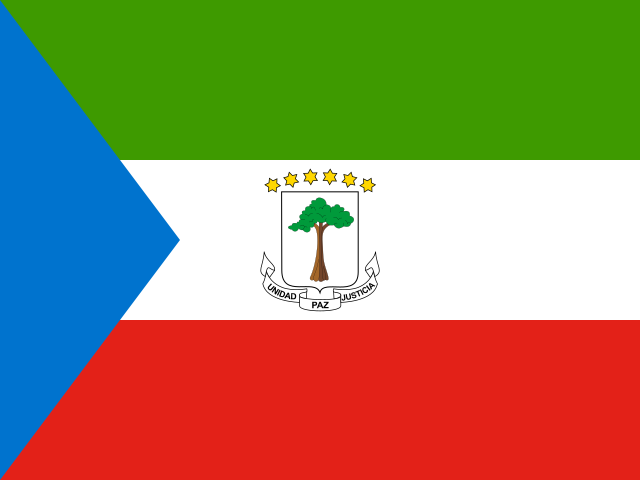 Equatorial Guinea
 Gabon
Gabon Sao Tome and Principe
Earlier Report Observations
The oil seeds and oleaginous fruits market in Middle Africa expanded consistently from 68 362 t in 2018 to 77 674 t in 2023. This growth was initially supported by the development of agricultural market information systems in 2020, which provided producers with price data to better direct their products and achieve fairer market prices, enhancing production efficiency and output.
Further momentum came from increased availability of quality seeds for crops like maize and cocoa through cooperatives in 2021, directly boosting yields. In 2022, despite rising input costs, the arrival of a significant shipment of fertilizers from Russia alleviated local shortages and helped sustain production volumes, while the PADFA II project aimed to strengthen agricultural value chains, contributing to market resilience and growth.
By 2024, factors such as improved peanut availability in northern regions and stable inflation with better supply of pulses and oilseeds supported favorable market conditions, although flooding affected other agricultural products without halting the overall positive trajectory for oil seeds.
Table of content
- 1. Disclaimer
- 2. Terms of use of the report
- 3. Product codes in the statistical classifications used in the report
-
4. Key Market Indicators and Trends
-
4.1. Key Market Indicators
-
4.1.1. In kind
- 4.1.1.1. Production, 2018-2023
- 4.1.1.2. Imports, 2018-2024
- 4.1.1.3. Exports, 2018-2024
- 4.1.1.4. Market size, 2018-2023
-
4.1.1. In kind
- 4.2. Market Trends and Factors
-
4.1. Key Market Indicators
-
5. Production
-
5.1. Production in Middle Africa
- 5.1.1. Annual dynamics of production in Middle Africa in kind, 2018-2023, t
-
5.2. Global production by Country, 2018-2023
- 5.2.1. Annual dynamics of production by macroregions in kind, 2018-2023, t
- 5.2.2. Dynamics of production structure by macroregions in kind, 2018-2023
- 5.2.3. Annual dynamics of production by country in kind, 2018-2023, t
- 5.2.4. Structure of production by countries in kind, 2018-2023
- 5.2.5. Dynamics of peoduction structure by countries in kind, 2018-2023
-
5.1. Production in Middle Africa
-
6. Imports
-
6.1. Imports (Direct Data*)
- 6.1.1. Imports - Total information
-
6.1.2. Imports in kind, t
- 6.1.2.1. Annual dynamics of product's imports to Angola in kind, 2018-2024, t
- 6.1.2.2. Dynamics of product's imports in kind to Angola by countries, 2018-2024, t
- 6.1.2.3. Structure of product's imports in kind by countries, 2018-2024
-
6.1.3. Imports in value, K $ US
- 6.1.3.1. Annual dynamics of product's imports to Angola in value, 2018-2024, K $ US
- 6.1.3.2. Dynamics of product's imports in value to Angola by countries, 2018-2024, K $ US
- 6.1.3.3. Structure of product's imports in value by countries, 2018-2024
-
6.1.4. Average price of product's imports, $ US/kg
- 6.1.4.1. Annual dynamics of average price of product's imports to Angola, 2018-2024, $ US/kg
- 6.1.4.2. Dynamics of average price of product's imports to Angola by countries, 2018-2024, $ US/kg
-
6.2. Imports (Mirror Data)
- 6.2.1. Imports - Total information
-
6.2.2. Imports in kind, t
- 6.2.2.1. Annual dynamics of product's imports to Angola in kind, 2018-2024, t
- 6.2.2.2. Dynamics of product's imports in kind to Angola by countries, 2018-2024, t
- 6.2.2.3. Structure of product's imports in kind by countries, 2018-2024
-
6.2.3. Imports in value, K $ US
- 6.2.3.1. Annual dynamics of product's imports to Angola in value, 2018-2024, K $ US
- 6.2.3.2. Dynamics of product's imports in value to Angola by countries, 2018-2024, K $ US
- 6.2.3.3. Structure of product's imports in value by countries, 2018-2024
-
6.2.4. Average price of product's imports, $ US/kg
- 6.2.4.1. Annual dynamics of average price of product's imports to Angola, 2018-2024, $ US/kg
- 6.2.4.2. Dynamics of average price of product's imports to Angola by countries, 2018-2024, $ US/kg
-
6.1. Imports (Direct Data*)
-
7. Exports
-
7.1. Exports (Direct Data*)
- 7.1.1. Exports - Total information
-
7.1.2. Exports in kind, t
- 7.1.2.1. Annual dynamics of product's exports from Angola in kind, 2018-2024, t
- 7.1.2.2. Dynamics of product's exports in kind from Angola by countries, 2018-2024, t
- 7.1.2.3. Structure of product's exports in kind by countries, 2018-2024
-
7.1.3. Exports in value, K $ US
- 7.1.3.1. Annual dynamics of product's exports from Angola in value, 2018-2024, K $ US
- 7.1.3.2. Dynamics of product's exports in value from Angola by countries, 2018-2024, K $ US
- 7.1.3.3. Structure of product's exports in value by countries, 2018-2024
-
7.1.4. Average price of product's exports, $ US/kg
- 7.1.4.1. Annual dynamics of average price of product's exports from Angola, 2018-2024, $ US/kg
- 7.1.4.2. Dynamics of average price of product's exports from Angola by countries, 2018-2024, $ US/kg
-
7.2. Exports (Mirror Data)
- 7.2.1. Exports - Total information
-
7.2.2. Exports in kind, t
- 7.2.2.1. Annual dynamics of product's exports from Angola in kind, 2018-2024, t
- 7.2.2.2. Dynamics of product's exports in kind from Angola by countries, 2018-2024, t
- 7.2.2.3. Structure of product's exports in kind by countries, 2018-2024
-
7.2.3. Exports in value, K $ US
- 7.2.3.1. Annual dynamics of product's exports from Angola in value, 2018-2024, K $ US
- 7.2.3.2. Dynamics of product's exports in value from Angola by countries, 2018-2024, K $ US
- 7.2.3.3. Structure of product's exports in value by countries, 2018-2024
-
7.2.4. Average price of product's exports, $ US/kg
- 7.2.4.1. Annual dynamics of average price of product's exports from Angola, 2018-2024, $ US/kg
- 7.2.4.2. Dynamics of average price of product's exports from Angola by countries, 2018-2024, $ US/kg
-
7.1. Exports (Direct Data*)
-
8. Trade balance
-
8.1. Trade balance (Direct Data)
- 8.1.1. In kind, t
- 8.1.2. In value, K $ US
-
8.2. Trade balance (Mirror Data)
- 8.2.1. In kind, t
- 8.2.2. In value, K $ US
-
8.1. Trade balance (Direct Data)
-
9. Top buying and selling countries, 2018-2024
-
9.1. Direct Data
- 9.1.1. Import in Value by Countries-buyers
- 9.1.2. Export in Value by Countries-suppliers
-
9.2. Mirror Data
- 9.2.1. Import in Value by Countries-buyers
- 9.2.2. Export in Value by Countries-suppliers
-
9.1. Direct Data
Production oil seeds and oleaginous fruits in Middle Africa
In kind, 2017-2020, t
Top producers of oil seeds and oleaginous fruits, 2017-2020
World map of production of oil seeds and oleaginous fruits, 2017-2020
Middle Africa's production of oil seeds and oleaginous fruits has grown for the third year in a row. In 2020, the region produced 74 100 tonnes, which represents a 5.7% increase compared to 2019. Looking at the period from 2017 to 2020, production rose by 8.6%, translating to an average annual growth rate of 2.8%.
Annual dynamics of production in Middle Africa in kind, 2017-2020, t
| Parameter | 2018 | 2019 | 2020 | CAGR | |
|---|---|---|---|---|---|
| 1 | Change from last year | 0.2% | 2.6% | 5.7% | 2.8% |
Exports oil seeds and oleaginous fruits from Middle Africa
Exports in kind, t
Middle Africa's exports of oil seeds and oleaginous fruits have declined for the second consecutive year. In 2020, exports totaled 18.0 tonnes, showing a sharp drop of 57.5% from the previous year. Over the 2017-2020 period, exports decreased by 53.6%, with a compound annual growth rate of -22.6%. The highest export volume was recorded in 2018 at 47.9 tonnes, which also saw the largest annual increase of 23.7%.
Annual dynamics of product's exports from Middle Africa in kind, 2017-2020, t
| Parameter | 2018 | 2019 | 2020 | CAGR | |
|---|---|---|---|---|---|
| 1 | Change from last year | 23.7% | (11.7%) | (57.5%) | (22.6%) |
From 2017 to 2020, Nigeria, Niger, and Kenya were the core destinations for Middle Africa's exports of oil seeds and oleaginous fruits in volume terms. Nigeria accounted for 45.0% of exports, Niger for 8.8%, and Kenya for 6.3%, together making up 60.0% of total export flows.
Structure of product's exports in kind by countries, 2017-2020
World map of product's exports from Middle Africa in kind, 2017-2020
Exports in value, K $ US
The market showed significant volatility during these years. Export values varied by 2.8 times, with the low point in 2017 and the high in 2020. In 2020, Middle Africa exported oil seeds and oleaginous fruits worth 51 000 US dollars, reflecting a substantial year-on-year increase of 120.3%. The largest decline occurred in 2019, with a drop of 41.8%.
Annual dynamics of product's exports from Middle Africa in value, 2017-2020, K $ US
| Parameter | 2018 | 2019 | 2020 | CAGR | |
|---|---|---|---|---|---|
| 1 | Change from last year | 115.5% | (41.8%) | 120.3% | 40.3% |
Between 2017 and 2020, the leading destinations for Middle Africa's exports of oil seeds and oleaginous fruits in value terms were Nigeria, Kenya, and Niger. Nigeria represented 31.6% of export value, Kenya 15.0%, and Niger 5.1%, collectively accounting for 51.7% of total export flows.
Structure of product's exports in value by countries, 2017-2020
World map of product's exports from Middle Africa in value, 2017-2020
Imports oil seeds and oleaginous fruits to Middle Africa
Imports in kind, t
The data shows irregular changes, indicating a volatile market environment. Import volumes varied significantly, with an 8.1-fold difference between the peak in 2019 and the trough in 2017. In 2020, Middle Africa imported 71.9 tonnes of oil seeds and oleaginous fruits, down 76.6% from the previous year. The highest import volume was recorded in 2019 at 307.9 tonnes, which also saw the largest annual increase of 401.2%.
Annual dynamics of product's imports to Middle Africa in kind, 2017-2020, t
| Parameter | 2018 | 2019 | 2020 | CAGR | |
|---|---|---|---|---|---|
| 1 | Change from last year | 62.3% | 401.2% | (76.6%) | 23.9% |
From 2017 to 2020, Namibia, Portugal, and Lebanon were the main sources for Middle Africa's imports of oil seeds and oleaginous fruits in volume terms. Namibia accounted for 43.7% of imports, Portugal for 31.9%, and Lebanon for 5.1%, together representing 80.7% of total import flows.
Structure of product's imports in kind by countries, 2017-2020
World map of product's imports to Middle Africa in kind, 2017-2020
Imports in value, K $ US
The market exhibited an unstable trend throughout this period. Import values varied by 3.9 times, with the high in 2017 and the low in 2020. In 2020, Middle Africa's imports of oil seeds and oleaginous fruits reached 271 000 US dollars, marking a 59.2% decrease compared to the prior year. The largest increase was recorded in 2019, with a rise of 34.5%.
Annual dynamics of product's imports to Middle Africa in value, 2017-2020, K $ US
| Parameter | 2018 | 2019 | 2020 | CAGR | |
|---|---|---|---|---|---|
| 1 | Change from last year | (52.8%) | 34.5% | (59.2%) | (36.2%) |
Over the 2017-2020 period, Benin, Papua New Guinea, and Portugal were the primary suppliers of oil seeds and oleaginous fruits to Middle Africa in value terms. Benin accounted for 29.2% of import value, Papua New Guinea for 18.7%, and Portugal for 12.6%, jointly making up 60.5% of total imports.
Structure of product's imports in value by countries, 2017-2020
World map of product's imports to Middle Africa in value, 2017-2020
Related Reports


Sunflower seeds market in Middle Africa
2026-03-28

Sesame seeds market in Middle Africa
2026-03-28

Soybeans market in Middle Africa
2026-03-28

Why Choose Us?
Only Verified Data
No Hidden Costs or Separate Fees
Smarter Subscription Pricing
Contact Our Team
Submit your inquiry using the form below — our team will get back to you within 24 hours.