






"Sub-Saharan Africa" region includes following countries:
 Cabo Verde
 Benin
Benin Gambia
 Ghana
Ghana Guinea
 Côte d'Ivoire
 Liberia
 Mali
Mali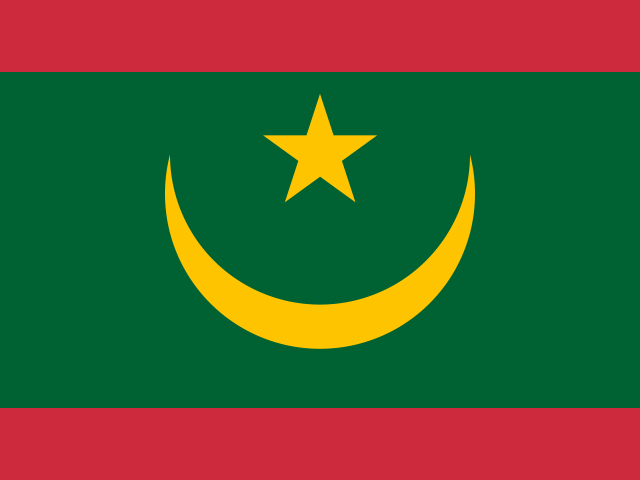 Mauritania
 Niger
Niger Nigeria
 Guinea-Bissau
 Saint Helena, Ascension and Tristan da Cunha
 Senegal
 Sierra Leone
 Togo
Togo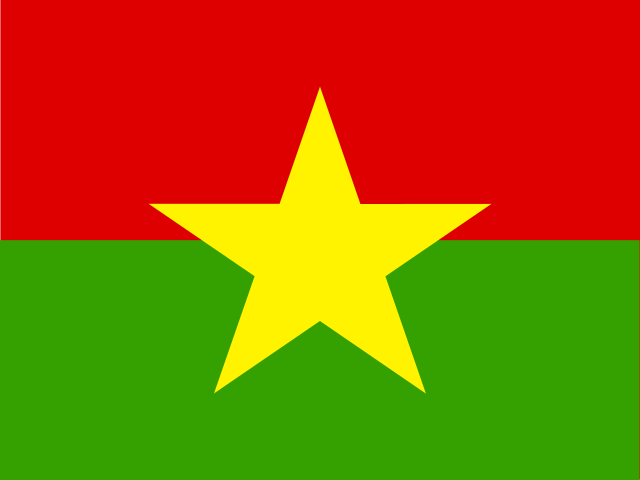 Burkina Faso
 British Indian Ocean Territory
 Burundi
 Comoros
 Mayotte
 Ethiopia
 Eritrea
 French Southern Territories
 Djibouti
 Kenya
Kenya Madagascar
 Malawi
 Mauritius
 Mozambique
 Reunion
 Rwanda
 Seychelles
 Somalia
 Zimbabwe
 South Sudan
 Uganda
 Tanzania
 Zambia
 Angola
 Cameroon
 Central African Republic
 Chad
Chad Congo
Congo Democratic Republic of the Congo
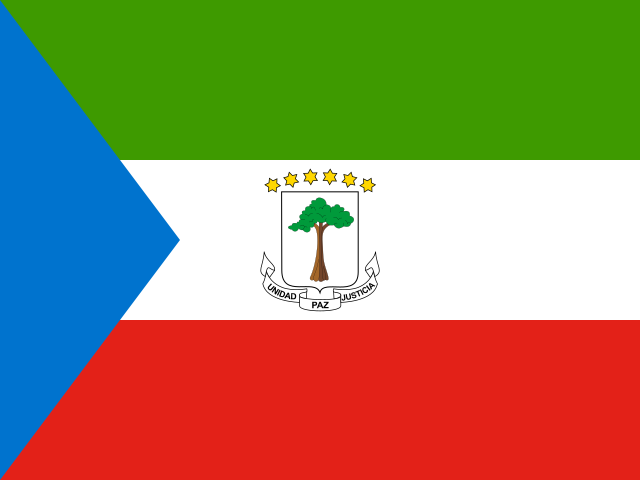 Equatorial Guinea
 Gabon
Gabon Sao Tome and Principe
 Botswana
 Lesotho
 Namibia
 South Africa
 Eswatini
Earlier Report Observations
The market volume for semi-milled or wholly milled rice in Sub-Saharan Africa grew substantially from 17.3 million tonnes in 2018 to 27.5 million tonnes in 2022. This expansion was fueled by a consistent increase in local production, which rose from 7.9 million to 12.1 million tonnes, supported by regional efforts like the second phase of the CARD initiative launched in 2019 to boost rice output and the Ricowas project from 2021 strengthening agricultural capacity. Imports remained high throughout this period, supplementing supply as domestic production could not keep pace with demand growing over 6% annually, driven by population growth, urbanization, and shifting consumer preferences.
In 2023, the market volume contracted to 23.4 million tonnes despite local production reaching a new high of 12.2 million tonnes. This decline was primarily due to a sharp reduction in imports, likely influenced by global disruptions such as the war in Ukraine and regional conflicts noted in sources, which constrained international trade flows. Concurrently, significant international investments, including $77 million from South Korea and $33.5 million from Japan directed to the rice sector, underscored ongoing commitments to enhance local production resilience and reduce import reliance over the long term.
Looking ahead, market developments in 2024 include the introduction of new improved rice varieties through alliances like AGGRi and the launch of fortified rice in Kenya, diversifying product offerings. These innovations, alongside continued FAO support for projects aimed at reducing post-harvest losses and strengthening the rice value chain, are set to improve productivity and sustainability across the region.
Table of content
- 1. Disclaimer
- 2. Terms of use of the report
- 3. Product codes in the statistical classifications used in the report
-
4. Key Market Indicators and Trends
-
4.1. Key Market Indicators
-
4.1.1. In kind
- 4.1.1.1. Production, 2018-2023
- 4.1.1.2. Imports, 2018-2024
- 4.1.1.3. Exports, 2018-2024
- 4.1.1.4. Market size, 2018-2023
-
4.1.1. In kind
- 4.2. Market Trends and Factors
-
4.1. Key Market Indicators
-
5. Production
-
5.1. Production in Sub-Saharan Africa
- 5.1.1. Annual dynamics of production in Sub-Saharan Africa in kind, 2018-2023, K t
-
5.2. Global production by Country, 2018-2023
- 5.2.1. Annual dynamics of production by macroregions in kind, 2018-2023, K t
- 5.2.2. Dynamics of production structure by macroregions in kind, 2018-2023
- 5.2.3. Annual dynamics of production by country in kind, 2018-2023, K t
- 5.2.4. Structure of production by countries in kind, 2018-2023
- 5.2.5. Dynamics of peoduction structure by countries in kind, 2018-2023
-
5.1. Production in Sub-Saharan Africa
-
6. Imports
-
6.1. Imports (Direct Data*)
- 6.1.1. Imports - Total information
-
6.1.2. Imports in kind, K t
- 6.1.2.1. Annual dynamics of product's imports to Cabo Verde in kind, 2018-2024, K t
- 6.1.2.2. Dynamics of product's imports in kind to Cabo Verde by countries, 2018-2024, K t
- 6.1.2.3. Structure of product's imports in kind by countries, 2018-2024
-
6.1.3. Imports in value, M $ US
- 6.1.3.1. Annual dynamics of product's imports to Cabo Verde in value, 2018-2024, M $ US
- 6.1.3.2. Dynamics of product's imports in value to Cabo Verde by countries, 2018-2024, M $ US
- 6.1.3.3. Structure of product's imports in value by countries, 2018-2024
-
6.1.4. Average price of product's imports, $ US/t
- 6.1.4.1. Annual dynamics of average price of product's imports to Cabo Verde, 2018-2024, $ US/t
- 6.1.4.2. Dynamics of average price of product's imports to Cabo Verde by countries, 2018-2024, $ US/t
-
6.2. Imports (Mirror Data)
- 6.2.1. Imports - Total information
-
6.2.2. Imports in kind, K t
- 6.2.2.1. Annual dynamics of product's imports to Cabo Verde in kind, 2018-2024, K t
- 6.2.2.2. Dynamics of product's imports in kind to Cabo Verde by countries, 2018-2024, K t
- 6.2.2.3. Structure of product's imports in kind by countries, 2018-2024
-
6.2.3. Imports in value, M $ US
- 6.2.3.1. Annual dynamics of product's imports to Cabo Verde in value, 2018-2024, M $ US
- 6.2.3.2. Dynamics of product's imports in value to Cabo Verde by countries, 2018-2024, M $ US
- 6.2.3.3. Structure of product's imports in value by countries, 2018-2024
-
6.2.4. Average price of product's imports, $ US/t
- 6.2.4.1. Annual dynamics of average price of product's imports to Cabo Verde, 2018-2024, $ US/t
- 6.2.4.2. Dynamics of average price of product's imports to Cabo Verde by countries, 2018-2024, $ US/t
-
6.1. Imports (Direct Data*)
-
7. Exports
-
7.1. Exports (Direct Data*)
- 7.1.1. Exports - Total information
-
7.1.2. Exports in kind, K t
- 7.1.2.1. Annual dynamics of product's exports from Cabo Verde in kind, 2018-2024, K t
- 7.1.2.2. Dynamics of product's exports in kind from Cabo Verde by countries, 2018-2024, K t
- 7.1.2.3. Structure of product's exports in kind by countries, 2018-2024
-
7.1.3. Exports in value, M $ US
- 7.1.3.1. Annual dynamics of product's exports from Cabo Verde in value, 2018-2024, M $ US
- 7.1.3.2. Dynamics of product's exports in value from Cabo Verde by countries, 2018-2024, M $ US
- 7.1.3.3. Structure of product's exports in value by countries, 2018-2024
-
7.1.4. Average price of product's exports, $ US/t
- 7.1.4.1. Annual dynamics of average price of product's exports from Cabo Verde, 2018-2024, $ US/t
- 7.1.4.2. Dynamics of average price of product's exports from Cabo Verde by countries, 2018-2024, $ US/t
-
7.2. Exports (Mirror Data)
- 7.2.1. Exports - Total information
-
7.2.2. Exports in kind, K t
- 7.2.2.1. Annual dynamics of product's exports from Cabo Verde in kind, 2018-2024, K t
- 7.2.2.2. Dynamics of product's exports in kind from Cabo Verde by countries, 2018-2024, K t
- 7.2.2.3. Structure of product's exports in kind by countries, 2018-2024
-
7.2.3. Exports in value, M $ US
- 7.2.3.1. Annual dynamics of product's exports from Cabo Verde in value, 2018-2024, M $ US
- 7.2.3.2. Dynamics of product's exports in value from Cabo Verde by countries, 2018-2024, M $ US
- 7.2.3.3. Structure of product's exports in value by countries, 2018-2024
-
7.2.4. Average price of product's exports, $ US/t
- 7.2.4.1. Annual dynamics of average price of product's exports from Cabo Verde, 2018-2024, $ US/t
- 7.2.4.2. Dynamics of average price of product's exports from Cabo Verde by countries, 2018-2024, $ US/t
-
7.1. Exports (Direct Data*)
-
8. Trade balance
-
8.1. Trade balance (Direct Data)
- 8.1.1. In kind, K t
- 8.1.2. In value, M $ US
-
8.2. Trade balance (Mirror Data)
- 8.2.1. In kind, K t
- 8.2.2. In value, M $ US
-
8.1. Trade balance (Direct Data)
-
9. Top buying and selling countries, 2018-2024
-
9.1. Direct Data
- 9.1.1. Import in Value by Countries-buyers
- 9.1.2. Export in Value by Countries-suppliers
-
9.2. Mirror Data
- 9.2.1. Import in Value by Countries-buyers
- 9.2.2. Export in Value by Countries-suppliers
-
9.1. Direct Data
Production semi-milled or wholly milled rice in Sub-Saharan Africa
In kind, 2017-2020, K t
Top producers of semi-milled or wholly milled rice, 2017-2020
World map of production of semi-milled or wholly milled rice, 2017-2020
Sub-Saharan Africa's production of semi-milled or wholly milled rice grew for the third year in a row. In 2020, the region produced 10 878 K t, marking a significant 34.5% increase from the previous year. Looking at the period from 2017 to 2020, production rose by 55.6%, which translates to an average annual growth rate of 15.9%.
Annual dynamics of production in Sub-Saharan Africa in kind, 2017-2020, K t
| Parameter | 2018 | 2019 | 2020 | CAGR | |
|---|---|---|---|---|---|
| 1 | Change from last year | 13.6% | 1.8% | 34.5% | 15.9% |
Exports semi-milled or wholly milled rice from Sub-Saharan Africa
Exports in kind, K t
The market showed an unstable pattern over the observed period. Export volumes reached their lowest point in 2018 at 58 K t and peaked in 2020 at 136 K t, resulting in a 2.4-fold variation between these years. In 2020, exports increased by 10.5% compared to 2019. The largest decline occurred in 2018, with a drop of 43.7%, while the most substantial increase was in 2019, at 112.7%.
Annual dynamics of product's exports from Sub-Saharan Africa in kind, 2017-2020, K t
| Parameter | 2018 | 2019 | 2020 | CAGR | |
|---|---|---|---|---|---|
| 1 | Change from last year | (43.7%) | 112.7% | 10.5% | 9.8% |
Structure of product's exports in kind by countries, 2017-2020
World map of product's exports from Sub-Saharan Africa in kind, 2017-2020
Exports in value, M $ US
Cross-border shipments of semi-milled or wholly milled rice from Sub-Saharan Africa expanded for the third consecutive year. In 2020, export value reached 240 M $ US, reflecting a dramatic 65.0% rise from 2019. From 2017 to 2020, exports grew by 197.6%, with a compound annual growth rate (CAGR) of 43.8%.
Annual dynamics of product's exports from Sub-Saharan Africa in value, 2017-2020, M $ US
| Parameter | 2018 | 2019 | 2020 | CAGR | |
|---|---|---|---|---|---|
| 1 | Change from last year | 23.4% | 46.2% | 65.0% | 43.8% |
Structure of product's exports in value by countries, 2017-2020
World map of product's exports from Sub-Saharan Africa in value, 2017-2020
Imports semi-milled or wholly milled rice to Sub-Saharan Africa
Imports in kind, K t
After two years of growth, imports of semi-milled or wholly milled rice into Sub-Saharan Africa declined. In 2020, imports totaled 9 212 K t, down 3.4% from 2019. Over the 2017-2020 period, imports increased by 16.8%, with a CAGR of 5.3%. The highest import volume was recorded in 2019 at 9 539 K t, and the largest increase occurred in 2018, at 19.9%.
Annual dynamics of product's imports to Sub-Saharan Africa in kind, 2017-2020, K t
| Parameter | 2018 | 2019 | 2020 | CAGR | |
|---|---|---|---|---|---|
| 1 | Change from last year | 19.9% | 0.9% | (3.4%) | 5.3% |
From 2017 to 2020, Thailand, India, and Pakistan were the primary suppliers of semi-milled or wholly milled rice to Sub-Saharan Africa. Thailand accounted for 30.4% of imports in kind, India for 30.2%, and Pakistan for 10.3%. Together, these three countries made up 70.9% of total imports in kind.
Structure of product's imports in kind by countries, 2017-2020
World map of product's imports to Sub-Saharan Africa in kind, 2017-2020
Imports in value, M $ US
In 2020, cross-border shipments of semi-milled or wholly milled rice into Sub-Saharan Africa were valued at 4 501 M $ US, up 14.1% from 2019. Between 2017 and 2020, imports grew by 38.6%, equivalent to an annualized rate of 11.5%. The largest increase was in 2018, at 21.5%, while the largest decline was in 2019, at 0.0%.
Annual dynamics of product's imports to Sub-Saharan Africa in value, 2017-2020, M $ US
| Parameter | 2018 | 2019 | 2020 | CAGR | |
|---|---|---|---|---|---|
| 1 | Change from last year | 21.5% | (0.0%) | 14.1% | 11.5% |
During 2017-2020, Thailand, India, and Pakistan remained the main suppliers of semi-milled or wholly milled rice to Sub-Saharan Africa in value terms. Thailand held a 32.5% share of imports, India 27.7%, and Pakistan 10.4%. Collectively, they represented 70.6% of total import value.
Structure of product's imports in value by countries, 2017-2020
World map of product's imports to Sub-Saharan Africa in value, 2017-2020
Related Reports


Maize market in Sub-Saharan Africa
2026-03-28
Brown rice market in Sub-Saharan Africa
2026-03-28

Fonio market in Sub-Saharan Africa
2026-03-28

Barley market in Sub-Saharan Africa
2026-03-28
Why Choose Us?
Only Verified Data
No Hidden Costs or Separate Fees
Smarter Subscription Pricing
Contact Our Team
Submit your inquiry using the form below — our team will get back to you within 24 hours.