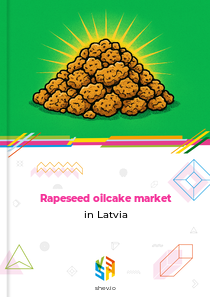







Earlier Report Observations
The market volume for rapeseed oilcake in Latvia increased significantly from 49.6 thousand tonnes in 2018 to 80.8 thousand tonnes in 2021, representing growth of over 60%. This expansion was followed by a contraction in the subsequent two years, with the market size falling to 69.2 thousand tonnes in 2022 and further to 65.4 thousand tonnes in 2023.
By 2024, several key factors began shaping the market. Rising rapeseed prices, driven by higher energy, fuel, and labor costs as well as increases in the minimum wage, directly impacted production expenses for oilcake. Simultaneously, the expansion of agricultural output and sown areas in Latvia supported greater domestic availability of rapeseed and its by-products. Global and regional energy policy goals promoting renewable resources bolstered demand for rapeseed oilcake in biofuel production, while the development of sustainable materials such as polyurethane foam containing rapeseed oil by-products opened new application avenues by 2025.
Table of content
- 1. Disclaimer
- 2. Terms of use of the report
- 3. Product codes in the statistical classifications used in the report
-
4. Key Market Indicators and Trends
-
4.1. Key Market Indicators
-
4.1.1. In kind
- 4.1.1.1. Production, 2018-2023
- 4.1.1.2. Imports, 2018-2025
- 4.1.1.3. Exports, 2018-2025
- 4.1.1.4. Market size, 2018-2023
-
4.1.1. In kind
- 4.2. Market Trends and Factors
-
4.1. Key Market Indicators
-
5. Production
-
5.1. Production in Latvia
- 5.1.1. In kind, 2018-2023, K t
-
5.2. Production in the EU, 2018-2024
- 5.2.1. In kind, 2018-2024, K t
- 5.2.2. In value, 2018-2024, M $ US
-
5.3. Global production by Country, 2018-2023
-
5.3.1. Global Production by Country in kind
- 5.3.1.1. Annual dynamics of production by country in kind, 2018-2023, t
- 5.3.1.2. Structure of production by countries in kind, 2018-2023
- 5.3.1.3. Dynamics of peoduction structure by countries in kind, 2018-2023
-
5.3.1. Global Production by Country in kind
-
5.1. Production in Latvia
-
6. Imports
-
6.1. Imports (Direct Data)
- 6.1.1. Imports - Total information
-
6.1.2. Imports in kind, K t
- 6.1.2.1. Annual dynamics of product's imports to Latvia in kind, 2018-2025, K t
- 6.1.2.2. Dynamics of product's imports in kind to Latvia by countries, 2018-2025, K t
- 6.1.2.3. Structure of product's imports in kind by countries, 2018-2025
-
6.1.3. Imports in value, K $ US
- 6.1.3.1. Annual dynamics of product's imports to Latvia in value, 2018-2025, K $ US
- 6.1.3.2. Dynamics of product's imports in value to Latvia by countries, 2018-2025, K $ US
- 6.1.3.3. Structure of product's imports in value by countries, 2018-2025
-
6.1.4. Average price of product's imports, $ US/t
- 6.1.4.1. Annual dynamics of average price of product's imports to Latvia, 2018-2025, $ US/t
- 6.1.4.2. Dynamics of average price of product's imports to Latvia by countries, 2018-2025, $ US/t
-
6.2. Imports (Mirror Data)
- 6.2.1. Imports - Total information
-
6.2.2. Imports in kind, K t
- 6.2.2.1. Annual dynamics of product's imports to Latvia in kind, 2018-2025, K t
- 6.2.2.2. Dynamics of product's imports in kind to Latvia by countries, 2018-2025, K t
- 6.2.2.3. Structure of product's imports in kind by countries, 2018-2025
-
6.2.3. Imports in value, K $ US
- 6.2.3.1. Annual dynamics of product's imports to Latvia in value, 2018-2025, K $ US
- 6.2.3.2. Dynamics of product's imports in value to Latvia by countries, 2018-2025, K $ US
- 6.2.3.3. Structure of product's imports in value by countries, 2018-2025
-
6.2.4. Average price of product's imports, $ US/t
- 6.2.4.1. Annual dynamics of average price of product's imports to Latvia, 2018-2025, $ US/t
- 6.2.4.2. Dynamics of average price of product's imports to Latvia by countries, 2018-2025, $ US/t
-
6.1. Imports (Direct Data)
-
7. Exports
-
7.1. Exports (Direct Data)
- 7.1.1. Exports - Total information
-
7.1.2. Exports in kind, K t
- 7.1.2.1. Annual dynamics of product's exports from Latvia in kind, 2018-2025, K t
- 7.1.2.2. Dynamics of product's exports in kind from Latvia by countries, 2018-2025, K t
- 7.1.2.3. Structure of product's exports in kind by countries, 2018-2025
-
7.1.3. Exports in value, K $ US
- 7.1.3.1. Annual dynamics of product's exports from Latvia in value, 2018-2025, K $ US
- 7.1.3.2. Dynamics of product's exports in value from Latvia by countries, 2018-2025, K $ US
- 7.1.3.3. Structure of product's exports in value by countries, 2018-2025
-
7.1.4. Average price of product's exports, $ US/t
- 7.1.4.1. Annual dynamics of average price of product's exports from Latvia, 2018-2025, $ US/t
- 7.1.4.2. Dynamics of average price of product's exports from Latvia by countries, 2018-2025, $ US/t
-
7.2. Exports (Mirror Data)
- 7.2.1. Exports - Total information
-
7.2.2. Exports in kind, K t
- 7.2.2.1. Annual dynamics of product's exports from Latvia in kind, 2018-2025, K t
- 7.2.2.2. Dynamics of product's exports in kind from Latvia by countries, 2018-2025, K t
- 7.2.2.3. Structure of product's exports in kind by countries, 2018-2025
-
7.2.3. Exports in value, K $ US
- 7.2.3.1. Annual dynamics of product's exports from Latvia in value, 2018-2025, K $ US
- 7.2.3.2. Dynamics of product's exports in value from Latvia by countries, 2018-2025, K $ US
- 7.2.3.3. Structure of product's exports in value by countries, 2018-2025
-
7.2.4. Average price of product's exports, $ US/t
- 7.2.4.1. Annual dynamics of average price of product's exports from Latvia, 2018-2025, $ US/t
- 7.2.4.2. Dynamics of average price of product's exports from Latvia by countries, 2018-2025, $ US/t
-
7.1. Exports (Direct Data)
-
8. Trade balance
-
8.1. Trade balance (Direct Data)
- 8.1.1. In kind, K t
- 8.1.2. In value, K $ US
-
8.2. Trade balance (Mirror Data)
- 8.2.1. In kind, K t
- 8.2.2. In value, K $ US
-
8.1. Trade balance (Direct Data)
-
9. Top buying and selling countries, 2018-2025
-
9.1. Direct Data
- 9.1.1. Import in Value by Countries-buyers
- 9.1.2. Export in Value by Countries-suppliers
-
9.2. Mirror Data
- 9.2.1. Import in Value by Countries-buyers
- 9.2.2. Export in Value by Countries-suppliers
-
9.1. Direct Data
Production rapeseed oilcake in Latvia
In kind, 2018-2021, K t
Top producers of rapeseed oilcake, 2018-2021
World map of production of rapeseed oilcake, 2018-2021
Latvia's rapeseed oilcake production saw a decline in 2021 after two years of growth. The country produced 74 K t that year, down 14.2% from 2020. Looking at the period from 2018 to 2021, production overall increased by 5.4%, with an average annual growth rate of 1.8%. The highest production level was recorded in 2020 at 86 K t, while the largest year-on-year increase occurred in 2019 at 14.9%.
Annual dynamics of production in Latvia in kind, 2018-2021, K t
| Parameter | 2019 | 2020 | 2021 | CAGR | |
|---|---|---|---|---|---|
| 1 | Change from last year | 14.9% | 7.0% | (14.2%) | 1.8% |
Exports rapeseed oilcake from Latvia
Exports in kind, t
In 2021, Latvia's cross-border shipments of rapeseed oilcake totaled 62 258 t, showing a moderate decrease of 7.6% compared to the previous year. Over the 2018-2021 period, exports grew by 17.3%, with a compound annual growth rate of 5.5%. The lowest export volume was in 2019 at 51 534 t, while the peak was in 2020 at 67 385 t. The most significant increase happened in 2020, with a jump of 30.8%.
Annual dynamics of product's exports from Latvia in kind, 2018-2021, t
| Parameter | 2019 | 2020 | 2021 | CAGR | |
|---|---|---|---|---|---|
| 1 | Change from last year | (2.9%) | 30.8% | (7.6%) | 5.5% |
From 2018 to 2021, Norway was the primary buyer of rapeseed oilcake from Latvia, accounting for 78.1% of total exports by volume. The remaining share was distributed among a diverse group of other countries.
Structure of product's exports in kind by countries, 2018-2021
World map of product's exports from Latvia in kind, 2018-2021
Exports in value, K $ US
Latvia's rapeseed oilcake exports in value terms rose for the second year in a row in 2021, reaching 21 354 K $ US, a strong increase of 16.0% over 2020. Between 2018 and 2021, export value grew by 23.6%, with an average annual rate of 7.3%. The lowest value was recorded in 2019 at 13 785 K $ US, which also saw the largest decline of 20.2%. In contrast, the biggest increase occurred in 2020, with a surge of 33.5%.
Annual dynamics of product's exports from Latvia in value, 2018-2021, K $ US
| Parameter | 2019 | 2020 | 2021 | CAGR | |
|---|---|---|---|---|---|
| 1 | Change from last year | (20.2%) | 33.5% | 16.0% | 7.3% |
During the 2018-2021 period, Norway dominated Latvia's rapeseed oilcake exports in value, holding 77.8% of the total. The rest was spread across numerous countries, each with relatively small individual shares.
Structure of product's exports in value by countries, 2018-2021
World map of product's exports from Latvia in value, 2018-2021
Imports rapeseed oilcake to Latvia
Imports in kind, t
Latvia's imports of rapeseed oilcake continued to grow for the third consecutive year in 2021, reaching 69 252 t, a sharp increase of 30.2% from 2020. From 2018 to 2021, import volume surged by 112.2%, with a compound annual growth rate of 28.5%.
Annual dynamics of product's imports to Latvia in kind, 2018-2021, t
| Parameter | 2019 | 2020 | 2021 | CAGR | |
|---|---|---|---|---|---|
| 1 | Change from last year | 36.9% | 19.1% | 30.2% | 28.5% |
Between 2018 and 2021, Latvia's rapeseed oilcake imports by volume were primarily sourced from Lithuania and Belarus, which together made up 84.2% of total inflows. Other countries played a minor role in the import structure.
Structure of product's imports in kind by countries, 2018-2021
World map of product's imports to Latvia in kind, 2018-2021
Imports in value, K $ US
Latvia's rapeseed oilcake import value increased for the third straight year in 2021, hitting 22 443 K $ US, up 69.0% from the previous year. From 2018 to 2021, import value soared by 158.6%, translating to an annualized growth rate of 37.3%.
Annual dynamics of product's imports to Latvia in value, 2018-2021, K $ US
| Parameter | 2019 | 2020 | 2021 | CAGR | |
|---|---|---|---|---|---|
| 1 | Change from last year | 28.2% | 19.4% | 69.0% | 37.3% |
In the 2018-2021 timeframe, Lithuania and Belarus were the key sources for Latvia's rapeseed oilcake imports in value terms, jointly accounting for 83.8% of the total. The remainder was distributed among a wide array of other countries.
Structure of product's imports in value by countries, 2018-2021
World map of product's imports to Latvia in value, 2018-2021
Related Reports

Rapeseed oilcake market in Western Asia
2026-03-29
Rapeseed oilcake market in ASEAN
2026-03-29
Rapeseed oilcake market in the United States
2026-03-29

Stuffed pasta market in Latvia
2026-03-29


2026-03-29
Why Choose Us?
Only Verified Data
No Hidden Costs or Separate Fees
Smarter Subscription Pricing
Contact Our Team
Submit your inquiry using the form below — our team will get back to you within 24 hours.