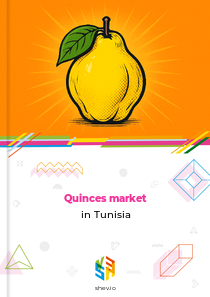







Earlier Report Observations
The quince market in Tunisia began the period at 4,232 t in 2018, a volume supported by influential state-owned enterprises in fruit production and the development of dedicated processing units for products like quince jam.
Market size then contracted to 3,837 t by 2020, recovered to 4,047 t in 2021, and stabilized around 3,950–4,000 t in the following years, ending at 3,958 t in 2023.
In the later years, the market environment was marked by rising fresh fruit prices at major wholesale centers and continued investment in quince processing capacity, factors influencing production costs and supply.
Table of content
- 1. Disclaimer
- 2. Terms of use of the report
- 3. Product codes in the statistical classifications used in the report
-
4. Key Market Indicators and Trends
-
4.1. Key Market Indicators
-
4.1.1. In kind
- 4.1.1.1. Production, 2018-2023
- 4.1.1.2. Imports, 2018-2024
- 4.1.1.3. Exports, 2018-2024
- 4.1.1.4. Market size, 2018-2023
-
4.1.1. In kind
- 4.2. Market Trends and Factors
-
4.1. Key Market Indicators
-
5. Production
-
5.1. Production in Tunisia
- 5.1.1. Annual dynamics of production in Tunisia in kind, 2018-2023, t
- 5.1.2. Annual dynamics of production in Tunisia in value, 2018-2023, $ US
-
5.2. Global production by Country, 2018-2023
- 5.2.1. Annual dynamics of production by macroregions in kind, 2018-2023, t
- 5.2.2. Dynamics of production structure by macroregions in kind, 2018-2023
- 5.2.3. Annual dynamics of production by country in kind, 2018-2023, t
- 5.2.4. Structure of production by countries in kind, 2018-2023
- 5.2.5. Dynamics of peoduction structure by countries in kind, 2018-2023
-
5.1. Production in Tunisia
-
6. Exports
-
6.1. Exports (Direct Data)
- 6.1.1. Exports - Total information
-
6.1.2. Exports in kind, kg
- 6.1.2.1. Annual dynamics of product's exports from Tunisia in kind, 2018-2024, kg
- 6.1.2.2. Dynamics of product's exports in kind from Tunisia by countries, 2018-2024, kg
- 6.1.2.3. Structure of product's exports in kind by countries, 2018-2024
-
6.1.3. Exports in value, $ US
- 6.1.3.1. Annual dynamics of product's exports from Tunisia in value, 2018-2024, $ US
- 6.1.3.2. Dynamics of product's exports in value from Tunisia by countries, 2018-2024, $ US
- 6.1.3.3. Structure of product's exports in value by countries, 2018-2024
-
6.1.4. Average price of product's exports, $ US/t
- 6.1.4.1. Annual dynamics of average price of product's exports from Tunisia, 2018-2024, $ US/t
- 6.1.4.2. Dynamics of average price of product's exports from Tunisia by countries, 2018-2024, $ US/t
-
6.2. Exports (Mirror Data)
- 6.2.1. Exports - Total information
-
6.2.2. Exports in kind, kg
- 6.2.2.1. Annual dynamics of product's exports from Tunisia in kind, 2018-2024, kg
- 6.2.2.2. Dynamics of product's exports in kind from Tunisia by countries, 2018-2024, kg
- 6.2.2.3. Structure of product's exports in kind by countries, 2018-2024
-
6.2.3. Exports in value, $ US
- 6.2.3.1. Annual dynamics of product's exports from Tunisia in value, 2018-2024, $ US
- 6.2.3.2. Dynamics of product's exports in value from Tunisia by countries, 2018-2024, $ US
- 6.2.3.3. Structure of product's exports in value by countries, 2018-2024
-
6.2.4. Average price of product's exports, $ US/t
- 6.2.4.1. Annual dynamics of average price of product's exports from Tunisia, 2018-2024, $ US/t
- 6.2.4.2. Dynamics of average price of product's exports from Tunisia by countries, 2018-2024, $ US/t
-
6.1. Exports (Direct Data)
-
7. Trade balance
-
7.1. Trade balance (Direct Data)
- 7.1.1. In kind, kg
- 7.1.2. In value, $ US
-
7.2. Trade balance (Mirror Data)
- 7.2.1. In kind, kg
- 7.2.2. In value, $ US
-
7.1. Trade balance (Direct Data)
-
8. Top buying and selling countries, 2018-2024
-
8.1. Direct Data
- 8.1.1. Import in Value by Countries-buyers
- 8.1.2. Export in Value by Countries-suppliers
-
8.2. Mirror Data
- 8.2.1. Import in Value by Countries-buyers
- 8.2.2. Export in Value by Countries-suppliers
-
8.1. Direct Data
Production quinces in Tunisia
In kind, 2017-2020, t
From 2017 to 2020, Tunisia ranked as the 16th largest producer of quinces globally.
Top producers of quinces, 2017-2020
World map of production of quinces, 2017-2020
Tunisia's quince production declined for the second year in a row. In 2020, the country produced 3 837 tonnes of quinces, representing a 5.9% decrease from the previous year. Over the 2017-2020 period, production grew by 19.9%, with an average annual growth rate of 6.2%. The highest production volume was recorded in 2018 at 4 233 tonnes, which also saw the largest annual increase of 32.3%.
Annual dynamics of production in Tunisia in kind, 2017-2020, t
| Parameter | 2018 | 2019 | 2020 | CAGR | |
|---|---|---|---|---|---|
| 1 | Change from last year | 32.3% | (3.7%) | (5.9%) | 6.2% |
Exports quinces from Tunisia
Exports in kind, kg
The export market for Tunisian quinces showed significant volatility during this period. Exports reached their lowest point in 2020 at just 50 kilograms, marking a dramatic 99.3% decline from the previous year. The peak occurred in 2019 with 7 294 kilograms exported, creating a 146-fold difference between these two years. The largest annual increase was recorded in 2019 at 611.6%.
Annual dynamics of product's exports from Tunisia in kind, 2017-2020, kg
| Parameter | 2018 | 2019 | 2020 | CAGR | |
|---|---|---|---|---|---|
| 1 | Change from last year | (67.8%) | 611.6% | (99.3%) | (75.0%) |
From 2017 to 2020, Saudi Arabia, France, and Kuwait were the dominant markets for Tunisian quince exports by volume. Saudi Arabia accounted for 54.5% of exports, France for 13.8%, and Kuwait for 10.5%. Together, these three countries represented 78.9% of Tunisia's total quince exports during this period.
Structure of product's exports in kind by countries, 2017-2020
World map of product's exports from Tunisia in kind, 2017-2020
Exports in value, $ US
Export values for Tunisian quinces experienced notable fluctuations between 2017 and 2020. The lowest value was recorded in 2020 at just 207 US dollars, representing a sharp 98.2% decrease from the previous year. The peak occurred in 2019 with exports valued at 11 306 US dollars, creating a 55-fold difference between these two years. The largest annual increase in export value was recorded in 2019 at 531.1%.
Annual dynamics of product's exports from Tunisia in value, 2017-2020, $ US
| Parameter | 2018 | 2019 | 2020 | CAGR | |
|---|---|---|---|---|---|
| 1 | Change from last year | (80.3%) | 531.1% | (98.2%) | (71.6%) |
During the 2017-2020 period, three key markets dominated Tunisia's quince exports by value: Saudi Arabia, Kuwait, and Oman. Together, these countries accounted for 79.4% of Tunisia's total quince export revenue.
Structure of product's exports in value by countries, 2017-2020
World map of product's exports from Tunisia in value, 2017-2020
Imports quinces to Tunisia
Market data indicates that Tunisia did not import any quinces between 2017 and 2020.
Related Reports

2026-03-28
Quinces market in Eastern Asia
2026-03-28
2026-03-28
Quinces market in Central Asia
2026-03-28

Strawberries market in Tunisia
2026-03-28

2026-03-28

2026-03-30

In-shell almonds market in Tunisia
2026-03-28
Why Choose Us?
Only Verified Data
No Hidden Costs or Separate Fees
Smarter Subscription Pricing
Contact Our Team
Submit your inquiry using the form below — our team will get back to you within 24 hours.