






"Western Africa" region includes following countries:
 Cabo Verde
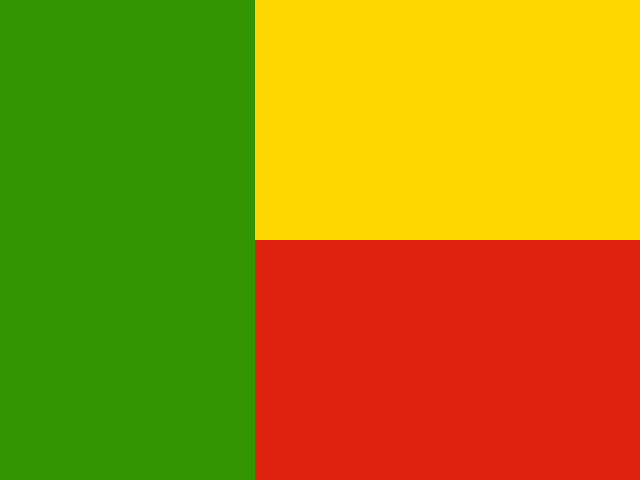 Benin
Benin Gambia
 Ghana
Ghana Guinea
 Côte d'Ivoire
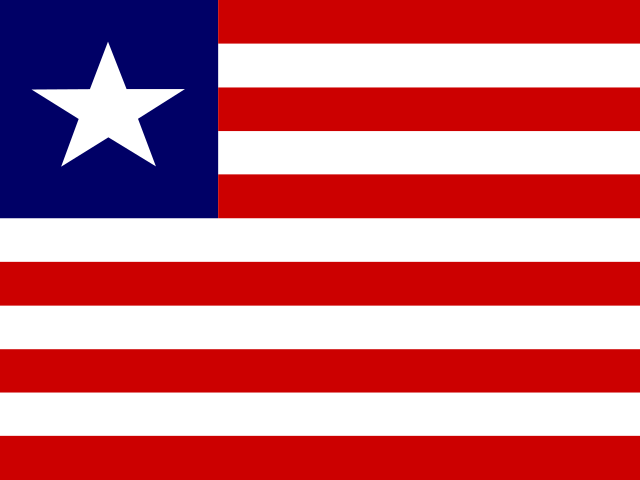 Liberia
 Mali
Mali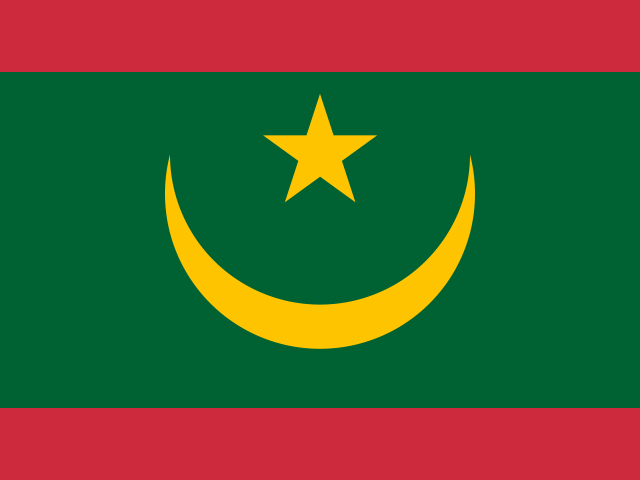 Mauritania
 Niger
Niger Nigeria
 Guinea-Bissau
 Saint Helena, Ascension and Tristan da Cunha
 Senegal
 Sierra Leone
 Togo
Togo Burkina Faso
Earlier Report Observations
The palm oil market in West Africa contracted in 2019, with market volume falling to 3.45 million tonnes from 4.02 million tonnes the previous year. This decline coincided with the European Union's initial steps to classify palm oil as a high-risk feedstock for biofuels, reducing its eligibility for incentives in key markets like France. Production also dipped, reflecting adjusted output in response to shifting demand signals.
Market volume stabilized around 3.64-3.65 million tonnes in 2020-2021. During this period, the EU's regulatory pressure intensified, with France formally excluding palm oil-based biofuels from its tax incentive scheme and the European Commission proposing a deforestation-free product regulation. Despite these headwinds for exports to Europe, West African exports surged in 2021, reaching 328 thousand tonnes, potentially supported by resilient global demand.
The market dipped again in 2022 to 3.26 million tonnes, influenced by the final adoption of the EU's anti-deforestation regulation and the phase-out of palm oil by major European biofuel producers like TotalEnergies. A sharp recovery followed in 2023, with market volume jumping to 3.72 million tonnes and exports hitting 480 thousand tonnes. This rebound was driven by global factors, including a over 25% price increase for palm oil due to supply disruptions in Malaysia and Indonesia and heightened demand as the war in Ukraine constrained supplies of alternative oils like sunflower.
Table of content
- 1. Disclaimer
- 2. Terms of use of the report
- 3. Product codes in the statistical classifications used in the report
-
4. Key Market Indicators and Trends
-
4.1. Key Market Indicators
-
4.1.1. In kind
- 4.1.1.1. Production, 2018-2023
- 4.1.1.2. Imports, 2018-2024
- 4.1.1.3. Exports, 2018-2024
- 4.1.1.4. Market size, 2018-2023
-
4.1.1. In kind
- 4.2. Market Trends and Factors
-
4.1. Key Market Indicators
-
5. Production
-
5.1. Production in Western Africa
- 5.1.1. Annual dynamics of production in Western Africa in kind, 2018-2023, K t
-
5.2. Global production by Country, 2018-2023
- 5.2.1. Annual dynamics of production by macroregions in kind, 2018-2023, K t
- 5.2.2. Dynamics of production structure by macroregions in kind, 2018-2023
- 5.2.3. Annual dynamics of production by country in kind, 2018-2023, K t
- 5.2.4. Structure of production by countries in kind, 2018-2023
- 5.2.5. Dynamics of peoduction structure by countries in kind, 2018-2023
-
5.1. Production in Western Africa
-
6. Imports
-
6.1. Imports (Direct Data*)
- 6.1.1. Imports - Total information
-
6.1.2. Imports in kind, K t
- 6.1.2.1. Annual dynamics of product's imports to Cabo Verde in kind, 2018-2024, K t
- 6.1.2.2. Dynamics of product's imports in kind to Cabo Verde by countries, 2018-2024, K t
- 6.1.2.3. Structure of product's imports in kind by countries, 2018-2024
-
6.1.3. Imports in value, M $ US
- 6.1.3.1. Annual dynamics of product's imports to Cabo Verde in value, 2018-2024, M $ US
- 6.1.3.2. Dynamics of product's imports in value to Cabo Verde by countries, 2018-2024, M $ US
- 6.1.3.3. Structure of product's imports in value by countries, 2018-2024
-
6.1.4. Average price of product's imports, $ US/t
- 6.1.4.1. Annual dynamics of average price of product's imports to Cabo Verde, 2018-2024, $ US/t
- 6.1.4.2. Dynamics of average price of product's imports to Cabo Verde by countries, 2018-2024, $ US/t
-
6.2. Imports (Mirror Data)
- 6.2.1. Imports - Total information
-
6.2.2. Imports in kind, K t
- 6.2.2.1. Annual dynamics of product's imports to Cabo Verde in kind, 2018-2024, K t
- 6.2.2.2. Dynamics of product's imports in kind to Cabo Verde by countries, 2018-2024, K t
- 6.2.2.3. Structure of product's imports in kind by countries, 2018-2024
-
6.2.3. Imports in value, M $ US
- 6.2.3.1. Annual dynamics of product's imports to Cabo Verde in value, 2018-2024, M $ US
- 6.2.3.2. Dynamics of product's imports in value to Cabo Verde by countries, 2018-2024, M $ US
- 6.2.3.3. Structure of product's imports in value by countries, 2018-2024
-
6.2.4. Average price of product's imports, $ US/t
- 6.2.4.1. Annual dynamics of average price of product's imports to Cabo Verde, 2018-2024, $ US/t
- 6.2.4.2. Dynamics of average price of product's imports to Cabo Verde by countries, 2018-2024, $ US/t
-
6.1. Imports (Direct Data*)
-
7. Exports
-
7.1. Exports (Direct Data*)
- 7.1.1. Exports - Total information
-
7.1.2. Exports in kind, K t
- 7.1.2.1. Annual dynamics of product's exports from Cabo Verde in kind, 2018-2024, K t
- 7.1.2.2. Dynamics of product's exports in kind from Cabo Verde by countries, 2018-2024, K t
- 7.1.2.3. Structure of product's exports in kind by countries, 2018-2024
-
7.1.3. Exports in value, M $ US
- 7.1.3.1. Annual dynamics of product's exports from Cabo Verde in value, 2018-2024, M $ US
- 7.1.3.2. Dynamics of product's exports in value from Cabo Verde by countries, 2018-2024, M $ US
- 7.1.3.3. Structure of product's exports in value by countries, 2018-2024
-
7.1.4. Average price of product's exports, $ US/t
- 7.1.4.1. Annual dynamics of average price of product's exports from Cabo Verde, 2018-2024, $ US/t
- 7.1.4.2. Dynamics of average price of product's exports from Cabo Verde by countries, 2018-2024, $ US/t
-
7.2. Exports (Mirror Data)
- 7.2.1. Exports - Total information
-
7.2.2. Exports in kind, K t
- 7.2.2.1. Annual dynamics of product's exports from Cabo Verde in kind, 2018-2024, K t
- 7.2.2.2. Dynamics of product's exports in kind from Cabo Verde by countries, 2018-2024, K t
- 7.2.2.3. Structure of product's exports in kind by countries, 2018-2024
-
7.2.3. Exports in value, M $ US
- 7.2.3.1. Annual dynamics of product's exports from Cabo Verde in value, 2018-2024, M $ US
- 7.2.3.2. Dynamics of product's exports in value from Cabo Verde by countries, 2018-2024, M $ US
- 7.2.3.3. Structure of product's exports in value by countries, 2018-2024
-
7.2.4. Average price of product's exports, $ US/t
- 7.2.4.1. Annual dynamics of average price of product's exports from Cabo Verde, 2018-2024, $ US/t
- 7.2.4.2. Dynamics of average price of product's exports from Cabo Verde by countries, 2018-2024, $ US/t
-
7.1. Exports (Direct Data*)
-
8. Trade balance
-
8.1. Trade balance (Direct Data)
- 8.1.1. In kind, K t
- 8.1.2. In value, M $ US
-
8.2. Trade balance (Mirror Data)
- 8.2.1. In kind, K t
- 8.2.2. In value, M $ US
-
8.1. Trade balance (Direct Data)
-
9. Top buying and selling countries, 2018-2024
-
9.1. Direct Data
- 9.1.1. Import in Value by Countries-buyers
- 9.1.2. Export in Value by Countries-suppliers
-
9.2. Mirror Data
- 9.2.1. Import in Value by Countries-buyers
- 9.2.2. Export in Value by Countries-suppliers
-
9.1. Direct Data
Production palm oil and fractions in Western Africa
In kind, 2017-2020, K t
Top producers of palm oil and fractions, 2017-2020
World map of production of palm oil and fractions, 2017-2020
In Western Africa, palm oil and fractions production reached 2 364 K t in 2020, marking a modest year-on-year increase of 1.9%. However, looking at the broader period from 2017 to 2020, overall production declined by 6.5%, with an average annual decrease of 2.2%. The lowest production level was recorded in 2019 at 2 320 K t, while the peak occurred in 2018 with 2 635 K t. The most significant drop was observed in 2019, when production fell by 12.0%, whereas the largest gain was in 2018 with a 4.2% increase.
Annual dynamics of production in Western Africa in kind, 2017-2020, K t
| Parameter | 2018 | 2019 | 2020 | CAGR | |
|---|---|---|---|---|---|
| 1 | Change from last year | 4.2% | (12.0%) | 1.9% | (2.2%) |
In value, 2017-2020, M $ US
Western Africa's palm oil and fractions production experienced a decline for the second year in a row. In 2020, the output was valued at 18 810 M $ US, reflecting a slight decrease of 9.6% compared to the previous year. Over the 2017-2020 period, production value dropped by 16.9%, translating to an average annual decline of 6.0%. The highest value was recorded in 2018 at 27 656 M $ US. The most substantial decrease occurred in 2019 with a 24.8% drop, while the largest increase was in 2018, rising by 22.1%.
Annual dynamics of production in Western Africa in value, 2017-2020, M $ US
| Parameter | 2018 | 2019 | 2020 | CAGR | |
|---|---|---|---|---|---|
| 1 | Change from last year | 22.1% | (24.8%) | (9.6%) | (6.0%) |
Exports palm oil and fractions from Western Africa
Exports in kind, K t
The export data shows irregular fluctuations, pointing to a volatile market environment. In 2020, Western Africa exported 141 K t of palm oil and fractions, which represents a sharp reduction of 29.2% from 2019. Over the 2017-2020 span, exports reached their lowest point in 2018 at 105 K t and peaked in 2019 at 199 K t, with a 1.9-fold difference between these years. The most significant decline was in 2018, falling by 45.9%, while the largest increase was in 2019, surging by 89.4%.
Annual dynamics of product's exports from Western Africa in kind, 2017-2020, K t
| Parameter | 2018 | 2019 | 2020 | CAGR | |
|---|---|---|---|---|---|
| 1 | Change from last year | (45.9%) | 89.4% | (29.2%) | (10.1%) |
From 2017 to 2020, the core destinations for Western Africa's palm oil and fractions exports in kind were Spain, the Netherlands, and Italy, accounting for 1.8%, 1.8%, and 1.0% of exports, respectively. Together, these three countries represented 4.6% of total export flows.
Structure of product's exports in kind by countries, 2017-2020
World map of product's exports from Western Africa in kind, 2017-2020
Exports in value, M $ US
Following a two-year upward trend, Western Africa's palm oil and fractions export value declined. In 2020, exports amounted to 416 M $ US, down by 2.9% from 2019. Over the 2017-2020 period, exports increased by 26.3%, with an average annual growth rate of 8.1%. The highest value was recorded in 2019 at 428 M $ US, which also saw the largest increase of 25.7%.
Annual dynamics of product's exports from Western Africa in value, 2017-2020, M $ US
| Parameter | 2018 | 2019 | 2020 | CAGR | |
|---|---|---|---|---|---|
| 1 | Change from last year | 3.5% | 25.7% | (2.9%) | 8.1% |
Between 2017 and 2020, Western Africa's palm oil and fractions exports in value terms were distributed across various partner countries. The Netherlands, Spain, and Chad were notable, contributing 1.9%, 1.3%, and 0.9% of export value, respectively. Collectively, these three countries accounted for only 4.0% of total export flows.
Structure of product's exports in value by countries, 2017-2020
World map of product's exports from Western Africa in value, 2017-2020
Imports palm oil and fractions to Western Africa
Imports in kind, K t
In 2020, Western Africa's imports of palm oil and fractions stood at 1 420 K t, showing a measured improvement of 6.7% compared to the previous year. From 2017 to 2020, imports decreased by 2.8%, equivalent to an average annual decline of 0.9%. The lowest import level was in 2019 at 1 330 K t, while the highest was in 2018 at 1 493 K t. The most significant drop occurred in 2019 with a 10.9% decrease.
Annual dynamics of product's imports to Western Africa in kind, 2017-2020, K t
| Parameter | 2018 | 2019 | 2020 | CAGR | |
|---|---|---|---|---|---|
| 1 | Change from last year | 2.2% | (10.9%) | 6.7% | (0.9%) |
Over the 2017-2020 period, Malaysia, Indonesia, and Singapore were the primary sources for Western Africa's palm oil and fractions imports in kind. Malaysia accounted for 47.2% of imports, Indonesia for 24.9%, and Singapore for 1.8%. Together, these three countries made up 73.9% of total import flows.
Structure of product's imports in kind by countries, 2017-2020
World map of product's imports to Western Africa in kind, 2017-2020
Imports in value, M $ US
After a two-year decline, Western Africa's palm oil and fractions import value increased. In 2020, imports totaled 1 059 M $ US, up by 17.3% from the previous year. Over the 2017-2020 period, imports decreased by 6.3%, with an average annual decline of 2.1%. The lowest value was recorded in 2019 at 903 M $ US, which also experienced the largest drop of 18.6%.
Annual dynamics of product's imports to Western Africa in value, 2017-2020, M $ US
| Parameter | 2018 | 2019 | 2020 | CAGR | |
|---|---|---|---|---|---|
| 1 | Change from last year | (1.9%) | (18.6%) | 17.3% | (2.1%) |
Throughout 2017-2020, Malaysia, Indonesia, and Singapore remained key partners for Western Africa's palm oil and fractions imports in value terms. Malaysia contributed 49.2% of import value, Indonesia 19.4%, and Singapore 3.2%. Collectively, these three countries accounted for 71.8% of total import flows.
Structure of product's imports in value by countries, 2017-2020
World map of product's imports to Western Africa in value, 2017-2020
Related Reports

Palm oil and fractions market in Togo
2026-03-28
Palm oil and fractions market in Sweden
2026-03-28




Why Choose Us?
Only Verified Data
No Hidden Costs or Separate Fees
Smarter Subscription Pricing
Contact Our Team
Submit your inquiry using the form below — our team will get back to you within 24 hours.