






"Western Africa" region includes following countries:
 Cabo Verde
 Benin
Benin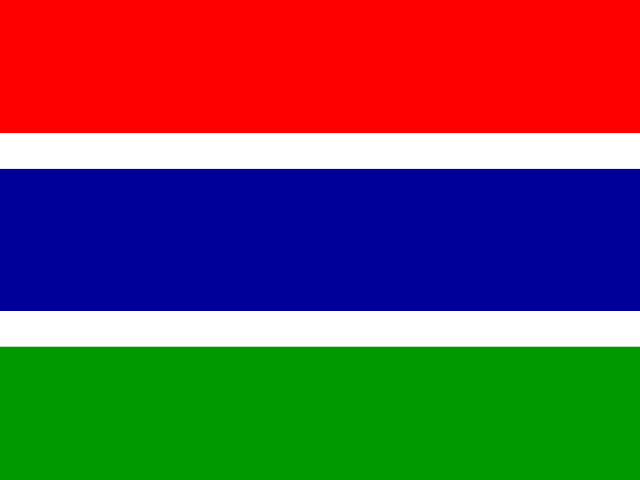 Gambia
 Ghana
Ghana Guinea
 Côte d'Ivoire
 Liberia
 Mali
Mali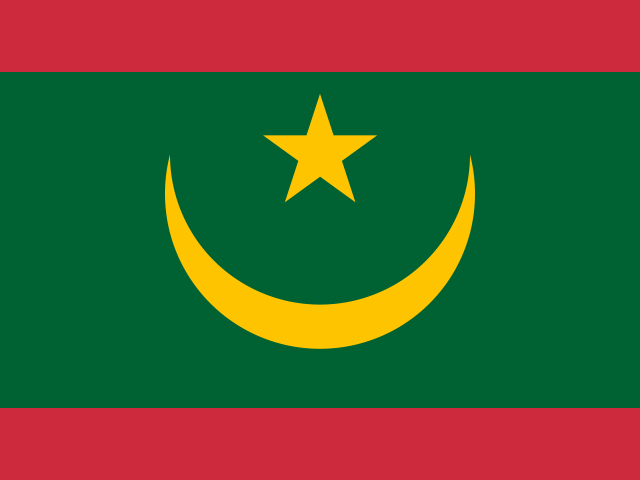 Mauritania
 Niger
Niger Nigeria
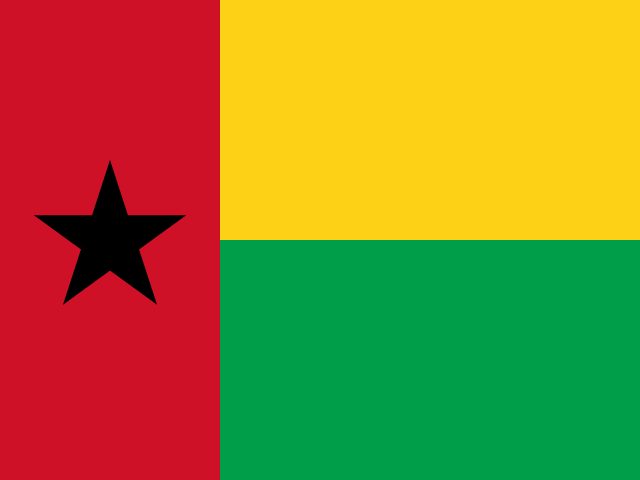 Guinea-Bissau
 Saint Helena, Ascension and Tristan da Cunha
 Senegal
 Sierra Leone
 Togo
Togo Burkina Faso
Earlier Report Observations
From 2018 to 2020, the West African coconut oil market contracted as underutilized production potential in Nigeria and high export volumes limited domestic availability. Local producers like BELL HORIZON and COHUDI provided a foundation, but the total market volume fell from 39 350 t in 2018 to 33 124 t in 2020, with exports from Nigeria generating significant revenue but reducing local supply.
The decline continued through 2021 and 2022, with the market volume dropping to a low of 24 256 t by 2022. This downward trend reflected broader challenges in the regional coconut sector.
A sharp recovery occurred in 2023, with the market volume rebounding to 35 850 t. This growth took place within a competitive edible oils landscape dominated by palm oil imports from West Africa and Asia. By 2024, regulatory action was initiated in Côte d'Ivoire to revive the coconut industry following a decades-long production drop, while consumer preferences across the region increasingly favored natural, unrefined products without chemical additives.
Table of content
- 1. Disclaimer
- 2. Terms of use of the report
- 3. Product codes in the statistical classifications used in the report
-
4. Key Market Indicators and Trends
-
4.1. Key Market Indicators
-
4.1.1. In kind
- 4.1.1.1. Production, 2018-2023
- 4.1.1.2. Imports, 2018-2024
- 4.1.1.3. Exports, 2018-2024
- 4.1.1.4. Market size, 2018-2023
-
4.1.1. In kind
- 4.2. Market Trends and Factors
-
4.1. Key Market Indicators
-
5. Production
-
5.1. Production in Western Africa
- 5.1.1. Annual dynamics of production in Western Africa in kind, 2018-2023, t
-
5.2. Global production by Country, 2018-2023
- 5.2.1. Annual dynamics of production by macroregions in kind, 2018-2023, t
- 5.2.2. Dynamics of production structure by macroregions in kind, 2018-2023
- 5.2.3. Annual dynamics of production by country in kind, 2018-2023, t
- 5.2.4. Structure of production by countries in kind, 2018-2023
- 5.2.5. Dynamics of peoduction structure by countries in kind, 2018-2023
-
5.1. Production in Western Africa
-
6. Imports
-
6.1. Imports (Direct Data*)
- 6.1.1. Imports - Total information
-
6.1.2. Imports in kind, t
- 6.1.2.1. Annual dynamics of product's imports to Cabo Verde in kind, 2018-2024, t
- 6.1.2.2. Dynamics of product's imports in kind to Cabo Verde by countries, 2018-2024, t
- 6.1.2.3. Structure of product's imports in kind by countries, 2018-2024
-
6.1.3. Imports in value, K $ US
- 6.1.3.1. Annual dynamics of product's imports to Cabo Verde in value, 2018-2024, K $ US
- 6.1.3.2. Dynamics of product's imports in value to Cabo Verde by countries, 2018-2024, K $ US
- 6.1.3.3. Structure of product's imports in value by countries, 2018-2024
-
6.1.4. Average price of product's imports, $ US/t
- 6.1.4.1. Annual dynamics of average price of product's imports to Cabo Verde, 2018-2024, $ US/t
- 6.1.4.2. Dynamics of average price of product's imports to Cabo Verde by countries, 2018-2024, $ US/t
-
6.2. Imports (Mirror Data)
- 6.2.1. Imports - Total information
-
6.2.2. Imports in kind, t
- 6.2.2.1. Annual dynamics of product's imports to Cabo Verde in kind, 2018-2024, t
- 6.2.2.2. Dynamics of product's imports in kind to Cabo Verde by countries, 2018-2024, t
- 6.2.2.3. Structure of product's imports in kind by countries, 2018-2024
-
6.2.3. Imports in value, K $ US
- 6.2.3.1. Annual dynamics of product's imports to Cabo Verde in value, 2018-2024, K $ US
- 6.2.3.2. Dynamics of product's imports in value to Cabo Verde by countries, 2018-2024, K $ US
- 6.2.3.3. Structure of product's imports in value by countries, 2018-2024
-
6.2.4. Average price of product's imports, $ US/t
- 6.2.4.1. Annual dynamics of average price of product's imports to Cabo Verde, 2018-2024, $ US/t
- 6.2.4.2. Dynamics of average price of product's imports to Cabo Verde by countries, 2018-2024, $ US/t
-
6.1. Imports (Direct Data*)
-
7. Exports
-
7.1. Exports (Direct Data*)
- 7.1.1. Exports - Total information
-
7.1.2. Exports in kind, t
- 7.1.2.1. Annual dynamics of product's exports from Cabo Verde in kind, 2018-2024, t
- 7.1.2.2. Dynamics of product's exports in kind from Cabo Verde by countries, 2018-2024, t
- 7.1.2.3. Structure of product's exports in kind by countries, 2018-2024
-
7.1.3. Exports in value, K $ US
- 7.1.3.1. Annual dynamics of product's exports from Cabo Verde in value, 2018-2024, K $ US
- 7.1.3.2. Dynamics of product's exports in value from Cabo Verde by countries, 2018-2024, K $ US
- 7.1.3.3. Structure of product's exports in value by countries, 2018-2024
-
7.1.4. Average price of product's exports, $ US/t
- 7.1.4.1. Annual dynamics of average price of product's exports from Cabo Verde, 2018-2024, $ US/t
- 7.1.4.2. Dynamics of average price of product's exports from Cabo Verde by countries, 2018-2024, $ US/t
-
7.2. Exports (Mirror Data)
- 7.2.1. Exports - Total information
-
7.2.2. Exports in kind, t
- 7.2.2.1. Annual dynamics of product's exports from Cabo Verde in kind, 2018-2024, t
- 7.2.2.2. Dynamics of product's exports in kind from Cabo Verde by countries, 2018-2024, t
- 7.2.2.3. Structure of product's exports in kind by countries, 2018-2024
-
7.2.3. Exports in value, K $ US
- 7.2.3.1. Annual dynamics of product's exports from Cabo Verde in value, 2018-2024, K $ US
- 7.2.3.2. Dynamics of product's exports in value from Cabo Verde by countries, 2018-2024, K $ US
- 7.2.3.3. Structure of product's exports in value by countries, 2018-2024
-
7.2.4. Average price of product's exports, $ US/t
- 7.2.4.1. Annual dynamics of average price of product's exports from Cabo Verde, 2018-2024, $ US/t
- 7.2.4.2. Dynamics of average price of product's exports from Cabo Verde by countries, 2018-2024, $ US/t
-
7.1. Exports (Direct Data*)
-
8. Trade balance
-
8.1. Trade balance (Direct Data)
- 8.1.1. In kind, t
- 8.1.2. In value, K $ US
-
8.2. Trade balance (Mirror Data)
- 8.2.1. In kind, t
- 8.2.2. In value, K $ US
-
8.1. Trade balance (Direct Data)
-
9. Top buying and selling countries, 2018-2024
-
9.1. Direct Data
- 9.1.1. Import in Value by Countries-buyers
- 9.1.2. Export in Value by Countries-suppliers
-
9.2. Mirror Data
- 9.2.1. Import in Value by Countries-buyers
- 9.2.2. Export in Value by Countries-suppliers
-
9.1. Direct Data
Production coconut oil and fractions in Western Africa
In kind, 2017-2020, t
Top producers of coconut oil and fractions, 2017-2020
World map of production of coconut oil and fractions, 2017-2020
Western Africa's production of coconut oil and fractions has declined for the second year in a row. In 2020, the region produced 42 443 tonnes, marking a slight decrease of 2.8% from the previous year. Looking at the period from 2017 to 2020, overall production fell by 2.8%, with an average annual decline of 0.9%. The highest output was recorded in 2018 at 44 149 tonnes, which also saw the largest increase of 1.2% during this timeframe.
Annual dynamics of production in Western Africa in kind, 2017-2020, t
| Parameter | 2018 | 2019 | 2020 | CAGR | |
|---|---|---|---|---|---|
| 1 | Change from last year | 1.2% | (1.0%) | (2.8%) | (0.9%) |
Exports coconut oil and fractions from Western Africa
Exports in kind, t
Exports of coconut oil and fractions from Western Africa have risen for the second consecutive year. In 2020, shipments reached 9 568 tonnes, a significant jump of 30.3% compared to 2019. Over the 2017-2020 period, exports grew by 46.1%, averaging an annual increase of 13.5%. The lowest export volume was in 2018 at 5 574 tonnes, which experienced the largest decline of 14.9%. In contrast, 2019 saw the biggest surge with a 31.7% increase.
Annual dynamics of product's exports from Western Africa in kind, 2017-2020, t
| Parameter | 2018 | 2019 | 2020 | CAGR | |
|---|---|---|---|---|---|
| 1 | Change from last year | (14.9%) | 31.7% | 30.3% | 13.5% |
From 2017 to 2020, exports of coconut oil and fractions from Western Africa were distributed across a wide range of markets. Switzerland accounted for 20.1% of exports, Spain for 13.4%, and the Netherlands for 7.6%. Together, these three countries made up just 41.2% of total export flows, highlighting the fragmented nature of the market.
Structure of product's exports in kind by countries, 2017-2020
World map of product's exports from Western Africa in kind, 2017-2020
Exports in value, K $ US
After two years of decline, the value of coconut oil and fractions exports from Western Africa rebounded in 2020. Export earnings stood at 12 583 thousand US dollars, a sharp increase of 51.1% from the previous year. Between 2017 and 2020, export value rose by 23.6%, translating to an average annual growth rate of 7.3%. The lowest value was recorded in 2019 at 8 328 thousand US dollars, which also saw the largest drop of 14.1%.
Annual dynamics of product's exports from Western Africa in value, 2017-2020, K $ US
| Parameter | 2018 | 2019 | 2020 | CAGR | |
|---|---|---|---|---|---|
| 1 | Change from last year | (4.7%) | (14.1%) | 51.1% | 7.3% |
The partner structure for export value from 2017 to 2020 remained highly diversified. Switzerland led with 26.1% of exports, followed by Spain at 11.9% and the Netherlands at 6.8%. Combined, these three countries accounted for only 44.8% of total flows, with no single nation dominating the market.
Structure of product's exports in value by countries, 2017-2020
World map of product's exports from Western Africa in value, 2017-2020
Imports coconut oil and fractions to Western Africa
Imports in kind, t
Imports of coconut oil and fractions into Western Africa have fallen for the third year in a row. In 2020, import volume dropped to 249 tonnes, a sharp decline of 60.2% compared to 2019. Over the 2017-2020 period, imports plummeted by 95.8%, averaging an annual decrease of 65.3%.
Annual dynamics of product's imports to Western Africa in kind, 2017-2020, t
| Parameter | 2018 | 2019 | 2020 | CAGR | |
|---|---|---|---|---|---|
| 1 | Change from last year | (87.0%) | (19.2%) | (60.2%) | (65.3%) |
Between 2017 and 2020, imports of coconut oil and fractions to Western Africa came from a broad array of partner countries. Singapore was the largest source, contributing 30.1% of imports, followed by Malaysia at 12.2% and Indonesia at 1.5%. Together, these three countries represented just 43.8% of total import flows, underscoring the diverse sourcing.
Structure of product's imports in kind by countries, 2017-2020
World map of product's imports to Western Africa in kind, 2017-2020
Imports in value, K $ US
The value of coconut oil and fractions imports into Western Africa has decreased for the third consecutive year. In 2020, import spending amounted to 612 thousand US dollars, a moderate decline of 9.7% from 2019. From 2017 to 2020, import value fell by 80.1%, with an average annual drop of 41.6%.
Annual dynamics of product's imports to Western Africa in value, 2017-2020, K $ US
| Parameter | 2018 | 2019 | 2020 | CAGR | |
|---|---|---|---|---|---|
| 1 | Change from last year | (70.1%) | (26.2%) | (9.7%) | (41.6%) |
Throughout 2017-2020, Singapore, Malaysia, and Indonesia were the key partners for import value of coconut oil and fractions into Western Africa. Singapore accounted for 34.7% of imports, Malaysia for 16.9%, and Indonesia for 4.9%. Collectively, they made up 56.5% of total import flows, forming the core group of suppliers.
Structure of product's imports in value by countries, 2017-2020
World map of product's imports to Western Africa in value, 2017-2020
Related Reports

Coconut oil and fractions market in Africa
2026-03-28




Why Choose Us?
Only Verified Data
No Hidden Costs or Separate Fees
Smarter Subscription Pricing
Contact Our Team
Submit your inquiry using the form below — our team will get back to you within 24 hours.