






"MERCOSUR" region includes following countries:
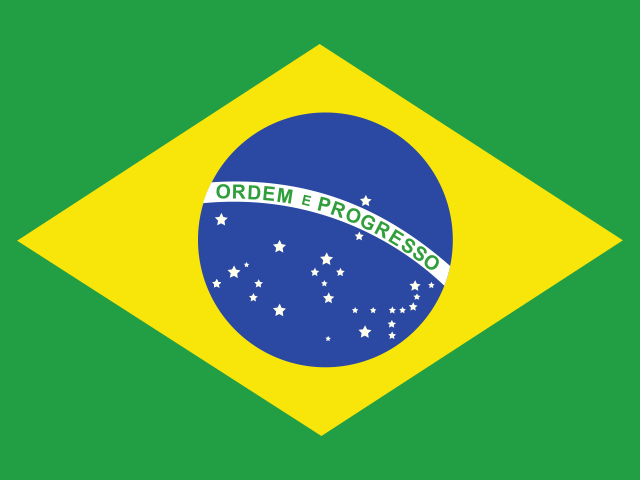 Brazil
 Argentina
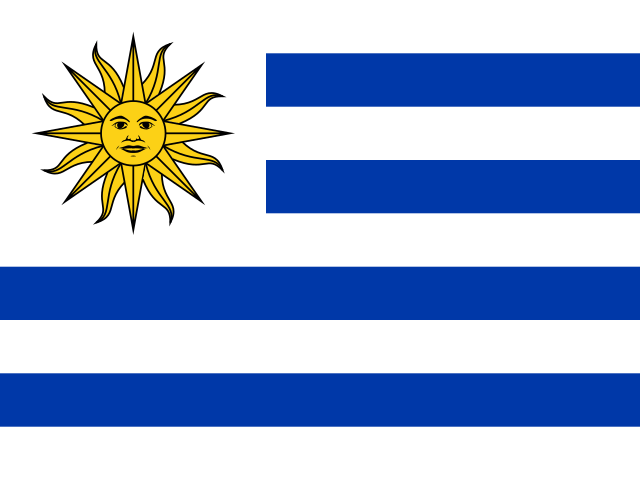 Uruguay
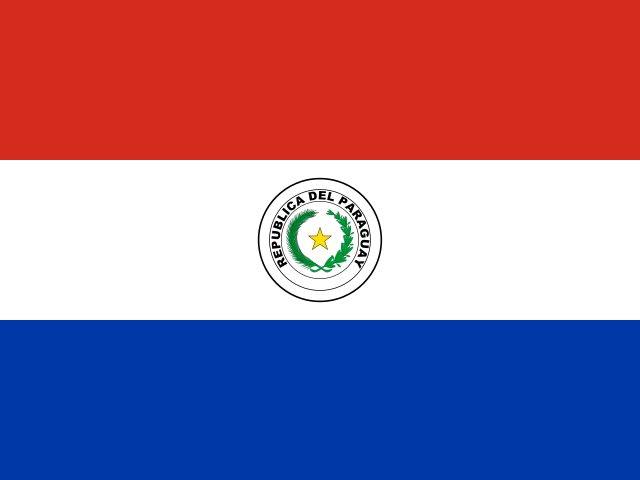 Paraguay
Earlier Report Observations
The palm oil and fractions market in MERCOSUR began at 569 thousand tons in 2018, supported by rising demand for biofuels across Latin America. In 2019, volume stabilized near 553 thousand tons as producers adopted organic cultivation techniques to attract more conscious consumers. A sharp 50% surge to 827 thousand tons followed in 2020, as the COVID-19 pandemic accelerated demand for biofuels, which became a key driver for economic recovery.
Market growth continued into 2021, reaching 960 thousand tons, fueled by mandatory biodiesel blending programs in major producing countries like Indonesia and Malaysia, which boosted global demand. However, 2022 saw a 9% contraction to 873 thousand tons, primarily due to tightened global supply from aging plantations in Southeast Asia. Recovery followed in 2023, with volume climbing to 912 thousand tons, aided by technological innovations such as AI-powered drones to increase yields and the development of new market segments like biodegradable emulsifiers for cosmetics.
Table of content
- 1. Disclaimer
- 2. Terms of use of the report
- 3. Product codes in the statistical classifications used in the report
-
4. Key Market Indicators and Trends
-
4.1. Key Market Indicators
-
4.1.1. In kind
- 4.1.1.1. Production, 2018-2023
- 4.1.1.2. Imports, 2018-2024
- 4.1.1.3. Exports, 2018-2024
- 4.1.1.4. Market size, 2018-2023
-
4.1.1. In kind
- 4.2. Market Trends and Factors
-
4.1. Key Market Indicators
-
5. Production
-
5.1. Production in MERCOSUR
- 5.1.1. Annual dynamics of production in MERCOSUR in kind, 2018-2023, K t
-
5.2. Global production by Country, 2018-2023
- 5.2.1. Annual dynamics of production by macroregions in kind, 2018-2023, K t
- 5.2.2. Dynamics of production structure by macroregions in kind, 2018-2023
- 5.2.3. Annual dynamics of production by country in kind, 2018-2023, K t
- 5.2.4. Structure of production by countries in kind, 2018-2023
- 5.2.5. Dynamics of peoduction structure by countries in kind, 2018-2023
-
5.1. Production in MERCOSUR
-
6. Imports
-
6.1. Imports (Direct Data)
- 6.1.1. Imports - Total information
-
6.1.2. Imports in kind, K t
- 6.1.2.1. Annual dynamics of product's imports to Brazil in kind, 2018-2024, K t
- 6.1.2.2. Dynamics of product's imports in kind to Brazil by countries, 2018-2024, K t
- 6.1.2.3. Structure of product's imports in kind by countries, 2018-2024
-
6.1.3. Imports in value, M $ US
- 6.1.3.1. Annual dynamics of product's imports to Brazil in value, 2018-2024, M $ US
- 6.1.3.2. Dynamics of product's imports in value to Brazil by countries, 2018-2024, M $ US
- 6.1.3.3. Structure of product's imports in value by countries, 2018-2024
-
6.1.4. Average price of product's imports, $ US/t
- 6.1.4.1. Annual dynamics of average price of product's imports to Brazil, 2018-2024, $ US/t
- 6.1.4.2. Dynamics of average price of product's imports to Brazil by countries, 2018-2024, $ US/t
-
6.2. Imports (Mirror Data)
- 6.2.1. Imports - Total information
-
6.2.2. Imports in kind, K t
- 6.2.2.1. Annual dynamics of product's imports to Brazil in kind, 2018-2024, K t
- 6.2.2.2. Dynamics of product's imports in kind to Brazil by countries, 2018-2024, K t
- 6.2.2.3. Structure of product's imports in kind by countries, 2018-2024
-
6.2.3. Imports in value, M $ US
- 6.2.3.1. Annual dynamics of product's imports to Brazil in value, 2018-2024, M $ US
- 6.2.3.2. Dynamics of product's imports in value to Brazil by countries, 2018-2024, M $ US
- 6.2.3.3. Structure of product's imports in value by countries, 2018-2024
-
6.2.4. Average price of product's imports, $ US/t
- 6.2.4.1. Annual dynamics of average price of product's imports to Brazil, 2018-2024, $ US/t
- 6.2.4.2. Dynamics of average price of product's imports to Brazil by countries, 2018-2024, $ US/t
-
6.1. Imports (Direct Data)
-
7. Exports
-
7.1. Exports (Direct Data)
- 7.1.1. Exports - Total information
-
7.1.2. Exports in kind, K t
- 7.1.2.1. Annual dynamics of product's exports from Brazil in kind, 2018-2024, K t
- 7.1.2.2. Dynamics of product's exports in kind from Brazil by countries, 2018-2024, K t
- 7.1.2.3. Structure of product's exports in kind by countries, 2018-2024
-
7.1.3. Exports in value, M $ US
- 7.1.3.1. Annual dynamics of product's exports from Brazil in value, 2018-2024, M $ US
- 7.1.3.2. Dynamics of product's exports in value from Brazil by countries, 2018-2024, M $ US
- 7.1.3.3. Structure of product's exports in value by countries, 2018-2024
-
7.1.4. Average price of product's exports, $ US/t
- 7.1.4.1. Annual dynamics of average price of product's exports from Brazil, 2018-2024, $ US/t
- 7.1.4.2. Dynamics of average price of product's exports from Brazil by countries, 2018-2024, $ US/t
-
7.2. Exports (Mirror Data)
- 7.2.1. Exports - Total information
-
7.2.2. Exports in kind, K t
- 7.2.2.1. Annual dynamics of product's exports from Brazil in kind, 2018-2024, K t
- 7.2.2.2. Dynamics of product's exports in kind from Brazil by countries, 2018-2024, K t
- 7.2.2.3. Structure of product's exports in kind by countries, 2018-2024
-
7.2.3. Exports in value, M $ US
- 7.2.3.1. Annual dynamics of product's exports from Brazil in value, 2018-2024, M $ US
- 7.2.3.2. Dynamics of product's exports in value from Brazil by countries, 2018-2024, M $ US
- 7.2.3.3. Structure of product's exports in value by countries, 2018-2024
-
7.2.4. Average price of product's exports, $ US/t
- 7.2.4.1. Annual dynamics of average price of product's exports from Brazil, 2018-2024, $ US/t
- 7.2.4.2. Dynamics of average price of product's exports from Brazil by countries, 2018-2024, $ US/t
-
7.1. Exports (Direct Data)
-
8. Trade balance
-
8.1. Trade balance (Direct Data)
- 8.1.1. In kind, K t
- 8.1.2. In value, M $ US
-
8.2. Trade balance (Mirror Data)
- 8.2.1. In kind, K t
- 8.2.2. In value, M $ US
-
8.1. Trade balance (Direct Data)
-
9. Top buying and selling countries, 2018-2024
-
9.1. Direct Data
- 9.1.1. Import in Value by Countries-buyers
- 9.1.2. Export in Value by Countries-suppliers
-
9.2. Mirror Data
- 9.2.1. Import in Value by Countries-buyers
- 9.2.2. Export in Value by Countries-suppliers
-
9.1. Direct Data
Production palm oil and fractions in MERCOSUR
In kind, 2017-2020, K t
Top producers of palm oil and fractions, 2017-2020
World map of production of palm oil and fractions, 2017-2020
MERCOSUR's palm oil and fractions production has increased for the third consecutive year. In 2020, production reached 580.7 thousand tons, which is 43.6% higher than in 2019. From 2017 to 2020, production grew by 83%, representing an annualized growth rate of 22.3%.
Annual dynamics of production in MERCOSUR in kind, 2017-2020, K t
| Parameter | 2018 | 2019 | 2020 | CAGR | |
|---|---|---|---|---|---|
| 1 | Change from last year | 15.6% | 10.3% | 43.6% | 22.3% |
In value, 2017-2020, M $ US
Palm oil and fractions production in MERCOSUR has risen for the third year in a row. In 2020, the output was valued at 358.1 million US dollars, marking a 41.8% increase compared to the previous year. Over the period from 2017 to 2020, production increased by 67%, with a compound annual growth rate of 18.6%.
Annual dynamics of production in MERCOSUR in value, 2017-2020, M $ US
| Parameter | 2018 | 2019 | 2020 | CAGR | |
|---|---|---|---|---|---|
| 1 | Change from last year | 11.1% | 6.0% | 41.8% | 18.6% |
Exports palm oil and fractions from MERCOSUR
Exports in kind, K t
After two years of decline, MERCOSUR's palm oil and fractions export volume increased in 2020. Exports totaled 17.4 thousand tons, showing a slight rise of 0.8% compared to 2019. From 2017 to 2020, exports decreased by 81.6%, with a compound annual growth rate of 43.1%. The lowest volume was recorded in 2019 at 17.2 thousand tons, while the largest decline occurred in 2018 at 65.2%.
Annual dynamics of product's exports from MERCOSUR in kind, 2017-2020, K t
| Parameter | 2018 | 2019 | 2020 | CAGR | |
|---|---|---|---|---|---|
| 1 | Change from last year | (65.2%) | (47.5%) | 0.8% | (43.1%) |
From 2017 to 2020, Colombia, Germany, and Switzerland were the leading destinations for MERCOSUR's palm oil and fractions exports in kind. Colombia accounted for 44.4% of exports, Germany for 21.0%, and Switzerland for 17.9%, together representing 83.4% of total export flows.
Structure of product's exports in kind by countries, 2017-2020
World map of product's exports from MERCOSUR in kind, 2017-2020
Exports in value, M $ US
Palm oil and fractions export values from MERCOSUR declined for the third consecutive year. In 2020, exports reached 10.7 million US dollars, showing only a marginal change compared to 2019. Between 2017 and 2020, exports decreased by 83.2%, equating to an annualized decline rate of 44.8%.
Annual dynamics of product's exports from MERCOSUR in value, 2017-2020, M $ US
| Parameter | 2018 | 2019 | 2020 | CAGR | |
|---|---|---|---|---|---|
| 1 | Change from last year | (66.6%) | (49.5%) | (0.4%) | (44.8%) |
Throughout 2017 to 2020, Colombia, Germany, and Switzerland formed the key group of partners for MERCOSUR's palm oil and fractions exports in value terms. Colombia represented 39.0% of exports, Germany 22.4%, and Switzerland 12.6%, jointly accounting for 74.1% of total export flows.
Structure of product's exports in value by countries, 2017-2020
World map of product's exports from MERCOSUR in value, 2017-2020
Imports palm oil and fractions to MERCOSUR
Imports in kind, K t
MERCOSUR imported 264.1 thousand tons of palm oil and fractions in 2020, showing a steep year-on-year increase of 59.7%. Over the period from 2017 to 2020, imports grew by 25.3%, with a compound annual growth rate of 7.8%. The lowest import volume was in 2019 at 165.5 thousand tons, and the largest decline occurred in 2019 at 29.5%.
Annual dynamics of product's imports to MERCOSUR in kind, 2017-2020, K t
| Parameter | 2018 | 2019 | 2020 | CAGR | |
|---|---|---|---|---|---|
| 1 | Change from last year | 11.4% | (29.5%) | 59.7% | 7.8% |
From 2017 to 2020, Indonesia and Colombia dominated MERCOSUR's palm oil and fractions imports in kind, together capturing 86.0% of total imports, while the remaining flows were distributed thinly across other markets.
Structure of product's imports in kind by countries, 2017-2020
World map of product's imports to MERCOSUR in kind, 2017-2020
Imports in value, M $ US
There were noticeable fluctuations in market performance during this period. Imports bottomed in 2019 and peaked in 2020, with a 1.8-fold difference between these years. In 2020, MERCOSUR's palm oil and fractions imports stood at 207.0 million US dollars, representing a dramatic increase of 77.9% compared to the previous year. The minimum value was recorded in 2019 at 116.3 million US dollars, and the largest decline occurred in 2019 at 35.2%.
Annual dynamics of product's imports to MERCOSUR in value, 2017-2020, M $ US
| Parameter | 2018 | 2019 | 2020 | CAGR | |
|---|---|---|---|---|---|
| 1 | Change from last year | 5.0% | (35.2%) | 77.9% | 6.6% |
Over 2017 to 2020, Indonesia, Colombia, and Denmark consistently held leading positions in MERCOSUR's palm oil and fractions imports in value terms. Indonesia accounted for 41.9% of imports, Colombia for 36.6%, and Denmark for 11.0%, jointly representing 89.5% of total import flows.
Structure of product's imports in value by countries, 2017-2020
World map of product's imports to MERCOSUR in value, 2017-2020
Related Reports

Palm oil and fractions market in Mexico
2026-03-28
Palm oil and fractions market in Tanzania
2026-03-28

Non-vegetable waxes market in MERCOSUR
2026-03-28

Coconut oil and fractions market in MERCOSUR
2026-03-28


Beef, sheep or goat fat market in MERCOSUR
2026-03-28
Why Choose Us?
Only Verified Data
No Hidden Costs or Separate Fees
Smarter Subscription Pricing
Contact Our Team
Submit your inquiry using the form below — our team will get back to you within 24 hours.