






"Middle Africa" region includes following countries:
 Angola
 Cameroon
 Central African Republic
 Chad
Chad Congo
Congo Democratic Republic of the Congo
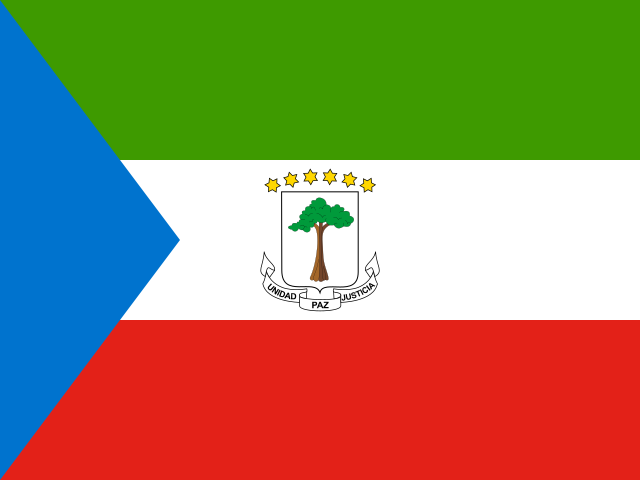 Equatorial Guinea
 Gabon
Gabon Sao Tome and Principe
Earlier Report Observations
The market for not carded or combed cotton in Middle Africa expanded significantly from 505 thousand tons in 2018 to 871 thousand tons in 2023. This growth was not steady, with a sharp increase in 2019 followed by a slight rise in 2020, a contraction in 2021, and a recovery in 2022 and 2023.
Domestic production mirrored this trend, jumping from 619 thousand tons in 2018 to 954 thousand tons in 2019 and remaining around that level before dipping in 2021 and climbing again. Exports also grew over the period, from 114 thousand tons to 128 thousand tons, while imports were minimal, indicating a largely self-sufficient regional market.
By 2024, several developments were noted, including a rise in exports from Côte d'Ivoire and major investments in cotton processing in West Africa, such as Olam Agri's $100 million expansion in Nigeria to increase decortication capacity and local value addition. Global factors like an abundant supply in West Africa and competitive pressure from Brazil, which became the world's top exporter, also influenced the market context. Additionally, growing consumer preference for organic and sustainable cotton has been shaping demand, supported by stricter EU organic certification rules implemented from 2022.
Table of content
- 1. Disclaimer
- 2. Terms of use of the report
- 3. Product codes in the statistical classifications used in the report
-
4. Key Market Indicators and Trends
-
4.1. Key Market Indicators
-
4.1.1. In kind
- 4.1.1.1. Production, 2018-2023
- 4.1.1.2. Imports, 2018-2024
- 4.1.1.3. Exports, 2018-2024
- 4.1.1.4. Market size, 2018-2023
-
4.1.2. In value
- 4.1.2.1. Production, 2018-2023
- 4.1.2.2. Imports, 2018-2024
- 4.1.2.3. Exports, 2018-2024
- 4.1.2.4. Market size, 2018-2023
-
4.1.1. In kind
- 4.2. Market Trends and Factors
-
4.1. Key Market Indicators
-
5. Production
-
5.1. Production in Middle Africa
- 5.1.1. Annual dynamics of production in Middle Africa in kind, 2018-2023, K t
-
5.2. Global production by Country, 2018-2023
- 5.2.1. Annual dynamics of production by macroregions in kind, 2018-2023, K t
- 5.2.2. Dynamics of production structure by macroregions in kind, 2018-2023
- 5.2.3. Annual dynamics of production by country in kind, 2018-2023, K t
- 5.2.4. Structure of production by countries in kind, 2018-2023
- 5.2.5. Dynamics of peoduction structure by countries in kind, 2018-2023
-
5.1. Production in Middle Africa
-
6. Imports
-
6.1. Imports (Direct Data*)
- 6.1.1. Imports - Total information
-
6.1.2. Imports in kind, K t
- 6.1.2.1. Annual dynamics of product's imports to Angola in kind, 2018-2024, K t
- 6.1.2.2. Dynamics of product's imports in kind to Angola by countries, 2018-2024, K t
- 6.1.2.3. Structure of product's imports in kind by countries, 2018-2024
-
6.1.3. Imports in value, M $ US
- 6.1.3.1. Annual dynamics of product's imports to Angola in value, 2018-2024, M $ US
- 6.1.3.2. Dynamics of product's imports in value to Angola by countries, 2018-2024, M $ US
- 6.1.3.3. Structure of product's imports in value by countries, 2018-2024
-
6.1.4. Average price of product's imports, $ US/t
- 6.1.4.1. Annual dynamics of average price of product's imports to Angola, 2018-2024, $ US/t
- 6.1.4.2. Dynamics of average price of product's imports to Angola by countries, 2018-2024, $ US/t
-
6.2. Imports (Mirror Data)
- 6.2.1. Imports - Total information
-
6.2.2. Imports in kind, K t
- 6.2.2.1. Annual dynamics of product's imports to Angola in kind, 2018-2024, K t
- 6.2.2.2. Dynamics of product's imports in kind to Angola by countries, 2018-2024, K t
- 6.2.2.3. Structure of product's imports in kind by countries, 2018-2024
-
6.2.3. Imports in value, M $ US
- 6.2.3.1. Annual dynamics of product's imports to Angola in value, 2018-2024, M $ US
- 6.2.3.2. Dynamics of product's imports in value to Angola by countries, 2018-2024, M $ US
- 6.2.3.3. Structure of product's imports in value by countries, 2018-2024
-
6.2.4. Average price of product's imports, $ US/t
- 6.2.4.1. Annual dynamics of average price of product's imports to Angola, 2018-2024, $ US/t
- 6.2.4.2. Dynamics of average price of product's imports to Angola by countries, 2018-2024, $ US/t
-
6.1. Imports (Direct Data*)
-
7. Exports
-
7.1. Exports (Direct Data*)
- 7.1.1. Exports - Total information
-
7.1.2. Exports in kind, K t
- 7.1.2.1. Annual dynamics of product's exports from Angola in kind, 2018-2024, K t
- 7.1.2.2. Dynamics of product's exports in kind from Angola by countries, 2018-2024, K t
- 7.1.2.3. Structure of product's exports in kind by countries, 2018-2024
-
7.1.3. Exports in value, M $ US
- 7.1.3.1. Annual dynamics of product's exports from Angola in value, 2018-2024, M $ US
- 7.1.3.2. Dynamics of product's exports in value from Angola by countries, 2018-2024, M $ US
- 7.1.3.3. Structure of product's exports in value by countries, 2018-2024
-
7.1.4. Average price of product's exports, $ US/t
- 7.1.4.1. Annual dynamics of average price of product's exports from Angola, 2018-2024, $ US/t
- 7.1.4.2. Dynamics of average price of product's exports from Angola by countries, 2018-2024, $ US/t
-
7.2. Exports (Mirror Data)
- 7.2.1. Exports - Total information
-
7.2.2. Exports in kind, K t
- 7.2.2.1. Annual dynamics of product's exports from Angola in kind, 2018-2024, K t
- 7.2.2.2. Dynamics of product's exports in kind from Angola by countries, 2018-2024, K t
- 7.2.2.3. Structure of product's exports in kind by countries, 2018-2024
-
7.2.3. Exports in value, M $ US
- 7.2.3.1. Annual dynamics of product's exports from Angola in value, 2018-2024, M $ US
- 7.2.3.2. Dynamics of product's exports in value from Angola by countries, 2018-2024, M $ US
- 7.2.3.3. Structure of product's exports in value by countries, 2018-2024
-
7.2.4. Average price of product's exports, $ US/t
- 7.2.4.1. Annual dynamics of average price of product's exports from Angola, 2018-2024, $ US/t
- 7.2.4.2. Dynamics of average price of product's exports from Angola by countries, 2018-2024, $ US/t
-
7.1. Exports (Direct Data*)
-
8. Trade balance
-
8.1. Trade balance (Direct Data)
- 8.1.1. In kind, K t
- 8.1.2. In value, M $ US
-
8.2. Trade balance (Mirror Data)
- 8.2.1. In kind, K t
- 8.2.2. In value, M $ US
-
8.1. Trade balance (Direct Data)
-
9. Top buying and selling countries, 2018-2024
-
9.1. Direct Data
- 9.1.1. Import in Value by Countries-buyers
- 9.1.2. Export in Value by Countries-suppliers
-
9.2. Mirror Data
- 9.2.1. Import in Value by Countries-buyers
- 9.2.2. Export in Value by Countries-suppliers
-
9.1. Direct Data
Production not carded or combed cotton in Middle Africa
In kind, 2017-2020, K t
Top producers of not carded or combed cotton, 2017-2020
World map of production of not carded or combed cotton, 2017-2020
Middle Africa's production of not carded or combed cotton grew for the third year in a row. In 2020, the region produced 956.2 K t, showing little change from 2019. Over the 2017-2020 period, production rose by 56.3%, with an average annual growth rate of 16.1%.
Annual dynamics of production in Middle Africa in kind, 2017-2020, K t
| Parameter | 2018 | 2019 | 2020 | CAGR | |
|---|---|---|---|---|---|
| 1 | Change from last year | 1.2% | 54.1% | 0.3% | 16.1% |
In value, 2017-2020, M $ US
Following two years of growth, Middle Africa's production value for not carded or combed cotton fell. In 2020, output was valued at 1 524 M $ US, a modest decline of 6.3% compared to 2019. From 2017 to 2020, production value increased by 54.8%, translating to an annualized rate of 15.7%. The peak value occurred in 2019 at 1 627 M $ US, with the largest year-on-year increase of 42.0% also recorded that year.
Annual dynamics of production in Middle Africa in value, 2017-2020, M $ US
| Parameter | 2018 | 2019 | 2020 | CAGR | |
|---|---|---|---|---|---|
| 1 | Change from last year | 16.4% | 42.0% | (6.3%) | 15.7% |
Exports not carded or combed cotton from Middle Africa
Exports in kind, K t
After two years of growth, Middle Africa's exports of not carded or combed cotton decreased. In 2020, exports totaled 123.5 K t, down 5.0% from 2019. Between 2017 and 2020, exports grew by 19.7%, averaging 6.2% per year. The highest export volume was in 2019 at 130.1 K t, which also saw the largest increase of 13.8%.
Annual dynamics of product's exports from Middle Africa in kind, 2017-2020, K t
| Parameter | 2018 | 2019 | 2020 | CAGR | |
|---|---|---|---|---|---|
| 1 | Change from last year | 10.8% | 13.8% | (5.0%) | 6.2% |
From 2017 to 2020, Bangladesh, Malaysia, and India were the top destinations for Middle Africa's exports in kind. Bangladesh accounted for 52.0% of exports, Malaysia for 19.4%, and India for 7.3%, together making up 78.7% of total flows.
Structure of product's exports in kind by countries, 2017-2020
World map of product's exports from Middle Africa in kind, 2017-2020
Exports in value, M $ US
Following a two-year rise, Middle Africa's export value for not carded or combed cotton dropped. In 2020, exports were valued at 196.9 M $ US, a significant decline of 11.3% compared to the previous year. Over the 2017-2020 period, export value increased by 18.5%, with an annualized rate of 5.8%. The peak value was in 2019 at 221.9 M $ US, while the largest increase occurred in 2018 at 27.4%.
Annual dynamics of product's exports from Middle Africa in value, 2017-2020, M $ US
| Parameter | 2018 | 2019 | 2020 | CAGR | |
|---|---|---|---|---|---|
| 1 | Change from last year | 27.4% | 4.8% | (11.3%) | 5.8% |
Between 2017 and 2020, Bangladesh, Malaysia, and India dominated Middle Africa's export value. Bangladesh represented 52.8% of exports, Malaysia 20.1%, and India 7.4%, collectively accounting for 80.3% of total flows.
Structure of product's exports in value by countries, 2017-2020
World map of product's exports from Middle Africa in value, 2017-2020
Imports not carded or combed cotton to Middle Africa
Imports in kind, K t
The import market for not carded or combed cotton in Middle Africa experienced volatility from 2017 to 2020. Imports hit their lowest point in 2020 at 0.0 K t, down 33.6% from 2019, and peaked in 2018 at 0.3 K t, resulting in a 13.2-fold difference between these years. The largest decline occurred in 2019 at 88.5%, while the biggest increase was in 2018 at 43.8%.
Annual dynamics of product's imports to Middle Africa in kind, 2017-2020, K t
| Parameter | 2018 | 2019 | 2020 | CAGR | |
|---|---|---|---|---|---|
| 1 | Change from last year | 43.8% | (88.5%) | (33.6%) | (52.2%) |
During 2017-2020, Uganda, Indonesia, and China were the leading sources for imports in kind to Middle Africa. Uganda contributed 68.4% of imports, Indonesia 8.7%, and China 7.5%, together comprising 84.6% of total flows.
Structure of product's imports in kind by countries, 2017-2020
World map of product's imports to Middle Africa in kind, 2017-2020
Imports in value, M $ US
Middle Africa's import value for not carded or combed cotton showed notable fluctuations from 2017 to 2020. Imports reached their lowest in 2020 at 0.0 M $ US, a sharp decrease of 52.3% from 2019, and peaked in 2018 at 0.6 M $ US, creating a 36-fold gap. The largest decline was in 2019 at 94.2%, and the biggest increase was in 2018 at 38.6%.
Annual dynamics of product's imports to Middle Africa in value, 2017-2020, M $ US
| Parameter | 2018 | 2019 | 2020 | CAGR | |
|---|---|---|---|---|---|
| 1 | Change from last year | 38.6% | (94.2%) | (52.3%) | (66.3%) |
From 2017 to 2020, Uganda, China, and Indonesia formed the core markets for Middle Africa's imports in value terms. Uganda accounted for 66.9% of imports, China for 9.0%, and Indonesia for 8.8%, with a combined share of 84.8% of total flows.
Structure of product's imports in value by countries, 2017-2020
World map of product's imports to Middle Africa in value, 2017-2020
Related Reports

Not carded or combed cotton market in ECOWAS
2026-03-30


Cassava market in Middle Africa
2026-03-27


Why Choose Us?
Only Verified Data
No Hidden Costs or Separate Fees
Smarter Subscription Pricing
Contact Our Team
Submit your inquiry using the form below — our team will get back to you within 24 hours.