






"Middle Africa" region includes following countries:
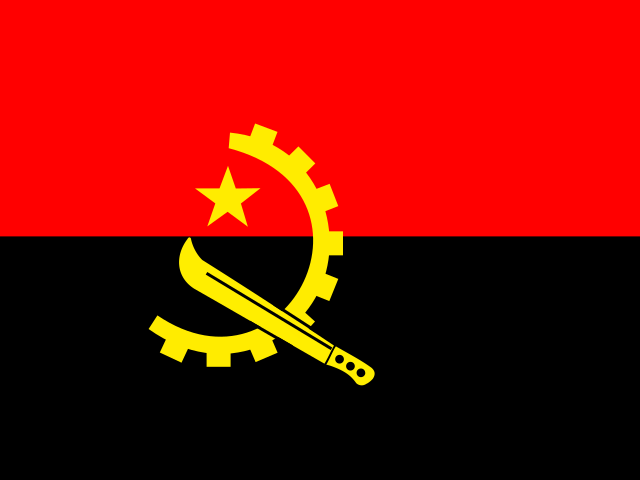 Angola
 Cameroon
 Central African Republic
 Chad
Chad Congo
Congo Democratic Republic of the Congo
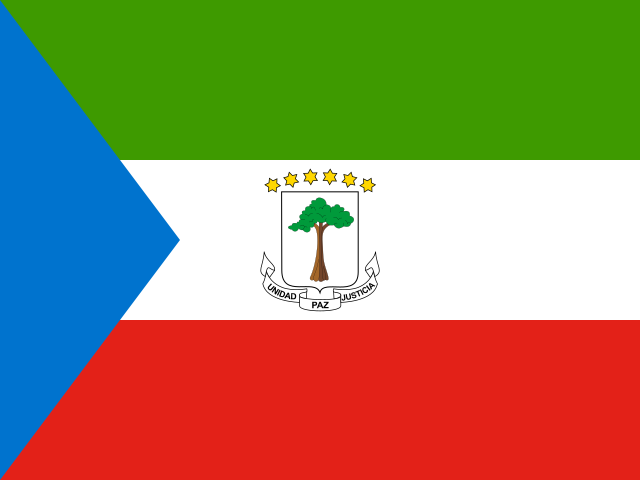 Equatorial Guinea
 Gabon
Gabon Sao Tome and Principe
Earlier Report Observations
The cassava market in Middle Africa, with the Democratic Republic of the Congo as a leading global producer, demonstrated steady growth from 2018 to 2023. The period began with a market volume of 57 011 thousand t, which increased to 58 563 thousand t in 2019. That year, efforts to enhance productivity, including the provision of equipment to the INERA research institute for better detection of crop viruses and pests, contributed to strengthening production foundations.
Market expansion continued through 2020 and 2021, with volumes rising to 61 442 thousand t and 61 643 thousand t, respectively. This sustained growth set the stage for more targeted interventions in the following years.
A significant development occurred in 2022 with the adoption of a national standard requiring the inclusion of cassava flour in bread and pastry production. This policy, aimed at valorizing domestic cassava and reducing wheat import costs, created new industrial demand. In 2023, this was reinforced by the launch of a major cassava value chain development project, supported by the government and international partners, which focused on improving seeds, processing, and market access. These initiatives drove the market volume to 64 012 thousand t in 2022 and further to 66 293 thousand t in 2023.
Table of content
- 1. Disclaimer
- 2. Terms of use of the report
- 3. Product codes in the statistical classifications used in the report
-
4. Key Market Indicators and Trends
-
4.1. Key Market Indicators
-
4.1.1. In kind
- 4.1.1.1. Production, 2018-2023
- 4.1.1.2. Imports, 2018-2024
- 4.1.1.3. Exports, 2018-2024
- 4.1.1.4. Market size, 2018-2023
-
4.1.1. In kind
- 4.2. Market Trends and Factors
-
4.1. Key Market Indicators
-
5. Production
-
5.1. Production in Middle Africa
- 5.1.1. Annual dynamics of production in Middle Africa in kind, 2018-2023, K t
-
5.2. Global production by Country, 2018-2023
- 5.2.1. Annual dynamics of production by macroregions in kind, 2018-2023, K t
- 5.2.2. Dynamics of production structure by macroregions in kind, 2018-2023
- 5.2.3. Annual dynamics of production by country in kind, 2018-2023, K t
- 5.2.4. Structure of production by countries in kind, 2018-2023
- 5.2.5. Dynamics of peoduction structure by countries in kind, 2018-2023
-
5.1. Production in Middle Africa
-
6. Exports
-
6.1. Exports (Direct Data*)
- 6.1.1. Exports - Total information
-
6.1.2. Exports in kind, t
- 6.1.2.1. Annual dynamics of product's exports from Angola in kind, 2018-2024, t
- 6.1.2.2. Dynamics of product's exports in kind from Angola by countries, 2018-2024, t
- 6.1.2.3. Structure of product's exports in kind by countries, 2018-2024
-
6.1.3. Exports in value, K $ US
- 6.1.3.1. Annual dynamics of product's exports from Angola in value, 2018-2024, K $ US
- 6.1.3.2. Dynamics of product's exports in value from Angola by countries, 2018-2024, K $ US
- 6.1.3.3. Structure of product's exports in value by countries, 2018-2024
-
6.1.4. Average price of product's exports, $ US/t
- 6.1.4.1. Annual dynamics of average price of product's exports from Angola, 2018-2024, $ US/t
- 6.1.4.2. Dynamics of average price of product's exports from Angola by countries, 2018-2024, $ US/t
-
6.2. Exports (Mirror Data)
- 6.2.1. Exports - Total information
-
6.2.2. Exports in kind, t
- 6.2.2.1. Annual dynamics of product's exports from Angola in kind, 2018-2024, t
- 6.2.2.2. Dynamics of product's exports in kind from Angola by countries, 2018-2024, t
- 6.2.2.3. Structure of product's exports in kind by countries, 2018-2024
-
6.2.3. Exports in value, K $ US
- 6.2.3.1. Annual dynamics of product's exports from Angola in value, 2018-2024, K $ US
- 6.2.3.2. Dynamics of product's exports in value from Angola by countries, 2018-2024, K $ US
- 6.2.3.3. Structure of product's exports in value by countries, 2018-2024
-
6.2.4. Average price of product's exports, $ US/t
- 6.2.4.1. Annual dynamics of average price of product's exports from Angola, 2018-2024, $ US/t
- 6.2.4.2. Dynamics of average price of product's exports from Angola by countries, 2018-2024, $ US/t
-
6.1. Exports (Direct Data*)
-
7. Imports
-
7.1. Imports (Direct Data*)
- 7.1.1. Imports - Total information
-
7.1.2. Imports in kind, t
- 7.1.2.1. Annual dynamics of product's imports to Angola in kind, 2018-2024, t
- 7.1.2.2. Dynamics of product's imports in kind to Angola by countries, 2018-2024, t
- 7.1.2.3. Structure of product's imports in kind by countries, 2018-2024
-
7.1.3. Imports in value, K $ US
- 7.1.3.1. Annual dynamics of product's imports to Angola in value, 2018-2024, K $ US
- 7.1.3.2. Dynamics of product's imports in value to Angola by countries, 2018-2024, K $ US
- 7.1.3.3. Structure of product's imports in value by countries, 2018-2024
-
7.1.4. Average price of product's imports, $ US/t
- 7.1.4.1. Annual dynamics of average price of product's imports to Angola, 2018-2024, $ US/t
- 7.1.4.2. Dynamics of average price of product's imports to Angola by countries, 2018-2024, $ US/t
-
7.2. Imports (Mirror Data)
- 7.2.1. Imports - Total information
-
7.2.2. Imports in kind, t
- 7.2.2.1. Annual dynamics of product's imports to Angola in kind, 2018-2024, t
- 7.2.2.2. Dynamics of product's imports in kind to Angola by countries, 2018-2024, t
- 7.2.2.3. Structure of product's imports in kind by countries, 2018-2024
-
7.2.3. Imports in value, K $ US
- 7.2.3.1. Annual dynamics of product's imports to Angola in value, 2018-2024, K $ US
- 7.2.3.2. Dynamics of product's imports in value to Angola by countries, 2018-2024, K $ US
- 7.2.3.3. Structure of product's imports in value by countries, 2018-2024
-
7.2.4. Average price of product's imports, $ US/t
- 7.2.4.1. Annual dynamics of average price of product's imports to Angola, 2018-2024, $ US/t
- 7.2.4.2. Dynamics of average price of product's imports to Angola by countries, 2018-2024, $ US/t
-
7.1. Imports (Direct Data*)
-
8. Trade balance
-
8.1. Trade balance (Direct Data)
- 8.1.1. In kind, t
- 8.1.2. In value, K $ US
-
8.2. Trade balance (Mirror Data)
- 8.2.1. In kind, t
- 8.2.2. In value, K $ US
-
8.1. Trade balance (Direct Data)
-
9. Top buying and selling countries, 2018-2024
-
9.1. Direct Data
- 9.1.1. Import in Value by Countries-buyers
- 9.1.2. Export in Value by Countries-suppliers
-
9.2. Mirror Data
- 9.2.1. Import in Value by Countries-buyers
- 9.2.2. Export in Value by Countries-suppliers
-
9.1. Direct Data
Production cassava in Middle Africa
In kind, 2017-2020, K t
Top producers of cassava, 2017-2020
World map of production of cassava, 2017-2020
Cassava production in Middle Africa has grown for the third year in a row. In 2020, the region produced 61 444 thousand tonnes of cassava, marking a 4.9% increase from 2019. Over the period from 2017 to 2020, production rose by 11.7%, with an average annual growth rate of 3.8%.
Annual dynamics of production in Middle Africa in kind, 2017-2020, K t
| Parameter | 2018 | 2019 | 2020 | CAGR | |
|---|---|---|---|---|---|
| 1 | Change from last year | 3.6% | 2.7% | 4.9% | 3.8% |
Exports cassava from Middle Africa
Exports in kind, t
The market experienced significant fluctuations during this period. From 2017 to 2019, exports varied widely, with a peak-to-trough amplitude of 7.2 times. In 2020, Middle Africa exported 3 218 tonnes of cassava, which was an 8.0% decrease compared to 2019. The highest export volume was recorded in 2019 at 3 498 tonnes, while the largest increase occurred in 2018 with a growth of 233.3%.
Annual dynamics of product's exports from Middle Africa in kind, 2017-2020, t
| Parameter | 2018 | 2019 | 2020 | CAGR | |
|---|---|---|---|---|---|
| 1 | Change from last year | 233.3% | 115.2% | (8.0%) | 87.6% |
From 2017 to 2020, the three largest markets for cassava exports in kind were France, Belgium, and Vietnam, which together accounted for 63.8% of total export flows.
Structure of product's exports in kind by countries, 2017-2020
World map of product's exports from Middle Africa in kind, 2017-2020
Exports in value, K $ US
The market displayed an unstable trend over this timeframe. Exports reached their lowest point in 2017 and peaked in 2019, with a 7.9-fold difference between these years. In 2020, Middle Africa's cassava exports totaled 643.7 thousand US dollars, representing a sharp decline of 26.5% from the previous year. The maximum value was recorded in 2019 at 875.8 thousand US dollars, and the largest increase also occurred in 2019 with a growth of 195.4%.
Annual dynamics of product's exports from Middle Africa in value, 2017-2020, K $ US
| Parameter | 2018 | 2019 | 2020 | CAGR | |
|---|---|---|---|---|---|
| 1 | Change from last year | 167.2% | 195.4% | (26.5%) | 79.7% |
Throughout 2017–2020, France, Belgium, and Vietnam were the core markets for cassava exports in value terms, contributing 37.5%, 14.8%, and 7.0% of total exports, respectively. Together, they represented 59.3% of all export flows.
Structure of product's exports in value by countries, 2017-2020
World map of product's exports from Middle Africa in value, 2017-2020
Imports cassava to Middle Africa
Imports in kind, t
The market showed noticeable fluctuations in performance during this period. Import levels varied significantly, with a 21-fold difference between the high in 2020 and the low in 2018. In 2020, Middle Africa imported cassava totaling a value that corresponded to a 55.2% improvement from the previous year. The minimum import volume was recorded in 2018 at 39 tonnes. The largest decline occurred in 2018 with a drop of 70.6%, while the largest increase was in 2019 with a surge of 1 227.6%.
Annual dynamics of product's imports to Middle Africa in kind, 2017-2020, t
| Parameter | 2018 | 2019 | 2020 | CAGR | |
|---|---|---|---|---|---|
| 1 | Change from last year | (70.6%) | 1 227.6% | 55.2% | 82.2% |
From 2017 to 2020, Uganda, Zambia, and Tanzania were the main sources for cassava imports in kind to Middle Africa, accounting for 17.6%, 1.8%, and 1.1% of imports, respectively. Their combined share made up 20.4% of total import flows.
Structure of product's imports in kind by countries, 2017-2020
World map of product's imports to Middle Africa in kind, 2017-2020
Imports in value, K $ US
The market exhibited volatility over the observed period. Imports bottomed in 2018 and peaked in 2019, with an 18-fold variation between these years. In 2020, Middle Africa's cassava import volume totaled 306.5 thousand US dollars, indicating a 40.0% decrease compared to 2019. The minimum value was recorded in 2018 at 28.6 thousand US dollars, while the maximum was in 2019 at 511.1 thousand US dollars. The largest decline occurred in 2018 with a drop of 45.4%, and the largest increase was in 2019 with a rise of 1 686.9%.
Annual dynamics of product's imports to Middle Africa in value, 2017-2020, K $ US
| Parameter | 2018 | 2019 | 2020 | CAGR | |
|---|---|---|---|---|---|
| 1 | Change from last year | (45.4%) | 1 686.9% | (40.0%) | 80.2% |
In 2017–2020, Uganda, France, and Zambia played notable roles as suppliers of cassava to Middle Africa in value terms, contributing 20.4%, 1.7%, and 1.5% of imports, respectively. However, their combined share reached only 23.7% of total imports in value terms, indicating they were not dominant in the market.
Structure of product's imports in value by countries, 2017-2020
World map of product's imports to Middle Africa in value, 2017-2020
Related Reports

Cassava market in Papua New Guinea
2026-03-27
Cassava market in the Philippines
2026-03-27
2026-03-27
Cassava market in Dominican Republic
2026-03-27

Garlic market in Middle Africa
2026-03-27

Sweet potatoe market in Middle Africa
2026-03-27


Why Choose Us?
Only Verified Data
No Hidden Costs or Separate Fees
Smarter Subscription Pricing
Contact Our Team
Submit your inquiry using the form below — our team will get back to you within 24 hours.