






"SADC" region includes following countries:
 Angola
 Botswana
 Comoros
 Democratic Republic of the Congo
 Eswatini
 Lesotho
 Madagascar
 Malawi
 Mauritius
 Mozambique
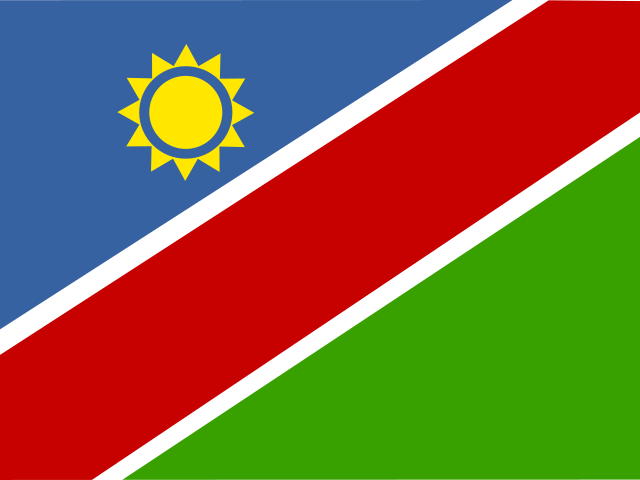 Namibia
 Seychelles
 South Africa
 Tanzania
 Zambia
 Zimbabwe
Earlier Report Observations
The millet market in SADC grew from 646.5 thousand tons in 2018 to a peak of 690.7 thousand tons in 2020, supported by an increase in domestic production to 683.9 thousand tons that same year.
A sustained contraction followed from 2021 to 2023, with the market size declining to 544.4 thousand tons as production fell to 545.7 thousand tons. Over this period, import volumes also decreased while exports began to rise steadily.
Market dynamics in 2024 were influenced by fragmented supply chains and high post-harvest losses stemming from inadequate storage and processing infrastructure, which elevated costs for small processors. Simultaneously, the emergence of direct-to-consumer e-commerce platforms started to reshape trade by bypassing traditional retail intermediaries, improving price realization for farmers.
Table of content
- 1. Disclaimer
- 2. Terms of use of the report
- 3. Product codes in the statistical classifications used in the report
-
4. Key Market Indicators and Trends
-
4.1. Key Market Indicators
-
4.1.1. In kind
- 4.1.1.1. Production, 2018-2023
- 4.1.1.2. Imports, 2018-2024
- 4.1.1.3. Exports, 2018-2024
- 4.1.1.4. Market size, 2018-2023
-
4.1.1. In kind
- 4.2. Market Trends and Factors
-
4.1. Key Market Indicators
-
5. Production
-
5.1. Production in SADC
- 5.1.1. Annual dynamics of production in SADC in kind, 2018-2023, K t
-
5.2. Global production by Country, 2018-2023
- 5.2.1. Annual dynamics of production by macroregions in kind, 2018-2023, K t
- 5.2.2. Dynamics of production structure by macroregions in kind, 2018-2023
- 5.2.3. Annual dynamics of production by country in kind, 2018-2023, K t
- 5.2.4. Structure of production by countries in kind, 2018-2023
- 5.2.5. Dynamics of peoduction structure by countries in kind, 2018-2023
-
5.1. Production in SADC
-
6. Imports
-
6.1. Imports (Direct Data*)
- 6.1.1. Imports - Total information
-
6.1.2. Imports in kind, t
- 6.1.2.1. Annual dynamics of product's imports to Angola in kind, 2018-2024, t
- 6.1.2.2. Dynamics of product's imports in kind to Angola by countries, 2018-2024, t
- 6.1.2.3. Structure of product's imports in kind by countries, 2018-2024
-
6.1.3. Imports in value, K $ US
- 6.1.3.1. Annual dynamics of product's imports to Angola in value, 2018-2024, K $ US
- 6.1.3.2. Dynamics of product's imports in value to Angola by countries, 2018-2024, K $ US
- 6.1.3.3. Structure of product's imports in value by countries, 2018-2024
-
6.1.4. Average price of product's imports, $ US/t
- 6.1.4.1. Annual dynamics of average price of product's imports to Angola, 2018-2024, $ US/t
- 6.1.4.2. Dynamics of average price of product's imports to Angola by countries, 2018-2024, $ US/t
-
6.2. Imports (Mirror Data)
- 6.2.1. Imports - Total information
-
6.2.2. Imports in kind, t
- 6.2.2.1. Annual dynamics of product's imports to Angola in kind, 2018-2024, t
- 6.2.2.2. Dynamics of product's imports in kind to Angola by countries, 2018-2024, t
- 6.2.2.3. Structure of product's imports in kind by countries, 2018-2024
-
6.2.3. Imports in value, K $ US
- 6.2.3.1. Annual dynamics of product's imports to Angola in value, 2018-2024, K $ US
- 6.2.3.2. Dynamics of product's imports in value to Angola by countries, 2018-2024, K $ US
- 6.2.3.3. Structure of product's imports in value by countries, 2018-2024
-
6.2.4. Average price of product's imports, $ US/t
- 6.2.4.1. Annual dynamics of average price of product's imports to Angola, 2018-2024, $ US/t
- 6.2.4.2. Dynamics of average price of product's imports to Angola by countries, 2018-2024, $ US/t
-
6.1. Imports (Direct Data*)
-
7. Exports
-
7.1. Exports (Direct Data*)
- 7.1.1. Exports - Total information
-
7.1.2. Exports in kind, t
- 7.1.2.1. Annual dynamics of product's exports from Angola in kind, 2018-2024, t
- 7.1.2.2. Dynamics of product's exports in kind from Angola by countries, 2018-2024, t
- 7.1.2.3. Structure of product's exports in kind by countries, 2018-2024
-
7.1.3. Exports in value, K $ US
- 7.1.3.1. Annual dynamics of product's exports from Angola in value, 2018-2024, K $ US
- 7.1.3.2. Dynamics of product's exports in value from Angola by countries, 2018-2024, K $ US
- 7.1.3.3. Structure of product's exports in value by countries, 2018-2024
-
7.1.4. Average price of product's exports, $ US/t
- 7.1.4.1. Annual dynamics of average price of product's exports from Angola, 2018-2024, $ US/t
- 7.1.4.2. Dynamics of average price of product's exports from Angola by countries, 2018-2024, $ US/t
-
7.2. Exports (Mirror Data)
- 7.2.1. Exports - Total information
-
7.2.2. Exports in kind, t
- 7.2.2.1. Annual dynamics of product's exports from Angola in kind, 2018-2024, t
- 7.2.2.2. Dynamics of product's exports in kind from Angola by countries, 2018-2024, t
- 7.2.2.3. Structure of product's exports in kind by countries, 2018-2024
-
7.2.3. Exports in value, K $ US
- 7.2.3.1. Annual dynamics of product's exports from Angola in value, 2018-2024, K $ US
- 7.2.3.2. Dynamics of product's exports in value from Angola by countries, 2018-2024, K $ US
- 7.2.3.3. Structure of product's exports in value by countries, 2018-2024
-
7.2.4. Average price of product's exports, $ US/t
- 7.2.4.1. Annual dynamics of average price of product's exports from Angola, 2018-2024, $ US/t
- 7.2.4.2. Dynamics of average price of product's exports from Angola by countries, 2018-2024, $ US/t
-
7.1. Exports (Direct Data*)
-
8. Trade balance
-
8.1. Trade balance (Direct Data)
- 8.1.1. In kind, t
- 8.1.2. In value, K $ US
-
8.2. Trade balance (Mirror Data)
- 8.2.1. In kind, t
- 8.2.2. In value, K $ US
-
8.1. Trade balance (Direct Data)
-
9. Top buying and selling countries, 2018-2024
-
9.1. Direct Data
- 9.1.1. Import in Value by Countries-buyers
- 9.1.2. Export in Value by Countries-suppliers
-
9.2. Mirror Data
- 9.2.1. Import in Value by Countries-buyers
- 9.2.2. Export in Value by Countries-suppliers
-
9.1. Direct Data
Production millet in SADC
In kind, 2017-2020, K t
Top producers of millet, 2017-2020
World map of production of millet, 2017-2020
In 2020, SADC produced 683.9 thousand tonnes of millet, marking an 8.0% increase compared to the previous year. Over the period from 2017 to 2020, production grew by 9.9%, with an average annual growth rate of 3.2%. The most significant decline occurred in 2019, when production fell by 0.8%.
Annual dynamics of production in SADC in kind, 2017-2020, K t
| Parameter | 2018 | 2019 | 2020 | CAGR | |
|---|---|---|---|---|---|
| 1 | Change from last year | 2.6% | (0.8%) | 8.0% | 3.2% |
Exports millet from SADC
Exports in kind, t
The data shows irregular fluctuations, reflecting a volatile market environment. Millet exports from SADC reached their lowest point in 2018 at 471 tonnes, then peaked in 2020 at 4 045 tonnes, representing an 8.6-fold difference between these years. In 2020, exports surged by 98.1% compared to the previous year. The largest decline was recorded in 2018, with a drop of 62.1%, while the most substantial increase occurred in 2019, rising by 333.6%.
Annual dynamics of product's exports from SADC in kind, 2017-2020, t
| Parameter | 2018 | 2019 | 2020 | CAGR | |
|---|---|---|---|---|---|
| 1 | Change from last year | (62.1%) | 333.6% | 98.1% | 48.2% |
From 2017 to 2020, Kenya, Canada, and Italy consistently held the top positions in SADC's millet export structure by volume. Kenya accounted for 57.8% of exports, Canada for 4.7%, and Italy for 1.5%, together making up 64.0% of total export flows.
Structure of product's exports in kind by countries, 2017-2020
World map of product's exports from SADC in kind, 2017-2020
Exports in value, K $ US
SADC's millet exports in value terms increased for the second consecutive year. In 2020, exports amounted to 1 063 thousand US dollars, showing a 16.1% improvement over the previous year. Between 2017 and 2020, exports grew by 29.1%, equivalent to an annualized rate of 8.9%. The lowest value was recorded in 2018 at 555 thousand US dollars, with the largest decline that year at 32.6%. The most significant increase occurred in 2019, rising by 65.0%.
Annual dynamics of product's exports from SADC in value, 2017-2020, K $ US
| Parameter | 2018 | 2019 | 2020 | CAGR | |
|---|---|---|---|---|---|
| 1 | Change from last year | (32.6%) | 65.0% | 16.1% | 8.9% |
From 2017 to 2020, Kenya, Canada, and Italy were the primary buyers of millet from SADC in value terms. Kenya represented 44.5% of exports, Canada 7.7%, and Italy 4.6%, collectively accounting for 56.8% of total export value.
Structure of product's exports in value by countries, 2017-2020
World map of product's exports from SADC in value, 2017-2020
Imports millet to SADC
Imports in kind, t
SADC's millet imports in volume increased for the second year in a row. In 2020, imports totaled 10 864 tonnes, showing a slight rise of 1.5% compared to the previous year. Over the period from 2017 to 2020, imports decreased by 15.8%, with a compound annual growth rate of -5.6%. The lowest volume was recorded in 2018 at 8 498 tonnes, with the largest decline that year at 34.1%. The most substantial increase occurred in 2019, growing by 26.0%.
Annual dynamics of product's imports to SADC in kind, 2017-2020, t
| Parameter | 2018 | 2019 | 2020 | CAGR | |
|---|---|---|---|---|---|
| 1 | Change from last year | (34.1%) | 26.0% | 1.5% | (5.6%) |
Throughout 2017 to 2020, Ukraine, India, and Russia formed the key group of partners for SADC's millet imports by volume. Ukraine accounted for 45.7% of imports, India for 28.4%, and Russia for 14.5%, together representing 88.6% of total import flows.
Structure of product's imports in kind by countries, 2017-2020
World map of product's imports to SADC in kind, 2017-2020
Imports in value, K $ US
In 2020, SADC imported millet worth 4 177 thousand US dollars, representing a strong reduction of 11.5% year-over-year. Between 2017 and 2020, imports increased by 8.2%, equating to an annualized rate of 2.7%. The minimum value was recorded in 2018 at 2 779 thousand US dollars, while the maximum occurred in 2019 at 4 722 thousand US dollars. The largest decline was in 2018 at 28.0%, and the largest increase was in 2019 at 70.0%.
Annual dynamics of product's imports to SADC in value, 2017-2020, K $ US
| Parameter | 2018 | 2019 | 2020 | CAGR | |
|---|---|---|---|---|---|
| 1 | Change from last year | (28.0%) | 70.0% | (11.5%) | 2.7% |
From 2017 to 2020, the three largest markets for SADC's millet imports in value terms were India, Ukraine, and Russia, together accounting for 80.1% of total flows.
Structure of product's imports in value by countries, 2017-2020
World map of product's imports to SADC in value, 2017-2020
Related Reports

2026-03-28
2026-03-28
2026-03-28
2026-03-28
2026-03-28
2026-03-28
2026-03-28

2026-03-28
In-depth market research on this product
Global Finger Millet Market 2021–2031: Size, Share, Trends and Forecast
Global market report: size, trends and forecast to 2031 · 184 pages
Global Proso Millet Market 2021–2031: Size, Share, Trends and Forecast
Global market report: size, trends and forecast to 2031 · 184 pages
Why Choose Us?
Only Verified Data
No Hidden Costs or Separate Fees
Smarter Subscription Pricing
Contact Our Team
Submit your inquiry using the form below — our team will get back to you within 24 hours.