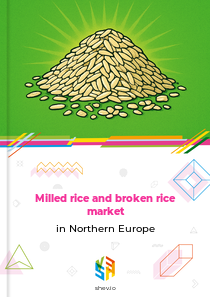







"Northern Europe" region includes following countries:
 Denmark
 Estonia
 Faroe Islands
 Finland
 Iceland
 Ireland
 Latvia
 Lithuania
 Sweden
 the United Kingdom
 Isle of Man
Earlier Report Observations
The milled rice and broken rice market in Northern Europe saw substantial growth in volume from 652 thousand tons in 2018 to 829 thousand tons in 2020. This expansion was facilitated by increased global rice production, as government subsidies and minimum support prices for farmers in major Asian producing countries, combined with the adoption of modern agricultural techniques and genetically edited varieties, enhanced yields and supply availability for import-dependent regions.
After a contraction to 762 thousand tons in 2021, market volume recovered to 853 thousand tons by 2023. In value terms, the market stabilized in 2021 at 1 078 million dollars before rising to 1 395 million dollars in 2023. The dip in volume coincided with broader adjustments in global trade flows, while the subsequent recovery reflected renewed import demand and stable consumption patterns.
Global trade policies significantly influenced market conditions; India's suspension of non-basmati rice exports in 2023 tightened international supply, contributing to higher prices and increased market value. Additionally, the entry of new players through mergers, such as the Olam Agri and Louis Dreyfus Company consolidation, aimed at optimizing logistics, and consumer shifts toward premium varieties like basmati and jasmine rice, supported by rising urban incomes, have reshaped competitive dynamics.
Table of content
- 1. Disclaimer
- 2. Terms of use of the report
- 3. Product codes in the statistical classifications used in the report
-
4. Key Market Indicators and Trends
-
4.1. Key Market Indicators
-
4.1.1. In kind
- 4.1.1.1. Production, 2018-2023
- 4.1.1.2. Imports, 2018-2024
- 4.1.1.3. Exports, 2018-2024
- 4.1.1.4. Market size, 2018-2023
-
4.1.2. In value
- 4.1.2.1. Production, 2018-2023
- 4.1.2.2. Imports, 2018-2024
- 4.1.2.3. Exports, 2018-2024
- 4.1.2.4. Market size, 2018-2023
-
4.1.1. In kind
- 4.2. Market Trends and Factors
-
4.1. Key Market Indicators
-
5. Production
-
5.1. Production in Northern Europe
- 5.1.1. Annual dynamics of production in Northern Europe in kind, 2018-2023, K t
-
5.2. Global production by Country, 2018-2023
- 5.2.1. Annual dynamics of production by macroregions in kind, 2018-2023, K t
- 5.2.2. Dynamics of production structure by macroregions in kind, 2018-2023
- 5.2.3. Annual dynamics of production by country in kind, 2018-2023, K t
- 5.2.4. Structure of production by countries in kind, 2018-2023
- 5.2.5. Dynamics of peoduction structure by countries in kind, 2018-2023
-
5.1. Production in Northern Europe
-
6. Imports
-
6.1. Imports (Direct Data*)
- 6.1.1. Imports - Total information
-
6.1.2. Imports in kind, K t
- 6.1.2.1. Annual dynamics of product's imports to Denmark in kind, 2018-2024, K t
- 6.1.2.2. Dynamics of product's imports in kind to Denmark by countries, 2018-2024, K t
- 6.1.2.3. Structure of product's imports in kind by countries, 2018-2024
-
6.1.3. Imports in value, M $ US
- 6.1.3.1. Annual dynamics of product's imports to Denmark in value, 2018-2024, M $ US
- 6.1.3.2. Dynamics of product's imports in value to Denmark by countries, 2018-2024, M $ US
- 6.1.3.3. Structure of product's imports in value by countries, 2018-2024
-
6.1.4. Average price of product's imports, $ US/t
- 6.1.4.1. Annual dynamics of average price of product's imports to Denmark, 2018-2024, $ US/t
- 6.1.4.2. Dynamics of average price of product's imports to Denmark by countries, 2018-2024, $ US/t
-
6.2. Imports (Mirror Data)
- 6.2.1. Imports - Total information
-
6.2.2. Imports in kind, K t
- 6.2.2.1. Annual dynamics of product's imports to Denmark in kind, 2018-2024, K t
- 6.2.2.2. Dynamics of product's imports in kind to Denmark by countries, 2018-2024, K t
- 6.2.2.3. Structure of product's imports in kind by countries, 2018-2024
-
6.2.3. Imports in value, M $ US
- 6.2.3.1. Annual dynamics of product's imports to Denmark in value, 2018-2024, M $ US
- 6.2.3.2. Dynamics of product's imports in value to Denmark by countries, 2018-2024, M $ US
- 6.2.3.3. Structure of product's imports in value by countries, 2018-2024
-
6.2.4. Average price of product's imports, $ US/t
- 6.2.4.1. Annual dynamics of average price of product's imports to Denmark, 2018-2024, $ US/t
- 6.2.4.2. Dynamics of average price of product's imports to Denmark by countries, 2018-2024, $ US/t
-
6.1. Imports (Direct Data*)
-
7. Exports
-
7.1. Exports (Direct Data*)
- 7.1.1. Exports - Total information
-
7.1.2. Exports in kind, K t
- 7.1.2.1. Annual dynamics of product's exports from Denmark in kind, 2018-2024, K t
- 7.1.2.2. Dynamics of product's exports in kind from Denmark by countries, 2018-2024, K t
- 7.1.2.3. Structure of product's exports in kind by countries, 2018-2024
-
7.1.3. Exports in value, M $ US
- 7.1.3.1. Annual dynamics of product's exports from Denmark in value, 2018-2024, M $ US
- 7.1.3.2. Dynamics of product's exports in value from Denmark by countries, 2018-2024, M $ US
- 7.1.3.3. Structure of product's exports in value by countries, 2018-2024
-
7.1.4. Average price of product's exports, $ US/t
- 7.1.4.1. Annual dynamics of average price of product's exports from Denmark, 2018-2024, $ US/t
- 7.1.4.2. Dynamics of average price of product's exports from Denmark by countries, 2018-2024, $ US/t
-
7.2. Exports (Mirror Data)
- 7.2.1. Exports - Total information
-
7.2.2. Exports in kind, K t
- 7.2.2.1. Annual dynamics of product's exports from Denmark in kind, 2018-2024, K t
- 7.2.2.2. Dynamics of product's exports in kind from Denmark by countries, 2018-2024, K t
- 7.2.2.3. Structure of product's exports in kind by countries, 2018-2024
-
7.2.3. Exports in value, M $ US
- 7.2.3.1. Annual dynamics of product's exports from Denmark in value, 2018-2024, M $ US
- 7.2.3.2. Dynamics of product's exports in value from Denmark by countries, 2018-2024, M $ US
- 7.2.3.3. Structure of product's exports in value by countries, 2018-2024
-
7.2.4. Average price of product's exports, $ US/t
- 7.2.4.1. Annual dynamics of average price of product's exports from Denmark, 2018-2024, $ US/t
- 7.2.4.2. Dynamics of average price of product's exports from Denmark by countries, 2018-2024, $ US/t
-
7.1. Exports (Direct Data*)
-
8. Trade balance
-
8.1. Trade balance (Direct Data)
- 8.1.1. In kind, K t
- 8.1.2. In value, M $ US
-
8.2. Trade balance (Mirror Data)
- 8.2.1. In kind, K t
- 8.2.2. In value, M $ US
-
8.1. Trade balance (Direct Data)
-
9. Top buying and selling countries, 2018-2024
-
9.1. Direct Data
- 9.1.1. Import in Value by Countries-buyers
- 9.1.2. Export in Value by Countries-suppliers
-
9.2. Mirror Data
- 9.2.1. Import in Value by Countries-buyers
- 9.2.2. Export in Value by Countries-suppliers
-
9.1. Direct Data
Production milled rice and broken rice in Northern Europe
In kind, 2017-2020, K t
Top producers of milled rice and broken rice, 2017-2020
World map of production of milled rice and broken rice, 2017-2020
Northern Europe's production of milled rice and broken rice has grown for the second year in a row. In 2020, the region produced 308.9 K t, representing a significant 28.0% increase compared to the previous year. From 2017 to 2020, production rose by 13.6%, with an average annual growth rate of 4.3%. The lowest production level was in 2018 at 200.5 K t, which also saw the largest decline of 26.3%.
Annual dynamics of production in Northern Europe in kind, 2017-2020, K t
| Parameter | 2018 | 2019 | 2020 | CAGR | |
|---|---|---|---|---|---|
| 1 | Change from last year | (26.3%) | 20.3% | 28.0% | 4.3% |
In value, 2017-2020, M $ US
The value of milled rice and broken rice production in Northern Europe has increased for the second consecutive year. In 2020, output was valued at 309.0 M $ US, up 7.6% year-on-year. Between 2017 and 2020, production value grew by 5.1%, translating to an annualized rate of 1.7%. The lowest value was recorded in 2018 at 223.5 M $ US, with the largest decline that year of 24.0%. In contrast, 2019 saw the biggest increase at 28.5%.
Annual dynamics of production in Northern Europe in value, 2017-2020, M $ US
| Parameter | 2018 | 2019 | 2020 | CAGR | |
|---|---|---|---|---|---|
| 1 | Change from last year | (24.0%) | 28.5% | 7.6% | 1.7% |
Exports milled rice and broken rice from Northern Europe
Exports in kind, K t
In 2020, Northern Europe exported 103.2 K t of milled rice and broken rice, a sharp rise of 41.9% from the previous year. From 2017 to 2020, exports increased by 42.2%, with a compound annual growth rate of 12.5%. The largest decline occurred in 2019, at 4.4%.
Annual dynamics of product's exports from Northern Europe in kind, 2017-2020, K t
| Parameter | 2018 | 2019 | 2020 | CAGR | |
|---|---|---|---|---|---|
| 1 | Change from last year | 4.9% | (4.4%) | 41.9% | 12.5% |
Between 2017 and 2020, the export market for milled rice and broken rice in kind was highly diverse. France accounted for 14.8% of exports, the Netherlands for 9.4%, and Germany for 7.4%, together making up just 31.6% of total flows. The remaining 68.4% was distributed among numerous other countries.
Structure of product's exports in kind by countries, 2017-2020
World map of product's exports from Northern Europe in kind, 2017-2020
Exports in value, M $ US
Cross-border shipments of milled rice and broken rice from Northern Europe have increased for the third consecutive year. In 2020, exports reached 103.2 M $ US, a notable 19.3% improvement over the previous year. From 2017 to 2020, exports grew by 31.6%, equating to an annualized rate of 9.6%.
Annual dynamics of product's exports from Northern Europe in value, 2017-2020, M $ US
| Parameter | 2018 | 2019 | 2020 | CAGR | |
|---|---|---|---|---|---|
| 1 | Change from last year | 8.1% | 2.1% | 19.3% | 9.6% |
From 2017 to 2020, the country breakdown of exports in value terms was scattered. France contributed 15.7% of export value, the Netherlands 10.8%, and Germany 9.0%, together accounting for only 35.5% of total flows. No single partner emerged as clearly dominant.
Structure of product's exports in value by countries, 2017-2020
World map of product's exports from Northern Europe in value, 2017-2020
Imports milled rice and broken rice to Northern Europe
Imports in kind, K t
Northern Europe's imports of milled rice and broken rice in kind have risen for the second year in a row. In 2020, imports totaled 622.9 K t, a slight uptick of 3.0% compared to the prior year. Over the period 2017-2020, imports increased by 6.2%, with a compound annual growth rate of 2.0%. The lowest import volume was in 2018 at 527.2 K t, which also saw the largest decline of 10.1%. The biggest increase occurred in 2019, at 14.7%.
Annual dynamics of product's imports to Northern Europe in kind, 2017-2020, K t
| Parameter | 2018 | 2019 | 2020 | CAGR | |
|---|---|---|---|---|---|
| 1 | Change from last year | (10.1%) | 14.7% | 3.0% | 2.0% |
Between 2017 and 2020, the country structure of imports in kind was highly diversified. Italy accounted for 18.2% of imports, Spain for 11.3%, and Myanmar for 9.9%, together making up only 39.4% of total flows. A long tail of smaller markets comprised the remaining 60.6%.
Structure of product's imports in kind by countries, 2017-2020
World map of product's imports to Northern Europe in kind, 2017-2020
Imports in value, M $ US
Deliveries of milled rice and broken rice to Northern Europe have increased for the third consecutive year. In 2020, import volume amounted to 593.0 M $ US, showing a moderate gain of 9.4% versus the previous year. From 2017 to 2020, imports grew by 27.3%, with a compound annual growth rate of 8.4%.
Annual dynamics of product's imports to Northern Europe in value, 2017-2020, M $ US
| Parameter | 2018 | 2019 | 2020 | CAGR | |
|---|---|---|---|---|---|
| 1 | Change from last year | 4.7% | 11.2% | 9.4% | 8.4% |
From 2017 to 2020, imports in value terms of milled rice and broken rice to Northern Europe were spread across many countries. Italy accounted for 18.4% of import value, Thailand for 12.0%, and India for 10.2%, together representing only 40.6% of total flows.
Structure of product's imports in value by countries, 2017-2020
World map of product's imports to Northern Europe in value, 2017-2020
Related Reports

Milled rice and broken rice market in ECOWAS
2026-03-30
Milled rice and broken rice market in Angola
2026-03-30

Maize market in Northern Europe
2026-03-28

Oats market in Northern Europe
2026-03-28

Wheat and meslin market in Northern Europe
2026-03-28

In-depth market research on this product
Global Broken Rice Market 2021–2031: Size, Share, Trends and Forecast
Global market report: size, trends and forecast to 2031 · 192 pages
Why Choose Us?
Only Verified Data
No Hidden Costs or Separate Fees
Smarter Subscription Pricing
Contact Our Team
Submit your inquiry using the form below — our team will get back to you within 24 hours.