






"MENA" region includes following countries:
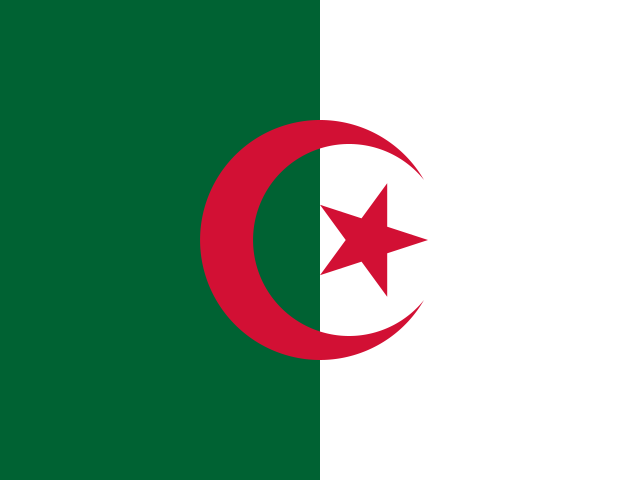 Algeria
 Bahrain
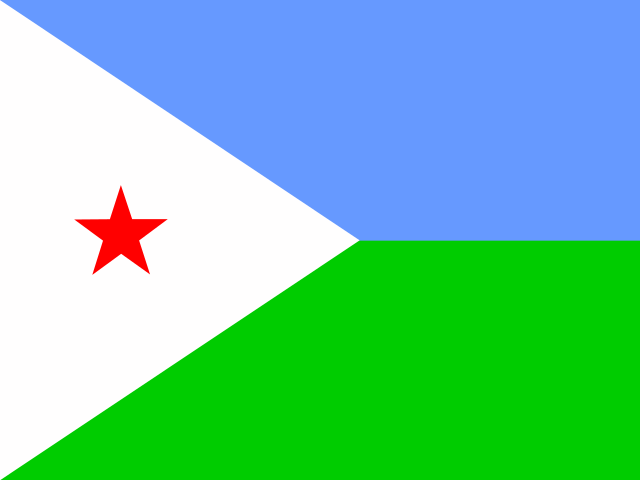 Djibouti
 Egypt
Egypt Israel
 Jordan
 Iran
Iran Iraq
Iraq Qatar
Qatar Kuwait
 Lebanon
 Libya
Libya Malta
Malta Morocco
 the United Arab Emirates
 Oman
Oman Saudi Arabia
 Syria
Syria Tunisia
 Yemen
YemenEarlier Report Observations
The milk market volume in the MENA region grew from 29 858 thousand tonnes in 2018 to a peak of 32 842 thousand tonnes in 2021, driven by global factors such as population growth, urbanization, and rising disposable incomes which increased dairy consumption. This upward trend was supported by growing health awareness and greater availability of dairy products in emerging markets.
After a contraction to 31 649 thousand tonnes in 2022, the market recovered to 32 141 thousand tonnes in 2023. The recovery aligned with a global moderate rebound in milk production, where increased per capita consumption and improved availability of dairy products helped lift demand. Lower feed costs also contributed to more stable production economics during this period.
Table of content
- 1. Disclaimer
- 2. Terms of use of the report
- 3. Product codes in the statistical classifications used in the report
-
4. Key Market Indicators and Trends
-
4.1. Key Market Indicators
-
4.1.1. In kind
- 4.1.1.1. Production, 2018-2023
- 4.1.1.2. Imports, 2018-2024
- 4.1.1.3. Exports, 2018-2024
- 4.1.1.4. Market size, 2018-2023
-
4.1.1. In kind
- 4.2. Market Trends and Factors
-
4.1. Key Market Indicators
-
5. Production
-
5.1. Production in MENA
- 5.1.1. Annual dynamics of production in MENA in kind, 2018-2023, K t
-
5.2. Global production by Country, 2018-2023
- 5.2.1. Annual dynamics of production by macroregions in kind, 2018-2023, K t
- 5.2.2. Dynamics of production structure by macroregions in kind, 2018-2023
- 5.2.3. Annual dynamics of production by country in kind, 2018-2023, K t
- 5.2.4. Structure of production by countries in kind, 2018-2023
- 5.2.5. Dynamics of peoduction structure by countries in kind, 2018-2023
-
5.1. Production in MENA
-
6. Imports
-
6.1. Imports (Direct Data*)
- 6.1.1. Imports - Total information
-
6.1.2. Imports in kind, K t
- 6.1.2.1. Annual dynamics of product's imports to Algeria in kind, 2018-2024, K t
- 6.1.2.2. Dynamics of product's imports in kind to Algeria by countries, 2018-2024, K t
- 6.1.2.3. Structure of product's imports in kind by countries, 2018-2024
-
6.1.3. Imports in value, M $ US
- 6.1.3.1. Annual dynamics of product's imports to Algeria in value, 2018-2024, M $ US
- 6.1.3.2. Dynamics of product's imports in value to Algeria by countries, 2018-2024, M $ US
- 6.1.3.3. Structure of product's imports in value by countries, 2018-2024
-
6.1.4. Average price of product's imports, $ US/t
- 6.1.4.1. Annual dynamics of average price of product's imports to Algeria, 2018-2024, $ US/t
- 6.1.4.2. Dynamics of average price of product's imports to Algeria by countries, 2018-2024, $ US/t
-
6.2. Imports (Mirror Data)
- 6.2.1. Imports - Total information
-
6.2.2. Imports in kind, K t
- 6.2.2.1. Annual dynamics of product's imports to Algeria in kind, 2018-2024, K t
- 6.2.2.2. Dynamics of product's imports in kind to Algeria by countries, 2018-2024, K t
- 6.2.2.3. Structure of product's imports in kind by countries, 2018-2024
-
6.2.3. Imports in value, M $ US
- 6.2.3.1. Annual dynamics of product's imports to Algeria in value, 2018-2024, M $ US
- 6.2.3.2. Dynamics of product's imports in value to Algeria by countries, 2018-2024, M $ US
- 6.2.3.3. Structure of product's imports in value by countries, 2018-2024
-
6.2.4. Average price of product's imports, $ US/t
- 6.2.4.1. Annual dynamics of average price of product's imports to Algeria, 2018-2024, $ US/t
- 6.2.4.2. Dynamics of average price of product's imports to Algeria by countries, 2018-2024, $ US/t
-
6.1. Imports (Direct Data*)
-
7. Exports
-
7.1. Exports (Direct Data*)
- 7.1.1. Exports - Total information
-
7.1.2. Exports in kind, K t
- 7.1.2.1. Annual dynamics of product's exports from Algeria in kind, 2018-2024, K t
- 7.1.2.2. Dynamics of product's exports in kind from Algeria by countries, 2018-2024, K t
- 7.1.2.3. Structure of product's exports in kind by countries, 2018-2024
-
7.1.3. Exports in value, M $ US
- 7.1.3.1. Annual dynamics of product's exports from Algeria in value, 2018-2024, M $ US
- 7.1.3.2. Dynamics of product's exports in value from Algeria by countries, 2018-2024, M $ US
- 7.1.3.3. Structure of product's exports in value by countries, 2018-2024
-
7.1.4. Average price of product's exports, $ US/t
- 7.1.4.1. Annual dynamics of average price of product's exports from Algeria, 2018-2024, $ US/t
- 7.1.4.2. Dynamics of average price of product's exports from Algeria by countries, 2018-2024, $ US/t
-
7.2. Exports (Mirror Data)
- 7.2.1. Exports - Total information
-
7.2.2. Exports in kind, K t
- 7.2.2.1. Annual dynamics of product's exports from Algeria in kind, 2018-2024, K t
- 7.2.2.2. Dynamics of product's exports in kind from Algeria by countries, 2018-2024, K t
- 7.2.2.3. Structure of product's exports in kind by countries, 2018-2024
-
7.2.3. Exports in value, M $ US
- 7.2.3.1. Annual dynamics of product's exports from Algeria in value, 2018-2024, M $ US
- 7.2.3.2. Dynamics of product's exports in value from Algeria by countries, 2018-2024, M $ US
- 7.2.3.3. Structure of product's exports in value by countries, 2018-2024
-
7.2.4. Average price of product's exports, $ US/t
- 7.2.4.1. Annual dynamics of average price of product's exports from Algeria, 2018-2024, $ US/t
- 7.2.4.2. Dynamics of average price of product's exports from Algeria by countries, 2018-2024, $ US/t
-
7.1. Exports (Direct Data*)
-
8. Trade balance
-
8.1. Trade balance (Direct Data)
- 8.1.1. In kind, K t
- 8.1.2. In value, M $ US
-
8.2. Trade balance (Mirror Data)
- 8.2.1. In kind, K t
- 8.2.2. In value, M $ US
-
8.1. Trade balance (Direct Data)
-
9. Top buying and selling countries, 2018-2024
-
9.1. Direct Data
- 9.1.1. Import in Value by Countries-buyers
- 9.1.2. Export in Value by Countries-suppliers
-
9.2. Mirror Data
- 9.2.1. Import in Value by Countries-buyers
- 9.2.2. Export in Value by Countries-suppliers
-
9.1. Direct Data
Production milk in MENA
In kind, 2017-2020, K t
Top producers of milk, 2017-2020
World map of production of milk, 2017-2020
Milk production in the MENA region increased for the second consecutive year. In 2020, production reached 30 529 K t, marking a 6.7% rise compared to 2019. Over the period from 2017 to 2020, production grew by 5.3%, with a compound annual growth rate of 1.7%. The lowest production level was recorded in 2018 at 28 112 K t, which also saw the largest decline of 3.0%.
Annual dynamics of production in MENA in kind, 2017-2020, K t
| Parameter | 2018 | 2019 | 2020 | CAGR | |
|---|---|---|---|---|---|
| 1 | Change from last year | (3.0%) | 1.8% | 6.7% | 1.7% |
Exports milk from MENA
Exports in kind, K t
The market exhibited volatility during the observed period. Export volumes reached their lowest point in 2019 at 430 K t, with the largest decline of 30.7% recorded that year. Volumes peaked in 2017, showing a 2.1-fold difference between the highest and lowest points. In 2020, cross-border shipments of milk from MENA totaled 856 K t, representing a significant increase of 99.2% compared to the previous year.
Annual dynamics of product's exports from MENA in kind, 2017-2020, K t
| Parameter | 2018 | 2019 | 2020 | CAGR | |
|---|---|---|---|---|---|
| 1 | Change from last year | (30.0%) | (30.7%) | 99.2% | (1.1%) |
From 2017 to 2020, milk exports from MENA were not heavily concentrated. Somalia accounted for 4.0% of exports in kind, Afghanistan for 2.9%, and Mauritania for 1.8%. Together, these three countries captured only 8.7% of total export flows.
Structure of product's exports in kind by countries, 2017-2020
World map of product's exports from MENA in kind, 2017-2020
Exports in value, M $ US
In 2020, foreign milk supplies from MENA amounted to 1 879 M $ US, showing a modest rise of 5.2% compared to the previous year. The maximum value was recorded in 2018 at 1 938 M $ US, which also saw the largest increase of 14.7%. The largest decline occurred in 2019 at 7.8%. Between 2017 and 2020, exports increased by 11.2%, equating to an annualized growth rate of 3.6%.
Annual dynamics of product's exports from MENA in value, 2017-2020, M $ US
| Parameter | 2018 | 2019 | 2020 | CAGR | |
|---|---|---|---|---|---|
| 1 | Change from last year | 14.7% | (7.8%) | 5.2% | 3.6% |
The market base for exports in value terms from 2017 to 2020 was wide. Somalia accounted for 7.1% of exports in value terms, Afghanistan for 3.0%, and Pakistan for 1.5%. Together, these three countries jointly accounted for just 11.6% of total flows, with the remaining 88.4% shared by numerous other countries.
Structure of product's exports in value by countries, 2017-2020
World map of product's exports from MENA in value, 2017-2020
Imports milk to MENA
Imports in kind, K t
Milk imports into MENA declined for the second consecutive year. In 2020, imports stood at 2 054 K t, constituting a reduction of 2.9% relative to the prior year. The maximum value was recorded in 2018 at 2 366 K t, which also saw the largest increase of 7.8%. The largest decline occurred in 2019 at 10.6%. Between 2017 and 2020, imports decreased by 6.4%, equating to an annualized decline rate of 2.2%.
Annual dynamics of product's imports to MENA in kind, 2017-2020, K t
| Parameter | 2018 | 2019 | 2020 | CAGR | |
|---|---|---|---|---|---|
| 1 | Change from last year | 7.8% | (10.6%) | (2.9%) | (2.2%) |
From 2017 to 2020, New Zealand, the Netherlands, and Germany were the largest but not dominant suppliers of milk to MENA. New Zealand accounted for 14.2% of imports in kind, the Netherlands for 9.6%, and Germany for 5.6%. Together, these three countries accounted for 29.3% of total imports in kind, against a broad background of smaller partners.
Structure of product's imports in kind by countries, 2017-2020
World map of product's imports to MENA in kind, 2017-2020
Imports in value, M $ US
After a two-year decline, the volume of milk imports into MENA increased. In 2020, imports came to 5 493 M $ US, reflecting a robust increase of 13.9% year-over-year. The minimum value was recorded in 2019 at 4 823 M $ US, which also saw the largest decline of 8.8%. Over the period from 2017 to 2020, imports increased by 2.4%, with a compound annual growth rate of 0.8%.
Annual dynamics of product's imports to MENA in value, 2017-2020, M $ US
| Parameter | 2018 | 2019 | 2020 | CAGR | |
|---|---|---|---|---|---|
| 1 | Change from last year | (1.4%) | (8.8%) | 13.9% | 0.8% |
From 2017 to 2020, imports in value terms were distributed across a wide set of partner countries. New Zealand accounted for 19.9% of imports in value terms, the Netherlands for 11.2%, and Germany for 5.3%. Together, these three countries jointly accounted for just 36.3% of total flows.
Structure of product's imports in value by countries, 2017-2020
World map of product's imports to MENA in value, 2017-2020
Related Reports

Milk market in Dominican Republic
2026-03-30
Milk market in North Macedonia
2026-03-30
2026-03-30
2026-03-30


2026-03-27

2026-03-30

In-depth market research on this product
Global Sheep Milk Cheese Market 2021–2031: Size, Share, Trends and Forecast
Global market report: size, trends and forecast to 2031 · 186 pages
Global Skimmed Milk Powder Market 2021–2031: Size, Share, Trends and Forecast
Global market report: size, trends and forecast to 2031 · 192 pages
Global Whole Milk Powder Market 2021–2031: Size, Share, Trends and Forecast
Global market report: size, trends and forecast to 2031 · 214 pages
Global Condensed Milk Market 2021–2031: Size, Share, Trends and Forecast
Global market report: size, trends and forecast to 2031 · 224 pages
Why Choose Us?
Only Verified Data
No Hidden Costs or Separate Fees
Smarter Subscription Pricing
Contact Our Team
Submit your inquiry using the form below — our team will get back to you within 24 hours.