






"Latin America and the Caribbean" region includes following countries:
 Argentina
 Bolivia
 Brazil
 Chile
Chile Colombia
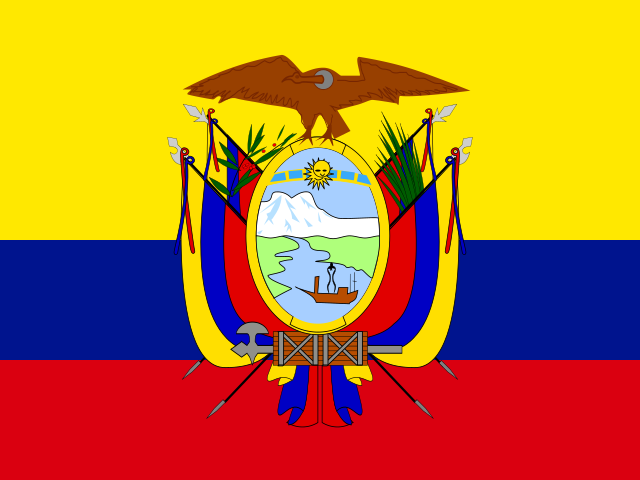 Ecuador
 Falkland Islands (Malvinas)
 French Guiana
 Guyana
 Paraguay
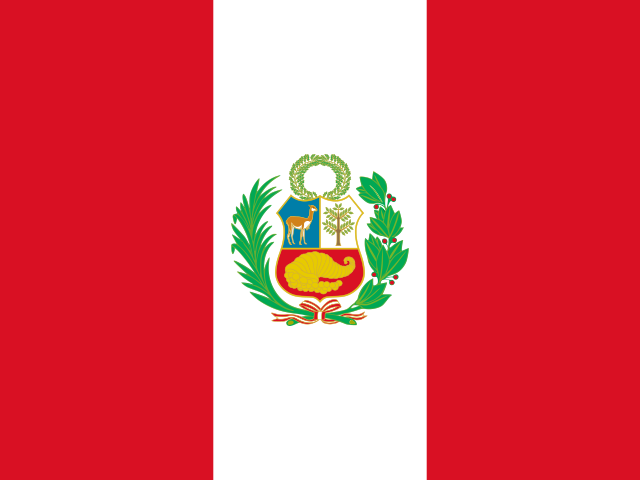 Peru
Peru Suriname
 Uruguay
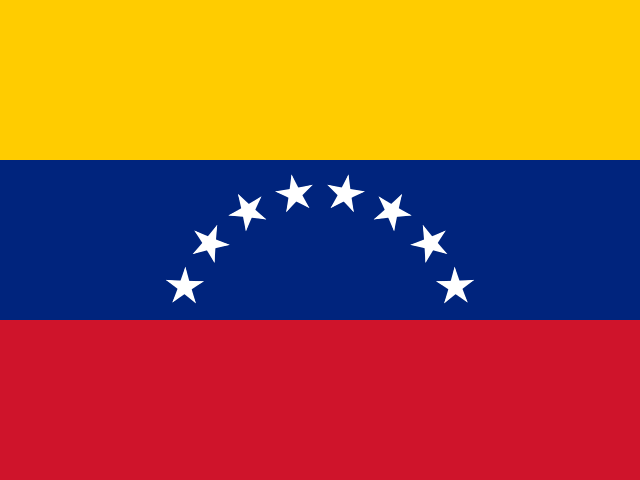 Venezuela
 Belize
 Costa Rica
 El Salvador
 Guatemala
 Honduras
 Mexico
 Nicaragua
 Panama
 Antigua and Barbuda
 the Bahamas
 Barbados
 British Virgin Islands
 Cayman Islands
 Cuba
Cuba Dominica
 Dominican Republic
 Grenada
 Guadeloupe
 Haiti
Haiti Jamaica
 Martinique
 Montserrat
 Curacao
 Aruba
Aruba Saint Maarten (Dutch part)
 Bonaire
 Puerto Rico
 Saint Kitts and Nevis
 Anguilla
 Saint Lucia
 Saint-Martin (French Part)
 Saint Vincent and the Grenadines
 Trinidad and Tobago
 Turks and Caicos Islands
 United States Virgin Islands
Earlier Report Observations
From 2018 to 2020, milk production in Latin America and the Caribbean grew from 84 thousand tons to 88 thousand tons, driven by technological innovation in the sector. This growth was constrained by declining efficiency and seasonal climatic conditions affecting pasture availability. The COVID-19 pandemic in 2020 introduced further disruptions to supply chains and demand, yet production continued to expand.
In the following years, production growth slowed, reaching 89.6 thousand tons in 2023. This occurred against a backdrop of rising production costs, leading some producers to exit, particularly in Brazil, and adverse climate events like La Niña. The market also faced competition from products incorrectly labeled as 'milk,' creating consumer confusion and affecting traditional demand.
In 2024, the Brazilian government launched a strategy to incentivize milk production and consumption among family farms, aiming to boost productivity and competitiveness. Concurrently, the expansion of distribution channels such as supermarkets and growing demand for functional dairy products supported the market, despite pressure from imports and plant-based alternatives.
Table of content
- 1. Disclaimer
- 2. Terms of use of the report
- 3. Product codes in the statistical classifications used in the report
-
4. Key Market Indicators and Trends
-
4.1. Key Market Indicators
-
4.1.1. In kind
- 4.1.1.1. Production, 2018-2023
- 4.1.1.2. Imports, 2018-2024
- 4.1.1.3. Exports, 2018-2024
- 4.1.1.4. Market size, 2018-2023
-
4.1.2. In value
- 4.1.2.1. Production, 2018-2023
- 4.1.2.2. Imports, 2018-2024
- 4.1.2.3. Exports, 2018-2024
- 4.1.2.4. Market size, 2018-2023
-
4.1.1. In kind
- 4.2. Market Trends and Factors
-
4.1. Key Market Indicators
-
5. Production
-
5.1. Production in Latin America and the Caribbean
- 5.1.1. Annual dynamics of production in Latin America and the Caribbean in kind, 2018-2023, K t
-
5.2. Global production by Country, 2018-2023
- 5.2.1. Annual dynamics of production by macroregions in kind, 2018-2023, K t
- 5.2.2. Dynamics of production structure by macroregions in kind, 2018-2023
- 5.2.3. Annual dynamics of production by country in kind, 2018-2023, K t
- 5.2.4. Structure of production by countries in kind, 2018-2023
- 5.2.5. Dynamics of peoduction structure by countries in kind, 2018-2023
-
5.1. Production in Latin America and the Caribbean
-
6. Exports
-
6.1. Exports (Direct Data*)
- 6.1.1. Exports - Total information
-
6.1.2. Exports in kind, K t
- 6.1.2.1. Annual dynamics of product's exports from Argentina in kind, 2018-2024, K t
- 6.1.2.2. Dynamics of product's exports in kind from Argentina by countries, 2018-2024, K t
- 6.1.2.3. Structure of product's exports in kind by countries, 2018-2024
-
6.1.3. Exports in value, M $ US
- 6.1.3.1. Annual dynamics of product's exports from Argentina in value, 2018-2024, M $ US
- 6.1.3.2. Dynamics of product's exports in value from Argentina by countries, 2018-2024, M $ US
- 6.1.3.3. Structure of product's exports in value by countries, 2018-2024
-
6.1.4. Average price of product's exports, $ US/t
- 6.1.4.1. Annual dynamics of average price of product's exports from Argentina, 2018-2024, $ US/t
- 6.1.4.2. Dynamics of average price of product's exports from Argentina by countries, 2018-2024, $ US/t
-
6.2. Exports (Mirror Data)
- 6.2.1. Exports - Total information
-
6.2.2. Exports in kind, K t
- 6.2.2.1. Annual dynamics of product's exports from Argentina in kind, 2018-2024, K t
- 6.2.2.2. Dynamics of product's exports in kind from Argentina by countries, 2018-2024, K t
- 6.2.2.3. Structure of product's exports in kind by countries, 2018-2024
-
6.2.3. Exports in value, M $ US
- 6.2.3.1. Annual dynamics of product's exports from Argentina in value, 2018-2024, M $ US
- 6.2.3.2. Dynamics of product's exports in value from Argentina by countries, 2018-2024, M $ US
- 6.2.3.3. Structure of product's exports in value by countries, 2018-2024
-
6.2.4. Average price of product's exports, $ US/t
- 6.2.4.1. Annual dynamics of average price of product's exports from Argentina, 2018-2024, $ US/t
- 6.2.4.2. Dynamics of average price of product's exports from Argentina by countries, 2018-2024, $ US/t
-
6.1. Exports (Direct Data*)
-
7. Imports
-
7.1. Imports (Direct Data*)
- 7.1.1. Imports - Total information
-
7.1.2. Imports in kind, K t
- 7.1.2.1. Annual dynamics of product's imports to Argentina in kind, 2018-2024, K t
- 7.1.2.2. Dynamics of product's imports in kind to Argentina by countries, 2018-2024, K t
- 7.1.2.3. Structure of product's imports in kind by countries, 2018-2024
-
7.1.3. Imports in value, M $ US
- 7.1.3.1. Annual dynamics of product's imports to Argentina in value, 2018-2024, M $ US
- 7.1.3.2. Dynamics of product's imports in value to Argentina by countries, 2018-2024, M $ US
- 7.1.3.3. Structure of product's imports in value by countries, 2018-2024
-
7.1.4. Average price of product's imports, $ US/t
- 7.1.4.1. Annual dynamics of average price of product's imports to Argentina, 2018-2024, $ US/t
- 7.1.4.2. Dynamics of average price of product's imports to Argentina by countries, 2018-2024, $ US/t
-
7.2. Imports (Mirror Data)
- 7.2.1. Imports - Total information
-
7.2.2. Imports in kind, K t
- 7.2.2.1. Annual dynamics of product's imports to Argentina in kind, 2018-2024, K t
- 7.2.2.2. Dynamics of product's imports in kind to Argentina by countries, 2018-2024, K t
- 7.2.2.3. Structure of product's imports in kind by countries, 2018-2024
-
7.2.3. Imports in value, M $ US
- 7.2.3.1. Annual dynamics of product's imports to Argentina in value, 2018-2024, M $ US
- 7.2.3.2. Dynamics of product's imports in value to Argentina by countries, 2018-2024, M $ US
- 7.2.3.3. Structure of product's imports in value by countries, 2018-2024
-
7.2.4. Average price of product's imports, $ US/t
- 7.2.4.1. Annual dynamics of average price of product's imports to Argentina, 2018-2024, $ US/t
- 7.2.4.2. Dynamics of average price of product's imports to Argentina by countries, 2018-2024, $ US/t
-
7.1. Imports (Direct Data*)
-
8. Trade balance
-
8.1. Trade balance (Direct Data)
- 8.1.1. In kind, K t
- 8.1.2. In value, M $ US
-
8.2. Trade balance (Mirror Data)
- 8.2.1. In kind, K t
- 8.2.2. In value, M $ US
-
8.1. Trade balance (Direct Data)
-
9. Top buying and selling countries, 2018-2024
-
9.1. Direct Data
- 9.1.1. Import in Value by Countries-buyers
- 9.1.2. Export in Value by Countries-suppliers
-
9.2. Mirror Data
- 9.2.1. Import in Value by Countries-buyers
- 9.2.2. Export in Value by Countries-suppliers
-
9.1. Direct Data
Production milk in Latin America and the Caribbean
In kind, 2017-2020, K t
Top producers of milk, 2017-2020
World map of production of milk, 2017-2020
Milk production in Latin America and the Caribbean has increased for the third consecutive year. In 2020, the region produced 88 040 K t of milk, marking a 3.1% year-over-year rise. From 2017 to 2020, production grew by 7%, which translates to an annualized growth rate of 2.3%.
Annual dynamics of production in Latin America and the Caribbean in kind, 2017-2020, K t
| Parameter | 2018 | 2019 | 2020 | CAGR | |
|---|---|---|---|---|---|
| 1 | Change from last year | 2.1% | 1.7% | 3.1% | 2.3% |
In value, 2017-2020, B $ US
In 2020, the value of milk output in Latin America and the Caribbean reached 291.0 B $ US, showing a robust increase of 21.0% compared to the previous year. Over the period from 2017 to 2020, production value rose by 20.3%, with a compound annual growth rate (CAGR) of 6.4%. The lowest value was recorded in 2019 at 240.5 B $ US, which saw a decline of 2.9% that year.
Annual dynamics of production in Latin America and the Caribbean in value, 2017-2020, B $ US
| Parameter | 2018 | 2019 | 2020 | CAGR | |
|---|---|---|---|---|---|
| 1 | Change from last year | 2.3% | (2.9%) | 21.0% | 6.4% |
Exports milk from Latin America and the Caribbean
Exports in kind, K t
Milk exports from Latin America and the Caribbean have declined for the second consecutive year. In 2020, exports amounted to 434.6 K t, reflecting a 2.0% decrease from the previous year. The highest export volume was in 2018 at 491.9 K t, which saw a 14.0% increase that year. In 2019, exports dropped by 9.8%, the largest decline during this period.
Annual dynamics of product's exports from Latin America and the Caribbean in kind, 2017-2020, K t
| Parameter | 2018 | 2019 | 2020 | CAGR | |
|---|---|---|---|---|---|
| 1 | Change from last year | 14.0% | (9.8%) | (2.0%) | 0.2% |
From 2017 to 2020, the country composition of milk exports in kind was dispersed. Algeria accounted for 19.5% of exports, the United States for 7.4%, and China for 2.7%, together making up just 29.7% of total flows. The remaining 70.3% was distributed among a wide range of other destinations.
Structure of product's exports in kind by countries, 2017-2020
World map of product's exports from Latin America and the Caribbean in kind, 2017-2020
Exports in value, M $ US
In 2020, milk exports from Latin America and the Caribbean were valued at 1 437 M $ US, up by 15.0% from the previous year. Over the period from 2017 to 2020, export value increased by 13.2%, with a CAGR of 4.2%. The lowest value was recorded in 2019 at 1 249 M $ US, which saw a decline of 13.8% that year. The highest value was in 2018 at 1 450 M $ US.
Annual dynamics of product's exports from Latin America and the Caribbean in value, 2017-2020, M $ US
| Parameter | 2018 | 2019 | 2020 | CAGR | |
|---|---|---|---|---|---|
| 1 | Change from last year | 14.3% | (13.8%) | 15.0% | 4.2% |
From 2017 to 2020, milk exports in value terms from Latin America and the Caribbean were not heavily concentrated. Algeria represented 25.6% of exports, the United States 6.2%, and Russia 3.4%, together capturing only 35.2% of total flows.
Structure of product's exports in value by countries, 2017-2020
World map of product's exports from Latin America and the Caribbean in value, 2017-2020
Imports milk to Latin America and the Caribbean
Imports in kind, K t
Milk imports into Latin America and the Caribbean have increased for the third consecutive year. In 2020, the region imported 925.3 K t of milk, showing a modest advance of 2.2% compared to the previous year. Over the period from 2017 to 2020, imports grew by 6.5%, with a CAGR of 2.1%.
Annual dynamics of product's imports to Latin America and the Caribbean in kind, 2017-2020, K t
| Parameter | 2018 | 2019 | 2020 | CAGR | |
|---|---|---|---|---|---|
| 1 | Change from last year | 3.5% | 0.7% | 2.2% | 2.1% |
From 2017 to 2020, the main sources for milk imports in kind were the United States, accounting for 42.1% of imports, New Zealand with 5.4%, and the Netherlands with 3.0%. Together, these three markets made up 50.5% of total import flows.
Structure of product's imports in kind by countries, 2017-2020
World map of product's imports to Latin America and the Caribbean in kind, 2017-2020
Imports in value, M $ US
In 2020, Latin America and the Caribbean imported milk worth 2 422 M $ US, representing an 11.8% gain from 2019. Over the period from 2017 to 2020, import value increased by 12.9%, with a CAGR of 4.1%. The largest decline was recorded in 2019, with a drop of 2.5%.
Annual dynamics of product's imports to Latin America and the Caribbean in value, 2017-2020, M $ US
| Parameter | 2018 | 2019 | 2020 | CAGR | |
|---|---|---|---|---|---|
| 1 | Change from last year | 3.6% | (2.5%) | 11.8% | 4.1% |
From 2017 to 2020, three principal markets—the United States, New Zealand, and the Netherlands—together accounted for 53.2% of total milk imports in value terms into Latin America and the Caribbean.
Structure of product's imports in value by countries, 2017-2020
World map of product's imports to Latin America and the Caribbean in value, 2017-2020
Related Reports

2026-03-30
2026-03-30
2026-03-30
2026-03-30




In-depth market research on this product
Global Sheep Milk Cheese Market 2021–2031: Size, Share, Trends and Forecast
Global market report: size, trends and forecast to 2031 · 186 pages
Global Skimmed Milk Powder Market 2021–2031: Size, Share, Trends and Forecast
Global market report: size, trends and forecast to 2031 · 192 pages
Global Whole Milk Powder Market 2021–2031: Size, Share, Trends and Forecast
Global market report: size, trends and forecast to 2031 · 214 pages
Global Condensed Milk Market 2021–2031: Size, Share, Trends and Forecast
Global market report: size, trends and forecast to 2031 · 224 pages
Why Choose Us?
Only Verified Data
No Hidden Costs or Separate Fees
Smarter Subscription Pricing
Contact Our Team
Submit your inquiry using the form below — our team will get back to you within 24 hours.