






"SADC" region includes following countries:
 Angola
 Botswana
 Comoros
 Democratic Republic of the Congo
 Eswatini
 Lesotho
 Madagascar
 Malawi
 Mauritius
 Mozambique
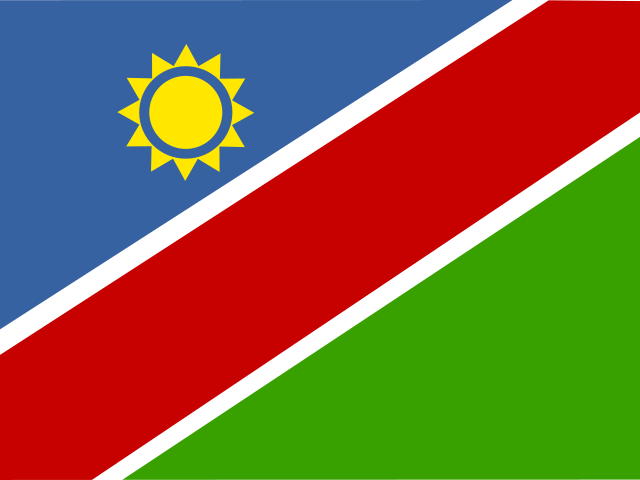 Namibia
 Seychelles
 South Africa
 Tanzania
 Zambia
 Zimbabwe
Earlier Report Observations
The market for milk and cream in SADC experienced moderate growth in 2018, supported by stable global dairy prices and steady domestic demand for traditional dairy products. However, in 2019, adverse weather conditions and rising input costs, particularly for animal feed, constrained production, leading to a slight market contraction to 10 130 thousand tons.
The COVID-19 pandemic in 2020 disrupted supply chains and consumer access, causing a sharp drop in imports. Despite this, domestic production expanded, and the overall market volume grew to 10 985 thousand tons. In the recovery phase, 2021 saw increased consumption of value-added, flavored, and organic dairy products, fueled by shifting consumer preferences towards healthier options with clean labels, pushing the market to 11 423 thousand tons.
Throughout 2022 and 2023, persistently high production costs and currency volatility posed challenges. The market responded through product diversification and innovation, including the rise of plant-based alternatives and new dairy formats catering to demand for sustainable and healthy choices. This adaptation supported continued growth, with the market volume reaching 12 276 thousand tons by 2023.
Table of content
- 1. Disclaimer
- 2. Terms of use of the report
- 3. Product codes in the statistical classifications used in the report
-
4. Key Market Indicators and Trends
-
4.1. Key Market Indicators
-
4.1.1. In kind
- 4.1.1.1. Production, 2018-2023
- 4.1.1.2. Imports, 2018-2024
- 4.1.1.3. Exports, 2018-2024
- 4.1.1.4. Market size, 2018-2023
-
4.1.1. In kind
- 4.2. Market Trends and Factors
-
4.1. Key Market Indicators
-
5. Production
-
5.1. Production in SADC
- 5.1.1. Annual dynamics of production in SADC in kind, 2018-2023, K t
-
5.2. Global production by Country, 2018-2023
- 5.2.1. Annual dynamics of production by macroregions in kind, 2018-2023, K t
- 5.2.2. Dynamics of production structure by macroregions in kind, 2018-2023
- 5.2.3. Annual dynamics of production by country in kind, 2018-2023, K t
- 5.2.4. Structure of production by countries in kind, 2018-2023
- 5.2.5. Dynamics of peoduction structure by countries in kind, 2018-2023
-
5.1. Production in SADC
-
6. Imports
-
6.1. Imports (Direct Data*)
- 6.1.1. Imports - Total information
-
6.1.2. Imports in kind, K t
- 6.1.2.1. Annual dynamics of product's imports to Angola in kind, 2018-2024, K t
- 6.1.2.2. Dynamics of product's imports in kind to Angola by countries, 2018-2024, K t
- 6.1.2.3. Structure of product's imports in kind by countries, 2018-2024
-
6.1.3. Imports in value, M $ US
- 6.1.3.1. Annual dynamics of product's imports to Angola in value, 2018-2024, M $ US
- 6.1.3.2. Dynamics of product's imports in value to Angola by countries, 2018-2024, M $ US
- 6.1.3.3. Structure of product's imports in value by countries, 2018-2024
-
6.1.4. Average price of product's imports, $ US/t
- 6.1.4.1. Annual dynamics of average price of product's imports to Angola, 2018-2024, $ US/t
- 6.1.4.2. Dynamics of average price of product's imports to Angola by countries, 2018-2024, $ US/t
-
6.2. Imports (Mirror Data)
- 6.2.1. Imports - Total information
-
6.2.2. Imports in kind, K t
- 6.2.2.1. Annual dynamics of product's imports to Angola in kind, 2018-2024, K t
- 6.2.2.2. Dynamics of product's imports in kind to Angola by countries, 2018-2024, K t
- 6.2.2.3. Structure of product's imports in kind by countries, 2018-2024
-
6.2.3. Imports in value, M $ US
- 6.2.3.1. Annual dynamics of product's imports to Angola in value, 2018-2024, M $ US
- 6.2.3.2. Dynamics of product's imports in value to Angola by countries, 2018-2024, M $ US
- 6.2.3.3. Structure of product's imports in value by countries, 2018-2024
-
6.2.4. Average price of product's imports, $ US/t
- 6.2.4.1. Annual dynamics of average price of product's imports to Angola, 2018-2024, $ US/t
- 6.2.4.2. Dynamics of average price of product's imports to Angola by countries, 2018-2024, $ US/t
-
6.1. Imports (Direct Data*)
-
7. Exports
-
7.1. Exports (Direct Data*)
- 7.1.1. Exports - Total information
-
7.1.2. Exports in kind, K t
- 7.1.2.1. Annual dynamics of product's exports from Angola in kind, 2018-2024, K t
- 7.1.2.2. Dynamics of product's exports in kind from Angola by countries, 2018-2024, K t
- 7.1.2.3. Structure of product's exports in kind by countries, 2018-2024
-
7.1.3. Exports in value, M $ US
- 7.1.3.1. Annual dynamics of product's exports from Angola in value, 2018-2024, M $ US
- 7.1.3.2. Dynamics of product's exports in value from Angola by countries, 2018-2024, M $ US
- 7.1.3.3. Structure of product's exports in value by countries, 2018-2024
-
7.1.4. Average price of product's exports, $ US/t
- 7.1.4.1. Annual dynamics of average price of product's exports from Angola, 2018-2024, $ US/t
- 7.1.4.2. Dynamics of average price of product's exports from Angola by countries, 2018-2024, $ US/t
-
7.2. Exports (Mirror Data)
- 7.2.1. Exports - Total information
-
7.2.2. Exports in kind, K t
- 7.2.2.1. Annual dynamics of product's exports from Angola in kind, 2018-2024, K t
- 7.2.2.2. Dynamics of product's exports in kind from Angola by countries, 2018-2024, K t
- 7.2.2.3. Structure of product's exports in kind by countries, 2018-2024
-
7.2.3. Exports in value, M $ US
- 7.2.3.1. Annual dynamics of product's exports from Angola in value, 2018-2024, M $ US
- 7.2.3.2. Dynamics of product's exports in value from Angola by countries, 2018-2024, M $ US
- 7.2.3.3. Structure of product's exports in value by countries, 2018-2024
-
7.2.4. Average price of product's exports, $ US/t
- 7.2.4.1. Annual dynamics of average price of product's exports from Angola, 2018-2024, $ US/t
- 7.2.4.2. Dynamics of average price of product's exports from Angola by countries, 2018-2024, $ US/t
-
7.1. Exports (Direct Data*)
-
8. Trade balance
-
8.1. Trade balance (Direct Data)
- 8.1.1. In kind, K t
- 8.1.2. In value, M $ US
-
8.2. Trade balance (Mirror Data)
- 8.2.1. In kind, K t
- 8.2.2. In value, M $ US
-
8.1. Trade balance (Direct Data)
-
9. Top buying and selling countries, 2018-2024
-
9.1. Direct Data
- 9.1.1. Import in Value by Countries-buyers
- 9.1.2. Export in Value by Countries-suppliers
-
9.2. Mirror Data
- 9.2.1. Import in Value by Countries-buyers
- 9.2.2. Export in Value by Countries-suppliers
-
9.1. Direct Data
Production milk and cream in SADC
In kind, 2017-2020, K t
Top producers of milk and cream, 2017-2020
World map of production of milk and cream, 2017-2020
In 2020, SADC produced 10 892 K t of milk and cream, marking a 9.0% increase compared to the previous year. Over the period from 2017 to 2020, production grew by 16.7%, with an average annual growth rate of 5.3%. The largest decline occurred in 2019, when production fell by 1.8%, while the most significant increase was recorded in 2018, with a 9.0% rise.
Annual dynamics of production in SADC in kind, 2017-2020, K t
| Parameter | 2018 | 2019 | 2020 | CAGR | |
|---|---|---|---|---|---|
| 1 | Change from last year | 9.0% | (1.8%) | 9.0% | 5.3% |
Exports milk and cream from SADC
Exports in kind, K t
The data shows irregular changes, indicating a volatile market environment. Milk and cream exports from SADC reached their lowest point in 2018, at 2.3 K t, and peaked in 2020, at 36.2 K t—a 16-fold difference between these years. In 2020, export volumes surged by 824.3% compared to 2019. The largest decline was recorded in 2018, with a drop of 90.7%.
Annual dynamics of product's exports from SADC in kind, 2017-2020, K t
| Parameter | 2018 | 2019 | 2020 | CAGR | |
|---|---|---|---|---|---|
| 1 | Change from last year | (90.7%) | 71.6% | 824.3% | 13.7% |
From 2017 to 2020, Special Categories were the leading buyers of milk and cream from SADC, accounting for 0.5% of total exports in kind.
Structure of product's exports in kind by countries, 2017-2020
World map of product's exports from SADC in kind, 2017-2020
Exports in value, M $ US
Foreign milk and cream supplies from SADC declined for the third consecutive year. In 2020, export value reached 52.8 M $ US, down by 1.3% from the previous year. Between 2017 and 2020, exports decreased by 5.3%, equating to an average annual decline of 1.8%.
Annual dynamics of product's exports from SADC in value, 2017-2020, M $ US
| Parameter | 2018 | 2019 | 2020 | CAGR | |
|---|---|---|---|---|---|
| 1 | Change from last year | (2.6%) | (1.4%) | (1.3%) | (1.8%) |
From 2017 to 2020, Special Categories consistently held the leading position in exports in value terms of milk and cream from SADC, representing 1.0% of total flows.
Structure of product's exports in value by countries, 2017-2020
World map of product's exports from SADC in value, 2017-2020
Imports milk and cream to SADC
Imports in kind, K t
SADC's milk and cream import volume declined for the third consecutive year. In 2020, imports amounted to 129.7 K t, a significant reduction of 10.2% compared to the previous year. Between 2017 and 2020, imports decreased by 67.7%, with an average annual decline of 31.4%.
Annual dynamics of product's imports to SADC in kind, 2017-2020, K t
| Parameter | 2018 | 2019 | 2020 | CAGR | |
|---|---|---|---|---|---|
| 1 | Change from last year | (61.5%) | (6.4%) | (10.2%) | (31.4%) |
From 2017 to 2020, imports in kind of milk and cream to SADC were not heavily concentrated. Portugal, Poland, and France together captured only 49.4% of total flows, with Portugal accounting for 36.8%, Poland for 9.6%, and France for 3.0% of imports in kind.
Structure of product's imports in kind by countries, 2017-2020
World map of product's imports to SADC in kind, 2017-2020
Imports in value, M $ US
Imported milk and cream volumes in SADC declined for the third consecutive year. In 2020, SADC imported 100.9 M $ US of milk and cream, down by 10.1% from 2019. Over the period from 2017 to 2020, imports decreased by 26.2%, with an average annual decline of 9.6%.
Annual dynamics of product's imports to SADC in value, 2017-2020, M $ US
| Parameter | 2018 | 2019 | 2020 | CAGR | |
|---|---|---|---|---|---|
| 1 | Change from last year | (8.0%) | (10.7%) | (10.1%) | (9.6%) |
Throughout 2017 to 2020, imports in value terms of milk and cream to SADC were not concentrated on a few key markets. Portugal, Poland, and France jointly accounted for only 35.9% of total flows, with Portugal representing 21.3%, Poland 9.6%, and France 5.1% of imports in value terms.
Structure of product's imports in value by countries, 2017-2020
World map of product's imports to SADC in value, 2017-2020
Related Reports

Milk and cream market in Northern Europe
2026-03-27
Milk and cream market in Chile
2026-03-27
Milk and cream market in Georgia
2026-03-27
Concentrated milk and cream market in SADC
2026-03-27



Why Choose Us?
Only Verified Data
No Hidden Costs or Separate Fees
Smarter Subscription Pricing
Contact Our Team
Submit your inquiry using the form below — our team will get back to you within 24 hours.