






"SADC" region includes following countries:
 Angola
 Botswana
 Comoros
 Democratic Republic of the Congo
 Eswatini
 Lesotho
 Madagascar
 Malawi
 Mauritius
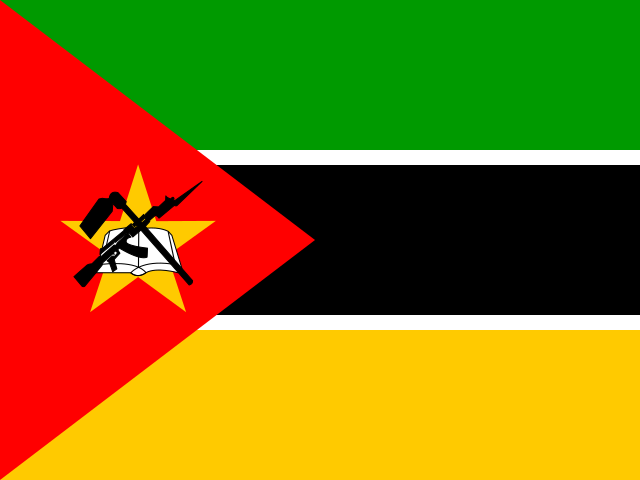 Mozambique
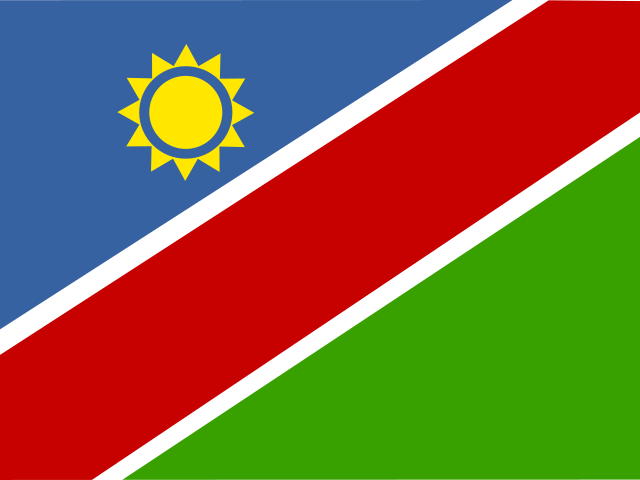 Namibia
 Seychelles
 South Africa
 Tanzania
 Zambia
 Zimbabwe
Earlier Report Observations
The market for concentrated not sweetened milk and cream in SADC grew from 47 479 t in 2018 to 59 379 t in 2021. This expansion was primarily driven by the COVID-19 pandemic, which shifted consumption to homes and increased demand for shelf-stable dairy products like concentrated milk throughout 2020 and 2021.
Following the peak in 2021, the market volume stabilized around 58 000–59 000 t, with a slight adjustment to 57 505 t in 2023. During this period, the dairy processing sector saw continued consolidation, reducing the number of producer-distributors, while new regulatory developments such as the Agricultural Products Standard Act Amendment set future standards for product composition and labeling.
Table of content
- 1. Disclaimer
- 2. Terms of use of the report
- 3. Product codes in the statistical classifications used in the report
-
4. Key Market Indicators and Trends
-
4.1. Key Market Indicators
-
4.1.1. In kind
- 4.1.1.1. Production, 2018-2023
- 4.1.1.2. Imports, 2018-2024
- 4.1.1.3. Exports, 2018-2024
- 4.1.1.4. Market size, 2018-2023
-
4.1.1. In kind
- 4.2. Market Trends and Factors
-
4.1. Key Market Indicators
-
5. Production
-
5.1. Production in SADC
- 5.1.1. Annual dynamics of production in SADC in kind, 2018-2023, t
-
5.2. Global production by Country, 2018-2023
- 5.2.1. Annual dynamics of production by macroregions in kind, 2018-2023, t
- 5.2.2. Dynamics of production structure by macroregions in kind, 2018-2023
- 5.2.3. Annual dynamics of production by country in kind, 2018-2023, t
- 5.2.4. Structure of production by countries in kind, 2018-2023
- 5.2.5. Dynamics of peoduction structure by countries in kind, 2018-2023
-
5.1. Production in SADC
-
6. Imports
-
6.1. Imports (Direct Data*)
- 6.1.1. Imports - Total information
-
6.1.2. Imports in kind, t
- 6.1.2.1. Annual dynamics of product's imports to Angola in kind, 2018-2024, t
- 6.1.2.2. Dynamics of product's imports in kind to Angola by countries, 2018-2024, t
- 6.1.2.3. Structure of product's imports in kind by countries, 2018-2024
-
6.1.3. Imports in value, K $ US
- 6.1.3.1. Annual dynamics of product's imports to Angola in value, 2018-2024, K $ US
- 6.1.3.2. Dynamics of product's imports in value to Angola by countries, 2018-2024, K $ US
- 6.1.3.3. Structure of product's imports in value by countries, 2018-2024
-
6.1.4. Average price of product's imports, $ US/t
- 6.1.4.1. Annual dynamics of average price of product's imports to Angola, 2018-2024, $ US/t
- 6.1.4.2. Dynamics of average price of product's imports to Angola by countries, 2018-2024, $ US/t
-
6.2. Imports (Mirror Data)
- 6.2.1. Imports - Total information
-
6.2.2. Imports in kind, t
- 6.2.2.1. Annual dynamics of product's imports to Angola in kind, 2018-2024, t
- 6.2.2.2. Dynamics of product's imports in kind to Angola by countries, 2018-2024, t
- 6.2.2.3. Structure of product's imports in kind by countries, 2018-2024
-
6.2.3. Imports in value, K $ US
- 6.2.3.1. Annual dynamics of product's imports to Angola in value, 2018-2024, K $ US
- 6.2.3.2. Dynamics of product's imports in value to Angola by countries, 2018-2024, K $ US
- 6.2.3.3. Structure of product's imports in value by countries, 2018-2024
-
6.2.4. Average price of product's imports, $ US/t
- 6.2.4.1. Annual dynamics of average price of product's imports to Angola, 2018-2024, $ US/t
- 6.2.4.2. Dynamics of average price of product's imports to Angola by countries, 2018-2024, $ US/t
-
6.1. Imports (Direct Data*)
-
7. Exports
-
7.1. Exports (Direct Data*)
- 7.1.1. Exports - Total information
-
7.1.2. Exports in kind, t
- 7.1.2.1. Annual dynamics of product's exports from Angola in kind, 2018-2024, t
- 7.1.2.2. Dynamics of product's exports in kind from Angola by countries, 2018-2024, t
- 7.1.2.3. Structure of product's exports in kind by countries, 2018-2024
-
7.1.3. Exports in value, K $ US
- 7.1.3.1. Annual dynamics of product's exports from Angola in value, 2018-2024, K $ US
- 7.1.3.2. Dynamics of product's exports in value from Angola by countries, 2018-2024, K $ US
- 7.1.3.3. Structure of product's exports in value by countries, 2018-2024
-
7.1.4. Average price of product's exports, $ US/t
- 7.1.4.1. Annual dynamics of average price of product's exports from Angola, 2018-2024, $ US/t
- 7.1.4.2. Dynamics of average price of product's exports from Angola by countries, 2018-2024, $ US/t
-
7.2. Exports (Mirror Data)
- 7.2.1. Exports - Total information
-
7.2.2. Exports in kind, t
- 7.2.2.1. Annual dynamics of product's exports from Angola in kind, 2018-2024, t
- 7.2.2.2. Dynamics of product's exports in kind from Angola by countries, 2018-2024, t
- 7.2.2.3. Structure of product's exports in kind by countries, 2018-2024
-
7.2.3. Exports in value, K $ US
- 7.2.3.1. Annual dynamics of product's exports from Angola in value, 2018-2024, K $ US
- 7.2.3.2. Dynamics of product's exports in value from Angola by countries, 2018-2024, K $ US
- 7.2.3.3. Structure of product's exports in value by countries, 2018-2024
-
7.2.4. Average price of product's exports, $ US/t
- 7.2.4.1. Annual dynamics of average price of product's exports from Angola, 2018-2024, $ US/t
- 7.2.4.2. Dynamics of average price of product's exports from Angola by countries, 2018-2024, $ US/t
-
7.1. Exports (Direct Data*)
-
8. Trade balance
-
8.1. Trade balance (Direct Data)
- 8.1.1. In kind, t
- 8.1.2. In value, K $ US
-
8.2. Trade balance (Mirror Data)
- 8.2.1. In kind, t
- 8.2.2. In value, K $ US
-
8.1. Trade balance (Direct Data)
-
9. Top buying and selling countries, 2018-2024
-
9.1. Direct Data
- 9.1.1. Import in Value by Countries-buyers
- 9.1.2. Export in Value by Countries-suppliers
-
9.2. Mirror Data
- 9.2.1. Import in Value by Countries-buyers
- 9.2.2. Export in Value by Countries-suppliers
-
9.1. Direct Data
Production concentrated not sweetened milk and cream in SADC
In kind, 2017-2020, t
Top producers of concentrated not sweetened milk and cream, 2017-2020
World map of production of concentrated not sweetened milk and cream, 2017-2020
SADC's production of concentrated, unsweetened milk and cream grew for the third consecutive year. In 2020, the region produced 53 109 tonnes, marking a 7.5% increase from the previous year. Between 2017 and 2020, production rose by 19.1%, which translates to an average annual growth rate of 6.0%.
Annual dynamics of production in SADC in kind, 2017-2020, t
| Parameter | 2018 | 2019 | 2020 | CAGR | |
|---|---|---|---|---|---|
| 1 | Change from last year | 10.2% | 0.5% | 7.5% | 6.0% |
Exports concentrated not sweetened milk and cream from SADC
Exports in kind, t
The export market for concentrated, unsweetened milk and cream from SADC showed significant volatility during this period. Volumes reached their lowest point in 2019 at 8 tonnes, then surged to a peak of 7 779 tonnes in 2018, representing a dramatic 1030-fold difference between these years. In 2020, exports stood at 6 452 tonnes, which was an extraordinary increase of 85,289.3% compared to 2019. The sharpest decline occurred in 2019, with a drop of 99.9%.
Annual dynamics of product's exports from SADC in kind, 2017-2020, t
| Parameter | 2018 | 2019 | 2020 | CAGR | |
|---|---|---|---|---|---|
| 1 | Change from last year | 3 600.4% | (99.9%) | 85 289.3% | 213.1% |
Structure of product's exports in kind by countries, 2017-2020
World map of product's exports from SADC in kind, 2017-2020
Exports in value, K $ US
After two years of growth, SADC's exports of concentrated, unsweetened milk and cream in value terms declined in 2020. The region exported goods worth 10 993 thousand US dollars that year, down 26.3% from 2019. Over the 2017-2020 period, exports decreased by 3.6%, with a compound annual growth rate of -1.2%. The highest value was recorded in 2019 at 14 923 thousand US dollars, while the largest annual increase occurred in 2018 at 14.6%.
Annual dynamics of product's exports from SADC in value, 2017-2020, K $ US
| Parameter | 2018 | 2019 | 2020 | CAGR | |
|---|---|---|---|---|---|
| 1 | Change from last year | 14.6% | 14.1% | (26.3%) | (1.2%) |
Structure of product's exports in value by countries, 2017-2020
World map of product's exports from SADC in value, 2017-2020
Imports concentrated not sweetened milk and cream to SADC
Imports in kind, t
Import volumes of concentrated, unsweetened milk and cream into SADC were highly volatile. The lowest volume was recorded in 2017, while imports peaked in 2020 at 10 338 tonnes, representing a 2.3-fold increase from the trough. This 2020 figure marked a sharp year-over-year rise of 105.4%. The most significant decline happened in 2019, with a drop of 17.6%.
Annual dynamics of product's imports to SADC in kind, 2017-2020, t
| Parameter | 2018 | 2019 | 2020 | CAGR | |
|---|---|---|---|---|---|
| 1 | Change from last year | 36.9% | (17.6%) | 105.4% | 32.4% |
Between 2017 and 2020, SADC's imports of concentrated, unsweetened milk and cream came from a diverse range of sources. The top three suppliers—Ireland (21.7% of import volume), Brazil (12.1%), and the United Arab Emirates (6.1%)—collectively accounted for 40.0% of total imports, while the remaining 60.0% was distributed among numerous other countries.
Structure of product's imports in kind by countries, 2017-2020
World map of product's imports to SADC in kind, 2017-2020
Imports in value, K $ US
The value of SADC's imports of concentrated, unsweetened milk and cream exhibited considerable volatility. Imports hit their lowest point in 2019 at 8 678 thousand US dollars, then climbed to a peak of 25 114 thousand US dollars in 2020, creating a 2.9-fold difference between these years. This 2020 value represented a dramatic 189.4% increase from the previous year. The steepest decline also occurred in 2019, falling by 30.6%.
Annual dynamics of product's imports to SADC in value, 2017-2020, K $ US
| Parameter | 2018 | 2019 | 2020 | CAGR | |
|---|---|---|---|---|---|
| 1 | Change from last year | 42.6% | (30.6%) | 189.4% | 42.0% |
From 2017 to 2020, Ireland (23.0% of import value), France (9.7%), and Brazil (9.1%) were the leading suppliers of concentrated, unsweetened milk and cream to SADC in monetary terms. Together, they represented 41.8% of total import value, with the remaining share spread across a wide array of smaller trading partners.
Structure of product's imports in value by countries, 2017-2020
World map of product's imports to SADC in value, 2017-2020
Related Reports





Why Choose Us?
Only Verified Data
No Hidden Costs or Separate Fees
Smarter Subscription Pricing
Contact Our Team
Submit your inquiry using the form below — our team will get back to you within 24 hours.