






"SADC" region includes following countries:
 Angola
 Botswana
 Comoros
 Democratic Republic of the Congo
 Eswatini
 Lesotho
 Madagascar
 Malawi
 Mauritius
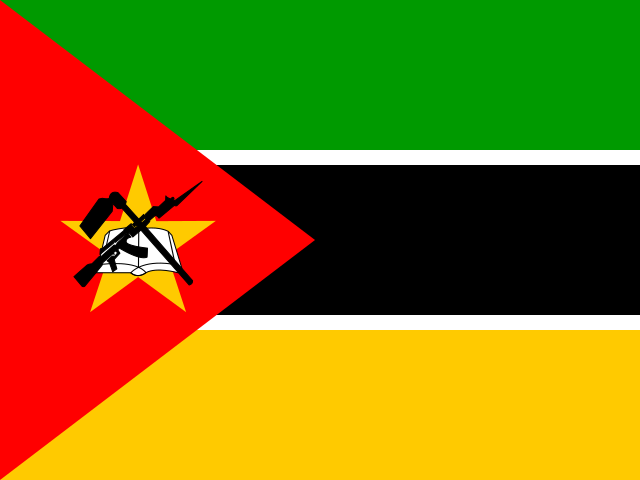 Mozambique
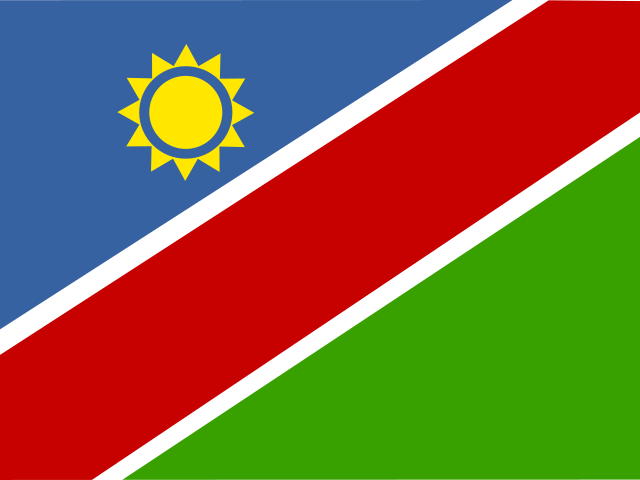 Namibia
 Seychelles
 South Africa
 Tanzania
 Zambia
 Zimbabwe
Earlier Report Observations
The market volume for concentrated or sweetened milk and cream in SADC declined from 266.6 тыс. т in 2018 to 226.0 тыс. т in 2021. This contraction was primarily driven by rising international dairy product prices in 2019, which increased import costs and affected local price levels. Climate challenges and structural changes in major global dairy-producing countries further constrained supply, creating market uncertainty among South African producers. A concurrent increase in consumer demand for fresh milk and products like soft cheeses and flavoured milk also diverted consumption away from concentrated dairy items.
Market volume recovered to 238.0 тыс. т in 2022, a 5.3% increase from the previous year, supported by balanced growth in milk supply and demand within South Africa. However, in 2023, volume fell again to 228.4 тыс. т as consumer preferences shifted notably towards plant-based alternative dairy products, reducing demand for traditional concentrated milk and cream.
Table of content
- 1. Disclaimer
- 2. Terms of use of the report
- 3. Product codes in the statistical classifications used in the report
-
4. Key Market Indicators and Trends
-
4.1. Key Market Indicators
-
4.1.1. In kind
- 4.1.1.1. Production, 2018-2023
- 4.1.1.2. Imports, 2018-2024
- 4.1.1.3. Exports, 2018-2024
- 4.1.1.4. Market size, 2018-2023
-
4.1.1. In kind
- 4.2. Market Trends and Factors
-
4.1. Key Market Indicators
-
5. Production
-
5.1. Production in SADC
- 5.1.1. Annual dynamics of production in SADC in kind, 2018-2023, K t
-
5.2. Global production by Country, 2018-2023
- 5.2.1. Annual dynamics of production by macroregions in kind, 2018-2023, K t
- 5.2.2. Dynamics of production structure by macroregions in kind, 2018-2023
- 5.2.3. Annual dynamics of production by country in kind, 2018-2023, K t
- 5.2.4. Structure of production by countries in kind, 2018-2023
- 5.2.5. Dynamics of peoduction structure by countries in kind, 2018-2023
-
5.1. Production in SADC
-
6. Imports
-
6.1. Imports (Direct Data*)
- 6.1.1. Imports - Total information
-
6.1.2. Imports in kind, K t
- 6.1.2.1. Annual dynamics of product's imports to Angola in kind, 2018-2024, K t
- 6.1.2.2. Dynamics of product's imports in kind to Angola by countries, 2018-2024, K t
- 6.1.2.3. Structure of product's imports in kind by countries, 2018-2024
-
6.1.3. Imports in value, M $ US
- 6.1.3.1. Annual dynamics of product's imports to Angola in value, 2018-2024, M $ US
- 6.1.3.2. Dynamics of product's imports in value to Angola by countries, 2018-2024, M $ US
- 6.1.3.3. Structure of product's imports in value by countries, 2018-2024
-
6.1.4. Average price of product's imports, $ US/t
- 6.1.4.1. Annual dynamics of average price of product's imports to Angola, 2018-2024, $ US/t
- 6.1.4.2. Dynamics of average price of product's imports to Angola by countries, 2018-2024, $ US/t
-
6.2. Imports (Mirror Data)
- 6.2.1. Imports - Total information
-
6.2.2. Imports in kind, K t
- 6.2.2.1. Annual dynamics of product's imports to Angola in kind, 2018-2024, K t
- 6.2.2.2. Dynamics of product's imports in kind to Angola by countries, 2018-2024, K t
- 6.2.2.3. Structure of product's imports in kind by countries, 2018-2024
-
6.2.3. Imports in value, M $ US
- 6.2.3.1. Annual dynamics of product's imports to Angola in value, 2018-2024, M $ US
- 6.2.3.2. Dynamics of product's imports in value to Angola by countries, 2018-2024, M $ US
- 6.2.3.3. Structure of product's imports in value by countries, 2018-2024
-
6.2.4. Average price of product's imports, $ US/t
- 6.2.4.1. Annual dynamics of average price of product's imports to Angola, 2018-2024, $ US/t
- 6.2.4.2. Dynamics of average price of product's imports to Angola by countries, 2018-2024, $ US/t
-
6.1. Imports (Direct Data*)
-
7. Exports
-
7.1. Exports (Direct Data*)
- 7.1.1. Exports - Total information
-
7.1.2. Exports in kind, K t
- 7.1.2.1. Annual dynamics of product's exports from Angola in kind, 2018-2024, K t
- 7.1.2.2. Dynamics of product's exports in kind from Angola by countries, 2018-2024, K t
- 7.1.2.3. Structure of product's exports in kind by countries, 2018-2024
-
7.1.3. Exports in value, M $ US
- 7.1.3.1. Annual dynamics of product's exports from Angola in value, 2018-2024, M $ US
- 7.1.3.2. Dynamics of product's exports in value from Angola by countries, 2018-2024, M $ US
- 7.1.3.3. Structure of product's exports in value by countries, 2018-2024
-
7.1.4. Average price of product's exports, $ US/t
- 7.1.4.1. Annual dynamics of average price of product's exports from Angola, 2018-2024, $ US/t
- 7.1.4.2. Dynamics of average price of product's exports from Angola by countries, 2018-2024, $ US/t
-
7.2. Exports (Mirror Data)
- 7.2.1. Exports - Total information
-
7.2.2. Exports in kind, K t
- 7.2.2.1. Annual dynamics of product's exports from Angola in kind, 2018-2024, K t
- 7.2.2.2. Dynamics of product's exports in kind from Angola by countries, 2018-2024, K t
- 7.2.2.3. Structure of product's exports in kind by countries, 2018-2024
-
7.2.3. Exports in value, M $ US
- 7.2.3.1. Annual dynamics of product's exports from Angola in value, 2018-2024, M $ US
- 7.2.3.2. Dynamics of product's exports in value from Angola by countries, 2018-2024, M $ US
- 7.2.3.3. Structure of product's exports in value by countries, 2018-2024
-
7.2.4. Average price of product's exports, $ US/t
- 7.2.4.1. Annual dynamics of average price of product's exports from Angola, 2018-2024, $ US/t
- 7.2.4.2. Dynamics of average price of product's exports from Angola by countries, 2018-2024, $ US/t
-
7.1. Exports (Direct Data*)
-
8. Trade balance
-
8.1. Trade balance (Direct Data)
- 8.1.1. In kind, K t
- 8.1.2. In value, M $ US
-
8.2. Trade balance (Mirror Data)
- 8.2.1. In kind, K t
- 8.2.2. In value, M $ US
-
8.1. Trade balance (Direct Data)
-
9. Top buying and selling countries, 2018-2024
-
9.1. Direct Data
- 9.1.1. Import in Value by Countries-buyers
- 9.1.2. Export in Value by Countries-suppliers
-
9.2. Mirror Data
- 9.2.1. Import in Value by Countries-buyers
- 9.2.2. Export in Value by Countries-suppliers
-
9.1. Direct Data
Production concentrated or sweetened milk and cream in SADC
In kind, 2017-2020, K t
Top producers of concentrated or sweetened milk and cream, 2017-2020
World map of production of concentrated or sweetened milk and cream, 2017-2020
In 2020, SADC produced 140.8 thousand tons of concentrated or sweetened milk and cream, marking a moderate year-over-year increase of 6.4%. Over the 2017-2020 period, production grew by 14.2%, with a compound annual growth rate of 4.5%. The highest production level was recorded in 2018 at 163.2 thousand tons, which represented a significant increase of 32.3% from the previous year. However, in 2019, production experienced its largest decline, dropping by 18.9%.
Annual dynamics of production in SADC in kind, 2017-2020, K t
| Parameter | 2018 | 2019 | 2020 | CAGR | |
|---|---|---|---|---|---|
| 1 | Change from last year | 32.3% | (18.9%) | 6.4% | 4.5% |
Exports concentrated or sweetened milk and cream from SADC
Exports in kind, K t
Export volumes of concentrated or sweetened milk and cream from SADC showed notable fluctuations during the period. The lowest point was in 2018 at 10.8 thousand tons, which saw the largest decline of 48.9%. Exports then rebounded, reaching their peak in 2020 at 22.4 thousand tons, a 70.1% increase from the previous year. Overall, exports in 2020 were 2.1 times higher than in 2018.
Annual dynamics of product's exports from SADC in kind, 2017-2020, K t
| Parameter | 2018 | 2019 | 2020 | CAGR | |
|---|---|---|---|---|---|
| 1 | Change from last year | (48.9%) | 22.4% | 70.1% | 2.1% |
Structure of product's exports in kind by countries, 2017-2020
World map of product's exports from SADC in kind, 2017-2020
Exports in value, M $ US
SADC's exports of concentrated or sweetened milk and cream in value terms declined for the third consecutive year. In 2020, exports amounted to 60.5 million US dollars, representing a limited reduction of 8.1% compared to 2019. Over the 2017-2020 period, exports decreased by 24.5%, with a compound annual growth rate of -8.9%.
Annual dynamics of product's exports from SADC in value, 2017-2020, M $ US
| Parameter | 2018 | 2019 | 2020 | CAGR | |
|---|---|---|---|---|---|
| 1 | Change from last year | (11.8%) | (6.8%) | (8.1%) | (8.9%) |
The export market in value terms from 2017 to 2020 was characterized by a wide base. Cameroon accounted for 1.4% of exports, Ghana for 0.8%, and Hong Kong for 0.8%, with these three countries together making up just 2.9% of total flows. The remaining 97.1% was distributed among numerous other countries.
Structure of product's exports in value by countries, 2017-2020
World map of product's exports from SADC in value, 2017-2020
Imports concentrated or sweetened milk and cream to SADC
Imports in kind, K t
After increasing for two years, SADC's imports of concentrated or sweetened milk and cream in volume terms declined. The highest import level was recorded in 2019 at 118.6 thousand tons, following the largest increase of 28.6% in 2018. In 2020, imports fell to 110.0 thousand tons, down 7.2% from the previous year. Over the 2017-2020 period, imports grew by 23.9%, with a compound annual growth rate of 7.4%.
Annual dynamics of product's imports to SADC in kind, 2017-2020, K t
| Parameter | 2018 | 2019 | 2020 | CAGR | |
|---|---|---|---|---|---|
| 1 | Change from last year | 28.6% | 3.8% | (7.2%) | 7.4% |
From 2017 to 2020, the country breakdown of imports in volume terms was scattered. Malaysia accounted for 19.1% of imports, New Zealand for 15.9%, and France for 8.4%, with these three partners together making up 43.4% of total flows. No single country stood out as clearly dominant, with the remainder distributed among various other partners.
Structure of product's imports in kind by countries, 2017-2020
World map of product's imports to SADC in kind, 2017-2020
Imports in value, M $ US
Following a two-year increase, SADC's imports of concentrated or sweetened milk and cream in value terms declined. The peak was in 2019 at 361.3 million US dollars, after the largest increase of 44.9% in 2018. In 2020, imports dropped to 304.1 million US dollars, reflecting a strong decline of 15.9% compared to 2019. Over the 2017-2020 period, imports increased by 22.2%, with a compound annual growth rate of 6.9%.
Annual dynamics of product's imports to SADC in value, 2017-2020, M $ US
| Parameter | 2018 | 2019 | 2020 | CAGR | |
|---|---|---|---|---|---|
| 1 | Change from last year | 44.9% | 0.2% | (15.9%) | 6.9% |
From 2017 to 2020, the country structure of imports in value terms remained highly diversified. New Zealand accounted for 19.5% of imports, Malaysia for 13.2%, and the Netherlands for 9.2%, with these three countries together making up only 41.9% of total flows. The remaining 58.1% was formed by a long tail of smaller markets.
Structure of product's imports in value by countries, 2017-2020
World map of product's imports to SADC in value, 2017-2020
Related Reports


2026-03-27


2026-03-30

Why Choose Us?
Only Verified Data
No Hidden Costs or Separate Fees
Smarter Subscription Pricing
Contact Our Team
Submit your inquiry using the form below — our team will get back to you within 24 hours.