






"MERCOSUR" region includes following countries:
 Brazil
 Argentina
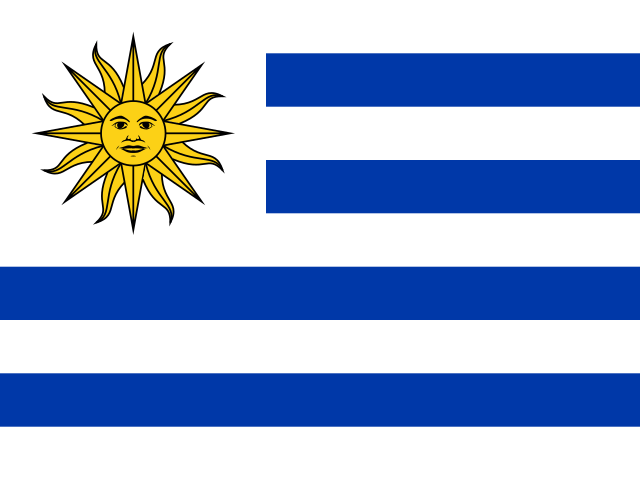 Uruguay
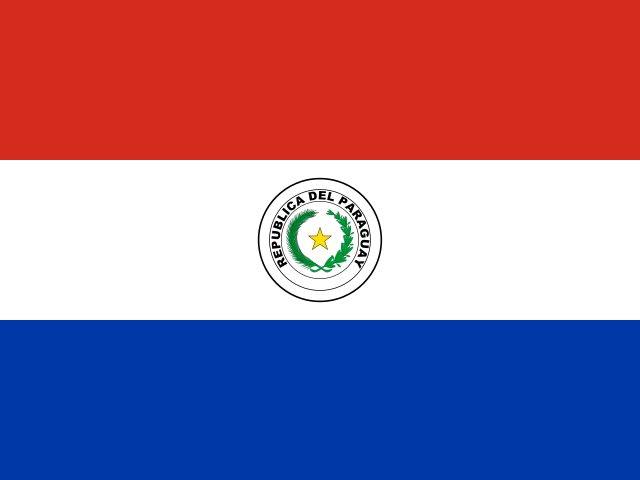 Paraguay
Earlier Report Observations
The concentrated milk and cream market in MERCOSUR experienced a general upward trend in volume from 2018 to 2023, expanding from 65 thousand tons to 81 thousand tons despite a contraction in 2020. In value terms, the market more than doubled, climbing from 124 million US dollars to 224 million US dollars, reflecting stronger price levels in later years.
Growth in 2023 was facilitated by rising productivity on remaining dairy farms as the number of producers continued to fall, boosting domestic supply. Furthermore, the expansion of supermarket and hypermarket networks across the region, along with a broader range of value-added dairy items, contributed to higher consumption of concentrated milk and cream.
Table of content
- 1. Disclaimer
- 2. Terms of use of the report
- 3. Product codes in the statistical classifications used in the report
-
4. Key Market Indicators and Trends
-
4.1. Key Market Indicators
-
4.1.1. In kind
- 4.1.1.1. Production, 2018-2023
- 4.1.1.2. Imports, 2018-2024
- 4.1.1.3. Exports, 2018-2024
- 4.1.1.4. Market size, 2018-2023
-
4.1.2. In value
- 4.1.2.1. Production, 2018-2023
- 4.1.2.2. Imports, 2018-2024
- 4.1.2.3. Exports, 2018-2024
- 4.1.2.4. Market size, 2018-2023
-
4.1.1. In kind
- 4.2. Market Trends and Factors
-
4.1. Key Market Indicators
-
5. Production
-
5.1. Production in MERCOSUR
- 5.1.1. Annual dynamics of production in MERCOSUR in kind, 2018-2023, t
-
5.2. Global production by Country, 2018-2023
- 5.2.1. Annual dynamics of production by macroregions in kind, 2018-2023, t
- 5.2.2. Dynamics of production structure by macroregions in kind, 2018-2023
- 5.2.3. Annual dynamics of production by country in kind, 2018-2023, t
- 5.2.4. Structure of production by countries in kind, 2018-2023
- 5.2.5. Dynamics of peoduction structure by countries in kind, 2018-2023
-
5.1. Production in MERCOSUR
-
6. Imports
-
6.1. Imports (Direct Data)
- 6.1.1. Imports - Total information
-
6.1.2. Imports in kind, t
- 6.1.2.1. Annual dynamics of product's imports to Brazil in kind, 2018-2024, t
- 6.1.2.2. Dynamics of product's imports in kind to Brazil by countries, 2018-2024, t
- 6.1.2.3. Structure of product's imports in kind by countries, 2018-2024
-
6.1.3. Imports in value, K $ US
- 6.1.3.1. Annual dynamics of product's imports to Brazil in value, 2018-2024, K $ US
- 6.1.3.2. Dynamics of product's imports in value to Brazil by countries, 2018-2024, K $ US
- 6.1.3.3. Structure of product's imports in value by countries, 2018-2024
-
6.1.4. Average price of product's imports, $ US/kg
- 6.1.4.1. Annual dynamics of average price of product's imports to Brazil, 2018-2024, $ US/kg
- 6.1.4.2. Dynamics of average price of product's imports to Brazil by countries, 2018-2024, $ US/kg
-
6.2. Imports (Mirror Data)
- 6.2.1. Imports - Total information
-
6.2.2. Imports in kind, t
- 6.2.2.1. Annual dynamics of product's imports to Brazil in kind, 2018-2024, t
- 6.2.2.2. Dynamics of product's imports in kind to Brazil by countries, 2018-2024, t
- 6.2.2.3. Structure of product's imports in kind by countries, 2018-2024
-
6.2.3. Imports in value, K $ US
- 6.2.3.1. Annual dynamics of product's imports to Brazil in value, 2018-2024, K $ US
- 6.2.3.2. Dynamics of product's imports in value to Brazil by countries, 2018-2024, K $ US
- 6.2.3.3. Structure of product's imports in value by countries, 2018-2024
-
6.2.4. Average price of product's imports, $ US/kg
- 6.2.4.1. Annual dynamics of average price of product's imports to Brazil, 2018-2024, $ US/kg
- 6.2.4.2. Dynamics of average price of product's imports to Brazil by countries, 2018-2024, $ US/kg
-
6.1. Imports (Direct Data)
-
7. Exports
-
7.1. Exports (Direct Data)
- 7.1.1. Exports - Total information
-
7.1.2. Exports in kind, t
- 7.1.2.1. Annual dynamics of product's exports from Brazil in kind, 2018-2024, t
- 7.1.2.2. Dynamics of product's exports in kind from Brazil by countries, 2018-2024, t
- 7.1.2.3. Structure of product's exports in kind by countries, 2018-2024
-
7.1.3. Exports in value, K $ US
- 7.1.3.1. Annual dynamics of product's exports from Brazil in value, 2018-2024, K $ US
- 7.1.3.2. Dynamics of product's exports in value from Brazil by countries, 2018-2024, K $ US
- 7.1.3.3. Structure of product's exports in value by countries, 2018-2024
-
7.1.4. Average price of product's exports, $ US/kg
- 7.1.4.1. Annual dynamics of average price of product's exports from Brazil, 2018-2024, $ US/kg
- 7.1.4.2. Dynamics of average price of product's exports from Brazil by countries, 2018-2024, $ US/kg
-
7.2. Exports (Mirror Data)
- 7.2.1. Exports - Total information
-
7.2.2. Exports in kind, t
- 7.2.2.1. Annual dynamics of product's exports from Brazil in kind, 2018-2024, t
- 7.2.2.2. Dynamics of product's exports in kind from Brazil by countries, 2018-2024, t
- 7.2.2.3. Structure of product's exports in kind by countries, 2018-2024
-
7.2.3. Exports in value, K $ US
- 7.2.3.1. Annual dynamics of product's exports from Brazil in value, 2018-2024, K $ US
- 7.2.3.2. Dynamics of product's exports in value from Brazil by countries, 2018-2024, K $ US
- 7.2.3.3. Structure of product's exports in value by countries, 2018-2024
-
7.2.4. Average price of product's exports, $ US/kg
- 7.2.4.1. Annual dynamics of average price of product's exports from Brazil, 2018-2024, $ US/kg
- 7.2.4.2. Dynamics of average price of product's exports from Brazil by countries, 2018-2024, $ US/kg
-
7.1. Exports (Direct Data)
-
8. Trade balance
-
8.1. Trade balance (Direct Data)
- 8.1.1. In kind, t
- 8.1.2. In value, K $ US
-
8.2. Trade balance (Mirror Data)
- 8.2.1. In kind, t
- 8.2.2. In value, K $ US
-
8.1. Trade balance (Direct Data)
-
9. Top buying and selling countries, 2018-2024
-
9.1. Direct Data
- 9.1.1. Import in Value by Countries-buyers
- 9.1.2. Export in Value by Countries-suppliers
-
9.2. Mirror Data
- 9.2.1. Import in Value by Countries-buyers
- 9.2.2. Export in Value by Countries-suppliers
-
9.1. Direct Data
Production concentrated milk and cream in MERCOSUR
In kind, 2017-2020, t
Top producers of concentrated milk and cream, 2017-2020
World map of production of concentrated milk and cream, 2017-2020
MERCOSUR's production of concentrated milk and cream increased for the third consecutive year. In 2020, the region produced 73 882 tonnes, showing only a slight fluctuation compared to the previous year.
Annual dynamics of production in MERCOSUR in kind, 2017-2020, t
| Parameter | 2018 | 2019 | 2020 | CAGR | |
|---|---|---|---|---|---|
| 1 | Change from last year | 0.2% | 1.4% | 0.3% | 0.7% |
In value, 2017-2020, M $ US
In 2020, the output of concentrated milk and cream in MERCOSUR was valued at 125.1 million US dollars, marking a significant decline of 19.4% from the previous year. Over the period from 2017 to 2020, production decreased by 20.2%, with a compound annual growth rate of 7.2%. The largest increase occurred in 2019, at 12.9%.
Annual dynamics of production in MERCOSUR in value, 2017-2020, M $ US
| Parameter | 2018 | 2019 | 2020 | CAGR | |
|---|---|---|---|---|---|
| 1 | Change from last year | (12.3%) | 12.9% | (19.4%) | (7.2%) |
Exports concentrated milk and cream from MERCOSUR
Exports in kind, t
After two years of decline, MERCOSUR's exports of concentrated milk and cream increased. In 2020, exports reached 10 856 tonnes, up by 38.6% compared to 2019. Over the 2017-2020 period, exports decreased by 41.2%, with a compound annual growth rate of 16.2%. The lowest value was recorded in 2019 at 7 834 tonnes, while the largest decline occurred in 2018, at 48.9%.
Annual dynamics of product's exports from MERCOSUR in kind, 2017-2020, t
| Parameter | 2018 | 2019 | 2020 | CAGR | |
|---|---|---|---|---|---|
| 1 | Change from last year | (48.9%) | (17.1%) | 38.6% | (16.2%) |
From 2017 to 2020, MERCOSUR's exports of concentrated milk and cream in kind were widely dispersed across partner countries. Trinidad and Tobago accounted for 16.6% of exports, Angola for 11.8%, and Chile for 11.2%, with these three countries together representing only 39.6% of total flows.
Structure of product's exports in kind by countries, 2017-2020
World map of product's exports from MERCOSUR in kind, 2017-2020
Exports in value, K $ US
Following a two-year drop, MERCOSUR's exports of concentrated milk and cream in value terms increased. In 2020, exports registered 18.382 million US dollars, showing a solid rise of 11.3% compared to the previous year. Over the 2017-2020 period, exports decreased by 54%, with a compound annual growth rate of 22.8%. The minimum value was in 2019 at 16.510 million US dollars, and the largest decline was in 2018, at 55.3%.
Annual dynamics of product's exports from MERCOSUR in value, 2017-2020, K $ US
| Parameter | 2018 | 2019 | 2020 | CAGR | |
|---|---|---|---|---|---|
| 1 | Change from last year | (55.3%) | (7.7%) | 11.3% | (22.8%) |
Between 2017 and 2020, MERCOSUR's exports of concentrated milk and cream in value terms were characterised by a broad spread across markets. Trinidad and Tobago accounted for 17.9% of exports, Angola for 11.9%, and the United States for 10.8%, with these three countries together making up only 40.6% of total flows.
Structure of product's exports in value by countries, 2017-2020
World map of product's exports from MERCOSUR in value, 2017-2020
Imports concentrated milk and cream to MERCOSUR
Imports in kind, t
After two years of decline, MERCOSUR's imports of concentrated milk and cream in kind increased. In 2020, imports amounted to 1 867 tonnes, marking a rise of 13.4% compared to 2019. Over the 2017-2020 period, imports decreased by 51.7%, with a compound annual growth rate of 21.6%. The lowest value was recorded in 2019 at 1 646 tonnes, while the largest decline occurred in 2018, at 40.6%.
Annual dynamics of product's imports to MERCOSUR in kind, 2017-2020, t
| Parameter | 2018 | 2019 | 2020 | CAGR | |
|---|---|---|---|---|---|
| 1 | Change from last year | (40.6%) | (28.4%) | 13.4% | (21.6%) |
From 2017 to 2020, Chile and Malaysia were the top markets for MERCOSUR's imports of concentrated milk and cream in kind, together accounting for 43.6% of total flows.
Structure of product's imports in kind by countries, 2017-2020
World map of product's imports to MERCOSUR in kind, 2017-2020
Imports in value, K $ US
Following a two-year decline, MERCOSUR's imports of concentrated milk and cream in value terms increased. In 2020, imports totalled 3.628 million US dollars, showing a rise of 12.3% compared to the previous year. Over the 2017-2020 period, imports decreased by 43.9%, with a compound annual growth rate of 17.5%. The minimum value was in 2019 at 3.231 million US dollars, and the largest decline was in 2018, at 29.8%.
Annual dynamics of product's imports to MERCOSUR in value, 2017-2020, K $ US
| Parameter | 2018 | 2019 | 2020 | CAGR | |
|---|---|---|---|---|---|
| 1 | Change from last year | (29.8%) | (28.8%) | 12.3% | (17.5%) |
In the period from 2017 to 2020, Chile and Malaysia remained the key destinations for MERCOSUR's imports of concentrated milk and cream in value terms, with a combined share of 39.3% of total flows.
Structure of product's imports in value by countries, 2017-2020
World map of product's imports to MERCOSUR in value, 2017-2020
Related Reports

Concentrated milk and cream market in Spain
2026-03-27

Milk and cream market in MERCOSUR
2026-03-27

2026-03-30

Milk powder market in MERCOSUR
2026-03-30

Why Choose Us?
Only Verified Data
No Hidden Costs or Separate Fees
Smarter Subscription Pricing
Contact Our Team
Submit your inquiry using the form below — our team will get back to you within 24 hours.