






"Northern Africa" region includes following countries:
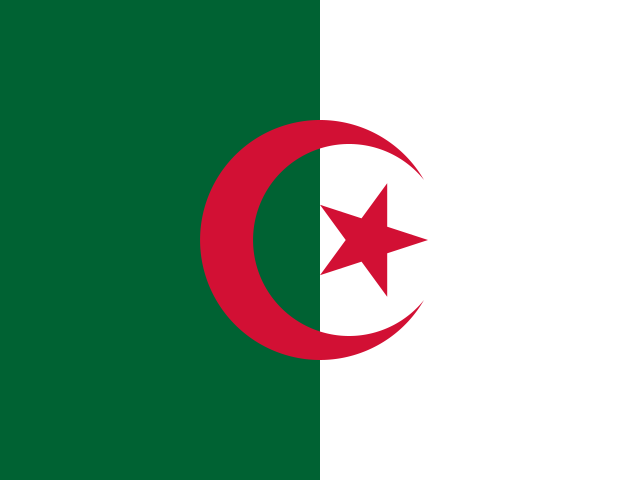 Algeria
 Libya
Libya Morocco
 Sudan
Sudan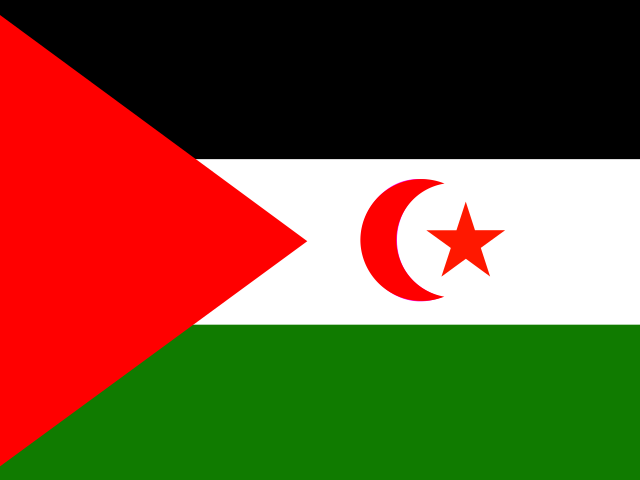 Western Sahara
 Tunisia
 Egypt
EgyptEarlier Report Observations
In 2018, the melon and papaya market in Northern Africa reached 6 320 thousand tonnes, a level supported by Morocco's strategic shift toward diversifying its agricultural exports. By expanding into melons and avocados, Moroccan producers increased output, contributing to the region's overall supply.
The market volume then contracted over the next two years, falling to 5 629 thousand tonnes in 2019 and 5 429 thousand tonnes in 2020. A partial recovery followed in 2021 and 2022, with volumes rising to 5 700 thousand tonnes and 5 866 thousand tonnes respectively, before another drop to 5 392 thousand tonnes in 2023. These movements occurred amid broader reports of variable weather patterns affecting melon production in Mediterranean regions.
During 2024, a continent-wide project aimed at improving market access for papaya and other tropical fruits was launched, while European demand for exotic African produce continued to grow, highlighting ongoing external interest in the region's fruit sector.
Table of content
- 1. Disclaimer
- 2. Terms of use of the report
- 3. Product codes in the statistical classifications used in the report
-
4. Key Market Indicators and Trends
-
4.1. Key Market Indicators
-
4.1.1. In kind
- 4.1.1.1. Production, 2018-2023
- 4.1.1.2. Imports, 2018-2024
- 4.1.1.3. Exports, 2018-2024
- 4.1.1.4. Market size, 2018-2023
-
4.1.2. In value
- 4.1.2.1. Production, 2018-2023
- 4.1.2.2. Imports, 2018-2024
- 4.1.2.3. Exports, 2018-2024
- 4.1.2.4. Market size, 2018-2023
-
4.1.1. In kind
- 4.2. Market Trends and Factors
-
4.1. Key Market Indicators
-
5. Production
-
5.1. Production in Northern Africa
- 5.1.1. Annual dynamics of production in Northern Africa in kind, 2018-2023, K t
-
5.2. Global production by Country, 2018-2023
- 5.2.1. Annual dynamics of production by macroregions in kind, 2018-2023, K t
- 5.2.2. Dynamics of production structure by macroregions in kind, 2018-2023
- 5.2.3. Annual dynamics of production by country in kind, 2018-2023, K t
- 5.2.4. Structure of production by countries in kind, 2018-2023
- 5.2.5. Dynamics of peoduction structure by countries in kind, 2018-2023
-
5.1. Production in Northern Africa
-
6. Exports
-
6.1. Exports (Direct Data*)
- 6.1.1. Exports - Total information
-
6.1.2. Exports in kind, K t
- 6.1.2.1. Annual dynamics of product's exports from Algeria in kind, 2018-2024, K t
- 6.1.2.2. Dynamics of product's exports in kind from Algeria by countries, 2018-2024, K t
- 6.1.2.3. Structure of product's exports in kind by countries, 2018-2024
-
6.1.3. Exports in value, M $ US
- 6.1.3.1. Annual dynamics of product's exports from Algeria in value, 2018-2024, M $ US
- 6.1.3.2. Dynamics of product's exports in value from Algeria by countries, 2018-2024, M $ US
- 6.1.3.3. Structure of product's exports in value by countries, 2018-2024
-
6.1.4. Average price of product's exports, $ US/t
- 6.1.4.1. Annual dynamics of average price of product's exports from Algeria, 2018-2024, $ US/t
- 6.1.4.2. Dynamics of average price of product's exports from Algeria by countries, 2018-2024, $ US/t
-
6.2. Exports (Mirror Data)
- 6.2.1. Exports - Total information
-
6.2.2. Exports in kind, K t
- 6.2.2.1. Annual dynamics of product's exports from Algeria in kind, 2018-2024, K t
- 6.2.2.2. Dynamics of product's exports in kind from Algeria by countries, 2018-2024, K t
- 6.2.2.3. Structure of product's exports in kind by countries, 2018-2024
-
6.2.3. Exports in value, M $ US
- 6.2.3.1. Annual dynamics of product's exports from Algeria in value, 2018-2024, M $ US
- 6.2.3.2. Dynamics of product's exports in value from Algeria by countries, 2018-2024, M $ US
- 6.2.3.3. Structure of product's exports in value by countries, 2018-2024
-
6.2.4. Average price of product's exports, $ US/t
- 6.2.4.1. Annual dynamics of average price of product's exports from Algeria, 2018-2024, $ US/t
- 6.2.4.2. Dynamics of average price of product's exports from Algeria by countries, 2018-2024, $ US/t
-
6.1. Exports (Direct Data*)
-
7. Imports
-
7.1. Imports (Direct Data*)
- 7.1.1. Imports - Total information
-
7.1.2. Imports in kind, K t
- 7.1.2.1. Annual dynamics of product's imports to Algeria in kind, 2018-2024, K t
- 7.1.2.2. Dynamics of product's imports in kind to Algeria by countries, 2018-2024, K t
- 7.1.2.3. Structure of product's imports in kind by countries, 2018-2024
-
7.1.3. Imports in value, M $ US
- 7.1.3.1. Annual dynamics of product's imports to Algeria in value, 2018-2024, M $ US
- 7.1.3.2. Dynamics of product's imports in value to Algeria by countries, 2018-2024, M $ US
- 7.1.3.3. Structure of product's imports in value by countries, 2018-2024
-
7.1.4. Average price of product's imports, $ US/t
- 7.1.4.1. Annual dynamics of average price of product's imports to Algeria, 2018-2024, $ US/t
- 7.1.4.2. Dynamics of average price of product's imports to Algeria by countries, 2018-2024, $ US/t
-
7.2. Imports (Mirror Data)
- 7.2.1. Imports - Total information
-
7.2.2. Imports in kind, K t
- 7.2.2.1. Annual dynamics of product's imports to Algeria in kind, 2018-2024, K t
- 7.2.2.2. Dynamics of product's imports in kind to Algeria by countries, 2018-2024, K t
- 7.2.2.3. Structure of product's imports in kind by countries, 2018-2024
-
7.2.3. Imports in value, M $ US
- 7.2.3.1. Annual dynamics of product's imports to Algeria in value, 2018-2024, M $ US
- 7.2.3.2. Dynamics of product's imports in value to Algeria by countries, 2018-2024, M $ US
- 7.2.3.3. Structure of product's imports in value by countries, 2018-2024
-
7.2.4. Average price of product's imports, $ US/t
- 7.2.4.1. Annual dynamics of average price of product's imports to Algeria, 2018-2024, $ US/t
- 7.2.4.2. Dynamics of average price of product's imports to Algeria by countries, 2018-2024, $ US/t
-
7.1. Imports (Direct Data*)
-
8. Trade balance
-
8.1. Trade balance (Direct Data)
- 8.1.1. In kind, K t
- 8.1.2. In value, M $ US
-
8.2. Trade balance (Mirror Data)
- 8.2.1. In kind, K t
- 8.2.2. In value, M $ US
-
8.1. Trade balance (Direct Data)
-
9. Top buying and selling countries, 2018-2024
-
9.1. Direct Data
- 9.1.1. Import in Value by Countries-buyers
- 9.1.2. Export in Value by Countries-suppliers
-
9.2. Mirror Data
- 9.2.1. Import in Value by Countries-buyers
- 9.2.2. Export in Value by Countries-suppliers
-
9.1. Direct Data
Production melons and papayas in Northern Africa
In kind, 2017-2020, K t
Top producers of melons and papayas, 2017-2020
World map of production of melons and papayas, 2017-2020
Northern Africa's production of melons and papayas declined for the second year in a row. In 2020, the region produced 5 753 K t, marking a slight year-over-year contraction of 1.9%. Looking at the period from 2017 to 2020, production fell by 6.7%, which translates to an annualized decline of 2.3%. The highest production level was recorded in 2018 at 6 560 K t, with a 6.4% increase that year. However, the largest drop occurred in 2019, when production decreased by 10.6%.
Annual dynamics of production in Northern Africa in kind, 2017-2020, K t
| Parameter | 2018 | 2019 | 2020 | CAGR | |
|---|---|---|---|---|---|
| 1 | Change from last year | 6.4% | (10.6%) | (1.9%) | (2.3%) |
Exports melons and papayas from Northern Africa
Exports in kind, K t
In 2020, Northern Africa's export volume of melons and papayas reached 324.7 K t, showing a sharp year-over-year increase of 35.6%. From 2017 to 2020, exports grew by 35.7%, equivalent to an annualized rate of 10.7%. The largest decline was recorded in 2019, with a modest drop of 0.6%.
Annual dynamics of product's exports from Northern Africa in kind, 2017-2020, K t
| Parameter | 2018 | 2019 | 2020 | CAGR | |
|---|---|---|---|---|---|
| 1 | Change from last year | 0.7% | (0.6%) | 35.6% | 10.7% |
Between 2017 and 2020, France, Spain, and the Netherlands were the top buyers of melons and papayas from Northern Africa. France accounted for 38.0% of exports in kind, Spain for 27.6%, and the Netherlands for 6.5%. Together, these three countries represented 72.1% of total exports in kind.
Structure of product's exports in kind by countries, 2017-2020
World map of product's exports from Northern Africa in kind, 2017-2020
Exports in value, M $ US
In 2020, cross-border shipments of melons and papayas from Northern Africa amounted to 235.1 M $ US, reflecting a sharp rise of 36.4% compared to the previous year. Over the period from 2017 to 2020, exports increased by 48%, with a compound annual growth rate (CAGR) of 14.0%. The largest decline was recorded in 2019, when exports fell by 18.0%.
Annual dynamics of product's exports from Northern Africa in value, 2017-2020, M $ US
| Parameter | 2018 | 2019 | 2020 | CAGR | |
|---|---|---|---|---|---|
| 1 | Change from last year | 32.5% | (18.0%) | 36.4% | 14.0% |
From 2017 to 2020, France, Spain, and the Netherlands were the main destinations for melons and papayas from Northern Africa in value terms. France contributed 46.5% of exports in value, Spain 25.9%, and the Netherlands 6.0%. Combined, these three countries accounted for 78.4% of total exports in value.
Structure of product's exports in value by countries, 2017-2020
World map of product's exports from Northern Africa in value, 2017-2020
Imports melons and papayas to Northern Africa
Imports in kind, K t
The market for imports in kind showed significant volatility during these years. In 2017, imports hit their lowest point, while they peaked in 2019, resulting in a 5.3-fold variation between these two years. In 2020, Northern Africa imported 0.8 K t of melons and papayas, down by 71.2% year-over-year. The maximum value was recorded in 2019 at 2.8 K t, with the largest increase that year of 368.7%.
Annual dynamics of product's imports to Northern Africa in kind, 2017-2020, K t
| Parameter | 2018 | 2019 | 2020 | CAGR | |
|---|---|---|---|---|---|
| 1 | Change from last year | 14.0% | 368.7% | (71.2%) | 15.4% |
Throughout 2017–2020, Brazil, Senegal, and Spain formed the key group of partners for imports in kind of melons and papayas to Northern Africa. Brazil accounted for 8.0% of imports in kind, Senegal for 1.1%, and Spain for 0.7%. Together, they represented 9.9% of total import flows.
Structure of product's imports in kind by countries, 2017-2020
World map of product's imports to Northern Africa in kind, 2017-2020
Imports in value, M $ US
The market for imports in value terms exhibited an unstable trend over this period. Imports reached their minimum in 2017 and their maximum in 2019, with a 5.7-fold variation between these years. In 2020, shipments of melons and papayas to Northern Africa from abroad reached 0.5 M $ US, which is 74.4% lower than the previous year. The highest value was recorded in 2019 at 1.9 M $ US, and the largest increase occurred in 2018, with a rise of 326.3%.
Annual dynamics of product's imports to Northern Africa in value, 2017-2020, M $ US
| Parameter | 2018 | 2019 | 2020 | CAGR | |
|---|---|---|---|---|---|
| 1 | Change from last year | 326.3% | 32.9% | (74.4%) | 13.3% |
During 2017–2020, imports in value terms of melons and papayas to Northern Africa were spread across numerous markets. Brazil accounted for 14.7% of imports in value terms, Senegal for 1.9%, and Spain for 1.4%. Collectively, these three countries represented only 18.0% of total import flows.
Structure of product's imports in value by countries, 2017-2020
World map of product's imports to Northern Africa in value, 2017-2020
Related Reports

Melons and papayas market in South Korea
2026-03-28
Melons and papayas market in Saint Lucia
2026-03-28
Melons and papayas market in Peru
2026-03-28
Melons and papayas market Ukraine
2026-03-28

Quinces market in Northern Africa
2026-03-28

Apricots market in Northern Africa
2026-03-28

Citrus fruit market in Northern Africa
2026-03-28

Dried apricots market in Northern Africa
2026-03-28
Why Choose Us?
Only Verified Data
No Hidden Costs or Separate Fees
Smarter Subscription Pricing
Contact Our Team
Submit your inquiry using the form below — our team will get back to you within 24 hours.