






"Sub-Saharan Africa" region includes following countries:
 Cabo Verde
 Benin
Benin Gambia
 Ghana
Ghana Guinea
 Côte d'Ivoire
 Liberia
 Mali
Mali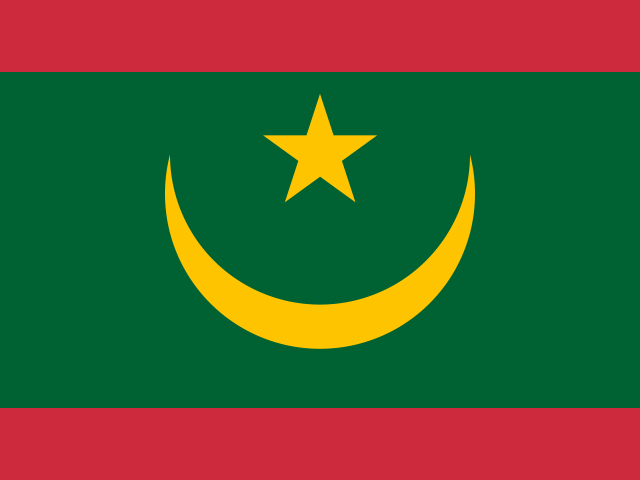 Mauritania
 Niger
Niger Nigeria
 Guinea-Bissau
 Saint Helena, Ascension and Tristan da Cunha
 Senegal
 Sierra Leone
 Togo
Togo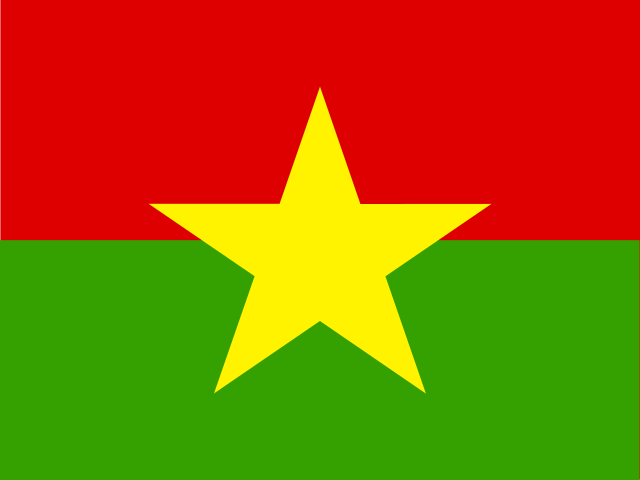 Burkina Faso
 British Indian Ocean Territory
 Burundi
 Comoros
 Mayotte
 Ethiopia
 Eritrea
 French Southern Territories
 Djibouti
 Kenya
Kenya Madagascar
 Malawi
 Mauritius
 Mozambique
 Reunion
 Rwanda
 Seychelles
 Somalia
 Zimbabwe
 South Sudan
 Uganda
 Tanzania
 Zambia
 Angola
 Cameroon
 Central African Republic
 Chad
Chad Congo
Congo Democratic Republic of the Congo
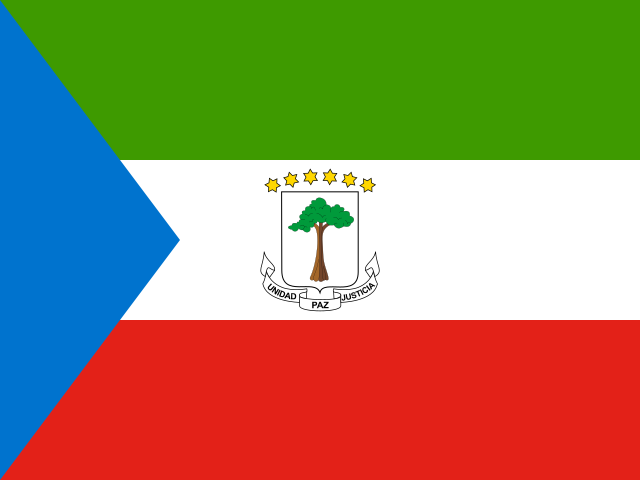 Equatorial Guinea
 Gabon
Gabon Sao Tome and Principe
 Botswana
 Lesotho
 Namibia
 South Africa
 Eswatini
Earlier Report Observations
The maize starch market in Sub-Saharan Africa grew from 668.6 thousand tons in 2018 to 715.2 thousand tons in 2021. This expansion was fueled by rising global demand for processed and convenience foods, which increased consumption of maize starch as a key ingredient. The entry of new product segments focused on natural and organic components further stimulated market volume, while regulatory shifts toward clean labeling in some countries reinforced this trend. During 2020, supply chain disruptions from the pandemic and climatic events affected raw material availability, but demand for modified starch in pharmaceuticals and processed foods helped stabilize the market.
After peaking in 2021, the market contracted to 664.3 thousand tons in 2022 and 654.6 thousand tons in 2023. Persistent volatility in corn prices raised production costs and dampened consumption. Climatic factors and geopolitical tensions continued to influence corn availability and pricing, sustaining pressure on the market. Alongside these drivers, regulatory changes in some markets strengthened traceability and food safety requirements, shaping industry practices during the downturn.
Throughout the period, major companies expanded production capacities to meet demand, and investments flowed into research and development for diversified starch applications. Innovations in extraction technology and a growing focus on plant-based, hypoallergenic ingredients marked the industry's adaptation to evolving consumer preferences and sustainability trends.
Table of content
- 1. Disclaimer
- 2. Terms of use of the report
- 3. Product codes in the statistical classifications used in the report
-
4. Key Market Indicators and Trends
-
4.1. Key Market Indicators
-
4.1.1. In kind
- 4.1.1.1. Production, 2018-2023
- 4.1.1.2. Imports, 2018-2024
- 4.1.1.3. Exports, 2018-2024
- 4.1.1.4. Market size, 2018-2023
-
4.1.1. In kind
- 4.2. Market Trends and Factors
-
4.1. Key Market Indicators
-
5. Production
-
5.1. Production in Sub-Saharan Africa
- 5.1.1. Annual dynamics of production in Sub-Saharan Africa in kind, 2018-2023, K t
-
5.2. Global production by Country, 2018-2023
- 5.2.1. Annual dynamics of production by macroregions in kind, 2018-2023, K t
- 5.2.2. Dynamics of production structure by macroregions in kind, 2018-2023
- 5.2.3. Annual dynamics of production by country in kind, 2018-2023, K t
- 5.2.4. Structure of production by countries in kind, 2018-2023
- 5.2.5. Dynamics of peoduction structure by countries in kind, 2018-2023
-
5.1. Production in Sub-Saharan Africa
-
6. Imports
-
6.1. Imports (Direct Data*)
- 6.1.1. Imports - Total information
-
6.1.2. Imports in kind, K t
- 6.1.2.1. Annual dynamics of product's imports to Cabo Verde in kind, 2018-2024, K t
- 6.1.2.2. Dynamics of product's imports in kind to Cabo Verde by countries, 2018-2024, K t
- 6.1.2.3. Structure of product's imports in kind by countries, 2018-2024
-
6.1.3. Imports in value, M $ US
- 6.1.3.1. Annual dynamics of product's imports to Cabo Verde in value, 2018-2024, M $ US
- 6.1.3.2. Dynamics of product's imports in value to Cabo Verde by countries, 2018-2024, M $ US
- 6.1.3.3. Structure of product's imports in value by countries, 2018-2024
-
6.1.4. Average price of product's imports, $ US/t
- 6.1.4.1. Annual dynamics of average price of product's imports to Cabo Verde, 2018-2024, $ US/t
- 6.1.4.2. Dynamics of average price of product's imports to Cabo Verde by countries, 2018-2024, $ US/t
-
6.2. Imports (Mirror Data)
- 6.2.1. Imports - Total information
-
6.2.2. Imports in kind, K t
- 6.2.2.1. Annual dynamics of product's imports to Cabo Verde in kind, 2018-2024, K t
- 6.2.2.2. Dynamics of product's imports in kind to Cabo Verde by countries, 2018-2024, K t
- 6.2.2.3. Structure of product's imports in kind by countries, 2018-2024
-
6.2.3. Imports in value, M $ US
- 6.2.3.1. Annual dynamics of product's imports to Cabo Verde in value, 2018-2024, M $ US
- 6.2.3.2. Dynamics of product's imports in value to Cabo Verde by countries, 2018-2024, M $ US
- 6.2.3.3. Structure of product's imports in value by countries, 2018-2024
-
6.2.4. Average price of product's imports, $ US/t
- 6.2.4.1. Annual dynamics of average price of product's imports to Cabo Verde, 2018-2024, $ US/t
- 6.2.4.2. Dynamics of average price of product's imports to Cabo Verde by countries, 2018-2024, $ US/t
-
6.1. Imports (Direct Data*)
-
7. Exports
-
7.1. Exports (Direct Data*)
- 7.1.1. Exports - Total information
-
7.1.2. Exports in kind, K t
- 7.1.2.1. Annual dynamics of product's exports from Cabo Verde in kind, 2018-2024, K t
- 7.1.2.2. Dynamics of product's exports in kind from Cabo Verde by countries, 2018-2024, K t
- 7.1.2.3. Structure of product's exports in kind by countries, 2018-2024
-
7.1.3. Exports in value, M $ US
- 7.1.3.1. Annual dynamics of product's exports from Cabo Verde in value, 2018-2024, M $ US
- 7.1.3.2. Dynamics of product's exports in value from Cabo Verde by countries, 2018-2024, M $ US
- 7.1.3.3. Structure of product's exports in value by countries, 2018-2024
-
7.1.4. Average price of product's exports, $ US/t
- 7.1.4.1. Annual dynamics of average price of product's exports from Cabo Verde, 2018-2024, $ US/t
- 7.1.4.2. Dynamics of average price of product's exports from Cabo Verde by countries, 2018-2024, $ US/t
-
7.2. Exports (Mirror Data)
- 7.2.1. Exports - Total information
-
7.2.2. Exports in kind, K t
- 7.2.2.1. Annual dynamics of product's exports from Cabo Verde in kind, 2018-2024, K t
- 7.2.2.2. Dynamics of product's exports in kind from Cabo Verde by countries, 2018-2024, K t
- 7.2.2.3. Structure of product's exports in kind by countries, 2018-2024
-
7.2.3. Exports in value, M $ US
- 7.2.3.1. Annual dynamics of product's exports from Cabo Verde in value, 2018-2024, M $ US
- 7.2.3.2. Dynamics of product's exports in value from Cabo Verde by countries, 2018-2024, M $ US
- 7.2.3.3. Structure of product's exports in value by countries, 2018-2024
-
7.2.4. Average price of product's exports, $ US/t
- 7.2.4.1. Annual dynamics of average price of product's exports from Cabo Verde, 2018-2024, $ US/t
- 7.2.4.2. Dynamics of average price of product's exports from Cabo Verde by countries, 2018-2024, $ US/t
-
7.1. Exports (Direct Data*)
-
8. Trade balance
-
8.1. Trade balance (Direct Data)
- 8.1.1. In kind, K t
- 8.1.2. In value, M $ US
-
8.2. Trade balance (Mirror Data)
- 8.2.1. In kind, K t
- 8.2.2. In value, M $ US
-
8.1. Trade balance (Direct Data)
-
9. Top buying and selling countries, 2018-2024
-
9.1. Direct Data
- 9.1.1. Import in Value by Countries-buyers
- 9.1.2. Export in Value by Countries-suppliers
-
9.2. Mirror Data
- 9.2.1. Import in Value by Countries-buyers
- 9.2.2. Export in Value by Countries-suppliers
-
9.1. Direct Data
Production maize starch in Sub-Saharan Africa
In kind, 2017-2020, K t
Top producers of maize starch, 2017-2020
World map of production of maize starch, 2017-2020
Maize starch production in Sub-Saharan Africa has declined for the second year in a row. In 2020, the region produced 539.9 thousand tons, representing a 2.5% decrease from the previous year. Looking at the period from 2017 to 2020, overall production grew by 14.9%, with an average annual growth rate of 4.7%. The highest production level was recorded in 2018 at 572.1 thousand tons, which saw a significant increase of 21.8%. In contrast, 2019 experienced the largest decline of 3.2%.
Annual dynamics of production in Sub-Saharan Africa in kind, 2017-2020, K t
| Parameter | 2018 | 2019 | 2020 | CAGR | |
|---|---|---|---|---|---|
| 1 | Change from last year | 21.8% | (3.2%) | (2.5%) | 4.7% |
In value, 2017-2020, M $ US
In 2020, the value of maize starch output in Sub-Saharan Africa was $348.3 million, marking an 8.8% drop from 2019. Over the four-year span from 2017 to 2020, production value decreased by 6.7%, translating to an average annual decline of 2.3%. The peak value occurred in 2019 at $382.1 million, which also saw the largest increase of 2.7%.
Annual dynamics of production in Sub-Saharan Africa in value, 2017-2020, M $ US
| Parameter | 2018 | 2019 | 2020 | CAGR | |
|---|---|---|---|---|---|
| 1 | Change from last year | (0.3%) | 2.7% | (8.8%) | (2.3%) |
Exports maize starch from Sub-Saharan Africa
Exports in kind, K t
Maize starch exports from Sub-Saharan Africa have risen for the second consecutive year. In 2020, exports reached 27.4 thousand tons, showing a strong growth of 14.0% compared to the previous year. However, over the 2017-2020 period, exports overall decreased by 5.7%, with an average annual decline of 1.9%. The lowest export volume was in 2018 at 19.1 thousand tons, which saw the largest drop of 34.5%. In contrast, 2019 recorded the biggest increase of 26.3%.
Annual dynamics of product's exports from Sub-Saharan Africa in kind, 2017-2020, K t
| Parameter | 2018 | 2019 | 2020 | CAGR | |
|---|---|---|---|---|---|
| 1 | Change from last year | (34.5%) | 26.3% | 14.0% | (1.9%) |
From 2017 to 2020, the export structure for maize starch in volume terms was quite diversified. Asia (not elsewhere specified) accounted for 21.6% of exports, Australia for 16.9%, and the Philippines for 7.8%. Together, these three regions made up just 46.3% of total flows, with no single country holding a clearly dominant position.
Structure of product's exports in kind by countries, 2017-2020
World map of product's exports from Sub-Saharan Africa in kind, 2017-2020
Exports in value, K $ US
Following a two-year decline, the value of maize starch exports from Sub-Saharan Africa has increased. In 2020, exports totaled $12.391 million, reflecting a moderate rise of 9.8% from the year before. Over the 2017-2020 timeframe, export value fell by 10.6%, with an average annual decrease of 3.7%. The lowest value was recorded in 2019 at $11.283 million, while 2018 saw the largest decline of 12.2%.
Annual dynamics of product's exports from Sub-Saharan Africa in value, 2017-2020, K $ US
| Parameter | 2018 | 2019 | 2020 | CAGR | |
|---|---|---|---|---|---|
| 1 | Change from last year | (12.2%) | (7.3%) | 9.8% | (3.7%) |
The market base for maize starch exports in value terms from 2017 to 2020 was broad. Asia (not elsewhere specified) represented 18.8% of export value, Australia 16.8%, and the Philippines 6.8%. Combined, these three accounted for only 42.3% of total flows, with the remaining 57.7% distributed among numerous other countries.
Structure of product's exports in value by countries, 2017-2020
World map of product's exports from Sub-Saharan Africa in value, 2017-2020
Imports maize starch to Sub-Saharan Africa
Imports in kind, K t
Maize starch imports into Sub-Saharan Africa have grown for the second year in a row. In 2020, imports amounted to a total volume, equivalent to a 10.9% increase from 2019. Over the 2017-2020 period, imports surged by 45.3%, with an average annual growth rate of 13.3%. The lowest import volume was in 2018 at 115.6 thousand tons, which also experienced the largest decline of 8.0%. In 2019, imports saw the biggest jump of 42.3%.
Annual dynamics of product's imports to Sub-Saharan Africa in kind, 2017-2020, K t
| Parameter | 2018 | 2019 | 2020 | CAGR | |
|---|---|---|---|---|---|
| 1 | Change from last year | (8.0%) | 42.3% | 10.9% | 13.3% |
From 2017 to 2020, Turkey, India, and China were the key partners for maize starch imports into Sub-Saharan Africa in volume terms. Turkey accounted for 38.3% of imports, India for 16.1%, and China for 11.3%. Together, these three countries represented 65.6% of total import flows.
Structure of product's imports in kind by countries, 2017-2020
World map of product's imports to Sub-Saharan Africa in kind, 2017-2020
Imports in value, K $ US
Maize starch deliveries to Sub-Saharan Africa have increased for the second consecutive year. In 2020, imports were valued at $93.943 million, showing a sharp rise of 36.6% from the previous year. Between 2017 and 2020, import value grew by 54.2%, equating to an average annual increase of 15.5%. The lowest value was recorded in 2018 at $53.260 million, which saw the largest decline of 12.6%.
Annual dynamics of product's imports to Sub-Saharan Africa in value, 2017-2020, K $ US
| Parameter | 2018 | 2019 | 2020 | CAGR | |
|---|---|---|---|---|---|
| 1 | Change from last year | (12.6%) | 29.1% | 36.6% | 15.5% |
Over the 2017-2020 period, Turkey, China, and India were the main destinations for maize starch imports into Sub-Saharan Africa in value terms. Turkey accounted for 37.3% of import value, China for 13.8%, and India for 13.6%. Collectively, these three countries absorbed 64.8% of total imports.
Structure of product's imports in value by countries, 2017-2020
World map of product's imports to Sub-Saharan Africa in value, 2017-2020
Related Reports

Maize starch market in Montenegro
2026-03-28
Maize starch market in Thailand
2026-03-28
Maize starch market in Northern Africa
2026-03-28
2026-03-30

Starches market in Sub-Saharan Africa
2026-03-28

Wheat starch market in Sub-Saharan Africa
2026-03-28


Cereal germ market in Sub-Saharan Africa
2026-03-28
Why Choose Us?
Only Verified Data
No Hidden Costs or Separate Fees
Smarter Subscription Pricing
Contact Our Team
Submit your inquiry using the form below — our team will get back to you within 24 hours.