






"SADC" region includes following countries:
 Angola
 Botswana
 Comoros
 Democratic Republic of the Congo
 Eswatini
 Lesotho
 Madagascar
 Malawi
 Mauritius
 Mozambique
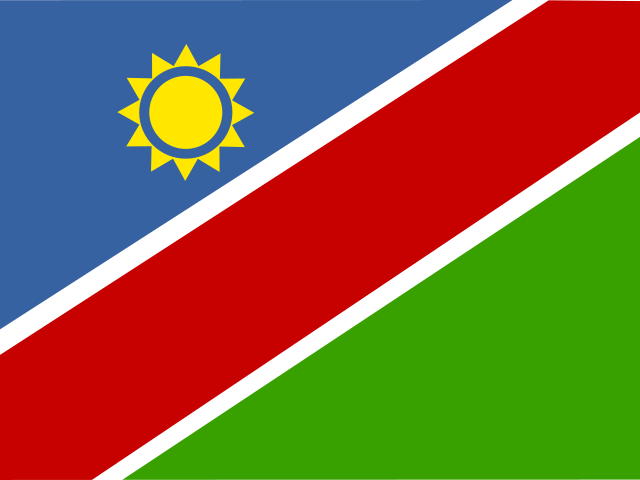 Namibia
 Seychelles
 South Africa
 Tanzania
 Zambia
 Zimbabwe
Earlier Report Observations
Between 2018 and 2023, goat meat production in the SADC region increased from 223.1 thousand t to 308.0 thousand t, driving total market volume up from 222.3 thousand t to 307.0 thousand t. The most significant expansion occurred in 2023, when global demand for goat meat surged due to health, cultural, and religious practices, putting pressure on local producers to increase output.
Domestic consumption was further supported by a growing consumer preference for locally sourced goat meat, perceived as fresher and safer than imports. This shift reinforced production growth and minimized import dependence, with imports remaining below 300 t annually throughout the period. The market's value more than doubled from $713 million to $1.3 billion, reflecting both the volume increase and underlying price trends.
Table of content
- 1. Disclaimer
- 2. Terms of use of the report
- 3. Product codes in the statistical classifications used in the report
-
4. Key Market Indicators and Trends
-
4.1. Key Market Indicators
-
4.1.1. In kind
- 4.1.1.1. Production, 2018-2023
- 4.1.1.2. Imports, 2018-2024
- 4.1.1.3. Exports, 2018-2024
- 4.1.1.4. Market size, 2018-2023
-
4.1.2. In value
- 4.1.2.1. Production, 2018-2023
- 4.1.2.2. Imports, 2018-2024
- 4.1.2.3. Exports, 2018-2024
- 4.1.2.4. Market size, 2018-2023
-
4.1.1. In kind
- 4.2. Market Trends and Factors
-
4.1. Key Market Indicators
-
5. Production
-
5.1. Production in SADC
- 5.1.1. Annual dynamics of production in SADC in kind, 2018-2023, K t
-
5.2. Global production by Country, 2018-2023
- 5.2.1. Annual dynamics of production by macroregions in kind, 2018-2023, K t
- 5.2.2. Dynamics of production structure by macroregions in kind, 2018-2023
- 5.2.3. Annual dynamics of production by country in kind, 2018-2023, K t
- 5.2.4. Structure of production by countries in kind, 2018-2023
- 5.2.5. Dynamics of peoduction structure by countries in kind, 2018-2023
-
5.1. Production in SADC
-
6. Imports
-
6.1. Imports (Direct Data*)
- 6.1.1. Imports - Total information
-
6.1.2. Imports in kind, t
- 6.1.2.1. Annual dynamics of product's imports to Angola in kind, 2018-2024, t
- 6.1.2.2. Dynamics of product's imports in kind to Angola by countries, 2018-2024, t
- 6.1.2.3. Structure of product's imports in kind by countries, 2018-2024
-
6.1.3. Imports in value, K $ US
- 6.1.3.1. Annual dynamics of product's imports to Angola in value, 2018-2024, K $ US
- 6.1.3.2. Dynamics of product's imports in value to Angola by countries, 2018-2024, K $ US
- 6.1.3.3. Structure of product's imports in value by countries, 2018-2024
-
6.1.4. Average price of product's imports, $ US/t
- 6.1.4.1. Annual dynamics of average price of product's imports to Angola, 2018-2024, $ US/t
- 6.1.4.2. Dynamics of average price of product's imports to Angola by countries, 2018-2024, $ US/t
-
6.2. Imports (Mirror Data)
- 6.2.1. Imports - Total information
-
6.2.2. Imports in kind, t
- 6.2.2.1. Annual dynamics of product's imports to Angola in kind, 2018-2024, t
- 6.2.2.2. Dynamics of product's imports in kind to Angola by countries, 2018-2024, t
- 6.2.2.3. Structure of product's imports in kind by countries, 2018-2024
-
6.2.3. Imports in value, K $ US
- 6.2.3.1. Annual dynamics of product's imports to Angola in value, 2018-2024, K $ US
- 6.2.3.2. Dynamics of product's imports in value to Angola by countries, 2018-2024, K $ US
- 6.2.3.3. Structure of product's imports in value by countries, 2018-2024
-
6.2.4. Average price of product's imports, $ US/t
- 6.2.4.1. Annual dynamics of average price of product's imports to Angola, 2018-2024, $ US/t
- 6.2.4.2. Dynamics of average price of product's imports to Angola by countries, 2018-2024, $ US/t
-
6.1. Imports (Direct Data*)
-
7. Exports
-
7.1. Exports (Direct Data*)
- 7.1.1. Exports - Total information
-
7.1.2. Exports in kind, t
- 7.1.2.1. Annual dynamics of product's exports from Angola in kind, 2018-2024, t
- 7.1.2.2. Dynamics of product's exports in kind from Angola by countries, 2018-2024, t
- 7.1.2.3. Structure of product's exports in kind by countries, 2018-2024
-
7.1.3. Exports in value, K $ US
- 7.1.3.1. Annual dynamics of product's exports from Angola in value, 2018-2024, K $ US
- 7.1.3.2. Dynamics of product's exports in value from Angola by countries, 2018-2024, K $ US
- 7.1.3.3. Structure of product's exports in value by countries, 2018-2024
-
7.1.4. Average price of product's exports, $ US/t
- 7.1.4.1. Annual dynamics of average price of product's exports from Angola, 2018-2024, $ US/t
- 7.1.4.2. Dynamics of average price of product's exports from Angola by countries, 2018-2024, $ US/t
-
7.2. Exports (Mirror Data)
- 7.2.1. Exports - Total information
-
7.2.2. Exports in kind, t
- 7.2.2.1. Annual dynamics of product's exports from Angola in kind, 2018-2024, t
- 7.2.2.2. Dynamics of product's exports in kind from Angola by countries, 2018-2024, t
- 7.2.2.3. Structure of product's exports in kind by countries, 2018-2024
-
7.2.3. Exports in value, K $ US
- 7.2.3.1. Annual dynamics of product's exports from Angola in value, 2018-2024, K $ US
- 7.2.3.2. Dynamics of product's exports in value from Angola by countries, 2018-2024, K $ US
- 7.2.3.3. Structure of product's exports in value by countries, 2018-2024
-
7.2.4. Average price of product's exports, $ US/t
- 7.2.4.1. Annual dynamics of average price of product's exports from Angola, 2018-2024, $ US/t
- 7.2.4.2. Dynamics of average price of product's exports from Angola by countries, 2018-2024, $ US/t
-
7.1. Exports (Direct Data*)
-
8. Trade balance
-
8.1. Trade balance (Direct Data)
- 8.1.1. In kind, t
- 8.1.2. In value, K $ US
-
8.2. Trade balance (Mirror Data)
- 8.2.1. In kind, t
- 8.2.2. In value, K $ US
-
8.1. Trade balance (Direct Data)
-
9. Top buying and selling countries, 2018-2024
-
9.1. Direct Data
- 9.1.1. Import in Value by Countries-buyers
- 9.1.2. Export in Value by Countries-suppliers
-
9.2. Mirror Data
- 9.2.1. Import in Value by Countries-buyers
- 9.2.2. Export in Value by Countries-suppliers
-
9.1. Direct Data
Production goat meat in SADC
In kind, 2017-2020, K t
Top producers of goat meat, 2017-2020
World map of production of goat meat, 2017-2020
After two years of growth, goat meat production in the SADC region experienced a decline. In 2020, production reached 231.5 thousand tons, marking a 1.1% decrease from the previous year. Looking at the broader period from 2017 to 2020, production increased by 11.6%, which translates to an average annual growth rate of 3.7%. The peak production level was recorded in 2019 at 234.0 thousand tons, with the most significant annual increase occurring in 2018 at 7.6%.
Annual dynamics of production in SADC in kind, 2017-2020, K t
| Parameter | 2018 | 2019 | 2020 | CAGR | |
|---|---|---|---|---|---|
| 1 | Change from last year | 7.6% | 4.9% | (1.1%) | 3.7% |
Exports goat meat from SADC
Exports in kind, t
Goat meat exports from the SADC region fell for the third year in a row. In 2020, exports totaled 265 tons, representing a sharp decline of 37.5% compared to 2019. Over the four-year span from 2017 to 2020, exports dropped by 81.4%, with a compound annual growth rate of -42.9%.
Annual dynamics of product's exports from SADC in kind, 2017-2020, t
| Parameter | 2018 | 2019 | 2020 | CAGR | |
|---|---|---|---|---|---|
| 1 | Change from last year | (28.6%) | (58.3%) | (37.5%) | (42.9%) |
From 2017 to 2020, the United Arab Emirates and Oman dominated goat meat exports from the SADC region, accounting for the majority of shipments. Other markets played a relatively minor role individually during this period.
Structure of product's exports in kind by countries, 2017-2020
World map of product's exports from SADC in kind, 2017-2020
Exports in value, K $ US
The value of goat meat exports from the SADC region declined for the second consecutive year. In 2020, exports were valued at 839 thousand US dollars, down 28.7% year-over-year. Between 2017 and 2020, export values fell by 71.4%, equivalent to an average annual decrease of 34.1%. The highest export value was recorded in 2018 at 3 250 thousand US dollars. The most substantial decline occurred in 2019 with a 63.8% drop, while the largest increase was seen in 2018 at 10.8%.
Annual dynamics of product's exports from SADC in value, 2017-2020, K $ US
| Parameter | 2018 | 2019 | 2020 | CAGR | |
|---|---|---|---|---|---|
| 1 | Change from last year | 10.8% | (63.8%) | (28.7%) | (34.1%) |
During the 2017-2020 period, the United Arab Emirates remained the primary market for SADC goat meat exports in value terms, capturing 72.0% of total export flows. The remaining export value was distributed among various other destinations.
Structure of product's exports in value by countries, 2017-2020
World map of product's exports from SADC in value, 2017-2020
Imports goat meat to SADC
Imports in kind, t
SADC's goat meat imports decreased for the second year running. In 2020, imports amounted to 129 tons, reflecting a 7.8% reduction from 2019. Over the 2017-2020 timeframe, imports fell by 28.6%, with a compound annual growth rate of -10.6%. The peak import volume was recorded in 2018 at 263 tons. The most significant decline occurred in 2019 with a 46.8% drop, while the largest increase was observed in 2018 at 45.5%.
Annual dynamics of product's imports to SADC in kind, 2017-2020, t
| Parameter | 2018 | 2019 | 2020 | CAGR | |
|---|---|---|---|---|---|
| 1 | Change from last year | 45.5% | (46.8%) | (7.8%) | (10.6%) |
Between 2017 and 2020, Australia (18.7% of import volume), Spain (15.9%), and Argentina (15.6%) led the structure of goat meat imports into the SADC region. Together, these three countries accounted for 50.2% of total import flows.
Structure of product's imports in kind by countries, 2017-2020
World map of product's imports to SADC in kind, 2017-2020
Imports in value, K $ US
The value of goat meat imports into the SADC region declined for the second consecutive year. In 2020, imports were valued at approximately 599 thousand US dollars, showing a significant decrease of 21.4% compared to 2019. Over the 2017-2020 period, import values fell by 28.3%, with a compound annual growth rate of -10.5%. The highest import value was recorded in 2018 at 1 005 thousand US dollars. The most substantial decline occurred in 2019 with a 24.2% drop, while the largest increase was seen in 2018 at 20.3%.
Annual dynamics of product's imports to SADC in value, 2017-2020, K $ US
| Parameter | 2018 | 2019 | 2020 | CAGR | |
|---|---|---|---|---|---|
| 1 | Change from last year | 20.3% | (24.2%) | (21.4%) | (10.5%) |
From 2017 to 2020, the leading sources of goat meat imports into the SADC region by value were Australia (28.0% of import value), Spain (14.6%), and Argentina (13.0%). Collectively, these three countries represented 55.6% of total import flows.
Structure of product's imports in value by countries, 2017-2020
World map of product's imports to SADC in value, 2017-2020
Related Reports

2026-03-27
2026-03-27
Goat meat market in South Africa
2026-03-27

Goose meat and offal market in SADC
2026-03-27


Why Choose Us?
Only Verified Data
No Hidden Costs or Separate Fees
Smarter Subscription Pricing
Contact Our Team
Submit your inquiry using the form below — our team will get back to you within 24 hours.