






"SADC" region includes following countries:
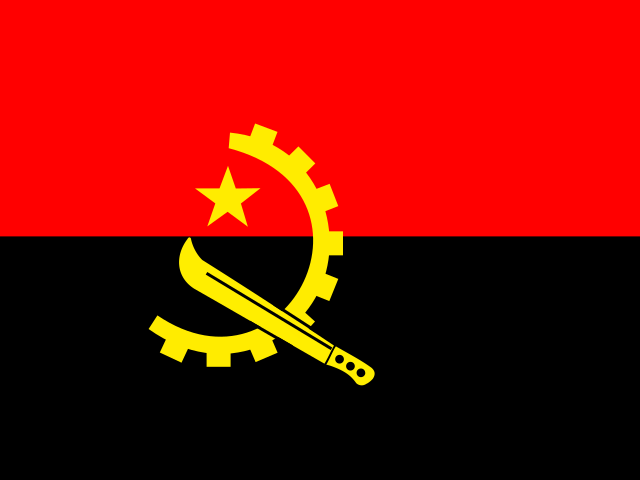 Angola
 Botswana
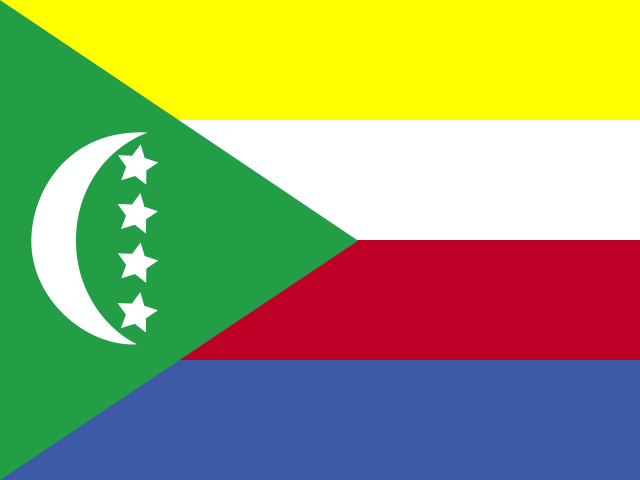 Comoros
 Democratic Republic of the Congo
 Eswatini
 Lesotho
 Madagascar
 Malawi
 Mauritius
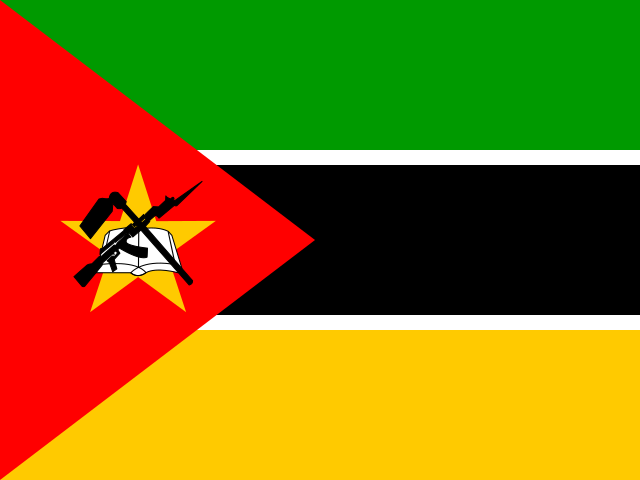 Mozambique
 Namibia
 Seychelles
 South Africa
 Tanzania
 Zambia
 Zimbabwe
Earlier Report Observations
The ginger market in SADC grew from 6 965 t in 2018 to 7 362 t in 2019, influenced by global cold weather that raised health awareness and tightened supply as seasons ended in China and Brazil. The COVID-19 pandemic in 2020 sharply increased demand for ginger due to its perceived immune-boosting benefits, driving market volume up by 35% to 9 954 t. Heavy rainfall that damaged harvests worldwide and high domestic consumption in China further constrained global supply, supporting higher prices and import flows from alternative sources like Peru and Brazil.
Market volume reached a peak of 10 889 t in 2021 as the second wave of COVID-19 sustained strong demand, despite rising import prices affecting retail costs. In 2022, volume fell 30% to 7 681 t. By 2023, it stabilized at 8 009 t, with local producers reducing dependence on Chinese imports by responding to consumer preference for regional varieties. Farmers experimented with seed rhizome sizes to improve yields, and the South African brand Ginger Love gained international exposure at trade shows, aided by support from agencies like the Small Enterprise Finance Agency.
Entering 2024, extreme weather in China damaged ginger crops, influencing global supply dynamics, while local production in South Africa remained steady. Health and wellness trends, along with growing popularity of ginger-flavored energy drinks among young adults, continued to drive consumer interest and market diversification.
Table of content
- 1. Disclaimer
- 2. Terms of use of the report
- 3. Product codes in the statistical classifications used in the report
-
4. Key Market Indicators and Trends
-
4.1. Key Market Indicators
-
4.1.1. In kind
- 4.1.1.1. Production, 2018-2023
- 4.1.1.2. Imports, 2018-2024
- 4.1.1.3. Exports, 2018-2024
- 4.1.1.4. Market size, 2018-2023
-
4.1.1. In kind
- 4.2. Market Trends and Factors
-
4.1. Key Market Indicators
-
5. Production
-
5.1. Production in SADC
- 5.1.1. Annual dynamics of production in SADC in kind, 2018-2023, t
-
5.2. Global production by Country, 2018-2023
- 5.2.1. Annual dynamics of production by macroregions in kind, 2018-2023, t
- 5.2.2. Dynamics of production structure by macroregions in kind, 2018-2023
- 5.2.3. Annual dynamics of production by country in kind, 2018-2023, t
- 5.2.4. Structure of production by countries in kind, 2018-2023
- 5.2.5. Dynamics of peoduction structure by countries in kind, 2018-2023
-
5.1. Production in SADC
-
6. Imports
-
6.1. Imports (Direct Data*)
- 6.1.1. Imports - Total information
-
6.1.2. Imports in kind, t
- 6.1.2.1. Annual dynamics of product's imports to Angola in kind, 2018-2024, t
- 6.1.2.2. Dynamics of product's imports in kind to Angola by countries, 2018-2024, t
- 6.1.2.3. Structure of product's imports in kind by countries, 2018-2024
-
6.1.3. Imports in value, K $ US
- 6.1.3.1. Annual dynamics of product's imports to Angola in value, 2018-2024, K $ US
- 6.1.3.2. Dynamics of product's imports in value to Angola by countries, 2018-2024, K $ US
- 6.1.3.3. Structure of product's imports in value by countries, 2018-2024
-
6.1.4. Average price of product's imports, $ US/t
- 6.1.4.1. Annual dynamics of average price of product's imports to Angola, 2018-2024, $ US/t
- 6.1.4.2. Dynamics of average price of product's imports to Angola by countries, 2018-2024, $ US/t
-
6.2. Imports (Mirror Data)
- 6.2.1. Imports - Total information
-
6.2.2. Imports in kind, t
- 6.2.2.1. Annual dynamics of product's imports to Angola in kind, 2018-2024, t
- 6.2.2.2. Dynamics of product's imports in kind to Angola by countries, 2018-2024, t
- 6.2.2.3. Structure of product's imports in kind by countries, 2018-2024
-
6.2.3. Imports in value, K $ US
- 6.2.3.1. Annual dynamics of product's imports to Angola in value, 2018-2024, K $ US
- 6.2.3.2. Dynamics of product's imports in value to Angola by countries, 2018-2024, K $ US
- 6.2.3.3. Structure of product's imports in value by countries, 2018-2024
-
6.2.4. Average price of product's imports, $ US/t
- 6.2.4.1. Annual dynamics of average price of product's imports to Angola, 2018-2024, $ US/t
- 6.2.4.2. Dynamics of average price of product's imports to Angola by countries, 2018-2024, $ US/t
-
6.1. Imports (Direct Data*)
-
7. Exports
-
7.1. Exports (Direct Data*)
- 7.1.1. Exports - Total information
-
7.1.2. Exports in kind, t
- 7.1.2.1. Annual dynamics of product's exports from Angola in kind, 2018-2024, t
- 7.1.2.2. Dynamics of product's exports in kind from Angola by countries, 2018-2024, t
- 7.1.2.3. Structure of product's exports in kind by countries, 2018-2024
-
7.1.3. Exports in value, K $ US
- 7.1.3.1. Annual dynamics of product's exports from Angola in value, 2018-2024, K $ US
- 7.1.3.2. Dynamics of product's exports in value from Angola by countries, 2018-2024, K $ US
- 7.1.3.3. Structure of product's exports in value by countries, 2018-2024
-
7.1.4. Average price of product's exports, $ US/t
- 7.1.4.1. Annual dynamics of average price of product's exports from Angola, 2018-2024, $ US/t
- 7.1.4.2. Dynamics of average price of product's exports from Angola by countries, 2018-2024, $ US/t
-
7.2. Exports (Mirror Data)
- 7.2.1. Exports - Total information
-
7.2.2. Exports in kind, t
- 7.2.2.1. Annual dynamics of product's exports from Angola in kind, 2018-2024, t
- 7.2.2.2. Dynamics of product's exports in kind from Angola by countries, 2018-2024, t
- 7.2.2.3. Structure of product's exports in kind by countries, 2018-2024
-
7.2.3. Exports in value, K $ US
- 7.2.3.1. Annual dynamics of product's exports from Angola in value, 2018-2024, K $ US
- 7.2.3.2. Dynamics of product's exports in value from Angola by countries, 2018-2024, K $ US
- 7.2.3.3. Structure of product's exports in value by countries, 2018-2024
-
7.2.4. Average price of product's exports, $ US/t
- 7.2.4.1. Annual dynamics of average price of product's exports from Angola, 2018-2024, $ US/t
- 7.2.4.2. Dynamics of average price of product's exports from Angola by countries, 2018-2024, $ US/t
-
7.1. Exports (Direct Data*)
-
8. Trade balance
-
8.1. Trade balance (Direct Data)
- 8.1.1. In kind, t
- 8.1.2. In value, K $ US
-
8.2. Trade balance (Mirror Data)
- 8.2.1. In kind, t
- 8.2.2. In value, K $ US
-
8.1. Trade balance (Direct Data)
-
9. Top buying and selling countries, 2018-2024
-
9.1. Direct Data
- 9.1.1. Import in Value by Countries-buyers
- 9.1.2. Export in Value by Countries-suppliers
-
9.2. Mirror Data
- 9.2.1. Import in Value by Countries-buyers
- 9.2.2. Export in Value by Countries-suppliers
-
9.1. Direct Data
Production ginger in SADC
In kind, 2017-2020, t
Top producers of ginger, 2017-2020
World map of production of ginger, 2017-2020
After two consecutive years of decline, ginger production in the SADC region rebounded. In 2020, production reached 5 796 tonnes, marking a significant year-over-year increase of 21.6%. Over the 2017-2020 period, production grew by 19.5%, with a compound annual growth rate of 6.1%. The lowest production level was recorded in 2019 at 4 766 tonnes, while the largest annual decline occurred in 2018 at 1.4%.
Annual dynamics of production in SADC in kind, 2017-2020, t
| Parameter | 2018 | 2019 | 2020 | CAGR | |
|---|---|---|---|---|---|
| 1 | Change from last year | (1.4%) | (0.3%) | 21.6% | 6.1% |
Exports ginger from SADC
Exports in kind, t
The export market for ginger showed considerable volatility throughout the period. Volumes reached their lowest point in 2019 at 352 tonnes, then surged to their peak in 2020 at 1 032 tonnes, representing a 2.9-fold increase between these years. The 2020 export volume represented a dramatic 193.2% increase compared to the previous year. The largest annual decline occurred in 2019 at 61.7%.
Annual dynamics of product's exports from SADC in kind, 2017-2020, t
| Parameter | 2018 | 2019 | 2020 | CAGR | |
|---|---|---|---|---|---|
| 1 | Change from last year | 9.1% | (61.7%) | 193.2% | 7.0% |
During the 2017-2020 period, Kenya (8.8% of export volume), France (5.4%), and Germany (3.7%) were notable buyers of SADC ginger. However, these three markets combined accounted for only 17.9% of total exports, with the remaining 82.1% distributed among numerous other trading partners.
Structure of product's exports in kind by countries, 2017-2020
World map of product's exports from SADC in kind, 2017-2020
Exports in value, K $ US
The value of ginger exports exhibited significant volatility during these years. The market saw a 2.1-fold difference between its peak and trough values from 2017 to 2020. In 2020, SADC ginger exports reached 4 491 thousand US dollars, representing a 104.2% increase compared to the previous year. The largest annual decline occurred in 2019 at 39.8%.
Annual dynamics of product's exports from SADC in value, 2017-2020, K $ US
| Parameter | 2018 | 2019 | 2020 | CAGR | |
|---|---|---|---|---|---|
| 1 | Change from last year | 73.8% | (39.8%) | 104.2% | 28.8% |
From 2017 to 2020, the value of SADC ginger exports was widely distributed across multiple markets. Germany (11.6% of export value), France (11.1%), and the Netherlands (3.2%) together accounted for just 25.9% of total export value, indicating a highly diversified market structure.
Structure of product's exports in value by countries, 2017-2020
World map of product's exports from SADC in value, 2017-2020
Imports ginger to SADC
Imports in kind, t
Import volumes displayed noticeable fluctuations during the period. The lowest level was recorded in 2019 at 2 947 tonnes, while the peak occurred in 2020 at 5 190 tonnes, representing a 1.8-fold difference between these years. The 2020 import volume showed a substantial 76.1% increase compared to 2019. The largest annual decline occurred in 2019 at 5.0%.
Annual dynamics of product's imports to SADC in kind, 2017-2020, t
| Parameter | 2018 | 2019 | 2020 | CAGR | |
|---|---|---|---|---|---|
| 1 | Change from last year | (1.8%) | (5.0%) | 76.1% | 18.0% |
During 2017-2020, three key suppliers dominated SADC ginger imports: China, Nigeria, and India together accounted for 65.3% of total import volume.
Structure of product's imports in kind by countries, 2017-2020
World map of product's imports to SADC in kind, 2017-2020
Imports in value, K $ US
The value of ginger imports showed considerable volatility during these years. From 2019 to 2020, the market experienced a 2.5-fold difference between its lowest and highest points. In 2020, SADC ginger imports reached 11 460 thousand US dollars, representing a 150.7% increase compared to the previous year. The lowest value was recorded in 2019 at 4 570 thousand US dollars, while the largest annual decline occurred in 2018 at 17.8%.
Annual dynamics of product's imports to SADC in value, 2017-2020, K $ US
| Parameter | 2018 | 2019 | 2020 | CAGR | |
|---|---|---|---|---|---|
| 1 | Change from last year | (17.8%) | (5.1%) | 150.7% | 25.1% |
From 2017 to 2020, China (29.0% of import value), Nigeria (21.7%), and India (11.2%) continued to be the leading suppliers of ginger to SADC, collectively accounting for 61.9% of total import value.
Structure of product's imports in value by countries, 2017-2020
World map of product's imports to SADC in value, 2017-2020
Related Reports

2026-03-28
2026-03-28
Ginger market in Southern Asia
2026-03-28
2026-03-28


2026-03-28

Nutmeg, mace and cardamoms market in SADC
2026-03-28
Tea in packings ≤3 kg market in SADC
2026-03-30
Why Choose Us?
Only Verified Data
No Hidden Costs or Separate Fees
Smarter Subscription Pricing
Contact Our Team
Submit your inquiry using the form below — our team will get back to you within 24 hours.