






"Middle Africa" region includes following countries:
 Angola
 Cameroon
 Central African Republic
 Chad
Chad Congo
Congo Democratic Republic of the Congo
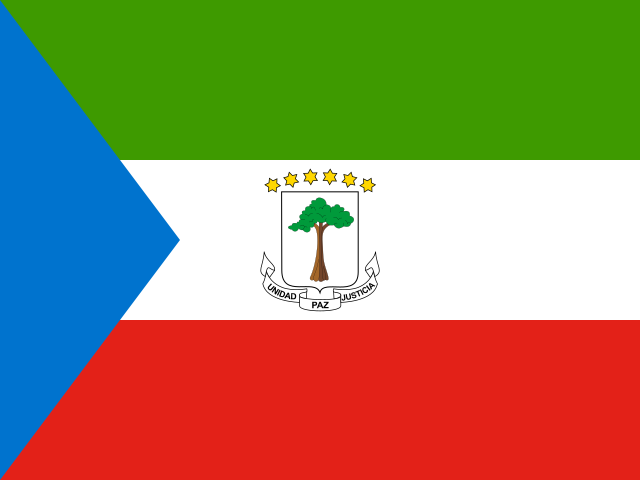 Equatorial Guinea
 Gabon
Gabon Sao Tome and Principe
Earlier Report Observations
The fresh garlic market in Middle Africa experienced notable fluctuations between 2018 and 2023. The period began with a market volume of 27 714 t in 2018, a year characterized by scarcity of garlic on the Cameroonian market, particularly the prized pink variety, which led to price speculation and affected product availability and cost. This tight supply situation coincided with high import levels to meet demand.
After a contraction to 24 260 t in 2019, the market gradually recovered, surpassing its 2018 level to reach a peak of 31 983 t in 2022. This significant expansion was driven by a sharp rise in imports, which jumped by over 29% that year, alongside steady growth in domestic production. The market then saw a moderate correction in 2023, with the total volume easing to 30 716 t as import volumes declined.
Domestic production showed resilience, increasing from 11 187 t in 2021 to 13 467 t in 2023. By 2024, import volumes had risen again to 19 568 t, while consumer habits such as refrigerator storage for freshness continued to shape demand patterns for fresh produce in the region.
Table of content
- 1. Disclaimer
- 2. Terms of use of the report
- 3. Product codes in the statistical classifications used in the report
-
4. Key Market Indicators and Trends
-
4.1. Key Market Indicators
-
4.1.1. In kind
- 4.1.1.1. Production, 2018-2023
- 4.1.1.2. Imports, 2018-2024
- 4.1.1.3. Exports, 2018-2024
- 4.1.1.4. Market size, 2018-2023
-
4.1.1. In kind
- 4.2. Market Trends and Factors
-
4.1. Key Market Indicators
-
5. Production
-
5.1. Production in Middle Africa
- 5.1.1. Annual dynamics of production in Middle Africa in kind, 2018-2023, t
-
5.2. Global production by Country, 2018-2023
- 5.2.1. Annual dynamics of production by macroregions in kind, 2018-2023, t
- 5.2.2. Dynamics of production structure by macroregions in kind, 2018-2023
- 5.2.3. Annual dynamics of production by country in kind, 2018-2023, t
- 5.2.4. Structure of production by countries in kind, 2018-2023
- 5.2.5. Dynamics of peoduction structure by countries in kind, 2018-2023
-
5.1. Production in Middle Africa
-
6. Imports
-
6.1. Imports (Direct Data*)
- 6.1.1. Imports - Total information
-
6.1.2. Imports in kind, t
- 6.1.2.1. Annual dynamics of product's imports to Angola in kind, 2018-2024, t
- 6.1.2.2. Dynamics of product's imports in kind to Angola by countries, 2018-2024, t
- 6.1.2.3. Structure of product's imports in kind by countries, 2018-2024
-
6.1.3. Imports in value, K $ US
- 6.1.3.1. Annual dynamics of product's imports to Angola in value, 2018-2024, K $ US
- 6.1.3.2. Dynamics of product's imports in value to Angola by countries, 2018-2024, K $ US
- 6.1.3.3. Structure of product's imports in value by countries, 2018-2024
-
6.1.4. Average price of product's imports, $ US/t
- 6.1.4.1. Annual dynamics of average price of product's imports to Angola, 2018-2024, $ US/t
- 6.1.4.2. Dynamics of average price of product's imports to Angola by countries, 2018-2024, $ US/t
-
6.2. Imports (Mirror Data)
- 6.2.1. Imports - Total information
-
6.2.2. Imports in kind, t
- 6.2.2.1. Annual dynamics of product's imports to Angola in kind, 2018-2024, t
- 6.2.2.2. Dynamics of product's imports in kind to Angola by countries, 2018-2024, t
- 6.2.2.3. Structure of product's imports in kind by countries, 2018-2024
-
6.2.3. Imports in value, K $ US
- 6.2.3.1. Annual dynamics of product's imports to Angola in value, 2018-2024, K $ US
- 6.2.3.2. Dynamics of product's imports in value to Angola by countries, 2018-2024, K $ US
- 6.2.3.3. Structure of product's imports in value by countries, 2018-2024
-
6.2.4. Average price of product's imports, $ US/t
- 6.2.4.1. Annual dynamics of average price of product's imports to Angola, 2018-2024, $ US/t
- 6.2.4.2. Dynamics of average price of product's imports to Angola by countries, 2018-2024, $ US/t
-
6.1. Imports (Direct Data*)
-
7. Exports
-
7.1. Exports (Direct Data*)
- 7.1.1. Exports - Total information
-
7.1.2. Exports in kind, t
- 7.1.2.1. Annual dynamics of product's exports from Angola in kind, 2018-2024, t
- 7.1.2.2. Dynamics of product's exports in kind from Angola by countries, 2018-2024, t
- 7.1.2.3. Structure of product's exports in kind by countries, 2018-2024
-
7.1.3. Exports in value, K $ US
- 7.1.3.1. Annual dynamics of product's exports from Angola in value, 2018-2024, K $ US
- 7.1.3.2. Dynamics of product's exports in value from Angola by countries, 2018-2024, K $ US
- 7.1.3.3. Structure of product's exports in value by countries, 2018-2024
-
7.1.4. Average price of product's exports, $ US/t
- 7.1.4.1. Annual dynamics of average price of product's exports from Angola, 2018-2024, $ US/t
- 7.1.4.2. Dynamics of average price of product's exports from Angola by countries, 2018-2024, $ US/t
-
7.2. Exports (Mirror Data)
- 7.2.1. Exports - Total information
-
7.2.2. Exports in kind, t
- 7.2.2.1. Annual dynamics of product's exports from Angola in kind, 2018-2024, t
- 7.2.2.2. Dynamics of product's exports in kind from Angola by countries, 2018-2024, t
- 7.2.2.3. Structure of product's exports in kind by countries, 2018-2024
-
7.2.3. Exports in value, K $ US
- 7.2.3.1. Annual dynamics of product's exports from Angola in value, 2018-2024, K $ US
- 7.2.3.2. Dynamics of product's exports in value from Angola by countries, 2018-2024, K $ US
- 7.2.3.3. Structure of product's exports in value by countries, 2018-2024
-
7.2.4. Average price of product's exports, $ US/t
- 7.2.4.1. Annual dynamics of average price of product's exports from Angola, 2018-2024, $ US/t
- 7.2.4.2. Dynamics of average price of product's exports from Angola by countries, 2018-2024, $ US/t
-
7.1. Exports (Direct Data*)
-
8. Trade balance
-
8.1. Trade balance (Direct Data)
- 8.1.1. In kind, t
- 8.1.2. In value, K $ US
-
8.2. Trade balance (Mirror Data)
- 8.2.1. In kind, t
- 8.2.2. In value, K $ US
-
8.1. Trade balance (Direct Data)
-
9. Top buying and selling countries, 2018-2024
-
9.1. Direct Data
- 9.1.1. Import in Value by Countries-buyers
- 9.1.2. Export in Value by Countries-suppliers
-
9.2. Mirror Data
- 9.2.1. Import in Value by Countries-buyers
- 9.2.2. Export in Value by Countries-suppliers
-
9.1. Direct Data
Production garlic in Middle Africa
In kind, 2017-2020, t
Top producers of garlic, 2017-2020
World map of production of garlic, 2017-2020
The garlic market in Middle Africa showed an unstable trend during the observed period. Production reached its lowest point in 2017, then peaked in 2018 with a {ampRatio}-fold difference between these years. In 2020, Middle Africa produced 11 136 tons of garlic, representing a modest 1.2% increase compared to 2019. The highest production volume was recorded in 2018 at 12 667 tons, while the largest decline occurred in 2019 with a 13.1% decrease.
Annual dynamics of production in Middle Africa in kind, 2017-2020, t
| Parameter | 2018 | 2019 | 2020 | CAGR | |
|---|---|---|---|---|---|
| 1 | Change from last year | n/a | (13.1%) | 1.2% | - |
Exports garlic from Middle Africa
Exports in kind, t
Garlic export volumes from Middle Africa displayed significant volatility over the period. Exports dropped to their minimum in 2020 and reached their maximum in 2018, showing a 5.2-fold difference between these years. In 2020, cross-border shipments of garlic from Middle Africa totaled 6 tons, marking a sharp 44.9% decrease compared to the previous year. The highest export volume was recorded in 2018 at 30 tons. The largest decline occurred in 2019 with a 64.8% drop, while the most substantial increase was in 2018 with a 219.3% rise.
Annual dynamics of product's exports from Middle Africa in kind, 2017-2020, t
| Parameter | 2018 | 2019 | 2020 | CAGR | |
|---|---|---|---|---|---|
| 1 | Change from last year | 219.3% | (64.8%) | (44.9%) | (14.7%) |
From 2017 to 2020, the main buyers of garlic from Middle Africa in volume terms were Uganda (12.5% of exports), Spain (3.3% of exports), and the Bahamas (1.3% of exports). Together, these three countries accounted for 17.0% of total garlic exports from the region.
Structure of product's exports in kind by countries, 2017-2020
World map of product's exports from Middle Africa in kind, 2017-2020
Exports in value, K $ US
Garlic exports from Middle Africa declined for the third consecutive year in 2020. The region exported 8 thousand US dollars worth of garlic that year, representing a substantial 13.5% year-over-year decrease. Between 2017 and 2020, exports decreased by 96.3%, which translates to an annualized decline rate of 66.6%.
Annual dynamics of product's exports from Middle Africa in value, 2017-2020, K $ US
| Parameter | 2018 | 2019 | 2020 | CAGR | |
|---|---|---|---|---|---|
| 1 | Change from last year | (87.9%) | (64.5%) | (13.5%) | (66.6%) |
From 2017 to 2020, the key buyers of garlic from Middle Africa in value terms were the Bahamas and Spain. Together, these two countries accounted for 4.0% of total garlic exports from the region during this period.
Structure of product's exports in value by countries, 2017-2020
World map of product's exports from Middle Africa in value, 2017-2020
Imports garlic to Middle Africa
Imports in kind, t
In 2020, foreign garlic supplies to Middle Africa stood at 14 569 tons, indicating a moderate 9.8% increase compared to the previous year. Between 2017 and 2020, imports increased by 16.3%, equating to an annualized growth rate of 5.1%. The highest import volume was recorded in 2018 at 15 077 tons. The largest decline occurred in 2019 with a 12.0% decrease, while the most significant increase was in 2018 with a 20.3% rise.
Annual dynamics of product's imports to Middle Africa in kind, 2017-2020, t
| Parameter | 2018 | 2019 | 2020 | CAGR | |
|---|---|---|---|---|---|
| 1 | Change from last year | 20.3% | (12.0%) | 9.8% | 5.1% |
From 2017 to 2020, China dominated garlic imports to Middle Africa in volume terms, accounting for 90.0% of total imports. The remaining imports were distributed among a broad group of smaller countries.
Structure of product's imports in kind by countries, 2017-2020
World map of product's imports to Middle Africa in kind, 2017-2020
Imports in value, K $ US
Garlic imports to Middle Africa declined for the second consecutive year in 2020. Imports totaled 7 635 thousand US dollars that year, representing a 1.6% drop compared to the previous year. Over the 2017-2020 period, imports decreased by 17.3%, with a compound annual growth rate of -6.1%. The highest import value was recorded in 2018 at 9 753 thousand US dollars. The largest decline occurred in 2019 with a 20.4% decrease, while the most substantial increase was in 2018 with a 5.7% rise.
Annual dynamics of product's imports to Middle Africa in value, 2017-2020, K $ US
| Parameter | 2018 | 2019 | 2020 | CAGR | |
|---|---|---|---|---|---|
| 1 | Change from last year | 5.7% | (20.4%) | (1.6%) | (6.1%) |
From 2017 to 2020, garlic imports to Middle Africa in value terms were almost entirely dependent on China, which accounted for 90.9% of total import flows during this period.
Structure of product's imports in value by countries, 2017-2020
World map of product's imports to Middle Africa in value, 2017-2020
Related Reports





Why Choose Us?
Only Verified Data
No Hidden Costs or Separate Fees
Smarter Subscription Pricing
Contact Our Team
Submit your inquiry using the form below — our team will get back to you within 24 hours.