






"Southern Asia" region includes following countries:
 Afghanistan
 Bangladesh
 Bhutan
 Sri Lanka
 India
India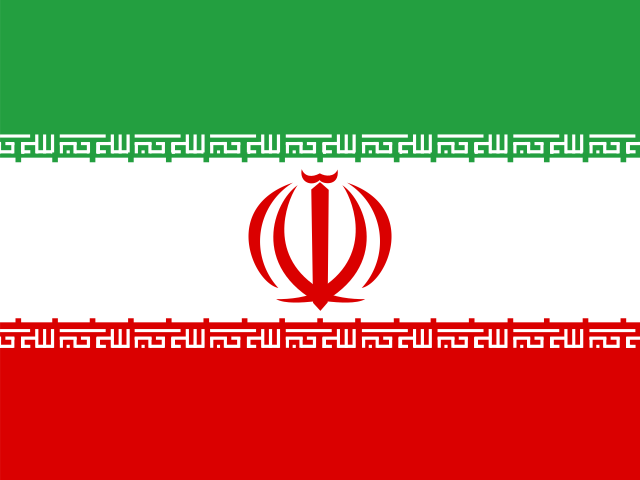 Iran
Iran Maldives
 Nepal
Nepal Pakistan
Earlier Report Observations
From 2018 to 2020, the market for fresh or chilled duck meat in Southern Asia expanded steadily, driven by the emergence of new production facilities and government initiatives to improve slaughter infrastructure and meat quality testing. Integrated production models gained traction, supported by regulations ensuring competitively priced feed supplies like maize and soybean, which lowered costs and encouraged output growth. The implementation of food safety management systems and traceability further shaped the sector's development, facilitating a shift toward chilled and frozen products that met evolving consumer and regulatory standards.
Growth continued through the early 2020s, with production rising consistently each year. In 2022, the market benefited from advances in cold chain solutions and meat preservation techniques, which boosted demand for fresh processed meat. The entry of startups such as FreshToHome and Licious transformed the trade by introducing wet meat and value-added services, improving market access and stimulating consumption. These innovations helped overcome traditional constraints like the lack of organized market linkages for duck meat.
By 2024, consumer preferences shifted further toward chilled and frozen meat products and ready-to-eat meals, driven by health consciousness and convenience trends. Stricter FSSAI regulations on contaminants and residues, effective from 2025, pushed producers toward higher safety standards, while government allocation of ₹110 crore for R&D in the meat sector promised future technological upgrades. Despite persistent challenges in market linkage, the overall volume growth reflected sustained investments in production efficiency and supply chain modernization.
Table of content
- 1. Disclaimer
- 2. Terms of use of the report
- 3. Product codes in the statistical classifications used in the report
-
4. Key Market Indicators and Trends
-
4.1. Key Market Indicators
-
4.1.1. In kind
- 4.1.1.1. Production, 2018-2023
- 4.1.1.2. Imports, 2018-2024
- 4.1.1.3. Exports, 2018-2024
- 4.1.1.4. Market size, 2018-2023
-
4.1.1. In kind
- 4.2. Market Trends and Factors
-
4.1. Key Market Indicators
-
5. Production
-
5.1. Production in Southern Asia
- 5.1.1. Annual dynamics of production in Southern Asia in kind, 2018-2023, K t
-
5.2. Global production by Country, 2018-2023
- 5.2.1. Annual dynamics of production by macroregions in kind, 2018-2023, K t
- 5.2.2. Dynamics of production structure by macroregions in kind, 2018-2023
- 5.2.3. Annual dynamics of production by country in kind, 2018-2023, K t
- 5.2.4. Structure of production by countries in kind, 2018-2023
- 5.2.5. Dynamics of peoduction structure by countries in kind, 2018-2023
-
5.1. Production in Southern Asia
-
6. Imports
-
6.1. Imports (Direct Data*)
- 6.1.1. Imports - Total information
-
6.1.2. Imports in kind, t
- 6.1.2.1. Annual dynamics of product's imports to Afghanistan in kind, 2018-2024, t
- 6.1.2.2. Dynamics of product's imports in kind to Afghanistan by countries, 2018-2024, t
- 6.1.2.3. Structure of product's imports in kind by countries, 2018-2024
-
6.1.3. Imports in value, K $ US
- 6.1.3.1. Annual dynamics of product's imports to Afghanistan in value, 2018-2024, K $ US
- 6.1.3.2. Dynamics of product's imports in value to Afghanistan by countries, 2018-2024, K $ US
- 6.1.3.3. Structure of product's imports in value by countries, 2018-2024
-
6.1.4. Average price of product's imports, $ US/t
- 6.1.4.1. Annual dynamics of average price of product's imports to Afghanistan, 2018-2024, $ US/t
- 6.1.4.2. Dynamics of average price of product's imports to Afghanistan by countries, 2018-2024, $ US/t
-
6.2. Imports (Mirror Data)
- 6.2.1. Imports - Total information
-
6.2.2. Imports in kind, t
- 6.2.2.1. Annual dynamics of product's imports to Afghanistan in kind, 2018-2024, t
- 6.2.2.2. Dynamics of product's imports in kind to Afghanistan by countries, 2018-2024, t
- 6.2.2.3. Structure of product's imports in kind by countries, 2018-2024
-
6.2.3. Imports in value, K $ US
- 6.2.3.1. Annual dynamics of product's imports to Afghanistan in value, 2018-2024, K $ US
- 6.2.3.2. Dynamics of product's imports in value to Afghanistan by countries, 2018-2024, K $ US
- 6.2.3.3. Structure of product's imports in value by countries, 2018-2024
-
6.2.4. Average price of product's imports, $ US/t
- 6.2.4.1. Annual dynamics of average price of product's imports to Afghanistan, 2018-2024, $ US/t
- 6.2.4.2. Dynamics of average price of product's imports to Afghanistan by countries, 2018-2024, $ US/t
-
6.1. Imports (Direct Data*)
-
7. Exports
-
7.1. Exports (Direct Data*)
- 7.1.1. Exports - Total information
-
7.1.2. Exports in kind, t
- 7.1.2.1. Annual dynamics of product's exports from Afghanistan in kind, 2018-2024, t
- 7.1.2.2. Dynamics of product's exports in kind from Afghanistan by countries, 2018-2024, t
- 7.1.2.3. Structure of product's exports in kind by countries, 2018-2024
-
7.1.3. Exports in value, K $ US
- 7.1.3.1. Annual dynamics of product's exports from Afghanistan in value, 2018-2024, K $ US
- 7.1.3.2. Dynamics of product's exports in value from Afghanistan by countries, 2018-2024, K $ US
- 7.1.3.3. Structure of product's exports in value by countries, 2018-2024
-
7.1.4. Average price of product's exports, $ US/t
- 7.1.4.1. Annual dynamics of average price of product's exports from Afghanistan, 2018-2024, $ US/t
- 7.1.4.2. Dynamics of average price of product's exports from Afghanistan by countries, 2018-2024, $ US/t
-
7.2. Exports (Mirror Data)
- 7.2.1. Exports - Total information
-
7.2.2. Exports in kind, t
- 7.2.2.1. Annual dynamics of product's exports from Afghanistan in kind, 2018-2024, t
- 7.2.2.2. Dynamics of product's exports in kind from Afghanistan by countries, 2018-2024, t
- 7.2.2.3. Structure of product's exports in kind by countries, 2018-2024
-
7.2.3. Exports in value, K $ US
- 7.2.3.1. Annual dynamics of product's exports from Afghanistan in value, 2018-2024, K $ US
- 7.2.3.2. Dynamics of product's exports in value from Afghanistan by countries, 2018-2024, K $ US
- 7.2.3.3. Structure of product's exports in value by countries, 2018-2024
-
7.2.4. Average price of product's exports, $ US/t
- 7.2.4.1. Annual dynamics of average price of product's exports from Afghanistan, 2018-2024, $ US/t
- 7.2.4.2. Dynamics of average price of product's exports from Afghanistan by countries, 2018-2024, $ US/t
-
7.1. Exports (Direct Data*)
-
8. Trade balance
-
8.1. Trade balance (Direct Data)
- 8.1.1. In kind, t
- 8.1.2. In value, K $ US
-
8.2. Trade balance (Mirror Data)
- 8.2.1. In kind, t
- 8.2.2. In value, K $ US
-
8.1. Trade balance (Direct Data)
-
9. Top buying and selling countries, 2018-2024
-
9.1. Direct Data
- 9.1.1. Import in Value by Countries-buyers
- 9.1.2. Export in Value by Countries-suppliers
-
9.2. Mirror Data
- 9.2.1. Import in Value by Countries-buyers
- 9.2.2. Export in Value by Countries-suppliers
-
9.1. Direct Data
Production fresh or chilled duck meat in Southern Asia
In kind, 2017-2020, K t
Top producers of fresh or chilled duck meat, 2017-2020
World map of production of fresh or chilled duck meat, 2017-2020
Southern Asia's production of fresh or chilled duck meat has grown for the third year in a row. In 2020, the region produced 111.0 K t, showing a modest increase of 2.3% compared to 2019. Looking at the period from 2017 to 2020, production rose by 10.3%, which translates to an average annual growth rate of 3.3%.
Annual dynamics of production in Southern Asia in kind, 2017-2020, K t
| Parameter | 2018 | 2019 | 2020 | CAGR | |
|---|---|---|---|---|---|
| 1 | Change from last year | 4.0% | 3.6% | 2.3% | 3.3% |
Exports fresh or chilled duck meat from Southern Asia
Exports in kind, t
Export volumes for fresh or chilled duck meat in Southern Asia showed significant volatility during this period. The lowest point was in 2017, while exports peaked in 2020, representing a dramatic 63-fold increase between these years. In 2020, exports totaled 449.7 t, up 88.8% from 2019. The largest annual decline occurred in 2019, at 40.6%, while the biggest jump was in 2018, with a staggering 5 520.5% increase.
Annual dynamics of product's exports from Southern Asia in kind, 2017-2020, t
| Parameter | 2018 | 2019 | 2020 | CAGR | |
|---|---|---|---|---|---|
| 1 | Change from last year | 5 520.5% | (40.6%) | 88.8% | 298.0% |
From 2017 to 2020, Vietnam and Hong Kong were the primary destinations for Southern Asia's fresh or chilled duck meat exports, together accounting for 94.7% of total shipments. Other markets played a much smaller role individually.
Structure of product's exports in kind by countries, 2017-2020
World map of product's exports from Southern Asia in kind, 2017-2020
Exports in value, K $ US
The value of fresh or chilled duck meat exports from Southern Asia followed an unstable trend from 2017 to 2020. The lowest value was recorded in 2017, with a peak in 2018, showing a 35-fold difference between these years. In 2020, export value reached 514 K $ US, up 5.5% from 2019. The highest value was in 2018 at 686 K $ US. The largest annual drop was in 2019, at 29.0%, while the biggest rise was also in 2018, with a 3 438.2% increase.
Annual dynamics of product's exports from Southern Asia in value, 2017-2020, K $ US
| Parameter | 2018 | 2019 | 2020 | CAGR | |
|---|---|---|---|---|---|
| 1 | Change from last year | 3 438.2% | (29.0%) | 5.5% | 198.2% |
Between 2017 and 2020, Vietnam and Hong Kong together accounted for 88.7% of the total value of fresh or chilled duck meat exports from Southern Asia. The remaining value was distributed among various smaller markets.
Structure of product's exports in value by countries, 2017-2020
World map of product's exports from Southern Asia in value, 2017-2020
Imports fresh or chilled duck meat to Southern Asia
Imports in kind, t
Import volumes for fresh or chilled duck meat in Southern Asia were volatile from 2017 to 2020. The lowest point was in 2018, with imports peaking in 2020, showing a 2.2-fold difference between these years. In 2020, imports reached 329.7 t, up 27.2% from 2019. The minimum volume was 147.7 t in 2018. The largest annual decrease was in 2018, at 8.8%, while the biggest increase was in 2019, at 75.4%.
Annual dynamics of product's imports to Southern Asia in kind, 2017-2020, t
| Parameter | 2018 | 2019 | 2020 | CAGR | |
|---|---|---|---|---|---|
| 1 | Change from last year | (8.8%) | 75.4% | 27.2% | 26.7% |
An analysis of import volumes from 2017 to 2020 reveals a broad distribution across many markets. China, Malaysia, and the United Arab Emirates were the top sources, but together they accounted for only 49.9% of total imports, with China at 26.9%, Malaysia at 12.4%, and the UAE at 10.6%. The remaining 50.1% came from various other partners.
Structure of product's imports in kind by countries, 2017-2020
World map of product's imports to Southern Asia in kind, 2017-2020
Imports in value, K $ US
In 2020, the value of fresh or chilled duck meat imports into Southern Asia was 979 K $ US, down 31.1% from the previous year. Over the period from 2017 to 2020, imports decreased by 23%, with an average annual decline of 8.3%. The highest value was recorded in 2019 at 1 421 K $ US. The largest annual increase was in 2019, at 21.0%.
Annual dynamics of product's imports to Southern Asia in value, 2017-2020, K $ US
| Parameter | 2018 | 2019 | 2020 | CAGR | |
|---|---|---|---|---|---|
| 1 | Change from last year | (7.6%) | 21.0% | (31.1%) | (8.3%) |
From 2017 to 2020, fresh or chilled duck meat imports into Southern Asia came from many different markets. Even the largest sources—the United Arab Emirates, France, and China—together represented only 47.5% of total import value, indicating a highly diversified supply base.
Structure of product's imports in value by countries, 2017-2020
World map of product's imports to Southern Asia in value, 2017-2020
Related Reports

Fresh or chilled duck meat market in Oceania
2026-03-30



Camel meat and offal market in Southern Asia
2026-03-27

Goat meat market in Southern Asia
2026-03-27
Why Choose Us?
Only Verified Data
No Hidden Costs or Separate Fees
Smarter Subscription Pricing
Contact Our Team
Submit your inquiry using the form below — our team will get back to you within 24 hours.