






"Southern Asia" region includes following countries:
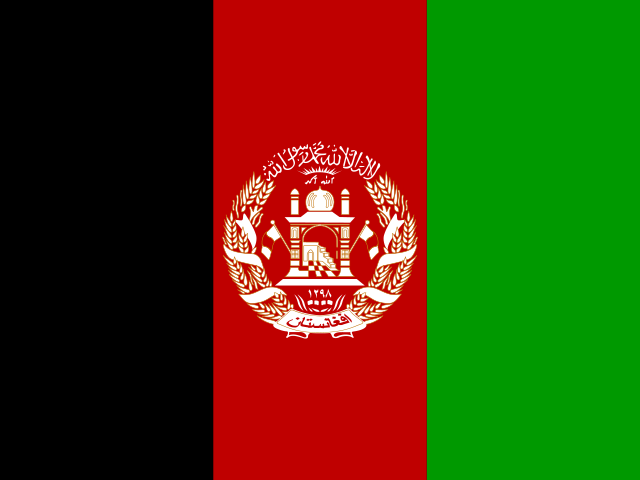 Afghanistan
 Bangladesh
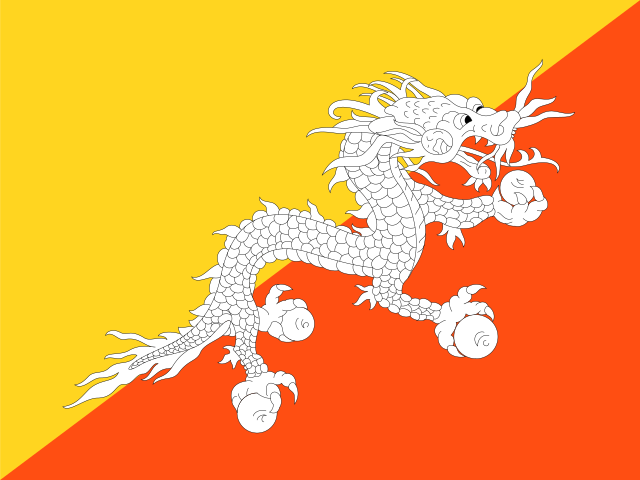 Bhutan
 Sri Lanka
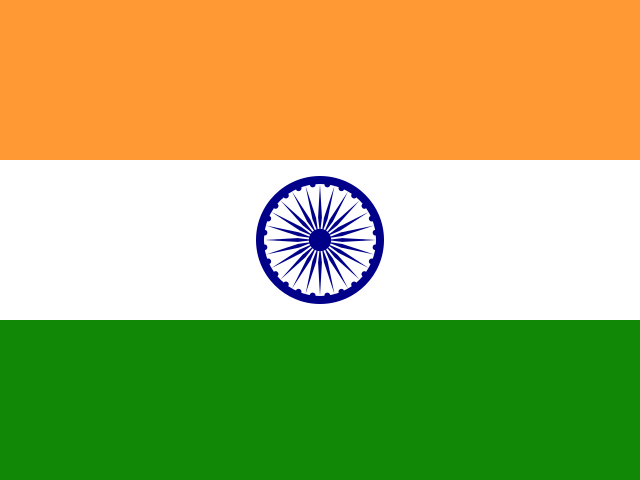 India
India Iran
Iran Maldives
 Nepal
Nepal Pakistan
Earlier Report Observations
From 2018 to 2019, the camel meat market in Southern Asia expanded from 16 709 t to 17 153 t in volume. This initial growth was supported by India's established export framework for meat, which included specific quality and safety standards for chilled and frozen products like camel meat under HS Code 0208. The market also benefited from price-inelastic demand for camel meat in certain regions and broader trends of rising incomes and urbanization, which increased overall meat consumption. In 2019, the rise of the frozen meat segment, driven by lifestyle changes, demand for ready-to-eat foods, and the expansion of retail stores with better refrigeration, provided additional momentum specifically for frozen camel meat products.
Market volume contracted to 15 397 t in 2020 before recovering to 16 803 t in 2021. The subsequent period through 2022 saw relative stability, with volume at 16 336 t.
A significant expansion occurred in 2023, with market volume reaching 18 730 t. This surge aligned with sustained drivers in the broader Indian meat sector, including ongoing shifts in dietary preferences, greater nutritional awareness, influence from international cuisines, and consistent demand for convenient and processed meat products, which continued to support consumption patterns.
Table of content
- 1. Disclaimer
- 2. Terms of use of the report
- 3. Product codes in the statistical classifications used in the report
-
4. Key Market Indicators and Trends
-
4.1. Key Market Indicators
-
4.1.1. In kind
- 4.1.1.1. Production, 2018-2023
- 4.1.1.2. Imports, 2018-2024
- 4.1.1.3. Exports, 2018-2024
- 4.1.1.4. Market size, 2018-2023
-
4.1.2. In value
- 4.1.2.1. Production, 2018-2023
- 4.1.2.2. Imports, 2018-2024
- 4.1.2.3. Exports, 2018-2024
- 4.1.2.4. Market size, 2018-2023
-
4.1.1. In kind
- 4.2. Market Trends and Factors
-
4.1. Key Market Indicators
-
5. Production
-
5.1. Production in Southern Asia
- 5.1.1. Annual dynamics of production in Southern Asia in kind, 2018-2023, t
-
5.2. Global production by Country, 2018-2023
- 5.2.1. Annual dynamics of production by macroregions in kind, 2018-2023, t
- 5.2.2. Dynamics of production structure by macroregions in kind, 2018-2023
- 5.2.3. Annual dynamics of production by country in kind, 2018-2023, t
- 5.2.4. Structure of production by countries in kind, 2018-2023
- 5.2.5. Dynamics of peoduction structure by countries in kind, 2018-2023
-
5.1. Production in Southern Asia
-
6. Exports
-
6.1. Exports (Direct Data*)
- 6.1.1. Exports - Total information
-
6.1.2. Exports in kind, t
- 6.1.2.1. Annual dynamics of product's exports from Afghanistan in kind, 2018-2024, t
- 6.1.2.2. Dynamics of product's exports in kind from Afghanistan by countries, 2018-2024, t
- 6.1.2.3. Structure of product's exports in kind by countries, 2018-2024
-
6.1.3. Exports in value, K $ US
- 6.1.3.1. Annual dynamics of product's exports from Afghanistan in value, 2018-2024, K $ US
- 6.1.3.2. Dynamics of product's exports in value from Afghanistan by countries, 2018-2024, K $ US
- 6.1.3.3. Structure of product's exports in value by countries, 2018-2024
-
6.1.4. Average price of product's exports, $ US/t
- 6.1.4.1. Annual dynamics of average price of product's exports from Afghanistan, 2018-2024, $ US/t
- 6.1.4.2. Dynamics of average price of product's exports from Afghanistan by countries, 2018-2024, $ US/t
-
6.2. Exports (Mirror Data)
- 6.2.1. Exports - Total information
-
6.2.2. Exports in kind, t
- 6.2.2.1. Annual dynamics of product's exports from Afghanistan in kind, 2018-2024, t
- 6.2.2.2. Dynamics of product's exports in kind from Afghanistan by countries, 2018-2024, t
- 6.2.2.3. Structure of product's exports in kind by countries, 2018-2024
-
6.2.3. Exports in value, K $ US
- 6.2.3.1. Annual dynamics of product's exports from Afghanistan in value, 2018-2024, K $ US
- 6.2.3.2. Dynamics of product's exports in value from Afghanistan by countries, 2018-2024, K $ US
- 6.2.3.3. Structure of product's exports in value by countries, 2018-2024
-
6.2.4. Average price of product's exports, $ US/t
- 6.2.4.1. Annual dynamics of average price of product's exports from Afghanistan, 2018-2024, $ US/t
- 6.2.4.2. Dynamics of average price of product's exports from Afghanistan by countries, 2018-2024, $ US/t
-
6.1. Exports (Direct Data*)
-
7. Trade balance
-
7.1. Trade balance (Direct Data)
- 7.1.1. In kind, t
- 7.1.2. In value, K $ US
-
7.2. Trade balance (Mirror Data)
- 7.2.1. In kind, t
- 7.2.2. In value, K $ US
-
7.1. Trade balance (Direct Data)
-
8. Top buying and selling countries, 2018-2024
-
8.1. Direct Data
- 8.1.1. Import in Value by Countries-buyers
- 8.1.2. Export in Value by Countries-suppliers
-
8.2. Mirror Data
- 8.2.1. Import in Value by Countries-buyers
- 8.2.2. Export in Value by Countries-suppliers
-
8.1. Direct Data
Production camel meat and offal in Southern Asia
In kind, 2017-2020, t
Top producers of camel meat and offal, 2017-2020
World map of production of camel meat and offal, 2017-2020
In 2020, Southern Asia produced 16 041 tonnes of camel meat and offal, representing an 8.9% decrease from the previous year. Over the 2017-2020 period, production fell by 14.6%, with a compound annual growth rate of -5.1%. The most significant decline occurred in 2018, dropping by 10.4%, while 2019 saw the largest increase at 4.6%.
Annual dynamics of production in Southern Asia in kind, 2017-2020, t
| Parameter | 2018 | 2019 | 2020 | CAGR | |
|---|---|---|---|---|---|
| 1 | Change from last year | (10.4%) | 4.6% | (8.9%) | (5.1%) |
Exports camel meat and offal from Southern Asia
Exports in kind, t
Camel meat and offal exports from Southern Asia have risen for the third year in a row. In 2020, the region exported 644.2 tonnes, marking a sharp 39.8% increase from 2019. From 2017 to 2020, exports surged by 33 277.5%, with a compound annual growth rate of 593.7%.
Annual dynamics of product's exports from Southern Asia in kind, 2017-2020, t
| Parameter | 2018 | 2019 | 2020 | CAGR | |
|---|---|---|---|---|---|
| 1 | Change from last year | 6 487.7% | 262.5% | 39.8% | 593.7% |
From 2017 to 2020, Saudi Arabia, Kuwait, and Oman were the primary markets for exports in kind, accounting for 37.7%, 30.4%, and 21.1% of total exports, respectively. Together, these three countries made up 89.2% of all export flows.
Structure of product's exports in kind by countries, 2017-2020
World map of product's exports from Southern Asia in kind, 2017-2020
Exports in value, K $ US
Export volumes of camel meat and offal from Southern Asia have grown for the third consecutive year. In 2020, the export value reached 2 596 thousand US dollars, up 27.3% from the previous year. Over the 2017-2020 period, exports increased by 39 981.5%, with a compound annual growth rate of 637.3%.
Annual dynamics of product's exports from Southern Asia in value, 2017-2020, K $ US
| Parameter | 2018 | 2019 | 2020 | CAGR | |
|---|---|---|---|---|---|
| 1 | Change from last year | 7 994.3% | 288.9% | 27.3% | 637.3% |
Between 2017 and 2020, Saudi Arabia, Kuwait, and Oman dominated the export structure in value terms, with shares of 38.7%, 30.2%, and 20.1%, respectively. Combined, these three markets represented 88.9% of total export flows.
Structure of product's exports in value by countries, 2017-2020
World map of product's exports from Southern Asia in value, 2017-2020
Imports camel meat and offal to Southern Asia
Desk-based research indicates that Southern Asia did not import any camel meat and offal from 2017 to 2020.
Related Reports

Camel meat and offal market in Iran
2026-03-27
Camel meat and offal market in Jordan
2026-03-27
Camel meat and offal market in Sudan
2026-03-27




Why Choose Us?
Only Verified Data
No Hidden Costs or Separate Fees
Smarter Subscription Pricing
Contact Our Team
Submit your inquiry using the form below — our team will get back to you within 24 hours.