






"Western Africa" region includes following countries:
 Cabo Verde
 Benin
Benin Gambia
 Ghana
Ghana Guinea
 Côte d'Ivoire
 Liberia
 Mali
Mali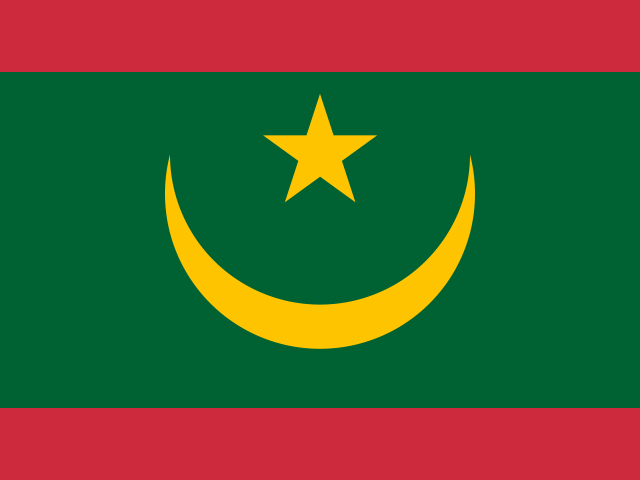 Mauritania
 Niger
Niger Nigeria
 Guinea-Bissau
 Saint Helena, Ascension and Tristan da Cunha
 Senegal
 Sierra Leone
 Togo
Togo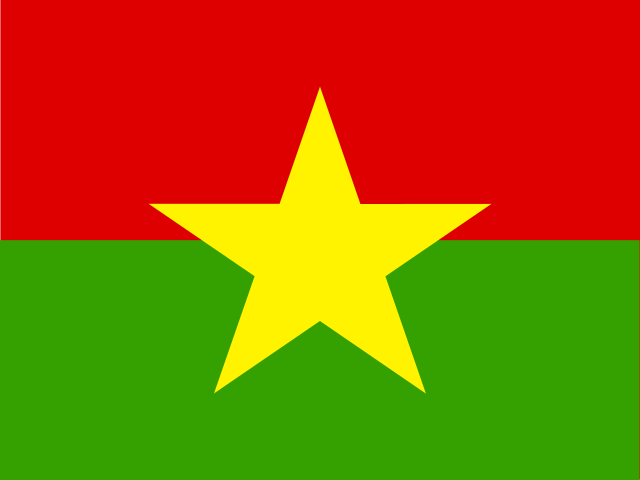 Burkina Faso
Earlier Report Observations
The West African edible brassicas market saw robust growth from 2018 to 2020, with production surging from 509.3 to 795.3 thousand tons. This expansion was driven by the entry of new local vegetable producers in Southern Benin, supported by agricultural programs, and the development of cold chain infrastructure in Côte d'Ivoire, which improved the preservation and availability of fresh produce.
Market volume continued to rise through 2021 despite a dip in domestic output, as imports increased significantly. The strengthening of informal distribution networks during this period affected market regulation, while the rapid saturation of refrigerated warehouses demonstrated sustained high demand for fresh brassicas. Production recovered in 2022, reaching 822.3 thousand tons, amidst persistent informal trade dynamics.
Growth accelerated again in 2023, with production hitting 957.1 thousand tons and total market size reaching 989.2 thousand tons. Planned expansions in refrigerated storage capacity in Côte d'Ivoire aimed to meet growing consumer preference for year-round fresh tropical vegetables. In 2024, import volumes rose sharply to 69.2 thousand tons, reflecting ongoing demand influenced by informal trade and increased global interest in African fresh produce.
Table of content
- 1. Disclaimer
- 2. Terms of use of the report
- 3. Product codes in the statistical classifications used in the report
-
4. Key Market Indicators and Trends
-
4.1. Key Market Indicators
-
4.1.1. In kind
- 4.1.1.1. Production, 2018-2023
- 4.1.1.2. Imports, 2018-2024
- 4.1.1.3. Exports, 2018-2024
- 4.1.1.4. Market size, 2018-2023
-
4.1.1. In kind
- 4.2. Market Trends and Factors
-
4.1. Key Market Indicators
-
5. Production
-
5.1. Production in Western Africa
- 5.1.1. Annual dynamics of production in Western Africa in kind, 2018-2023, K t
-
5.2. Global production by Country, 2018-2023
- 5.2.1. Annual dynamics of production by macroregions in kind, 2018-2023, K t
- 5.2.2. Dynamics of production structure by macroregions in kind, 2018-2023
- 5.2.3. Annual dynamics of production by country in kind, 2018-2023, K t
- 5.2.4. Structure of production by countries in kind, 2018-2023
- 5.2.5. Dynamics of peoduction structure by countries in kind, 2018-2023
-
5.1. Production in Western Africa
-
6. Imports
-
6.1. Imports (Direct Data*)
- 6.1.1. Imports - Total information
-
6.1.2. Imports in kind, t
- 6.1.2.1. Annual dynamics of product's imports to Cabo Verde in kind, 2018-2024, t
- 6.1.2.2. Dynamics of product's imports in kind to Cabo Verde by countries, 2018-2024, t
- 6.1.2.3. Structure of product's imports in kind by countries, 2018-2024
-
6.1.3. Imports in value, K $ US
- 6.1.3.1. Annual dynamics of product's imports to Cabo Verde in value, 2018-2024, K $ US
- 6.1.3.2. Dynamics of product's imports in value to Cabo Verde by countries, 2018-2024, K $ US
- 6.1.3.3. Structure of product's imports in value by countries, 2018-2024
-
6.1.4. Average price of product's imports, $ US/t
- 6.1.4.1. Annual dynamics of average price of product's imports to Cabo Verde, 2018-2024, $ US/t
- 6.1.4.2. Dynamics of average price of product's imports to Cabo Verde by countries, 2018-2024, $ US/t
-
6.2. Imports (Mirror Data)
- 6.2.1. Imports - Total information
-
6.2.2. Imports in kind, t
- 6.2.2.1. Annual dynamics of product's imports to Cabo Verde in kind, 2018-2024, t
- 6.2.2.2. Dynamics of product's imports in kind to Cabo Verde by countries, 2018-2024, t
- 6.2.2.3. Structure of product's imports in kind by countries, 2018-2024
-
6.2.3. Imports in value, K $ US
- 6.2.3.1. Annual dynamics of product's imports to Cabo Verde in value, 2018-2024, K $ US
- 6.2.3.2. Dynamics of product's imports in value to Cabo Verde by countries, 2018-2024, K $ US
- 6.2.3.3. Structure of product's imports in value by countries, 2018-2024
-
6.2.4. Average price of product's imports, $ US/t
- 6.2.4.1. Annual dynamics of average price of product's imports to Cabo Verde, 2018-2024, $ US/t
- 6.2.4.2. Dynamics of average price of product's imports to Cabo Verde by countries, 2018-2024, $ US/t
-
6.1. Imports (Direct Data*)
-
7. Exports
-
7.1. Exports (Direct Data*)
- 7.1.1. Exports - Total information
-
7.1.2. Exports in kind, t
- 7.1.2.1. Annual dynamics of product's exports from Cabo Verde in kind, 2018-2024, t
- 7.1.2.2. Dynamics of product's exports in kind from Cabo Verde by countries, 2018-2024, t
- 7.1.2.3. Structure of product's exports in kind by countries, 2018-2024
-
7.1.3. Exports in value, K $ US
- 7.1.3.1. Annual dynamics of product's exports from Cabo Verde in value, 2018-2024, K $ US
- 7.1.3.2. Dynamics of product's exports in value from Cabo Verde by countries, 2018-2024, K $ US
- 7.1.3.3. Structure of product's exports in value by countries, 2018-2024
-
7.1.4. Average price of product's exports, $ US/t
- 7.1.4.1. Annual dynamics of average price of product's exports from Cabo Verde, 2018-2024, $ US/t
- 7.1.4.2. Dynamics of average price of product's exports from Cabo Verde by countries, 2018-2024, $ US/t
-
7.2. Exports (Mirror Data)
- 7.2.1. Exports - Total information
-
7.2.2. Exports in kind, t
- 7.2.2.1. Annual dynamics of product's exports from Cabo Verde in kind, 2018-2024, t
- 7.2.2.2. Dynamics of product's exports in kind from Cabo Verde by countries, 2018-2024, t
- 7.2.2.3. Structure of product's exports in kind by countries, 2018-2024
-
7.2.3. Exports in value, K $ US
- 7.2.3.1. Annual dynamics of product's exports from Cabo Verde in value, 2018-2024, K $ US
- 7.2.3.2. Dynamics of product's exports in value from Cabo Verde by countries, 2018-2024, K $ US
- 7.2.3.3. Structure of product's exports in value by countries, 2018-2024
-
7.2.4. Average price of product's exports, $ US/t
- 7.2.4.1. Annual dynamics of average price of product's exports from Cabo Verde, 2018-2024, $ US/t
- 7.2.4.2. Dynamics of average price of product's exports from Cabo Verde by countries, 2018-2024, $ US/t
-
7.1. Exports (Direct Data*)
-
8. Trade balance
-
8.1. Trade balance (Direct Data)
- 8.1.1. In kind, t
- 8.1.2. In value, K $ US
-
8.2. Trade balance (Mirror Data)
- 8.2.1. In kind, t
- 8.2.2. In value, K $ US
-
8.1. Trade balance (Direct Data)
-
9. Top buying and selling countries, 2018-2024
-
9.1. Direct Data
- 9.1.1. Import in Value by Countries-buyers
- 9.1.2. Export in Value by Countries-suppliers
-
9.2. Mirror Data
- 9.2.1. Import in Value by Countries-buyers
- 9.2.2. Export in Value by Countries-suppliers
-
9.1. Direct Data
Production edible brassicas in Western Africa
In kind, 2017-2020, K t
Top producers of edible brassicas, 2017-2020
World map of production of edible brassicas, 2017-2020
Edible brassicas production in Western Africa has increased for the third consecutive year. In 2020, production reached 795.3 K t, representing a 33.0% rise compared to 2019. Between 2017 and 2020, production grew by 63.2%, which translates to an annualized growth rate of 17.7%.
Annual dynamics of production in Western Africa in kind, 2017-2020, K t
| Parameter | 2018 | 2019 | 2020 | CAGR | |
|---|---|---|---|---|---|
| 1 | Change from last year | 4.5% | 17.5% | 33.0% | 17.7% |
Exports edible brassicas from Western Africa
Exports in kind, t
The data reveals irregular changes, indicating a volatile market environment. Exports hit their lowest point in 2019, after reaching their maximum in 2017 — with a 39-fold difference between these years. In 2020, edible brassicas exports from Western Africa totaled 66 t, which is 46.8% higher year-over-year. The minimum value was recorded in 2019 at 45 t. The largest decline occurred in 2018, with a drop of 87.9%.
Annual dynamics of product's exports from Western Africa in kind, 2017-2020, t
| Parameter | 2018 | 2019 | 2020 | CAGR | |
|---|---|---|---|---|---|
| 1 | Change from last year | (87.9%) | (78.8%) | 46.8% | (66.5%) |
From 2017 to 2020, Belarus remained the primary destination for edible brassicas exports from Western Africa, accounting for 76.1% of total exports in kind. Other destinations played a much smaller role during this period.
Structure of product's exports in kind by countries, 2017-2020
World map of product's exports from Western Africa in kind, 2017-2020
Exports in value, K $ US
The market showed signs of volatility over the observed period. Exports varied significantly, from a high in 2017 to a low in 2019 — with a 26-fold difference between these years. In 2020, the value of edible brassicas exports from Western Africa reached 462 K $ US, which is 425.8% higher than the previous year. The minimum value was recorded in 2019 at 88 K $ US. The largest decline occurred in 2018, with a decrease of 88.8%.
Annual dynamics of product's exports from Western Africa in value, 2017-2020, K $ US
| Parameter | 2018 | 2019 | 2020 | CAGR | |
|---|---|---|---|---|---|
| 1 | Change from last year | (88.8%) | (66.2%) | 425.8% | (41.6%) |
Throughout 2017–2020, Belarus dominated the partner structure for exports in value terms, with a share of 80.6% of total flows. Other markets had comparatively modest shares during this period.
Structure of product's exports in value by countries, 2017-2020
World map of product's exports from Western Africa in value, 2017-2020
Imports edible brassicas to Western Africa
Imports in kind, t
Edible brassicas imports into Western Africa have increased for the third consecutive year. In 2020, imports amounted to 11 514 t, up by 461.8% compared to the previous year. Between 2017 and 2020, imports grew by 731.9%, equating to an annualized growth rate of 102.6%.
Annual dynamics of product's imports to Western Africa in kind, 2017-2020, t
| Parameter | 2018 | 2019 | 2020 | CAGR | |
|---|---|---|---|---|---|
| 1 | Change from last year | 21.9% | 21.4% | 461.8% | 102.6% |
From 2017 to 2020, Morocco (30.0% of imports in kind), Portugal (2.7% of imports in kind), and the Netherlands (2.0% of imports in kind) were among the largest suppliers of edible brassicas to Western Africa. However, even combined, they represented just 34.7% of total imports in kind, indicating a broadly diversified partner base.
Structure of product's imports in kind by countries, 2017-2020
World map of product's imports to Western Africa in kind, 2017-2020
Imports in value, K $ US
Edible brassicas shipments to Western Africa from abroad have increased for the third consecutive year. In 2020, imports totaled 4 451 K $ US, up by 135.5% compared to the previous year. Between 2017 and 2020, imports grew by 251.1%, which translates to an annualized growth rate of 52.0%.
Annual dynamics of product's imports to Western Africa in value, 2017-2020, K $ US
| Parameter | 2018 | 2019 | 2020 | CAGR | |
|---|---|---|---|---|---|
| 1 | Change from last year | 31.9% | 13.0% | 135.5% | 52.0% |
Throughout 2017–2020, imports in value terms of edible brassicas to Western Africa were not concentrated on a few key markets. Morocco (26.4% of imports in value terms), the Netherlands (13.1% of imports in value terms), and France (9.3% of imports in value terms) jointly accounted for only 48.7% of total flows.
Structure of product's imports in value by countries, 2017-2020
World map of product's imports to Western Africa in value, 2017-2020
Related Reports

Edible brassicas market in Sweden
2026-03-27
Edible brassicas market in Togo
2026-03-27
Edible brassicas market in Austria
2026-03-27
Edible brassicas market in Eastern Africa
2026-03-27

Tomato market in Western Africa
2026-03-27


Cabbages market in Western Africa
2026-03-30

Aubergines market in Western Africa
2026-03-27
Why Choose Us?
Only Verified Data
No Hidden Costs or Separate Fees
Smarter Subscription Pricing
Contact Our Team
Submit your inquiry using the form below — our team will get back to you within 24 hours.